Essay Nine -- The Politics Of Metaphysics
Part One: Substitutionism -- Or, Why Workers Will Always Reject Dialectical Materialism
If you are using Internet Explorer 10 (or later), you might find some of the links I have used won't work properly unless you switch to 'Compatibility View' (in the Tools Menu); for IE11 select 'Compatibility View Settings' and add this site (anti-dialectics.co.uk). Microsoft's browser, Edge, automatically renders these links compatible; Windows 10 and 11 do likewise.
However, if you are using Windows 10 or 11, IE11 and Edge unfortunately appear to colour these links somewhat erratically. They are meant to be mid-blue, but they render them intermittently light blue, yellow, purple and red!
Firefox and Chrome reproduce them correctly, as far as I can tell.
Several browsers also appear to underline these links erratically. Many are underscored boldly in black, others more lightly in blue! They are all meant to be the latter.
Finally, if you are viewing this with Mozilla Firefox, you might not be able to read all the symbols I have used; Mozilla often replaces them with an "º'.
There are no problems with Chrome, Edge, or Internet Explorer, as far as I can determine.
Quick Links to my discussion of Marx's connection to Hegel and DM: Part One, Part Two.
[DM = Dialectical Materialism/Materialist, depending on the context; HM = Historical Materialism/Materialist, again depending on the context.]
This Essay should be read in conjunction with Essays Nine Part Two and Ten Part One. It takes also for granted much that was established in earlier Essays. Anyone who hasn't read that material is likely to conclude that most of the things I assert below are either dogmatic or baseless. However, without repeating all that previous material in this Essay(!), the only suggestion I can make is that readers should shelve their qualms until they have consulted those other Essays. I have supplied the relevant links where necessary.
As is the case with all my Essays, nothing at this site should be read as an attack either on HM -- a scientific theory I fully accept --, or, indeed, on revolutionary socialism itself. I remain as committed to the self-emancipation of the working class and the dictatorship of the proletariat as I was when I first became a revolutionary over thirty-five years ago.
The difference between DM and HM, as I see it, is explained here.
Some readers might wonder why I have quoted extensively from a wide variety of DM-sources in the Essays published at this site. In fact a good 10-20% of the material in many of them is comprised of just such quotations. Apologies are therefore owed the reader in advance for the length and extremely repetitive nature of most of these quoted passages. The reason for their inclusion is that long experience has taught me that Dialectical Marxists simply refuse to accept that their own classicists -- e.g., Engels, Plekhanov, Lenin, Trotsky and Mao, alongside countless 'lesser' DM-theorists --, actually said the things I have attributed to them. That is especially the case after they are confronted with the absurd consequences that flow from their words; and that remains the case unless and until they are shown chapter and verse and in extensive detail. In debate, when I quote only one or two passages in support of what I allege, they are simply brushed off as a "outliers" or as "atypical". Indeed, in the absence of dozens of proof texts drawn from many such sources (across all areas of Dialectical Marxism) they tend to regard anything that a particular theorist had to say -- regardless of whether they are one of the aforementioned classicists -- as either "far too crude", "unrepresentative" or even(!) unreliable. Failing that, they often complain that any such quotes have been "taken out of context". Many in fact object since -- surprising and sad though this is to say --, they are largely ignorant of their own theory or they simply haven't read the DM-literature with due care, or at all! The only way to counter such attempts to deflect, reject and deny is to quote DM-material frequently and at length.
Furthermore, because of the highly sectarian and partisan nature of Dialectical Marxism, I also have to quote a wide range of sources from across the entire 'dialectical spectrum'. Trotskyists object if I quote Stalin or Mao; Maoists and Stalinists complain if I reference Trotsky -- or even if I cite "Brezhnev era revisionists". Non-Leninist Marxists bemoan the fact that I haven't confined my remarks solely to what Marx or Hegel had to say, advising me to ignore the confused, even "simplistic", ideas expressed by Engels, Plekhanov, Lenin, Stalin, Mao and Trotsky! This often means I have to quote the lot!
That itself has had the (indirect) benefit of revealing how much and to what extent they (the classicists and subsequent epigones across all areas of Dialectical Marxism) largely agree with each other (despite sectarian rhetoric to the contrary), at least with respect to DM!
In relation to that, several readers have also complained about the sheer number of links I have added to these Essays because they say it makes them very difficult to read. Of course, DM-supporters can hardly lodge that complaint since they believe everything is interconnected, and that must surely apply even to Essays that attempt to debunk that very idea. However, to those who find such links do make these Essays difficult to read I say this: ignore those links(!) -- unless you want to access further supporting evidence and argument for a particular point, or a certain topic fires your interest.
Others wonder why I have linked to familiar subjects and issues that are part of common knowledge (such as the names of recent Presidents of the USA, UK Prime Ministers, the names of rivers and mountains, the titles of popular films, or certain words that are in common usage). I have done so for the following reason: my Essays are read all over the world and by people from all 'walks of life', so I can't assume that topics which are part of common knowledge in 'the west' are equally well-known across the planet -- or, indeed, by those who haven't had the benefit of the sort of education that is generally available in the 'advanced economies', or any at all. Many of my readers also struggle with English, so any help I can give them I will continue to provide.
Finally on this specific topic, several of the aforementioned links connect to web-pages that regularly change their URLs, or which vanish from the Internet altogether. While I try to update them when it becomes apparent that they have changed or have disappeared I can't possibly keep on top of this all the time. I would greatly appreciate it, therefore, if readers informed me of any dead links they happen to notice.
In general, links to Haloscan no longer seem to work, so readers needn't tell me about them! Links to RevForum, RevLeft, Socialist Unity and The North Star also appear to have died.
It is also worth pointing out that about 40% of my case against DM has been relegated to the End Notes. This has been done to allow the main body of the Essay to flow a little more smoothly. This means that if readers want fully to appreciate my case against DM, they will need to consult this material. In many cases, I have added considerably more detail to the main argument, along with numerous qualifications. I have even raised objections (some obvious, many not -- and some that will have occurred to the reader) to my own arguments, which I have then answered. [I have explained why I adopted this tactic in Essay One.]
If readers skip the Endnotes, then this additional material and my response to any objections they might have will be missed.
Since I have been debating this theory with comrades for over 30 years, I have heard all the objections there are! (Many of the more recent on-line debates are listed here.)
The last six points:
(1) Phrases like "ruling-class theory", "ruling-class view of reality", "ruling-class ideology" (etc.) used at this site (in connection with Traditional Philosophy and DM), aren't meant to suggest that all or even most members of various ruling-classes actually invented these ways of thinking or of seeing the world (although some of them did -- for example, Heraclitus, Plato, Cicero, and Marcus Aurelius). They are intended to highlight theories (or "ruling ideas") that are conducive to, or which rationalise the interests of the various ruling-classes history has inflicted on humanity, whoever invents them. Up until recently this dogmatic approach to knowledge had almost invariably been promoted by thinkers who either relied on ruling-class patronage, or who, in one capacity or another, helped run the system for the elite.**
However, that will become the main topic of Parts Two and Three of Essay Twelve (when they are published); until then, readers are directed here, here and here for further details.
[**Exactly how the above applies to DM will, of course, be explained in the other Essays published at this site (especially here, here and here). In addition to the three links in the previous paragraph, I have summarised the argument -- but this time with absolute beginners in mind --, here.]
(2) Some readers might be tempted to think my main argument against DM is the following:
DM is false because -- on Lenin's admission -- it grew out of various strands of ruling-class thought.
That isn't my argument. I am in fact arguing that DM is far too vague and confused for it to be declared either true or false. It doesn't make it that far. Its origin in ruling-class ideology has simply made a bad situation worse, and that is part of the reason why Dialectical Marxism has been such an a protracted, abject failure. [On that, see also here.]
[Notice, I said "part of the reason" not "the reason". Why I have claimed this is explained in Part Two of Essay Nine and in Essay Ten Part One.]
(3) Although I refer to DM throughout this Essay, readers also should take this to include 'Materialist Dialectics' [MD].
(4) Unless otherwise stated, I have used the word "dialectics" in this Essay and throughout this site in the same way that DM-theorists employ it -- i.e., to refer to the theory/method they inherited from Hegel (upside down or the 'right way up'). It is in that sense that the title of this site is "anti-dialectics". However, "dialectics" had a different meaning before Hegel appropriated it and turned it into a cosmic super-theory, or method. I have no specific problem with the use of the word "dialectics" before Hegel had completely altered its meaning, except to point out that it is a particularly inefficient way to argue; hence, I have no problem with its classical meaning.
Nevertheless, when I turn to a discussion of Marx's use of this word (for example, and more specifically, in his Afterword to the Second Edition of Das Kapital), my argument takes a dramatic turn, which has confused some readers. There, and only there, I try to use the word as Marx understood it in that Afterword, not as it has been employed by subsequent DM-apologists -- or even by Hegel himself. It is quite clear that in the Afterword Marx adopted an older understanding of "dialectics" -- one based on the work of Aristotle, Kant and The Scottish Historical School (of Ferguson, Millar, Robertson, Smith, Hume and Steuart). This means that his use of this word situates Das Kapital much closer to HM, not DM. [On that, see here.]
The difference between DM and HM, as I see it, is explained here.
[6] Some critics have complained that my linking to Wikipedia completely undermines the credibility of these Essays. When I launched this project on the Internet in 2005, for the vast majority of topics there was very little material easily available on-line to which I could link other than Wikipedia. In the intervening years alternative sites have become available (for example, the excellent Stanford Encyclopedia of Philosophy and the Internet Encyclopedia of Philosophy), so I have been progressively replacing most of the old Wikipedia links with links to these other sources. Having said that, I haven't done so for some of the Wikipedia links -- for instance, any that are connected with geographical, historical, scientific, biographical (etc.) topics, where the relevant areas aren't considered controversial, at least by fellow Marxists. In every instance, I have endeavoured to avoid linking to Wikipedia in relation to key areas of my arguments against DM so that at no point does my criticism of this theory/method depend exclusively on such links.
In addition to the above (as readers will soon see if they consult the Bibliography) I have provided copious references to other published academic and non-academic books and articles (posted on-line or printed in hard copy) in the End Notes to this Essay, which further develop or substantiate anything I argue, claim, allege or propose.
[7] Finally, anyone puzzled by the unremittingly hostile tone I have adopted toward DM might find it helpful to read this first.
~~~~~~oOo~~~~~~
As of January 2025, this Essay is just over 85,500 words long; a summary of some of its main ideas can be found here.
The material below does not represent my final view of any of the issues raised; it is merely 'work in progress'.
[Latest Update: 28/01/25.]
Anyone using these links must remember that they will be skipping past supporting argument and evidence set out in earlier sections.
If your Firewall/Browser has a pop-up blocker, you will need to press the "Ctrl" key at the same time or these and the other links here won't work!
I have adjusted the font size used at this site to ensure that even those with impaired vision can read what I have to say. However, if the text is still either too big or too small for you, please adjust your browser settings!
(1) Introduction
(a) The Aims Of Essay Nine Parts One And Two
(2) The Main Thesis Of This Site Seems Impossible To Believe
(a) The Origin Of DM
(c) Unwitting Dupes
(3) Substitutionism
(a) Philosophy -- Imported From The 'Outside'
(5) Dialectics: A Deep Mystery Even To Marxists
(b) Well, Have You Read And Fully Understood The Whole Of Hegel's Logic?
(6) A Mystery To Workers, Too?
(a) Unconscious Dialecticians?
(7) Historical Materialism Different
(a) Dialectical Marxism -- A Long-Term Failure
(b) Historical Materialism -- Introduced From The 'Inside'
(c) The Vernacular -- Hindrance Or Resource?
(e) Hegel And 'Double Meanings'
(f) The Revenge Of The 'Either-Or' Of 'Commonsense'
(g) Conclusion: Failure Substituted For Success
(8) Marx And Dialectical Materialism - 1
(9) Marx And Dialectical Materialism - 2
(10) Is Dialectical Materialism The Same As Historical Materialism?
(11) Appendix A -- Aristotle's Comments On His Dialectical Method
(12) Appendix B -- The Controversial Passage From What Is To Be Done?
(13) Notes
(14) References
Summary Of My Main Objections To Dialectical Materialism
Abbreviations Used At This Site
The Aims Of Essay Nine Parts One And Two
In Essay Nine Parts One and Two I hope to examine some of the political implications of the analysis of Metaphysics and DM advanced at this site, particularly those developed in Essay Twelve Part One.
[DM = Dialectical Materialism/Materialist, depending on the context; HM = Historical Materialism.]
Part One of this Essay will show that, unlike HM, DM can't form a theoretical foundation for the "world-view of the proletariat", and, therefore, that it has had to be imposed on what few workers Dialectical Marxism has managed to attract to its ranks over the last 150 years. What is more, this imposition runs 'against the grain' (so to speak) of workers' materialist good sense. Hence, it will be argued that DM is the ideology of substitutionist elements within Marxism. Moreover, since it is also possible to show that 'dialectics' is a total mystery -- even to DM-theorists themselves(!) --, it can't provide revolutionary socialists with a scientific or philosophical foundation for their politics or their practice. In which case, DM not only doesn't, it can't 'reflect the experience of the party or the class.
The distinction between HM and DM drawn at this site will also be explained.
Part Two will expose the role that dialectics (in either its DM-, or its 'Materialist Dialectics' [MD-], form) plays, or has played, in addressing and satisfying the contingent psychological needs of prominent Dialectical Marxists.
In addition, it will also show how and why Hegel's influence has assisted in the corruption of our movement from top to bottom (aggravating, but not causing, sectarian in-fighting, fostering splits and expulsions that often arise as a result), revealing, too, why DM has had such a deleterious and narcoleptic effect on militant minds. These untoward consequences will be linked to the class origin and current class position of leading revolutionaries -- those who have helped shape our movement's core ideas.
It will also be shown how and why the above comrades are particularly susceptible to ideas that have been peddled by ruling-class theorists for thousands of years -- specifically, the doctrine that there is a 'hidden world', a world of 'abstractions' and 'essences', anterior to 'appearances' that is more real than the material universe we see around us (in the sense that these 'abstractions' are somehow capable of rendering objects and processes in nature concrete, an ancient idea that implies nature is insufficient to itself, and needs 'Ideas', or 'Concepts', to make it 'Real'), which 'hidden world' can be accessed by thought alone.
In short, it will be shown that this theory has played a key role in making Dialectical Marxism synonymous with political and theoretical impotency --, which, naturally, helps explain its long-term lack of success.
[Notice the use of the indefinite article here -- i.e., in "a key role". I am not blaming all our woes on this theory! Doubters should read this caveat on the opening page of the site, in the right hand column.]
These fatal defects, among others, will be further explored in Essay Ten Part One, where this part of the sordid tale will be concluded.
In Essay Twelve it was argued that Ancient Greek Metaphysics was kick-started by contemporaneous ruling-class ideologies that expressed the interests and priorities of the (then current) ruling elite. In subsequent Modes of Production, Traditional Metaphysicians directly or indirectly benefited from, or helped serve, both the State and the ruling-class, rationalising hierarchy, class division and gross inequality as 'natural' or 'god'-ordained.
While, for example, Theology has always represented a theoretical expression of alienated religious sentiment (among other things), in its different forms Metaphysics has helped systematise, rationalise, and legitimate ruling-class hegemony, linking the authority of the State to the aforementioned 'natural', or 'divinely-instituted' order. From Ancient Greece onwards, metaphysicians busied themselves concocting Super-Scientific theories that supposedly revealed the fundamental principles governing the entire universe, unmasking its underlying 'rational' structure, which, un-coincidentally, also mirrored the interests of the various ruling-classes history has inflicted on humanity. Beneath the 'velvet glove' of Metaphysics lies the mailed fist of class domination, its 'necessary truths' dimly reflecting -- more often 'justifying' --, the iron rule of the State.
[The above argument is outlined in more detail, here.]
As Marx and Engels noted:
"The ideas of the ruling class are in every epoch the ruling ideas, i.e. the class which is the ruling material force of society, is at the same time its ruling intellectual force. The class which has the means of material production at its disposal, has control at the same time over the means of mental production, so that thereby, generally speaking, the ideas of those who lack the means of mental production are subject to it. The ruling ideas are nothing more than the ideal expression of the dominant material relationships, the dominant material relationships grasped as ideas; hence of the relationships which make the one class the ruling one, therefore, the ideas of its dominance. The individuals composing the ruling class possess among other things consciousness, and therefore think. Insofar, therefore, as they rule as a class and determine the extent and compass of an epoch, it is self-evident that they do this in its whole range, hence among other things rule also as thinkers, as producers of ideas, and regulate the production and distribution of the ideas of their age: thus their ideas are the ruling ideas of the epoch." [Marx and Engels (1970), pp.64-65. Bold emphases added.]
"In the social production of their existence, men inevitably enter into definite relations, which are independent of their will, namely relations of production appropriate to a given stage in the development of their material forces of production. The totality of these relations of production constitutes the economic structure of society, the real foundation, on which arises a legal and political superstructure and to which correspond definite forms of social consciousness. The mode of production of material life conditions the general process of social, political and intellectual life. It is not the consciousness of men that determines their existence, but their social existence that determines their consciousness. At a certain stage of development, the material productive forces of society come into conflict with the existing relations of production or -- this merely expresses the same thing in legal terms -- with the property relations within the framework of which they have operated hitherto. From forms of development of the productive forces these relations turn into their fetters. Then begins an era of social revolution. The changes in the economic foundation lead sooner or later to the transformation of the whole immense superstructure. In studying such transformations it is always necessary to distinguish between the material transformation of the economic conditions of production, which can be determined with the precision of natural science, and the legal, political, religious, artistic or philosophic -- in short, ideological forms in which men become conscious of this conflict and fight it out. Just as one does not judge an individual by what he thinks about himself, so one cannot judge such a period of transformation by its consciousness, but, on the contrary, this consciousness must be explained from the contradictions of material life, from the conflict existing between the social forces of production and the relations of production." [Marx (1859), pp.181-82. Bold emphasis added.]
It is worth underling the last part of the first quotation above, since many comrades appear to miss it, or, indeed, fail to see its significance (especially those who deny that Traditional Philosophy, including the age-old concepts that re-surfaced in DM, form a key component of the "ruling ideas" that Marx speaks about):
"[T]hey do this in the whole range...[they] rule as thinkers, producers of ideas, and regulate the production and distribution of the ideas of their age: thus their ideas are the ruling ideas of the epoch." [Ibid. Bold emphases added.]
Notice how the ruling-class "rule" in the "whole range", how they "regulate the production and distribution of the ideas of their age....", how they "rule as "thinkers". This can only mean that Traditional Philosophy is indeed one of the key elements of these "ruling ideas". In the second of the above passages, Marx confirms that Philosophy is one of the "ideological forms in which men become conscious" of the class war and then "fight it out."01
[Exactly how the ruling-class and their ideologues manage to do this was, of course, one of the main concerns of Essay Twelve (i.e., all seven Parts of it, when they are published; a summary of what they will argue can be accessed here), and Essay Three Parts One and Two. Essay Nine will simply examine the effect all this has had on Dialectical Marxism.]
It has also been argued (in the above Essays, alongside Essay Two) that it was largely through the influence Engels, Lenin, Trotsky and Plekhanov, among others (courtesy of Hegel), that such alien-class concepts were imported into revolutionary politics (upside down, or 'the right way up'). [I have omitted Marx's name for reasons explained here and here.]
Indeed, Lenin was quite open about this (as are many other DM-theorists):
"The theory of socialism, however, grew out of the philosophic, historical, and economic theories elaborated by educated representatives of the propertied classes, by intellectuals. By their social status the founders of modern scientific socialism, Marx and Engels, themselves belonged to the bourgeois intelligentsia. In the very same way, in Russia, the theoretical doctrine of Social-Democracy arose altogether independently of the spontaneous growth of the working-class movement; it arose as a natural and inevitable outcome of the development of thought among the revolutionary socialist intelligentsia." [Lenin (1947), pp.31-32. Bold emphases added.]
"The history of philosophy and the history of social science show with perfect clarity that there is nothing resembling 'sectarianism' in Marxism, in the sense of its being a hidebound, petrified doctrine, a doctrine which arose away from the high road of the development of world civilisation. On the contrary, the genius of Marx consists precisely in his having furnished answers to questions already raised by the foremost minds of mankind. His doctrine emerged as the direct and immediate continuation of the teachings of the greatest representatives of philosophy, political economy and socialism.
"The Marxist doctrine is omnipotent because it is true. It is comprehensive and harmonious, and provides men with an integral world outlook irreconcilable with any form of superstition, reaction, or defence of bourgeois oppression. It is the legitimate successor to the best that man produced in the nineteenth century, as represented by German philosophy, English political economy and French socialism." [Lenin, Three Sources and Component Parts of Marxism. Bold emphases alone added.]
In that case, one particular conclusion is reasonably clear -- in fact, Lenin seems quite proud to be able to acknowledge it -- DM-theorists have imported ruling-class forms-of-thought into Marxism.
It could be objected that Marx in fact argued as follows:
"In studying such transformations it is always necessary to distinguish between the material transformation of the economic conditions of production, which can be determined with the precision of natural science, and the legal, political, religious, artistic or philosophic -- in short, ideological forms in which men become conscious of this conflict and fight it out." [Marx (1859), p.182. Bold emphasis added.]
If this is correct, then it implies workers can use philosophy to fight back. But, for 2500 years, Philosophy has only ever been used in a limited number of ways in the class war: (i) To rationalise and defend the power and wealth of the elite, or (ii) To rationalise, promote and defend the pretentions of a new, rising class, challenging for power or rich enough to patronise philosophers. Neither of these has ever been true of workers. One can count on the fingers of a severely mutilated hand the number of workers who have ever bothered with Philosophy (in the sense that they have written and thought systematically about it). In fact, I can think only of Epictetus who might fit this bill -- with the mystic, Jakob Böhme, perhaps, on the subs bench. [As we will see, this isn't true of Dietzgen.]
Of late, I can only think of only two examples of professional philosophers with a working class background (I am not denying there are others!):
(1) The late G A Cohen -- but, in his case, it is worth adding that he was a notorious anti-Hegelian Marxist, and co-founder of what came to be known as Analytical Marxism -- an approach to Marxist Theory not a million miles distant from the line adopted at this site. [Having said that, there are important qualifications that need to be brought to the attention of the reader.]
(2) Donald Davidson -- a leading Analytic Philosopher who was both working class in origin and a socialist, although Davidson's working class credentials aren't quite as clear cut as Cohen's -- but who, as far as I know, didn't use philosophy to fight on behalf of either side in the class war.
[Details underlying Cohen's working class background can be found in Cohen (2000), pp.xx-xxi, as well as the key role he played in founding Analytical Marxism, pp.xvii-ff. Davidson's background and political orientation are detailed in Davidson (2004) pp.231-65. If anyone knows of other examples of working class philosophers (either from the past or the present), please e-mail me with the details.]
To be sure, Marxist intellectuals -- the vast majority of whom aren't working class (I will cover that topic in much more detail in Part Two) -- use Philosophy to fight their side in the class war, but because of that their ideas have been completely compromised, as we have seen. The fact is that workers don't use Philosophy, and this Part of Essay Nine, and also in Part Two, I will explain why. [I return to this theme and discuss it in more detail, below.]
With that in mind, it is quite clear that when Marx spoke about the use to which Philosophy is put in the class war, he can only have had in mind the two uses of it mentioned above, in which struggle no 'working class philosophers' have had "skin in the game", to use an Americanism. The ideas of the elite always rule, just as they rule the minds of Dialectical Marxists.
Admittedly, the allegations advanced at this site face several seemingly insurmountable objections, not the least of which is its apparent incapacity to explain how it is even remotely conceivable that the above revolutionaries could possibly have appropriated and then disseminated ideas that represent the theoretical and practical interests of the class enemy. On the face of it, it seems totally unbelievable that class fighters of the highest calibre -- comrades who (mostly) have, or had, impeccable revolutionary credentials -- how they could possibly have accepted a theory that supposedly represents the worst form of ideological compromise imaginable.
However, anyone tempted to argue along those lines should re-read what Lenin had to say -- he openly admitted, nay gloried in the fact that Dialectical Marxists had imported such ideas from the class enemy. And he wasn't the only one to do this -- on that see here.
It could be countered that revolutionary theory has been refined in struggle for over one hundred and fifty years by the very best theorists and activists in the Marxist tradition. Had there been the slightest hint of contamination from any form of ruling-class ideology this would have shown up long ago, becoming apparent perhaps in a series of disastrous theoretical, strategic and tactical blunders, or in major compromises and accommodations with the class enemy. It is therefore inconceivable that revolutionaries (not to mention countless thousands of militants and socialist workers -- many of whom were, and still are, prepared to give their lives in furtherance of revolutionary cause) would have, or could have, adopted ideas derived from the ideologues of the class enemy, totally vitiating their long-term political aims and life's work.
Furthermore, it might well be wondered how revolutionary classics (such as Marx's Das Kapital, Marx and Engels's The Communist Manifesto, Engels's Socialism: Utopian and Scientific, Lenin's What Is To Be Done? and State and Revolution, Trotsky's The Permanent Revolution and The History of the Russian Revolution, Luxembourg's The Mass Strike -- along with countless others) could have been written by comrades who have been portrayed in the Essays posted at this site as little more than undercover propagandists for the ruling-class.
Nevertheless, the contention advanced at this site -- in all seriousness -- is that the above comrades, in so far as they openly entertained a theory that is based on concepts drawn from Hegel and other ruling-class ideologues, succeeded in introducing into the revolutionary movement a world-view that constitutes a major theoretical compromise with the class enemy.
Indeed, and in answer to one of the objections rehearsed above, this is part of the reason why Dialectical Marxism has witnessed little other than defeat, disaster, retreat, and fragmentation over the last 100 years or so. If practice tells us anything, it tells us that practice has not served us well, and that Dialectical Marxism is now almost synonymous with catastrophic, long-term failure.
[Notice, please, the emphasised word ("part") used in the first sentence of the last paragraph! Once more, I am not blaming all our woes on DM! More on this in Part Two and Essay Ten Part One -- where I will be examining (among other things) the excuses generally advanced by DM-apologists for this abysmal record.]
Furthermore, both parts of Essay Nine aim to show why Dialectical Marxism has been about as 'successful' as religious belief has always been at fostering and aggravating sectarianism. Far from presenting a glowing beacon to mankind, Dialectical Marxism has become an object lesson in failure and (in the eyes of most people) a byword for corruption and bureaucratic callousness.
[I hasten to add -- since some have misinterpreted the comment in the previous paragraph -- that I am not blaming DM for the sectarianism in Dialectical Marxism, only that it has made a bad situation worse.]
Admittedly, much of this we can attribute to the malign influence of Stalinism; but STDs and MISTs were/are ardent DM-fans too. [In Part Two, I will examine the claim that they employed a "wooden and lifeless" version of the dialectic, transforming DM into an ossified state dogma. Of course, if you are a Stalinist or a Maoist, you can blame much of this on us Trotskyists. But, OTs and NOTs are also fervent DM-fans.]
[STD = Stalinist Dialectician; MIST = Maoist Dialectician; OT = Orthodox Trotskyist, NOT = Non-Orthodox Trotskyist.]
We can't put all this down to the destructive influence of bourgeois propaganda, either; time after time we have scored more than our fair share of own goals, presenting the capitalist media with abundant ammunition to use against us. [This is just the latest example. There are countless others.]
Furthermore, as we will see in Part Two, this shameful record is one reason why Dialectical Marxists cling to dialectics like terminally insecure limpets (despite the fact that it has been comprehensively refuted by history): it 'allows' them to re-interpret the long-term failure of Marxism as its opposite -- as success in disguise. Indeed, those who accept a theory that tells them that 'appearances contradict essence', or 'reality', are going to find it relatively easy to re-interpret each and every failure as its opposite, as a disguised success -- since, whatever happens, the NON is guaranteed to turn things around eventually. This then 'allows' them to argue that only those who don't 'understand' dialectics will conclude otherwise. [More on this in Part Two.]
[NON = Negation of the Negation.]
Given such a rosy view of history, not only does every failure appear to have a silver lining, there are in fact only silver linings!
Dialectics thus prevents the serious problems our movement faces from ever being addressed, which helps guarantee they will keep recurring. It does this by motivating those whose brains it has colonised into concluding that DM has been tested in practice and has emerged a resounding success --, the exact opposite of the truth.
And, that is why to the DM-faithful the allegations advanced in this and other Essays posted at this site will seem so patently false, so preposterous, that they will provide sufficient grounds for their rejection out-of-hand -- or, perhaps, for them to be ignored and left unread. Or, failing even that, misrepresented and their author vilified.
Of course, those lost in Dialectical Day-Dreams are going to resist all attempts to slap some materialist good sense into them.
Nevertheless, comrades, may I suggest you return to "the desert of the real"?
|
Heads Out Of The Sand, Comrades! Dialectical Marxism Sucks! |
Having said that, it needs emphasising up-front that it isn't being maintained here that leading revolutionaries adopted ruling-class ideas duplicitously or willingly. What is being alleged is that they did this unwittingly. Exactly how and why they did so will be revealed in Part Two.
However, in order to provide an adequate answer to the seemingly insurmountable objections outlined above, we must take a slight detour; strange as it might seem, we need to consider substitutionism.
It is quite remarkable that the ideological roots of substitutionist thinking have received scant attention from revolutionaries. For example, in his otherwise excellent essay on Trotsky's views on this phenomenon, Tony Cliff doesn't even mention the ideological roots of substitutionist thinking. The closest he gets to doing so is here, in the following passage:
"The fact that the working class needs a party or parties is in itself a proof of the cleavages in the working class. The more backward culturally, the weaker the organisation and self-administration of the workers generally, the greater will be the intellectual cleavage between the class and its Marxist party. From this unevenness in the working class flows the great danger of an autonomous development of the party and its machine till it becomes, instead of the servant of the class, its master. This unevenness is a main source of the danger of 'substitutionism'....
"Men make history, and if these men organised in a party have a greater impact on history than their relative number warrants, nevertheless they alone do not make history and, for better or worse, they alone are not the cause of their greater specific weight, neither of the general history of the class nor even of themselves in this class. In the final analysis, the only weapons to fight the 'substitutionism' of the revolutionary party for the class, and hence the transformation of the former into a conservative force, is the activity of the class itself, and its pressure not only against its social enemy, but also against its own agent, its party....
"Because the working class is far from being monolithic, and because the path to socialism is uncharted, wide differences of strategy and tactics can and should exist in the revolutionary party. The alternative is the bureaucratised party or the sect with its 'leader'. Here one cannot but regret Trotsky's sweeping statement that 'any serious factional fight in a party is always in the final analysis a reflection of the class struggle'. [Trotsky (1971), p.77.] This verges on a vulgar materialist interpretation of human thought as growing directly out of material conditions! What class pressures separated Lenin from Luxemburg, or Trotsky from Lenin (1903-17), or what change in class pressures can one see in Plekhanov's zigzags: with Lenin in 1903, against him in 1903, against him in 1905, with him again (and at last breaking, it is true, with Lenin and with the revolutionary movement and joining the class enemy)? Can the differences in the theory of imperialism between Lenin and Luxemburg be derived from an analysis of their position in class society? Scientific socialism must live and thrive on controversy. And scientists who start off with the same basic assumptions, and then use the same method of analysis, do differ in all fields of research." [Cliff (1960), pp.126-30. Here, I have used the version reprinted in Cliff (2001). Quotation marks altered to conform with the conventions adopted at this site. Bold emphases added.]
It is almost as if the party were run by automata, or by individuals who had no class-origin themselves -- and so no philosophical baggage which they had brought with them into the movement.
But, to suggest that the above stalwarts were human beings, who might have had ruling-class ideas already installed in their brains by their upbringing, socialisation, education and class background (ideas that had been concocted by countless generations of boss-class hacks, just as Marx noted), and who react to defeat and demoralisation like most human beings -- they look for some form of consolation, some sort of explanation to neutralise and rationalise the cognitive dissonance such set-backs often generate. To suggest this in no way amounts to a concession to "vulgar reductionism" (as is often claimed -- more on that here); it is to take Marx seriously when he said:
"It is not the consciousness of men that determines their being, but, on the contrary, their social being that determines their consciousness." [Marx (1859), p.181. Quoted from here.]
Naturally, we must handle the beliefs held by fellow human beings with some sensitivity, but revolutionaries like Marx, Engels, Lenin and Trotsky weren't beamed down to the earth from a passing spaceship, nor were they born fully-formed with every single one of their mature ideas pre-installed.
But, when we find virtually every avowed Marxist -- despite their otherwise massive political differences -- ranging from Leninists to Trotskyists, Maoists to Stalinists, Libertarian Communists to non-Orthodox Trotskyists, accepting and attempting to apply almost exactly the same dialectical doctrines (derived from that ruling-class hack, Hegel -- upside down or the 'right way up'), this constitutes reasonably powerful, prima facie evidence that "social being" might very well have been at work here -- indeed, as Marx indicated -- shaping the collective dialectical 'consciousness' of generations of Marxists. [There is much more on this in Part Two.]
Of course, this isn't to suggest that substitutionism hasn't been discussed at length by Marxists; far from it. But, the debate so far has often been defensive, uncharacteristically piecemeal and vaguely apologetic, lacking any attempt to examine its roots in ruling-class ideology. [Cliff's article perhaps constituting Exhibit A in this regard.]
In Cliff's case, and with respect to the revolutionary party itself, substitutionism is portrayed as a latent disposition of little consequence or danger when the wider movement is vibrant, healthy and advancing, but which poses considerable threat when the movement is weak, in retreat or in its death throws.
Hence, substitutionism is depicted in terms that make it look almost inevitable, given the 'right' sort of circumstances.
Indeed, Cliff all but suggests that the party will naturally gravitate in this direction unless it is prevented from doing so by an assertive working class!
But, in view of the fact that Marxist parties these days tend to be small (or, if large -- as they are in some 'third world' countries -- dependent on a largely passive working class, as election-fodder, etc.), this can only mean that, if Cliff is correct, every Marxist Party is actively substitutionist or tends in that direction!
There is even a hint of this in Victor Serge's famous comment:
"It is often said that 'the germ of all Stalinism was in Bolshevism at its beginning'. Well, I have no objection. Only, Bolshevism also contained many other germs, a mass of other germs, and those who lived through the enthusiasm of the first years of the first victorious socialist revolution ought not to forget it. To judge the living man by the death germs which the autopsy reveals in the corpse -- and which he may have carried in him since his birth -- is that very sensible?" [Quoted from here.]
However, Serge neglected to identify this "germ of Stalinism". Might it have something to do with the class origin, class position, ideology, and psychology of leading Marxists?
Naturally, that doesn't mean such theorists failed to consider other aspects or causes of substitutionism, or that different explanations of it don't exist. [Nor is this to minimise the objective and truly dire conditions on the ground in the former Soviet Union [fSU] in the period 1918-1925.] What is undeniable, though, is that little systematic thought appears to have been devoted to the internal features of this phenomenon, and especially to its ideological roots --, that is, little has been devoted to:
(i) The theoretical background that supplies Dialectical Marxism with what appears to be a revolutionary rationale of some sort or description; and,
(ii) The class origin of those DM seems to have so easily traduced.
Indeed, even less thought has been devoted to;
(iii) The material, social or philosophical roots of substitutionist ideology.
It is undeniable that substitutionism must have an ideological basis if it is to have any effect on human beings -- as opposed to, say, 'motivating' automata. But, exactly how it achieves this has never been examined.
To be sure, our understanding of the relationship between the revolutionary class and the Party has changed considerably over the last 150 years, yet the specific details of the theoretical (let alone the practical) relationship between the two have remained somewhat imprecise, vague and sketchy. Naturally, that is because few seem happy to admit that a serious problem actually exists in this area, even though the aforementioned relationship has presented the movement with intractable difficulties at important historical junctures -- for example in the fSU after October 1917 and during the subsequent Civil War following on the almost total destruction of the Russian proletariat as an effective political, economic and social force in the early 1920s.
Nevertheless, since the above relationship is central to the success or failure of Marxism -- and in view of the fact that Dialectical Marxism has witnessed little other than long-term failure -- this can only mean that there is something profoundly wrong with our movement and its ideas.
[DM = Dialectical Materialism/Materialist, depending on the context.]
Indeed, this also suggests that our relationship with the working-class isn't all it should be, either.
However, it isn't my intention to address that particular problem in this Essay. [It has been partially dealt with in Essay Ten.] My aim here will be limited to the connection that is alleged (by me) to exist between important ideological aspects of substitutionist thought and DM itself.
Clearly, a solution to the former can only benefit from a resolution of the latter.
Philosophy -- Imported From The 'Outside'
In his book Marxism And The Party, John Molyneux attempted to reconcile Marx's claim that the "emancipation of the working class" is the "act of the working class" with Lenin's belief that:
"Class political consciousness can be brought to the workers only from without, that is, only from outside the economic struggle, from outside the sphere of the relations between workers and employers." [Lenin (1947), p.78. Quoted in Molyneux (1978), p.45. Italic emphases in the original.]1
My aim here isn't to take issue with Molyneux's resolution of this apparent, but much discussed problem. What is of present concern is that whatever 'dialectical' relationship there in fact exists or is imagined to exist between the working class and the party, it is clear that Molyneux concedes that workers of themselves can't develop a "revolutionary consciousness" -- or, at least, one that is even, or fully-formed -- a fact which is undisputed by most Leninists anyway.
Of course, as Hal Draper argued many years ago, that is a caricature of Lenin's position, but the point is that this 'received' view has, rightly or wrongly, motivated many, if not most, self-described Leninists ever since. [Draper (1999).]
[More recently, Lars Lih has pushed his own 'revisionary' ideas to their limit (cf., Lih (2006)). See also Harman (2010) and Lih (2010).]
Nevertheless, how this particular theoretical dispute will finally be resolved (whether Lenin was right in what he appears to have said, or whether his views have been seriously misrepresented, etc.) doesn't affect the point being made here, as we are about to see.
The 'received' view tells us that there is a pressing need for intervention by the Party to bring revolutionary ideas to workers. To be sure, not only must the Party learn from workers and their struggles, it must have in its ranks revolutionary proletarians themselves (i.e., "advanced" sections of the working class). Indeed, the structure of the Party should be as democratic as the exigencies of the class struggle permit. Granted, too, that even though such a party will be "of the working class", it is still separate from it. In addition it represents the "memory" of the class, and remains a "tribune" for the oppressed (etc., etc.).2
However, it is worth pointing out that Lenin does not say that workers can't develop "political consciousness", and that they can only do so outside the "economic struggle". Lenin pointedly leaves it open that workers might be able to develop this form of 'consciousness' in other ways and hence they don't need to have it introduced to them by 'the intelligentsia'. Lenin is merely talking issue with those he calls the "economists", theorists who argue that workers should only concern themselves with 'bread and butter' issues -- for example, rate of pay, safety at work, the length of the working day, hours worked, etc. Lenin clearly argued that when workers are drawn into fighting all forms of oppression, they will develop 'Social Democratic consciousness'. So, his use of the controversial word "outside" refers not to the working class as such, but to the economic struggle. He is talking about "outside" that struggle! It is amazing, to say the least, that critics of Lenin (and most 'Leninists') have missed this simple point for over a century. Indeed, Lenin agreed with Marx and Engels:
"But every class struggle is a political struggle." [The Communist Manifesto.]
Marx was even clearer in this 1871 letter:
"The political movement of the working class has as its object, of course, the conquest of political power for the working class, and for this it is naturally necessary that a previous organisation of the working class, itself arising from their economic struggles, should have been developed up to a certain point. On the other hand, however, every movement in which the working class comes out as a class against the ruling classes and attempts to force them by pressure from without is a political movement. For instance, the attempt in a particular factory or even a particular industry to force a shorter working day out of the capitalists by strikes, etc., is a purely economic movement. On the other hand the movement to force an eight-hour day, etc., law is a political movement. And in this way, out of the separate economic movements of the workers there grows up everywhere a political movement, that is to say a movement of the class, with the object of achieving its interests in a general form, in a form possessing a general social force of compulsion. If these movements presuppose a certain degree of previous organisation, they are themselves equally a means of the development of this organisation." [Marx to F. Bolte, 23/11/1871. Paragraphs merged; bold emphases added.]
So, for Marx, as for Lenin, economic struggles are either already political or they often turn in that direction. So, economic struggles can soon lead workers into a confrontation with the state, and that then motivates the raising of political demands: representation, male and female suffrage, education, safety, housing, health care, pensions, the legalisation of Trade Unions, etc., etc. As we have seen in the intervening years, depending on contemporaneous (subjective and objective) circumstances these can even move in a revolutionary direction. [I have entered into this in more detail in an answer of mine published on Quora.]
Be this as it may, a paradox still remains: even though the Party's strategy and tactics have been derived from a series of long-term interventions in workers' struggles, its philosophical ideas have plainly originated elsewhere. And that is why the resolution of the above controversy is irrelevant (in this context).
Any such resolution can't alter the fact that Dialectical Marxism's core ideas have been introduced from "outside" the working class.
Lenin himself confirmed as much several times:
"The theory of socialism, however, grew out of the philosophic, historical, and economic theories elaborated by educated representatives of the propertied classes, by intellectuals. By their social status the founders of modern scientific socialism, Marx and Engels, themselves belonged to the bourgeois intelligentsia. In the very same way, in Russia, the theoretical doctrine of Social-Democracy arose altogether independently of the spontaneous growth of the working-class movement; it arose as a natural and inevitable outcome of the development of thought among the revolutionary socialist intelligentsia." [Lenin (1947), pp.31-32. Bold emphases added.]
"The history of philosophy and the history of social science show with perfect clarity that there is nothing resembling 'sectarianism' in Marxism, in the sense of its being a hidebound, petrified doctrine, a doctrine which arose away from the high road of the development of world civilisation. On the contrary, the genius of Marx consists precisely in his having furnished answers to questions already raised by the foremost minds of mankind. His doctrine emerged as the direct and immediate continuation of the teachings of the greatest representatives of philosophy, political economy and socialism.
"The Marxist doctrine is omnipotent because it is true. It is comprehensive and harmonious, and provides men with an integral world outlook irreconcilable with any form of superstition, reaction, or defence of bourgeois oppression. It is the legitimate successor to the best that man produced in the nineteenth century, as represented by German philosophy, English political economy and French socialism." [Lenin, Three Sources and Component Parts of Marxism. Bold emphases alone added.]2a
As we will see, philosophical ideas like these can't be derived by workers themselves (and that isn't because they lack necessary 'intelligence'), so they have to be introduced to them from the "outside". In which case, whatever Lenin really meant in What Is To Be Done?, and despite the 'revisionist' reading put about by Lars Lih, it is plain that DM itself has had to be introduced to the entire movement from the "outside".
In which case, this comment must apply to 'dialectics' and its origin:
"The ideas of the ruling class are in every epoch the ruling ideas, i.e. the class which is the ruling material force of society, is at the same time its ruling intellectual force. The class which has the means of material production at its disposal, has control at the same time over the means of mental production, so that thereby, generally speaking, the ideas of those who lack the means of mental production are subject to it. The ruling ideas are nothing more than the ideal expression of the dominant material relationships, the dominant material relationships grasped as ideas; hence of the relationships which make the one class the ruling one, therefore, the ideas of its dominance. The individuals composing the ruling class possess among other things consciousness, and therefore think. Insofar, therefore, as they rule as a class and determine the extent and compass of an epoch, it is self-evident that they do this in its whole range, hence among other things rule also as thinkers, as producers of ideas, and regulate the production and distribution of the ideas of their age: thus their ideas are the ruling ideas of the epoch...." [Marx and Engels (1970), pp.64-65. Bold emphasis added.]
"The philosophers have only to dissolve their language into the ordinary language, from which it is abstracted, in order to recognise it, as the distorted language of the actual world, and to realise that neither thoughts nor language in themselves form a realm of their own, that they are only manifestations of actual life." [Marx and Engels (1970), p.118. Bold emphases added.]
[The real significance of those comments will become increasingly clear as this Essay, and Part Two, unfold.]
To be sure, in TAR, John Rees argued that dialectical concepts have arisen partly out of a theoretical analysis of the growth of Capitalism, partly out of an engagement with the long-term resistance mounted by workers -- among other things --, and partly out of the interplay between the two. However, when these concepts are examined (as they will be below), it is clear that that picture of revolutionary theory is, to say the least, a stranger to the truth. In fact it is about as inaccurate as anything could be.
Not only is it impossible to believe that DM-concepts could have been cobbled-together in this way, it is equally impossible to believe they could have been developed by workers themselves. Nor could these concepts have been derived from any sort of interaction between the Party and workers -- nor even from a scientific analysis of the natural world or of social development.
And neither could they have been developed out of the experience of the Party -- nor yet from any conceivable body of experience that any human being could ever conceivably have encountered.3
Bold claims, for sure. However, much of the rest of this Essay (and the next two) will be devoted to showing why such boldness is fully justified.
[It should be pointed out that I first of all present what follows as a series of apparently dogmatic statements. The rest of this Essay, Part Two and Essay Ten Part One are aimed at substantiating each and every claim.]
I aim to show that while workers are capable of developing ideas consonant with HM (which is what enables them to connect with revolutionary theory and practice, systematised by the revolutionary party), they can't form from their own experience -- as a matter of fact and of logic -- any notion whatsoever of concepts drawn exclusively either from DM or from Hegel's work (upside down or ''the right way up").
Indeed, it will be shown that such concepts lie way beyond the experience that any human being could conceivably have.
And that includes dialecticians themselves.
It will be argued, therefore, that workers have had to have this alien-class ideology imposed on them. DM has to be substituted into workers' heads by outside influence, and this has to be done against their materialist inclinations. In fact, DM has to replace many of the ideas that workers might already have formed which could have helped them understand, not just Marxism, but how to transform their own lives by acting for themselves and in their own interests. In short, it will be argued that DM not only cripples workers' comprehension of Marxism, it hinders their self-activity, fatally compromising their capacity to create a socialist society for themselves.
Even worse: it will be maintained that not only does DM put workers off Marxism (because it is incomprehensible), it aggravates sectarianism and hence helps fragment what they might otherwise have assumed was 'their' (united) Party, encouraging a climate of unreasonableness and systematic corruption (political, personal, and sexual). Worse still, it 'allows' Dialectical Marxists to rationalise substitutionism, which frame-of-mind has helped cripple revolutionary socialism, putting hundreds of millions of workers off Marxism, leading directly or indirectly to the death or serious injury of countless millions of proletarians and their family members. [That particular topic will form part of Essay Nine Part Two.]
Plainly, this in no way makes the antics of generations of 'dialectical' revolutionaries appealing to workers.
Furthermore, it will also be shown that despite claims to the contrary, revolutionaries themselves couldn't possibly employ -- or have employed -- dialectical concepts, either (i) In their own day-to-day activity, or (ii) During revolutionary upheavals (such as 1917). [On that, see here.]
That is because it is impossible to use incomprehensible concepts. Since no one (not Engels, Lenin, Trotsky, Plekhanov, Stalin, Mao, Luxembourg, Gramsci, or anyone else for that matter) is capable of understanding dialectics, it can't feature, nor could it have featured, in the practical activity of the Party, despite what we are constantly told. Again, this isn't because dialectics is too difficult to grasp, it is because its theses are either non-sensical and incoherent, or they are far too confused for anyone to be able to understand and thus act upon. [Why that is so will be explained in detail in Essay Twelve Part One, especially here.]
Hence, it will be concluded that the concepts found in DM can't have been developed out of -- or in response to -- the class struggle (by any stretch of the imagination), by anyone, ever. In that case, whatever else DM-theses are, they are neither historical nor materialist.
Furthermore, it will also be argued that one of the side-effects of this alien-class 'theory' is that it glues workers to a passive ideology, which transforms them into the objects of theory, not the subjects of history. In connection with this it will be maintained that DM encourages in workers a servile, subservient notion of themselves as the playthings of mysterious metaphysical forces that neither they nor anyone else understands -- or ever will, or ever could --, but which they find they have to accept because DM forms an integral part of a philosophical tradition they had no part in building.4
Strange as it may seem, 'activity' performed by Traditional Dialectical Marxists has (a) Inadvertently contributed to the theoretical passivity of any workers they have managed to attract to their ranks, (b) Helped, directly or indirectly, put them off Marxism altogether by (i) Attempting to fill their heads with an incomprehensible theory they have to accept, and which no one is allowed to question, by (ii) Saddling them with undemocratic. even anti-democratic, party and/or state structures, and by (iii) Murdering them or otherwise directly or indirectly causing countless thousands of their deaths, among other anti-Marxist 'activities'.
All this is quite remarkable -- not just because the above represent another set of dialectical inversions -- but because no one seems to have spotted them before.
These (as yet to be substantiated and clarified) accusations are completely unique to this site.
Nevertheless, if the above remarks are correct, it is in fact the self-activity of workers that DM-theorists have turned on its head, not Hegel.
To that end, workers have had to be ideologically knocked off their feet, their materialist ideas inverted and mystified.
This topsy-turvy approach to revolutionary theory is just one more reason why Dialectical Marxism is and has been so revolutionarily impotent.
DM thus encapsulates, not the 'rational core' inside the famed 'mystical shell', but the rotten core of a monumental fiasco.
In stark contrast, HM provides workers with a clear and coherent analysis of the course of human history alongside the vital part they must play in overthrowing the system their exploiters and oppressors use to dominate them, a theory which also connects directly with their daily experience.
Hence, HM doesn't need to be substituted into workers' heads, simply introduced to them -- and, as we will see, not from the "outside", either.
In comparison, once more, DM stands out anachronistically as an atavistic throw-back to ideas that have motivated the ruling-class and their hacks for thousands of years. By bringing DM to workers, Dialectical Marxists have inadvertently substituted metaphysical obscurantism for crystal clear materialism, and have thereby imposed on workers (and themselves) a theory that not only do they not understand, no one understands or could understand.
Serious doubts have been raised throughout this site about the philosophical provenance of the concepts promoted in and by DM; however, its actual historical origins aren't in any doubt. The long and sordid trail is there for all to see (and will be exposed for those who want to witness it in Essay Fourteen Part One (summary here)).
[HM = Historical Materialism.]
That fact doesn't need inverting; it just needs airing. DM grew out of the most all-encompassing version of Absolute Idealism ever concocted -- a theory situated right at the heart of an age-old tradition of philosophical and mystical speculation that stretches back into Ancient Greece, and even further, into Ancient Egypt -- and arguably beyond that to the very origins of class society itself -- as, indeed, Lenin himself admitted.5
This means that DM has had to be brought to workers from the "outside", from ideological traditions and forms-of-thought that are inimical to their interests and alien to their materialist view of the world, whose concepts lie way beyond anybody's grasp and are foreign both to their experience and to their everyday use of language.
Contrary to what some might think, these claims are nearly as easy to substantiate as they are to make.
The rest of this Essay is aimed at showing that that isn't an empty boast.
DM: A Deep Mystery Even To Marxists
DM -- Terminally Obscure
It could be objected to the above that while many scientific theories lie way beyond the grasp of the majority -- given the poor education they receive in class society -- that doesn't automatically brand them as inimical to their interests. Most of modern science transcends ordinary experience; since this presents no problems for scientists, it can't present any for dialecticians. If so, the fact that workers don't understand dialectics (that is, even if it were conceded fro the purposes of argument that they don't) doesn't imply that DM represents alien-class interests.
Or, so it could be maintained.
However, with respect to understanding genuine scientific theories, only an inadequate education and insufficient leisure time stands in the way of ordinary individuals in this respect. With regard to DM, on the other hand, things are completely different. In the Essays posted at this site, we have seen on numerous occasions that even the DM-classicists find it impossible to explain its core ideas to one another -- or to anyone else, for that matter (let alone to workers) -- in a comprehensible form. Not only have we witnessed DM-theses repeatedly collapse into incoherence at the slightest encouragement, we have also seen how impenetrably vague and equivocal they are. In fact, even now, well over one hundred and forty years since Engels, Dietzgen and Plekhanov first invented DM, not one of its core ideas has been explicated in anything other than a terminally obscure form.6
Indeed, DM-theses have remained in the same confused state that the DM-classicists originally left them. From the beginning, dialecticians have relied largely on simply repeating, generation after generation, the same vague notions and confused ideas they inherited from Engels, Plekhanov and Lenin -- the dialectical needle well and truly stuck in that Ideal groove.
Hence, what we find in DM-writings are the same erroneous assertions made about FL (which is repeatedly -- and one now suspects, deliberately -- conflated with Aristotelian Syllogistic), the same confused references to the LOI, the LEM, the LOC (and their connection with change), the same soporific and mantra-like repetition of Engels's vague and confused "three laws of dialectics",7 the same appeal to an epistemology that is as implausible as it is unworkable, the same unimaginative examples repackaged as if they were still factory fresh or even relevant (e.g., those involving boiling or freezing water, Mendeleyev's table, John's manhood, a character from Molière's Monsieur Jourdain discovering he has been speaking prose all his life, plants negating seeds, Mamelukes out-fighting French soldiers (or maybe not), "yea, yea", and "nay, nay" (this one is very popular), and so on, ad nauseam). In tandem with we encounter the same old bluster, hand waving, sweeping generalisations, snide remarks and diversionary tactics whenever DM encounters any serious criticism.8
DM, the erstwhile philosophy of change has remained stuck in a 19th century time-warp; little sign there of the Heraclitean Flux!
[FL = Formal Logic; LOI = Law of Identity; LEM = Law of Excluded Middle; LOC = Law of Non-Contradiction.]
It is pertinent to ask, therefore: How is it possible for DM to be "brought to workers" (as an integral cog in revolutionary theory) if even its best theorists seem incapable of 'bringing it to themselves', as it were, after over 140 years of not trying all that hard?
Well: Have You Read And Fully Understood The Whole Of Hegel's Logic?
The alarming facts upon which the above allegations supervene are thrown into even starker relief by Lenin's surprising and oft-quoted remark that not one single Marxist up until his day -- which must have included Engels, Dietzgen, Kautsky, Luxemburg, and Plekhanov -- actually understood Marx's Capital, since none of them had fully mastered Hegel's Logic!
"It is impossible completely to understand Marx's Capital, and especially its first chapter, without having thoroughly studied and understood the whole of Hegel's Logic. Consequently, half a century later none of the Marxists understood Marx!!" [Lenin (1961), p.180. Bold emphases alone added.]9
Clearly, Lenin's aside raises serious questions of its own. If professional revolutionaries find Hegel's work impossibly difficult to comprehend (few in my experience bother even to consult much of what Hegel wrote, let alone attempt to study the entire Logic -- but, which Logic is actually meant by Lenin (there were in fact two!)?9a --, is it credible that workers themselves are capable of comprehending the whole of it in its entirety? In which case -- if Lenin is to be believed --, what chance is there that anyone (revolutionary or worker) will ever make head or tail of Das Kapital?10
Even worse, Lenin's comments suggest that only a tiny fraction (if that!) of revolutionaries have ever fully understood Marxism (or, at least Das Kapital). Lenin is quite clear: only those Marxists who have "thoroughly studied and understood the whole of Hegel's Logic" (emphases added) can claim to be able to comprehend Das Kapital; short of that they can't. Again, how many revolutionaries have thoroughly studied and understood the whole of Hegel's Logic (let alone read it) since Lenin's day? Even professional philosophers find Hegel's Logic daunting, and of those who claim to understand it, the presumption must be that that is an empty boast until they succeed in explaining it clearly to the rest of us.11
Perhaps of more significance is the additional, and surely unwelcome, fact that Lenin didn't have access to the substantive revisions Hegel wanted to add to the second edition of his Science of Logic, which are now available to modern readers -- i.e., Hegel (2015). These substantive changes are outlined on pp.vii-xv. As the Introduction notes:
"The Encyclopedia of the Philosophical Sciences in Basic Outline [i.e, Hegel (2015) -- RL] is the only form in which Hegel ever published his entire mature philosophical system. It is therefore an indispensable text for those who want to study Hegel's conception of philosophy as a whole." [Hegel (2015), p.x.]
Never mind Lenin, did Marx have access to these revisions? Do they matter? Do they change anything? [No pun intended.] Indeed, do they affect the interpretation of Das Kapital, even if you accept the standard view that Marx was influenced by Hegel when he wrote that classic work? [On this, see below.] I have yet to see a single Marxist comment on this. [If anyone knows differently, please e-mail me!]
Nevertheless, a far more serious and damaging question is the following: How would it be possible to decide if anyone has ever actually understood all of Hegel's Logic?
Plainly, we can't enquire of Hegel what the correct interpretation of his work is. Even Lenin himself failed to provide us with a comprehensive (or comprehensible) account of all of Hegel's Logic. And, as we know with regard to the interpretation of that other (but far less) obscure book -- The Bible --, it is always open for someone to claim that their interpretation is the correct one, while all the rest aren't, with no viable way of deciding between them.
Of course, as we will see, this is precisely what allows revolutionary sectarians to impose their own brand orthodoxy on their corner of the militant market. Indeed, buried in here somewhere is one of the reasons why sectarianism is endemic in Dialectical Marxism;12 Hegel's Logic is to DM what the Bible is to Theology. In relation to both of these books, a 'correct' interpretation functions as a permanent and handy test of orthodoxy; their use is a source of mystification as much as it is a guarantee of 'righteousness'.
Moreover, as is relatively easy to demonstrate, this helps Dialectical Marxists find whatever post hoc rationalisations they require in order to 'justify' inconsistent, undemocratic strategic manoeuvrings, or counter-revolutionary policies, as and when the need arises. Furthermore, as is the case with other sacred texts -- where priests, theologians and assorted 'holy men' claim exclusive interpretive rights --, only a handful of self-selected Dialectical Magi can 'rightly' claim to 'understand' Hegel's Logic (and thus "dialectics", and hence Marxism), even if they find it impossible to prove this by explaining DM clearly to anyone this side of the Kuiper Belt.
That being so, few among the rank-and-file will feel confident (or foolish) enough to question the theoretical deliverances made on their behalf by the likes of Stalin, Mao, Mandel, Healy, Pablo, Hoxha, Grant, North, Avakian --, or, whoever.13
Another analogy (drawn once more against the numinous) springs to mind here: there would be little point in anyone complaining that the pronouncements and tactical zigzags mentioned above were "inconsistent" in themselves, or with whatever had passed either for 'orthodoxy' or the party line only yesterday; that would simply confirm that the one complaining had failed to "understand" dialectics. Consistency is no more to be expected of dialecticians than it is of Doctors of Divinity -- perhaps even less so. [Or better, than can be expected of Zen Buddhists.] The Deity and The Dialectic move in mysterious and contradictory ways; the Divine Mind is no less baffling than the Dialectical Mind. This makes DM a handy ideological cover for our 'leaders' when they seek to justify whatever they like or whatever they find expedient -- i.e., saying one thing one day, the exact opposite the next. Which is, of course, one reason why they are loathe to abandon this infinitely pliable 'theory'.14
Here lies the source of much of the corruption we have witnessed in Dialectical Marxism. If your core theory allows you to justify anything you like and its opposite (since it glories in contradiction), then your party can be as undemocratic as you please while you argue that it is 'dialectically' the opposite and is the very epitome of democratic accountability. It will also 'allow' you to claim that your party is in the vanguard of the fight against all forms of oppression, all the while covering up, ignoring, justifying, rationalising, excusing or explaining away sexual abuse and rape in that very same party. After all, if you are used to 'thinking dialectically', an extra contradiction or two is simply more grist to the dialectical mill!
And if you complain, well you just don't 'understand' dialectics...
However, few scientists would be foolish enough to make similar claims for any of the classics in the history of science -- not even of Darwin's Origin or Newton's Principia --, i.e., that only if the latter were studied from end to end, and thoroughly understood, could an aspiring researcher or student claim to comprehend modern science. It is reasonably safe to assert that only a minority of scientists have actually read (let alone studied) most (or all) of the classics in the history of their field, but that doesn't materially affect their work.15
Now, even though revolutionary theory is different from other scientific disciplines, this doesn't mean that incomprehensible philosophical texts must be treated theologically, with every word regarded as required reading, and every syllable understood before initiation into deeper mysteries can even begin. And yet, Lenin's aside indicates that this is exactly how Hegel's Logic should be viewed by the DM-faithful: only the correct understanding of this intractably obscure work -- in its entirety -- is sufficient to allow novice socialists to proceed to the next level, and try to comprehend Marx's classic, before they too can presume to spread the Good News.
Of course, this is all rather puzzling since Marx himself never claimed this of his own work!16
DM: Beyond Workers' Ken?
It was asserted above that not only is DM not, it can't be associated, connected or linked with workers' experience, nor for it to an expression or generalisation of it. But, that appears to contradict this observation of Trotsky's:
"[A] worker who has gone through the school of class struggle gains from his own experience an inclination toward dialectical thinking…. Every worker knows that it is impossible to make two completely equal objects…. Every individual is a dialectician to some extent or other, in most cases, unconsciously. A housewife knows that a certain amount of salt flavours soup agreeably, but that added salt makes the soup unpalatable. Consequently, an illiterate peasant woman guides herself in cooking soup by the Hegelian law of the transformation of quantity into quality…. Even animals arrive at their practical conclusions…on the basis of the Hegelian dialectic. Thus a fox is aware that quadrupeds and birds are nutritious and tasty…. When the same fox, however, encounters the first animal which exceeds it in size, for example, a wolf, it quickly concludes that quantity passes into quality, and turns to flee. Clearly, the legs of a fox are equipped with Hegelian tendencies, even if not fully conscious ones. All this demonstrates, in passing, that our methods of thought, both formal logic and the dialectic, are not arbitrary constructions of our reason but rather expressions of the actual inter-relationships in nature itself. In this sense the universe is permeated with ‘unconscious’ dialectics." [Trotsky (1971), pp.58, 65, 106-07. Bold emphases added.]17
One of the more revealing aspects of the above comment is Trotsky's assertion that human beings -- indeed, workers -- obey the laws of dialectics for the most part "unconsciously", and, furthermore, that the actual law they observe is the "Hegelian law", not (note!) its alleged 'materialist inversion' --, i.e., they obey the full-blooded 'law' derived from Absolute Idealism -- pre-inversion!18
Trotsky also claimed that workers "obey" DM-laws "unconsciously" ("in most cases"). To be sure, if workers are themselves largely unaware of these 'laws', then, ex hypothesi, they would need to be informed of them from the 'outside', since it wouldn't be possible to learn about them from their own experience, left to their own devices.
This view presents several serious problems, since the above quotation also appears to suggest that workers can form rudimentary dialectical concepts if left to themselves. In which case, it would seem important for dialecticians to be able to show that (some? many? any?) workers can develop a rudimentary grasp of dialectics, as Trotsky argued.
If the above is indeed so, then it would appear that dialectics doesn't need to be introduced to workers from the 'outside'.
To that end, it could be argued that workers might become aware of these 'laws' to some extent when they encounter them in their day-to-day activity. Indeed, it could even be maintained that while most workers don't always think dialectically, certain advanced sections of the proletariat might gain a rudimentary or limited, ,dialectical view, of the world as a result of their experience of the class struggle (etc.).
In that case, there appear to be several alternatives -- and maybe even others -- that Trotsky might have had in mind in connection with workers like this (or, indeed, with human beings in general). Consider, therefore, the following possibilities:
[1] Some individuals might gain a vague or rudimentary grasp of DM as a result of their experiences in the class struggle.
[2] Some might gain a vague or rudimentary grasp of DM as a result of their practical activity in the labour process.
[3] Others might gain a vague or rudimentary grasp of DM as a result of their reflection on their own unconscious compliance with certain dialectical laws.
[4] Still others might gain a vague or rudimentary grasp of DM as a result of reading Hegel, or the DM-classics.
While Trotsky might have assented to [1], [2] and [3], he certainly wouldn't have disagreed with [4]. I won't, however, be discussing [4] here since the possibility it expresses has already been covered. [Interested readers are re-directed here for further details.]
Nevertheless, his general point seems to be that workers (and human beings in general) could attain a vague or rudimentary grasp of DM, in some way, by some means, somehow. Hence, he might have thought that ordinary folk (or workers) could comprehend certain aspects of change, the concrete inapplicability of the LOI, the 'three laws of dialectics', the "Totality" and universal inter-connectedness, in an attempt to account for some of the many changes there are in nature and society (etc.) as a result of their general life experiences.
I shall consider each of these options in turn, beginning, however, with [2].
But, first a brief digression.
To recapitulate, Trotsky argued as follows:
"Every worker knows that it is impossible to make two completely equal objects. In the elaboration of a bearing-brass into cone bearings, a certain deviation is allowed for the cones which should not, however, go beyond certain limits…. By observing the norms of tolerance, the cones are considered as being equal. ('A' is equal to 'A')…. Every individual is a dialectician to some extent or other, in most cases, unconsciously." [Trotsky (1971), pp.65, 106.]
This passage was tackled in Essay Six in the following way:
From this it is clear that Trotsky misconstrued his own version of the LOI! If he had wanted to direct our attention to the lack of identity between two different objects (the two "cone bearings" in the above example) he should have used the following schema:
W1: A is equal to B.
But not:
W2: A is equal to A.
In the quotation above, Trotsky referred to the manufacture of "cone bearings" as part of his argument against the unrestricted application of his own simplified version of the LOI. Here, he was clearly interpreting the two "A"s in W2 as standing for different (even if somewhat similar) "cone bearings", that is, he was in fact employing W1. Naturally, this throws into serious doubt Trotsky's ability to spot even when something is or isn't an instance of his own garbled version of the LOI!19
[LOI = Law of Identity.]
Some might regard this as unfair. Surely, Trotsky's point was to argue that just as cone bearings look very similar (but are nevertheless distinct), the two "A"s in W2 are equally similar but distinguishable (in some way). So, he was right to use W1.
This objection has some force -- but, fortunately, not much. That is because Trotsky began with the following assertion:
W3: Every worker knows that it is impossible to make two completely equal objects....
The idea seems to be that workers often (invariably?) realise that the LOI is of limited (or zero) applicability when they make things. However, even if this were correct, Trotsky's main point would be irrelevant. His avowed target had been the LOI ("A is equal to A", not "A is equal to B"), since he hoped to show that workers in their practical activity implicitly or explicitly reject that 'law', or, at least, that they are aware of its limitations. In order to do this, he advanced the claim that workers in general know that it is impossible to make two objects exactly alike. But, one of his criticisms of the LOI was that all objects change continually and hence they are never equal to themselves. Now, even if we accept Trotsky's version of the LOI, it doesn't refer to two separate objects being the same; in its classical form (and sometimes even in Trotsky's version) it is manifestly about an object's alleged relation to itself.
If, on the other hand, Trotsky had written:
W4: Every worker knows that it is impossible to make an object completely equal to itself,
the absurdity of what he was saying would have been clear to all; no worker (or anyone else for that matter) would entertain such a crazy idea.
W1: A is equal to B.
However, in W1, Trotsky's point is completely different; there he was arguing that different objects aren't identical, and that workers know this. In this particular case, he wasn't saying that any one specific object isn't self-identical, but that of any two objects, not only can workers see that they aren't the same, they also know they can't make two that are identical. He didn't say that workers are aware that they can't make one object the same as itself. But, that is precisely what Trotsky needed to show, that no worker believes that one object can be made the same as itself -- i.e., that it is impossible to make one that is self-identical. He manifestly failed to do this....
Put like this, it is reasonably clear that few workers (if any) would understand such a claim (does anyone understand it?), but, even if they did, no worker would draw such an odd conclusion from their own activity.20
In any case, Trotsky's point (in W3) can't even be derived from his own criticism of the LOI. W3 isn't even a DM-thesis! And, this is quite independent of whether or not workers conclude all he said they should. As seems clear, it isn't relevant to claim that workers are automatic dialecticians because they assent to a banal truth that isn't actually part of DM. It isn't a DM-thesis that two objects are different, only that no object is self-identical. What is wanted here is an example taken from DM that workers could assent to before they were persuaded to do so by a fast-talking Dialectical Missionary. What we actually have is a truism that any card-carrying member of the ruling-class could accept; even George W Bush knows that two apples aren't one apple!
[Trotsky's point that the two letter "A"s in "A is equal to A" aren't identical themselves is tackled in Essay Six, link above.]
Nevertheless, and contrary to what Trotsky said, workers can make countless identical objects. Given the fact that certain sub-atomic particles are identical with every other particle of the same type, any worker can easily 'produce' two or more identical objects. Hence, every time a worker throws a light switch, he or she makes (or generates) countless trillion identical objects per second -- which must mean that such workers are "unconscious" anti-dialecticians, if we apply the same sort of fractured reasoning here as Trotsky.21
[Supporting argument and evidence for these seemingly controversial assertions can be found in Note 21.]
This brings us back to point [2], mentioned earlier:
[2] Some might gain a vague or rudimentary grasp of DM as a result of their practical activity in the labour process.
Despite the comments made in the previous section, it could be argued that Trotsky's point is that all workers are aware of change, since they know that the machines they use produce seemingly alike, but slightly different, objects. Hence, it could be argued in line with [2] above that the labour process will enable them at least to form rudimentary dialectical ideas.
If that is what Trotsky meant then it is certainly unexceptionable, but it isn't what he said. And even if he had said it, it wouldn't have distinguished a DM-description of processes at work in nature and society from one available to anyone using ordinary language, or, indeed, anyone cognizant of 'bourgeois' science -- or even anyone with an ounce of 'commonsense'. Indeed, we can go further: no sane Capitalist believes that all commodities are identical or even that things do not change.
In fact, workers themselves were aware of change long before they arrived at their first job. They learn to talk about and understand change as they learn to use ordinary language and gain practical experience -- as, indeed, do members of the ruling-class, their hangers-on, and their ideologues. Hence, workers (at least) do not need to be informed from the "outside" about change -- and neither are they "unconscious" of it. Clearly, a failure to learn about change -- or, a lack of awareness of it -- would threaten the survival of any organism so afflicted, let alone that of workers. This means that the attempt made by DM-theorists to enlighten workers about change is about as useful as telling them that water is wet, grass is green or that fire burns.
Again, it could be objected that this admission simply confirms that DM is integral to workers' consciousness, after all, since it acknowledges that they are aware of change almost from birth.
Of course, this point was underlined in an earlier Essay: ordinary language contains countless words capable of describing and depicting every sort of change way beyond the limited capacity possessed of technical jargon -- and far in excess of anything expressible in the obscure terminology Hegel inflicted on his readers, as well as in the writings of his modern-day DM-proselytisers. Furthermore, ordinary human beings are highly proficient at recognising change. In fact, our ancestors would have left little or no progeny behind to ponder this question were they not possessed of this capacity or had failed to pass it on.
The only point at issue, therefore, is whether or not we should call this facility a sort of 'dialectical' awareness of the nature of reality. If this is what DM-theorists mean by such a skill, it is worth asking: What happened to the general DM-claim that ordinary language and 'commonsense' are super-glued to a static view of reality? The latter was underlined in TAR itself with the patently false assertion that all that ordinary humans are able to do when they speak about the world is pathetically mutter words like "this" and "that":
"Ordinary language assumes that things and ideas are stable, that they are either 'this' or 'that'…." [Rees (1998), p.45.]22
Here, too, is Engels:
"To the
metaphysician, things and their mental reflexes, ideas, are isolated, are to be
considered one after the other and apart from each other, are objects of
investigation fixed, rigid, given once for all. He thinks in absolutely
irreconcilable antitheses. 'His communication is "yea, yea; nay, nay"; for
whatsoever is more than these cometh of evil.' For him a thing either exists or
does not exist; a thing cannot at the same time be itself and something else.
Positive and negative absolutely exclude one another, cause and effect stand in
a rigid antithesis one to the other.
"At first sight this mode of thinking seems to us very luminous, because it is
that of so-called sound common sense. Only sound common sense, respectable
fellow that he is, in the homely realm of his own four walls, has very wonderful
adventures directly he ventures out into the wide world of research. And the
metaphysical mode of thought, justifiable and even necessary as it is in a
number of domains whose extent varies according to the nature of the particular
object of investigation, sooner or later reaches a limit, beyond which it
becomes one-sided, restricted, abstract, lost in insoluble contradictions. In
the contemplation of individual things it forgets the connection between them;
in the contemplation of their existence, it forgets the beginning and end of
that existence; of their repose, it forgets their motion. It cannot see the wood
for the trees." [Engels
(1976), p.26. Bold emphasis added.
Quotation marks altered to conform with the conventions adopted at this site.]
Again, as argued in an earlier Essay, it is in fact ordinary language and common sense that lend even to DM-theorists what little ability they have to talk about change -- not the other way round! Once more, if this is what Trotsky meant, there would be no problem because it concedes the point (defended at this site) that ordinary language is all right as it is (to paraphrase Wittgenstein). It doesn't need any assistance from dialecticians -- or their obscure jargon. Quite the reverse, in fact. As we have seen, if DM were true, change would be impossible.
However, this is almost certainly not what Trotsky meant -- that is, of course, if it were possible to decide what he did mean.
In addition, members of the ruling-class and their hangers-on are also aware of these issues (just as much as workers are) when they use the vernacular. Even they are able to refer to change -- and, it must be said, in a way that is vastly superior to dialecticians, since the latter insist on employing the impoverished and severely limited logico-linguistic resources they inherited from Hegel and other boss-class ideologues. This would, of course, make members of the ruling-class superior 'dialecticians', at least in this respect!
Anyway, this is completely different from showing that workers are capable of gaining a hazy, or even rudimentary, grasp of DM from their life experiences. Workers understand change as a result of their interaction with nature and with one another -- and because of the sophistication ordinary language and common understanding makes available to them (partly by means of which we are all socialised). This doesn't mean that the rest of DM can be lumped in as a job lot.
That is so for at least three reasons:
(1) Everyone (not just workers and their families) learns about change in this way -- including the most reactionary and conservative elements in society. Are we now to say that the latter are "unconscious" dialecticians, too? [And, as already noted, that would imply they were superior 'dialecticians', since their ideas don't imply change is impossible, unlike DM-fans.]
(2) Ordinary language is incomparably richer in its capacity to express change, identity, difference, negation, movement, stability, instability, opposition, struggle, development, resistance (etc., etc.), than the obscure jargon one finds in DM. Indeed, that is why ordinary language is used in all revolutionary papers, leaflets and interventions with the working class. Few of them quote Hegel at length, or at all! In which case, a switch by workers to the use of DM-lingo wouldn't just constitute a backward step, it would be detrimental to their ability to think clearly. If any of them subsequently wanted to comprehend more complex change, they would then have to unlearn DM and become conscious anti-dialecticians.
(3) The type of change referred to in the DM-classics isn't just change simpliciter, it is change through 'internal contradiction'. Not only is this sort of change incomprehensible (to one and all, as was demonstrated in Essay Eight Parts One, Two and Three -- but more specifically here), workers would never think of using such odd language to depict anything whatsoever, never mind change itself -- as we will soon find out.23
It could be argued in response that the labour process in fact teaches workers more about the deeper aspects of change than does ordinary language and 'commonsense', something DM later hooks onto and greatly amplifies.
Unfortunately, it is impossible to assess the validity of that particular claim until it is made clear what these "deeper aspects of change" actually are. And that is by no means easy.
Presumably, these are related to the 'appearance/reality' distinction, the notion that change occurs through 'internal contradiction', the 'mediated nature of the Totality', and so on. But, even if sense could be made of these notions (and we have seen that none has been so far), it is equally clear that workers could make little of them -- especially if the best minds in the DM-tradition have yet to attain to this blessed state themselves (again, as earlier Essays have shown).
It is worth remembering that workers are supposed to be able to conclude such things simply from watching items roll off the production line, or from engaging in collective activity, attending strike meetings or forming a picket line (etc.) -- if this interpretation of Trotsky's intentions is correct. But, are we really supposed to believe that as the 1000th Widget for the day is packed into the 100th crate, worker NN thinks to herself: "Well, that's another nail in the coffin of the LOI"? Or: "So, that's what the deeper aspects of change really are"? Or: "How amazing, the Totality has just mediated another 1000 Widgets!" Or even: "Now I understand why Being is identical with but at the same time different from Nothing, the contradiction resolved in Becoming!"?
Naturally, this doesn't mean that workers don't reflect on their experiences, or learn from them; far from it. But, if 2500 years of philosophical speculation, mountains of obscure Hegel-speak -- coupled with DM-theorists' own best efforts over the last 140 years -- can't produce a single clear description or characterisation of "deeper change", never mind other items that litter the Dialectical Midden, it is a pretty safe bet that workers can't either. Or even that they could make sense of such questions, to begin with.
Or, more significantly: whether there is actually anything substantive here for anyone, let alone workers, to make sense of.
By way of contrast, it does mean that we have once again discovered that Trotsky's claims are either completely misguided or they are far too vague and confused for us to evaluate, either way. Hence, in this respect, it isn't credible to suppose that workers can raise themselves up by their conceptual bootstraps in order to attain to a DM-understanding of their own experience, howsoever vague, attenuated and rudimentary this is deemed to be.
This isn't because workers are incapable of understanding complicated questions, it is because there is as yet nothing here that they (or anyone else, for that matter) can even aim toward comprehending. DM-theorists have yet to provide us with a clear goal for anyone -- again, let alone workers -- to aim for. They have yet to say with any clarity what the options before us actually are!
Indeed, we might as well be asked to suppose that workers could understand the Incarnation of Christ and the 'mysteries of the Trinity' by their own efforts.
In that case, not only must workers have DM imposed on them (since it is alien to their experience), we should also expect them to become confused in the process. That is because they would have to have an incoherent doctrine foisted on them, one that runs counter to their experience and their language, and one that not even DM-experts seem capable of fathoming.
Or, if the DM-club can, they have kept that fact well hidden for over 150 years.
Finally, it is worth noting that since workers already understand change (i.e., they know how to use language connected with real material change in everyday life), even if DM provided the bootstraps, workers wouldn't need them.24
In this sub-section, consideration will be given to option [1], which was:
[1] Some individuals might gain a vague or rudimentary grasp of DM as a result of their experiences in the class struggle.
Trotsky's probable assent to [1] seems to be much clearer and easier to evaluate. Few (if any) socialists would wish to contest the idea that workers have their lives or their ideas changed in, or by, struggle.
But, what has [1] got to do with DM?
Recall that the whole point of this part of the Essay is to ascertain if there are any ideas exclusive to DM (not HM) that workers can access on their own as a result of the class war.25
Perhaps, the following is an example of one such?
W5: As a result of the class struggle, worker, NN, learnt that change in nature and society occurred through internal contradiction.
But, it is worth noting here that until Hegel (and perhaps a few other Idealists/mystics) began to employ this term idiosyncratically approximately 200 years ago, no one had ever thought of using the word "contradiction" in such a way -- or, indeed, in the manner subsequently employed by DM-fans.26
In which case, it is pertinent to ask: Who today (outside DM-circles) utilises this term in this rather odd way in ordinary life -- or anywhere else, for that matter? As soon as this question is posed the answer seems rather obvious: no one. Not one soul on the planet (that is, outside of esoteric Hegelian/DM/Buddhist-circles and/or assorted mystical covens) uses this term in such an idiosyncratic way -- least of all ordinary workers and their families. [Examples of the alleged use of this word in ordinary discourse are examined here.]
In fact, in ordinary discourse, to "contradict" generally means to "gainsay" something that someone else has said (i.e., to deny what had been said, or to assert its negation), and a contradiction (in its simples form) is the conjunction of a proposition with its negation. For example:
T1: NN: It's raining.
T2: NM: No, it's not raining.
T3: NP: Someone fully understands Hegel.
T4: NR: You are wrong -- No one fully understands Hegel.
T5: PN: Someone fully understands Hegel and no one fully understands Hegel.
And so on. T1-T4 illustrate someone gainsaying -- i.e., contradicting -- someone else. T5 is a simple contradiction.
[For more on this, see Essay Four.]
Indeed, the ordinary word "contradiction" isn't even synonymous with its more tightly defined, typographical twin found in FL, let alone its distant, mutant cousin artificially cloned in DL.
[FL = Formal Logic; DL = Dialectical Logic.]
Now, if any workers were naïve enough to conclude from their experience of the class struggle that change occurs simply by "gainsaying" the boss, the police or even the state, then they are going to lose far, far more battles than they will win. But, this is precisely what the word "contradiction" in W5 would mean to workers (as brought out in W5a, below), based on their own experience -- not after having read a DM-tract --, that is, that change results from merely arguing with someone:
W5a: As a result of the class struggle, worker, NN, learnt that change in nature and society occurred through gainsaying, or denying, what someone has said.
[W5 would be interpreted this way by anyone unschooled in DM -- i.e., the overwhelming majority of language users on this planet.]
Furthermore, as we have seen several times already, DM-theorists themselves (LCDs and HCDs) have an alarmingly insecure grasp of the term "contradiction" as it is actually used in FL -- and even as it is supposedly used in DL. Hence, it is highly unlikely that workers would succeed in comprehending the Hegelian-, or even the DM-, use of this familiar word if generations of dialecticians have signally failed to do so themselves -- confusing it, as they regularly do, with contraries, opposites, paradoxes, puzzles, unexpected events and opposing forces (among many other things).
But, why should, or why would, workers bother grappling with this obscure Hegelian notion if they already understand (in use) the vernacular version of this term? Indeed, and because of this, few workers would commit the sort of simple-minded mistakes that DM-theorists constantly make, confusing the everyday "gainsaying" of someone with, say, the secret inner dynamic of reality. Here is the Mystery-Meister Himself (in a passage widely quoted by DM-fans):
"Contradiction is the very moving principle of the world: and it is ridiculous to say that contradiction is unthinkable. The only thing correct in that statement is that contradiction is not the end of the matter, but cancels itself. But contradiction, when cancelled, does not leave abstract identity; for that is itself only one side of the contrariety. The proximate result of opposition (when realised as contradiction) is the Ground, which contains identity as well as difference superseded and deposited to elements in the completer notion." [Hegel (1975), p.174, §119. Bold emphases and links added. I have used the on-line versions here.]
To be sure, you have to "understand" dialectics really well to swallow that one...
[LCD = Low Church Dialectician; HCD = High Church Dialectician. These terms are explained in Part Two; follow the links.]
Well, perhaps this is being unfair to Trotsky and other dialecticians? Maybe then the following is what he/they mean?
W6: As a result of the class struggle worker, NN, learnt that change occurred as a result of opposing class forces.
W6 is clearly unexceptional. Many workers who have never heard of Marxism would agree with W6 (or something like it). Unfortunately, however, W6 doesn't express an idea that is exclusive to DM. As noted elsewhere, if this is what Trotsky meant by "dialectics" then it would be perfectly acceptable. Unfortunately, what we are looking for here are ideas specific to DM that might conceivably pop into workers' heads before they encountered a single DM-evangelist. Clearly, W6 isn't relevant since it is a proposition taken from HM. What is required, on the other hand, is an example exclusive to DM that workers might form or grasp, unaided.27
Are there then any other notions exclusive to DM that workers could discover unaided? Perhaps the following:
W7: As a result of the class struggle worker, NN, learnt that truth is the Whole.
If W7 is meant to be restricted to DM-type ideas about the Totality (assuming, of course, that we are ever actually told what the Whole, the Totality, is (on that, see Essay Eleven Part One)), then it is difficult to see what NN could possibly conclude from the class war that would express this new state of mind.
Perhaps W7 might imply something about the Andromeda Galaxy, an idea prompted in worker NN's mind by her attending a strike meeting? Or, NN might begin to ponder the deep significance of the mass extinction of life at the end of the Permian Age as a result of winning the subsequent dispute? Or, maybe W7 implies something about semi-conductors, or the number of grains of wheat in Dallam County, Texas in August 1897 -- these startling ideas perhaps occurring to NN as a result of her union securing an above inflation pay award in a recent dispute? Alternatively, on an anti-war march, NN's thoughts could turn to issues connected with the minimum dimensionality of space required for Superstrings to exist. Or, maybe even whether there are any gravitons or tachyons -- that particular query arising perhaps because of that nasty look the foreman just gave her? Or, indeed, whether Being is identical with but at the same time different from Nothing, the contradiction resolved in Becoming?
And, it isn't to the point to object that the above examples are ridiculous. That is because such things, and many more, would have to occur to workers if they are to conclude that "truth is the Whole" as a result of their experience of the class war. So, if in W7 the Totality is meant to be the DM-Totality (whatever that mysterious 'object' turns out to be), then one or more of the above thoughts (along with many others) would have to occur to NN as a result of the class struggle alone -- if this is what Trotsky meant.
Again, this isn't to suppose that workers don't think about such things, but they don't appear to do so as a result of the class war. They don't begin to contemplate universal interconnectedness as a by-product of struggle, nor do they ponder deep metaphysical truths about "Being", "Becoming" and "Nothing" (whether or not these have been materially 'inverted' and put back 'on their feet'), either.
Or, if they do, they have either remained remarkably secretive about it for more than a few centuries, or DM-fans have unwisely kept the relevant evidence to themselves.
In addition, if W7 were correct, workers would have to conclude something about the Whole, not just the parts, as a result of struggle, and what they finally conclude must be exclusive to DM (but not be part of HM), if Trotsky is correct, and option [1] represents what he meant.28
W7: As a result of the class struggle worker, NN, learnt that truth is the Whole.
Even so, I don't propose to examine this option any further here -- that would be for me to do the hard theoretical work for DM-theorists -- a task they have themselves shirked for over 150 years. As far as I am aware, not one single DM-apologist has attempted to expand on or develop Trotsky's ideas on this topic -- or, indeed, survey workers to see if he was right -- in the intervening years (even though many of them unthinkingly quote this passage as if it were gospel truth).
Given the insurmountable problems they would have faced had they even attempted to show he was right -- merely hinted at above --, that was no doubt a wise move.
Perhaps Trotsky believed that DM-concepts might occur to workers (or to "peasant women") in a rudimentary sort of way as a result of their post hoc reflections on general features of the world, or as a result of their response to it? Alternatively, DM-thoughts could have arisen because of their unwitting adherence to certain dialectical laws, as indicated in [3]:
[3] Others might gain a vague or rudimentary grasp of DM as a result of their reflection on their own unconscious compliance with certain dialectical laws.
Hence, in connection with this, Trotsky might have meant something like the following:
W8: Worker/peasant NM realised as a result of her life-experiences that a change in quality could only come about through a change in quantity, and vice versa.
Naturally, W8 is far too broad a claim to be evaluated with ease because it clearly depends on individual life experiences. However, since Hegel was apparently the first human being in history to 'discover' the alleged 'Law' of the transformation of quantity into quality, and he wasn't a worker, the truth of W8 is dubious, to say the least.
Nevertheless, the veracity of W8 may only be ascertained after it has been decided what it actually means. As we saw in Essay Seven, this so-called "Law" (i.e., Q↔Q) is not only highly questionable, it is irredeemably vague and confused. Worse still, there is a strong suspicion that Hegel himself might not have intended his 'law' to be as universally applicable as Engels and others believed. [On this, see Note 18.]
[Q↔Q: The Law of the Change of Quantity into Quality, and vice versa.]
Despite these initial worries, it is worth considering the following everyday scenarios (of the sort we are all familiar with, even if we might disagree with them), which illustrate the peculiar nature of W8 -- if, indeed, it is applicable in such circumstances:
W9: MN drank five times as much tea this week as last week, but found that its quality hadn't changed.
W10: MM watched ten times as much TV this week as last week, but found that the dire quality of the programmes hadn't altered.
W11: The quality of the exercises PP performed improved greatly because she read the keep-fit manual far more carefully this time, even though she spent just as many hours in the gym as she had before.
W12: NP cooked three times as much potato soup today as yesterday, but his children said it tasted no different.
W13: The quality of MP's French homework improved dramatically this week -- even though she spent the same amount of time on it --, because of the superior pen and paper she used.
W14: MR read twice as many books and articles on DM in 2021 as he had in 2020 but found that the quality of the arguments they contained remained depressingly the same.
This list can be extended indefinitely to cover situations with which we are still all familiar, and the relevant numbers can be made as large as is practicable in each case, but no obvious dialectical conclusions would be drawn from any of them by ordinary workers or their families.
It could be objected that these examples have been deliberately chosen to challenge [3]; as a result they are highly contrived and banal in the extreme, which makes them unsuitable for use in a scientific or philosophical analysis. Anyway, they fail to consider the sort of situations or processes that illustrate Q↔Q.
However, with respect to the first charge, it is worth noting that the whole point of this exercise is to see how ordinary people/workers might conceivably grope their way toward a rudimentary grasp of DM-concepts from their own life-experiences. To that end, highly technical or philosophically complex examples would clearly be of little use or relevance. Anyway, Trotsky himself cited trite instances to make his point. Moreover, other dialecticians (including Engels, Plekhanov and Lenin) also cite everyday examples (such as water boiling, balding heads, and rubber bands snapping).
In addition, the accusation advanced here is that ordinary folk -- except when subject to outside influence -- can't develop DM-concepts because, at best, those concepts are either too vague and confused, or, at worst, they are non-sensical and incoherent. In their practical activity ordinary folk would find that dialectical concepts acted as a hindrance; indeed, non-sensical and incoherent ideas couldn't fail to impede day-to-day life. The point, therefore, isn't that the prosaic examples listed above were specifically chosen to embarrass DM -- whether or not they are contrived, or even whether they illustrate this obscure 'Law' -- but whether any day-to-day examples at all can be found to support Trotsky's claims -- if, that is, [3] expresses what he meant.
With respect to the last of the above counter-claims, the standard examples usually wheeled-out to illustrate the 'three laws of dialectics' were examined in detail in Essay Seven. There it was shown that not only do they fail to establish what DM-apologists claim for them, there are far more instances where these 'Laws' break down than there are where they even seem to work.
Finally, examples such as W9-W14 are more likely to teach workers that the opposite of Q↔Q is the case, which was all that was required of them. Recall that Trotsky needed to show that workers could gain a rudimentary grasp of something vaguely DM-specific as a result of some experience or other. The examples listed above (along with countless others) seem to indicate that, if anything, the opposite is the case.
Since Q↔Q is the least implausible DM-'Law', it is even less likely that workers would derive any of the other 'Laws' from reflecting on their own experience. Not only have we seen that these 'Laws' make not the slightest bit of sense, dialecticians have yet to tell us clearly what even they think they mean. Once more, if 'expert' dialecticians can't manage to do this, it is hardly credible that workers could do much better.
Recall, this isn't to put workers down; it is simply to remind the reader that DM-theorists have yet to tell us precisely what workers are supposed to be aiming for.
As things stand, dialecticians might just as well suppose that workers could airily travel through a looking glass.
To be fair, Trotsky does at least try to give a few examples to illustrate his point, but they are decidedly sketchy and far too fanciful to be of much use. Nevertheless, in order to be thorough, they require some consideration:
"Every individual is a dialectician to some extent or other, in most cases, unconsciously. A housewife knows that a certain amount of salt flavours soup agreeably, but that added salt makes the soup unpalatable. Consequently, an illiterate peasant woman guides herself in cooking soup by the Hegelian law of the transformation of quantity into quality…. Even animals arrive at their practical conclusions…on the basis of the Hegelian dialectic. Thus a fox is aware that quadrupeds and birds are nutritious and tasty…. When the same fox, however, encounters the first animal which exceeds it in size, for example, a wolf, it quickly concludes that quantity passes into quality, and turns to flee. Clearly, the legs of a fox are equipped with Hegelian tendencies, even if not fully conscious ones. All this demonstrates, in passing, that our methods of thought, both formal logic and the dialectic, are not arbitrary constructions of our reason but rather expressions of the actual inter-relationships in nature itself. In this sense the universe is permeated with 'unconscious' dialectics." [Trotsky (1971), pp.106-07.]
However, it isn't easy to take Trotsky's argument here seriously --, even though (amazingly) mega-OTs like Woods and Grant described this passage as "witty"! [Woods and Grant (1995), pp.47-48.]28a
My response below is therefore coloured by this fact.
[OT = Orthodox Trotskyist.]
The above passage was analysed in detail in Essay Seven Part One. Here is part of it:
But, what exactly did Trotsky imagine the change of quantity into quality to be, here?
Does an increase in the quantity of salt alter the salt's own quality? Presumably not. Does the quantity of soup change? Perhaps only marginally; but even so, the quantity of soup isn't what allegedly changed the quality of the soup -- that development is supposed to have resulted from the quantity of salt added.
In fact, the quantity of the original soup hasn't actually changed, merely the quantity of the salt/soup mixture; and neither has the quality of the salt altered (just its alleged quantity).
What appears to have happened (in this less than half-formed 'thought experiment') is that the addition of too much salt to the soup is supposed to change the taste of the resulting salt/soup mixture as the latter is perceived by the taster. Hence, at a certain ("nodal") point, a further increase in the quantity of salt alters the quality (i.e., the taste) of the soup, so that its acceptability changes either side of that "leap".
But, once more, even here the increased quantity of salt has not passed over into any change in its own quality. What has occurred is that one quality (a palatable taste) has morphed into another quality (an unpalatable taste) as a result of a quantitative change made to one ingredient (salt) added to the salt/soup mixture. So, a certain quality of the soup has changed from being acceptable to being unacceptable as a result of the increased quantity of salt that the mixture contains.
However, the relevant quality of the added salt remains the same no matter how much is added. Salt is (largely) Sodium Chloride, and it tastes salty whether it is delivered by the spoon, the bucket or the train-load. In that case, neither the quantity nor the quality of the salt has "passed over" into anything in the salt itself; there doesn't therefore seem to be anything in the initial part of this story for that particular aspect of the salt to "pass over" into.
Consequently, the first half of this 'Law' (the 'increase in quantity' part) is either mis-stated or it doesn't apply to the very substance being added, the salt.
As far as the second half is concerned (i.e., the alleged alteration in quality either to the salt or the soup), the postulated change relates to the taste of the soup. But manifestly, the soup remains salty no matter how much salt is poured in, as we saw. What we seem to have here is a batch of soup that becomes increasingly salty as more salt is added.
What qualitative change then is meant to have taken place? Again, it seems that this change relates to the acceptability of the taste of the soup as perceived by the taster. Hence, at -- or slightly beyond -- the alleged "nodal" point, the taste of the soup will become objectionable. But, this particular change is confined to the one doing the tasting. Manifestly, it isn't the soup that alters in this respect; soups do not taste themselves, or perceive their own taste. On one side of the "nodal" point the soup is objectively salty (i.e., it contains dissolved salt); on the other side it is still objectively salty, but with more salt in it. The difference is that on one side the taster tolerated the taste and continued to like it, but on the other side the taste became intolerable and she ceased to enjoy what she was sampling. This means that the soup itself has not actually changed in this respect, merely the taster's appreciation of it that has.
It now seems that a change in the quantity (of salt) doesn't actually affect the soup –- except, perhaps, its volume (very slightly) and its composition as a salt/soup mixture. No matter how much salt is dumped into the soup it remains just that, a salt/soup mixture, only with higher proportions of the former ingredient -– and that remains so even at the limit where the soup perhaps turns into sludge or a semi-solid lump, or whatever. A trillion tons of salt can't change that.28b
Consequently, even with respect to the relevant quality (interpreting the latter as this salt/soup mixture, if it can be so described), the concoction doesn't change (or, at least, not in a way that is relevant to Trotsky's purposes). Hence, a change in the quantity of salt hasn't "passed over" into a change in the quality of the soup (as soup), which means that the second part of this 'Law' (the change in 'quality' part) seems to be defective, too.
If there is a qualitative change anywhere at all that is relevant to the point Trotsky is trying to make, it seems to occur in the third party, here -– that is, in the taster. We are forced to interpret this 'thought experiment' this way unless, of course, we are to suppose that tastes actually reside 'objectively' in soups, as one of their alleged 'primary' qualities, perhaps. If that were so, qualities like this (that reside in soups, and not solely in tasters) would have to be able to alter 'objectively', even when they aren't being tasted! But, this example cannot mean that; no sane dialectician (one imagines!) believes that tastes reside in the objects we eat. Hence, if this 'Law' is to work in this case, the qualitative change must reside in the soup-taster, not the soup.28c
If so, this qualitative change must have been induced by a quantitative change in the taster, if this 'Law' is to apply to her. That is, her 'qualitative' change (if it may so be described) must have been induced by a quantitative change to her. But, what quantitative change could have taken place in this taster that might have prompted a corresponding change in (her) quality, or in her changed perception of a quality? Does she grow new nerve cells, or an extra head? A new tongue or a larger mouth? In fact, there is none at all -- or, none that Trotsky mentioned, and certainly none that is at all obvious.
Plainly, it is a quantitative change in the salt/soup mixture that resulted in the new quality as perceived by that taster, but that specific quantitative change had no effect on any quality actually in the soup (as previous comments sought to show -- tastes do not reside in soups!). But, there now seem to be no relevant quantitative changes in the taster which could initiate a corresponding qualitative change in her.
In that case, the best that can be made of this half-baked example is that while quantitative change leads to no qualitative change in some things (i.e., soups), it can prompt certain qualitative changes in other things (i.e., tasters), the latter of which weren't caused by any quantitative changes in those things themselves, but by something altogether mysterious.
So, the second part of the 'Law' is now doubly defective.
Of course, it could be objected that there is indeed a quantitative change in the said taster, namely the quantitative increase in salt particles hitting her tongue. But, this just pushes the problem one stage further back, for unless we are to suppose that tastes reside in salt molecules (or in Sodium and Chlorine ions), the qualitative change we seek will still have occurred in the taster and not in the chemicals in her mouth -- and we are back where we were a few paragraphs back. There seems to be no quantitative change to the taster apparent here; she does not grow another tongue or gain more taste buds. It is undeniable that there will have been an increase in salt molecules hitting her tongue, and that these will have a causal effect on the change in taste as she perceives it, but even given all that, no change in quantity to the taster herself will have taken place.
Again, it could be objected that there is a material/energetic change here; matter or energy will have been transferred to the taster (and/or her central nervous system) which causes her to experience a qualitative change in her appreciation of the soup.
In fact, what has happened is that the original salt has merged/interacted with the taster's tongue/nervous system upon being ingested. But, it is at precisely that point that the earlier problems associated with the salt/soup mixture now transfer to the salt/nervous system 'mixture'. Since tastes do not exist in nerves any more than they exist in soups, we are no further forward. And, as far as changes to the quantity of the taster is concerned, this will depend on how we draw the boundaries between inorganic salt molecules and living cells. Since this 'difficulty' is considered in more detail below, no more will be said about it here....
In any case, it seems rather odd to describe a change in taste (or in the appreciation of taste) as a qualitative change to a taster, whatever it was that caused it. As the term "quality" is understood by dialecticians, this can't in fact be a qualitative change of the sort they require. Qualities, as characterised by dialecticians -- or, rather, by those that bother to say what they mean by this word -- are the properties of bodies/processes that make them what they are, alteration to which will change that body/process into something else:
"Each of the three spheres of the logical idea proves to be a systematic whole of thought-terms, and a phase of the Absolute. This is the case with Being, containing the three grades of quality, quantity and measure.
"Quality is, in the first place, the character identical with being: so identical that a thing ceases to be what it is, if it loses its quality. Quantity, on the contrary, is the character external to being, and does not affect the being at all. Thus, e.g. a house remains what it is, whether it be greater or smaller; and red remains red, whether it be brighter or darker." [Hegel (1975), p.124, §85.]
As the Glossary at the Marxist Internet Archive notes:
"Quality is an aspect of something by which it is what it is and not something else and reflects that which is stable amidst variation. Quantity is an aspect of something which may change (become more or less) without the thing thereby becoming something else.
"Thus, if something changes to an extent that it is no longer the same kind of thing, this is a 'qualitative change', whereas a change in something by which it still the same thing, though more or less, bigger or smaller, is a 'quantitative change'.
"In Hegel's Logic, Quality is the first division of Being, when the world is just one thing after another, so to speak, while Quantity is the second division, where perception has progressed to the point of recognising what is stable within the ups and downs of things. The third and final stage, Measure, the unity of quality and quantity, denotes the knowledge of just when quantitative change becomes qualitative change." [Quoted from here. Accessed August 2007.]
This is an Aristotelian notion.
But, as a solid (ice), liquid, or a gas (steam), water remains H2O; no new "kind of thing" has emerged. Iron is still iron as a solid or a liquid. Oxygen is still oxygen in its liquid or gaseous state. The same can be said of all substances that undergo state of matter changes and which don't breakdown on heating or cooling.
"Quality is an aspect of something by which it is what it is and not something else..." [Ibid.]
Moreover, countless substances exist as solids, liquids, or gases, so this can't be what makes each of them "what it is and not something else". What makes iron, for example, iron is its atomic structure, and that remains the same in all three states of matter.
However, Cornforth tries gamely to tell us what a 'dialectical quality' is:
"For instance, if a piece of iron is painted black and instead we paint it red, that is merely an external alteration..., but it is not a qualitative change in the sense we are here defining. On the other hand, if the iron is heated to melting point, then this is such a qualitative change. And it comes about precisely as a change in the attraction-repulsion relationship characteristic of the internal molecular state of the metal. The metal passes from the solid to liquid state, its internal character and laws of motion become different in certain ways, it undergoes a qualitative change." [Cornforth (1976), p.99.]
And yet, as we have seen, no new substance emerges as a result; liquid iron, gold and aluminium are still gold, iron and aluminium. Worse still: as we have seen, metals melt slowly, not nodally!
Of course, it could be argued that liquid and solid states of matter are, as Cornforth seems to think, different kinds of things, as required by the definition. But, to describe something as a liquid isn't to present a kind of thing, since liquids comprise many different kinds of things, as noted above. The same is true of gases and solids. So, a state of matter isn't a "kind of thing", but a state possessed by kinds of things -- so we speak of liquid iron, liquid mercury, gaseous oxygen, gaseous nitrogen; and if that state changes, the "kind of thing" that a particular substance is does not (in general) change. To be sure, some substances do change when heat is added -- for example, solid Ammonium Chloride sublimates into Ammonia gas and Hydrochloric Acid when heated, but this isn't typical. [In fact, DM-theorists would be on firmer ground in this case (no pun intended) than they are with their clichéd water as a liquid, solid or gas example.] Again, liquid mercury is still mercury, just as solid mercury is. Melted sugar is still sugar. The same is true of plastics, and all the metals. Liquid chocolate is still chocolate. The elements aren't situated where they are in the Periodic Table because they are solid, liquid or gas, but because of their Atomic Number. This shows that states of matter aren't "kinds of things"; if they were, solid mercury would no longer be mercury, and cooling liquid mercury would move it around the Periodic Table!
But, the volunteered DM-objection at the beginning of the previous paragraph (that different states of matter are different "kinds of things") -- should it ever be advanced by a dialectician -- only goes to show just how vague these 'definitions' of "quality" are. Indeed, it allows DM-fans to count different states of matter as different "kind of things", but they don't regard shape, colour, heat, or motion as different "kinds of things". Hence, for example, an object in motion isn't counted as a different "kind of thing" from the same object at rest (both relative to some inertial frame). Spherical ingots of iron aren't regarded as different "kinds of thing" from cylindrical ingots of iron. A red box isn't a different "kind of thing" from a green box. Sure, gases, liquids and solids have different physical properties, but so do moving and stationary bodies, and so do spherical and cylindrical objects. So do differently coloured objects. It isn't easy to see why green and red objects aren't different "kinds of things" if liquids and solids are allowed to be. And, it is no use pointing to the "objective" nature of states of matter as opposed to the "subjective" nature of colour, since shape and motion are just as "objective".
[Anyway, the "subjective" nature of colour will be questioned in Essay Thirteen Part One -- as will the philosophical use of the terms "subjective" and "objective".]
But what about this?
"And it comes about precisely as a change in the attraction-repulsion relationship characteristic of the internal molecular state of the metal. The metal passes from the solid to liquid state, its internal character and laws of motion become different in certain ways, it undergoes a qualitative change." [Ibid.]
Are these "laws of motion" what make iron what it is and not another thing, so that it is "no longer the same kind of thing"? As we have just seen, even if Cornforth is right about these new "laws of motion", that doesn't re-classify iron and place it in a new location in the Periodic Table. This doesn't make iron a "new kind of thing". Furthermore, we have already seen that rapid changes to sub-atomic or inter-molecular forces (of the sort that Cornforth envisages) cannot be recruited to this 'Law', either.
Be this as it may, we have just seen in relation to the 'definition' found at the Marxist Internet Archive:
"Quality is an aspect of something by which it is what it is and not something else..." [Ibid.]
As noted earlier, countless substances exist as solids, liquids, or gases, so this cannot be what makes each of them "what it is and not something else". Again, what makes lead, for example, lead is its atomic structure, and that remains the same whether or not that metal is in its solid or its liquid state. As such, it remains "the same kind of thing".
Other than Cornforth, Kuusinen is one of the few DM-theorists who seems to make any note of this 'difficulty':
"The totality of essential features that make a particular thing or phenomenon what it is and distinguishes it from others, is called its quality.... It is...concept that denotes the inseparable distinguishing features, the inner structure, constituting the definiteness of a phenomenon and without which it cease to be what it is." [Kuusinen (1961), pp.83-84. Italic emphasis in the original.]
We will have occasion to question whether there are any "essential features" or properties in nature (sometimes associated with a technical term, "natural kind"); readers are re-directed to Essay Thirteen Part Two for more details. [That Essay will be published in 2017. Until then, see Note 8c.]
Independently of this, it isn't at all clear that someone's liking or not liking soup defines them as a person -- or as a being of a particular sort. While scientists might decide to classify certain aspects of nature (placing them in whatever categories they see fit), none, as far as I'm aware, has so far identified two different sorts of human beings: "soup-likers for n milligrams of salt per m litres of soup versus soup-dislikers for the same or different n or m". And even if they were to do this, that would merely save this part of DM by means of a re-definition, since it is reasonably clear that these two different sorts of human beings do not actually exist -- , or, at least, they didn't until I just invented them. Once again, that would make this part of DM eminently subjective, too, since it would imply that changes in quality are relative to a choice of descriptive framework. Once again, this introduces a fundamental element of arbitrariness into what dialecticians claim is a scientific law. And how would that be any different from "foisting" DM on nature?
Moreover, as has also been noted, H2O as ice, water or steam, is still H2O. As a liquid or a gas, Helium is still Helium. If so, these changes can't apply to any of the qualities covered by the DM/Aristotelian/Hegelian principles quoted above. So, it now seems that these hackneyed examples of Q↔Q either undermine the meaning of a key DM-concept on which this 'Law' was supposedly based (i.e., "quality"), vitiating its applicability in such instances -- or they weren't examples of this 'Law' to begin with!...
Given this new twist, it now seems that quantitative change to material bodies (such as salt/soup mixtures) actually cause changes to sensory systems (of a vague and perhaps non-quantitative -- or even non-qualitative -- kind); these in turn bring about some sort of qualitative change in the sensory modalities of the tasters involved. If so, the original 'Law' (applied in this area) is woefully wide of the mark; it should have read something like the following:
E1: Change in quantity merely causes change in quantity to the material bodies involved [no misprint!], but at a certain point this causes qualitative alterations (but these might not be Hegelian, or even Aristotelian, qualities) to the way some human beings perceive the world, even though these individuals have not undergone a quantitative change themselves.
Put like this, it isn't at all clear that anyone would conclude this (or anything like it) from their cooking soup, as Trotsky maintained. And we can be pretty sure about that -- since not even Engels got close to this more accurate version of his own 'Law'.
Nor did Trotsky!
It is scarcely credible that non-dialectical cooks, workers, or anyone else, for that matter, would advance much further -- or even this far -– based only on their own experience.
Of course, this can only mean that peasant cooks aren't "unconscious dialecticians", and neither is anyone else outside the DM-fraternity --, and this is probably because they aren't quite so easily conned by mystical Idealists.
'Foxy Dialectics' -- "Fair And Balanced"?
Perhaps the oddest part of Trotsky's argument is the following:
"Even animals arrive at their practical conclusions…on the basis of the Hegelian dialectic. Thus a fox is aware that quadrupeds and birds are nutritious and tasty…. When the same fox, however, encounters the first animal which exceeds it in size, for example, a wolf, it quickly concludes that quantity passes into quality, and turns to flee. Clearly the legs of a fox are equipped with Hegelian tendencies…. [T]he universe throughout is permeated with 'unconscious' dialectics." [Trotsky (1971), pp.106-07. Bold emphases added.]
This appears to mean that there are in nature some animals that actually employ (unconsciously or not) the Hegelian 'Law' that quantity "passes over" into quality, and vice versa, in their 'reasoning'. One wonders, therefore, why it took human beings so long to 'discover' these 'Laws' if simple beasts are such excellent, closet dialecticians, who discovered them millions of years ago.
The fox in the quoted passage apparently concludes that the wolf will vanquish it presumably because the wolf is bigger than the fox. The latter, making a qualitative 'judgement' about the relative size of the wolf, runs away -- these conclusions being forced on the fox by its 'intelligent legs'.
So much for Trotsky's attempt to out-do the Brothers Grimm.
Once again, this 'Law' is misapplied; here, an apparent quantitative change in the wolf -- which is, one presumes, that the wolf is above a certain size as the fox perceives it -- and this supposedly induces a qualitative change in the fox, which becomes scared as a result. However, all the while the wolf remains qualitatively the same (it doesn't change into a sparrow, for example), and the fox doesn't alter quantitatively, either (it neither shrinks nor splits into two).
But, there is no quantitative change in the wolf, either. As noted above, the supposed quantitative change in the wolf is only as the latter is supposedly perceived by the fox. But, it isn't even that, as we are about to see. The wolf's size hasn't altered in the least; no one supposes that wolves grow in size when they confront foxes! Of course, wolves may rear up, or assume a more aggressive posture, but the actual size of the wolf -- as opposed to its perceived or even misperceived size -- doesn't change.
Similarly, even though no quantitative change has taken place in the fox, it seems to have undergone some sort of qualitative change.
Hence, howsoever we try to re-phrase it, by no stretch of the imagination can this zoological pantomime be adapted to fit Engels's quirky 'Law':
(1) The fox doesn't change quantitatively, but it seems to undergo a 'qualitative change'. Why?
(2) The wolf hasn't in fact changed at all, neither quantitatively or qualitatively. In that case, how can this 'Law' apply, here?
However, the change in the fox can't have been qualitative, either -- if, that is, by "qualitative" we mean "appertaining to those features of an object or process that determine its nature" (as this rather vague term seems to mean in DM). Is there a single Zoologist on the planet who thinks that a defining characteristic of foxes is that they either do or do not run away from wolves of a certain size? Has the fox changed into a "new kind of thing"?
But, for the type of change envisioned by Trotsky to apply here, the qualitative change that should have occurred is the following:
F1: The fox, when confronted by a wolf (that has just grown in size), changes from being defined as a predator that "does not run from away wolves of a certain size" into a predator that "does run away from wolves if their size increases beyond a certain limit" (this being an 'essential' quality of all foxes, having been encoded perhaps in their DNA).
In the above fanciful (but more accurate, if not consistent) re-description, we would have a change in quantity in the wolf (it having grown on being confronted by the fox) causing a change in quality in the fox (which mutates from brave to cowardly -- perhaps, as a result of its genes(??), after having been confronted this rapidly growing wolf.
However, even here we still don't have a quantitative change which prompts, or is prompted by, a change in quality in the same animal. Even though the wolf might have changed quantitatively in the above fanciful re-write, it hasn't itself changed qualitatively (except as perceived by the fox). The obverse is true of the fox: it has undergone no quantitative change even though it has altered qualitatively!
Moreover, no relevant matter or energy has entered the fox, nor has any left the wolf -- nor has there been an "interruption in gradualness" required by the DM-classics.
"What distinguishes the dialectical transition from the undialectical transition? The leap. The contradiction. The interruption of gradualness...." [Lenin (1961), p.282. Bold emphases added.]
Hence, it isn't easy to see how Engels's Q↔Q can gain even so much as a paw-hold here. No matter what is done to this lame theory it still limps badly.
[Q↔Q: The Law of the Change of Quantity into Quality, and vice versa.]
Furthermore, if we return to the original example, Trotsky failed to say what the fox's 'inference' amounted to; he merely hinted that it had something to do with nutrition and taste.29 Does the fox, therefore, 'conclude' that wolves of a certain size aren't tasty? Or, does it decide that they aren't nutritious? Is this the quantitative change Trotsky was alluding to -- one that results in a qualitative revision to this fox's 'Hegelian beliefs'?
"Even animals arrive at their practical conclusions…on the basis of the Hegelian dialectic. Thus a fox is aware that quadrupeds and birds are nutritious and tasty…. When the same fox, however, encounters the first animal which exceeds it in size, for example, a wolf, it quickly concludes that quantity passes into quality, and turns to flee. Clearly the legs of a fox are equipped with Hegelian tendencies…. [T]he universe throughout is permeated with 'unconscious' dialectics." [Ibid. Bold emphasis added.]
If so, can this 'Law' be generalised? If it can, does this mean that, for example, all large animals aren't nutritious or delicious -- but only if they are perused or pursued by relatively smaller predators, or prey? Or, does it mean that the contrary view might be taken of the same animals by still others that are relatively larger than their prey, which larger animals now regard the very same animals (i.e., the ones that these keisty foxes turned their noses up at) as nutritious or delicious in return?
Hence, although a mouse might view a larger rat as tasteless or non-nutritious (given the above interpretation), the very same rat might seem to be delicious if confronted by a larger cat. Is relative size the "quantity" that is supposed to be the relevant issue here? And, is the "quality" the taste of one animal as perceived by another, which is also supposedly dependent on relative size? If not, what change in quantity or quality did Trotsky have in mind?
Or, is it that only certain animals cease to be delicious when they exceed a certain size? Perhaps they become less tasty as they grow larger (as a result perhaps of a DM-UO operating here; in this case, the UO might be this: 'both tasty and not tasty' in dialectical tension, causing them to grow, which is how the DM-classics picture the cause of change)? Maybe animals pass a "nodal" point as they exceed a certain body mass or volume -- something that has so far (mysteriously) escaped scientific detection?30
But, if so, why do some small animals eat larger ones? For example, why do stoats eat rabbits, which are up to three times their size? Why does a liver fluke eat a sheep? Why do some bacteria consume human flesh? Why, indeed, does a caterpillar eat a leaf?
[Are plants also allowed to play this game? Why, for instance, can't a tree scare off a caterpillar? Or, is the possession/absence of legs the crucial factor here?]
[UO = Unity of Opposites.]
Looking at this again, we might wonder what the intended quantitative change is in Trotsky's parable of the fox. Are we to suppose that the wolf slowly grows in size so that at a "nodal" point, where there has been a break in "gradualness", the fox ceases to regard the wolf as appetising? Clearly not. But if not, what quantitative change did Trotsky intend? Perhaps, he meant that given an array of animals of increasing size, at an arbitrary point unique to each fox (or is the response species-specific?), the said fox will 'conclude' that those one side of the "node" don't taste all that good (or aren't nutritious), while those the other side do (are) -- or, indeed, that they aren't worth the hassle?
If Trotsky was thinking along those lines, he was surely unwise to do so. That is because, even in this case, a quantitative change to some animals (wolves) wouldn't have induced a concomitant qualitative change in that animal (the wolf), as we have seen.31
Moreover, if we return to reality, we surely aren't meant to conclude that the taste of wolves is actually linked to their size. As seems reasonably clear, the alleged qualitative change here is the perceived taste of a prey as the latter strikes a prospective predator (in this case, the fox), not in the intended prey (the wolf). Once again, tastes don't reside in objects. But, as noted above, the original predator (the fox) itself has undergone no quantitative change (its size hasn't altered). So, even if it were possible to say which alteration was qualitative and which quantitative, it would still be clear that a change of quantity here hadn't produced a change in quality in the same animal (nor vice versa).
Even the tenuous link that connects the supposed change in quantity in the wolf with the change in quality of the fox isn't all it seems, either. Again, no one supposes that as the fox slopes off into the distance -- having been scared away in the manner supposed -- it reassesses the food value of its former prey, so that as the wolf looks smaller when further away, it seems more tasty to the fox. But, if quantitative changes -- of this vulpean sort -- always passed over into qualitative changes, we should expect the wolf to look more appetising the more it recedes into the distance, the smaller it looks to the fox -- presuming, of course, that foxes in general haven't had lessons in perspectival geometry, or are untutored in the philosophy of perception (even though they seem to know a smattering of dialectics and far more Aristotelian logic than most DM-fans seem capable of grasping, according to Trotsky).
Indeed, if this 'law' were valid, one would expect the quantitative increase in the number of metres separating the two animals to pass over into a qualitative change in the nutritional value of wolves-as-perceived-by-foxes. In that case, separation should make the stomach grow fonder.
Never mind that; can we generalise Trotsky's 'Law' about legs?
"When the same fox, however, encounters the first animal which exceeds it in size, for example, a wolf, it quickly concludes that quantity passes into quality, and turns to flee. Clearly the legs of a fox are equipped with Hegelian tendencies…." [Trotsky (1971), pp.106-07. Bold emphasis added.]
Does size really matter, therefore, when it comes to cowardice? Are all smaller animals practical dialecticians when they encounter larger ones? Do all legs bend the knee to Hegel's 'Law'?
But, what about a lion that breaks the 'Law' by killing a much larger wildebeest?32 And what are we to say of a small snake that attacks a man (even if that reptile has no legs)? And, why do many insects (and some spiders) bite human beings? Are they unconscious metaphysical rebels, railing against Hegel's iron 'Law'?
Is it significant here that the leg ratio -- i.e., insect-to-human -- favours the biter over the bitten by a factor of at least three to one (and if we throw in spiders, by a factor of four to one)? Are insect/arachnid legs and/or wings, therefore, law-breakers by sheer force of numbers? If, as a counter-measure, humans grew more legs (or carried, say, five extra limbs about with them as some sort of insect repellent) would that ward off, for instance, midges and mosquitoes -- and seven spare legs to ward off spiders and crabs, maybe more to scare away octopuses? On the other hand, does this mean that double amputees are more tasty? And what does this tell us about rugby scrums or centipedes?
Figure One: 'Dialectical Insect Repellent'?
But, why will a horse run away from a small dog (where there seems to be rough parity in the orthopaedic department)? Or, a man swim away from a shark (where, orthopaedically, the man wins feet down, every time -- at least, before the first few bites)?
Perhaps these animals/humans don't "understand" dialectics? Might they be 'unconscious' anti-dialecticians?
Finally, it is worth asking whether this 'Law' can be reversed (which is what Engels's 'definition' would have us believe, given the vice versa codicil he attached to it). Does, therefore, "quality pass over into quantity" in such cases as these? If it does, we should expect a lack of tastiness to have an affect on size, as this qualitative change turns the tables and induces an associated reversed quantitative difference.
Perhaps, then, evolution 'selected' certain animals to be large because they weren't nutritious -- indicating, again, that this particular quality (i.e., food value) has not only "passed over", it has descended with modification by natural selection into quantity (i.e., size). If so, does that mean the dinosaurs tasted awful? But, why then do humans still eat whales? On the other hand, though, this seems to imply that viruses should taste absolutely delicious. Did their taste mean they were 'selected' to be microscopic?
If this 'Law' is to work in 'reverse gear', something like the above would have to be the case, it would seem.33
However, as whacky as these flights-of-fancy might appear to be, not one of them would occur to workers -- not because they aren't intelligent, but because they aren't stupid --, even if they knew so much about the antics of foxes, wolves and chickens.
[I have said more about this particular example in Essay Seven Part One, here.]
Dialectical Marxism -- A Long-Term Failure
As noted above, Trotsky admitted that "in most cases" workers and peasants obey dialectical laws "unconsciously"; because of this it could be argued that workers might become aware of some of these 'Laws' at some point in their lives, by some means -- somehow. Indeed, it could also be maintained that the objectivity of such 'Laws' would allow socialists to alert workers to dialectics -- maybe as a result of a long history of successful interventions in their struggles (etc.). Hence, the argument might go: if it hadn't been the case that dialectics has delivered an increasingly objective picture of the world (i.e., if it were "subjective", "idealist", or "mystical"), revolutionaries wouldn't have been able to intervene successfully in the class war, and their activities would have repeatedly failed. In that case, it could be concluded that this shows that in practice (despite the 'academic', 'nit-picking' points made above), where it has been tested and proven, dialectics has been shown to be objective, and that workers actually benefit from learning about it.
Or, so a response might go.
Nevertheless, the question of practicalities will be examined in detail in Essay Ten Part One, and will be discussed again presently (as well as in Part Two of this Essay), where it will be shown that Dialectical Marxism is just about the most unsuccessful (leading) political or social movement in human history.
So much for 'objectivity', then...
Historical Materialism -- Introduced From The 'Inside'
However, the intervention of revolutionaries in workers' struggles will of necessity involve the use of concepts drawn from HM, not DM. The problem with the volunteered DM-response above is that it still leaves it unclear (i) which laws or concepts specific to DM are of any relevance at all in the class struggle, or (ii) are consonant with workers' experience. And it is even more difficult to comprehend (iii) why workers would need DM if concepts drawn from HM actually speak to their experience and show them how to fight back.
This is especially so if no sense can be made of DM-theses -- even by its most avid fans.
The fact that HM so easily meshes with workers' lives is, of course, why some of them become revolutionaries. HM relates to ordinary human beings in a way that DM can't since it speaks to them in terms with which they can readily connect. In this sense HM captures what they in effect "already know" when they encounter it.34
That is because HM is not only consonant with, it is dependent on concepts that have been developed out of material practices that relate to, and which underlie human language and communication in general. In addition, it also speaks to the oppression and exploitation experienced by the vast majority throughout recorded history, let alone in this century. The central tenets of HM revolve around, not just an understanding of history, but the self-emancipation of the working class (this links to Draper (1971), just as those tenets have depended in return on socialists learning from the collective labour, social organisation and working class resistance to their exploitation and oppression. Since HM is predicated on the social nature of language it can't help but harmonise with that experience of exploitation and oppression, as well as with aspects of life and alienation all of us share as members of the same "form of life". Since ordinary language is the language of the working-class, it can't avoid reflecting a working-class view of life -- but only when it isn't employed in the way that philosophers have always used it -- i.e., when it hasn't been distorted, as Marx himself pointed out.
[This isn't to suggest that there are no other distorting forces at work here; this topic will be taken up again in Essay Twelve Part Seven, summary here.]
All of these factors find expression in the language that working people across the planet have developed as a result of their interaction with each other and with the natural and social world over countless centuries. Because of this, HM (when it has been expressed in the vernacular -- with any technical terms clearly paraphrased) is capable of being used to explain to workers, in their own language, the significance of their experience in class society and how they can fight back to win full control over their lives.
This means that HM doesn't have to be brought to ordinary people from the "outside"; its core ideas are already present, expressed in working class experience.
In that case, all that workers need in this respect are reminders.
It is in this sense that the (non-dialectical) revolutionary party can be the memory, not just of the class, but of the human species. The account given at this site partially explains why that is so.
[More details will be added in Essay Twelve, summary here.]
As the context indicates, HM speaks to workers because of their experience of oppression and exploitation (and consequent alienation) -- and because it provides them with a coherent social and political account of how these can be eradicated through their own activity, their own struggle.
This is partly why HM makes immediate sense to most workers (when they are ready to listen), and why it appears so obvious to Marxists -- and to anyone else who has had to work for a living under Capitalism. In fact, it is difficult to believe that anyone with that specific background could read, say, Marx's 1844 Paris Manuscripts and fail to appreciate the profound insight into their condition that Marx expresses there (that is, if they ignore the frequent Hegelian flourishes). [Marx (1975b).]
Marx's analysis speaks to workers' collective experience of alienation, their sense of fragmentation from their "species being", aggravated by the division of labour and compounded by class oppression. It also addresses the connection these have with collective and individual self-development, the relationships we have with other human beings and with nature itself, and thus with our consequential de-humanisation. These profound truths do not really need to be taught (as would be the case if these were merely empirical facts); most human beings (who have had to work for a living) only need to be reminded of them -- or, perhaps, apprised merely of their significance.
As most revolutionaries know, it isn't difficult to convince workers -- when they are on strike, for example -- about the realities of class division, the nature of the class war, the role of the Police, or of Courts, along with a host of other ideas drawn from HM. In fact, much of this will already be known to some workers, and some of it to most -- as attitude surveys continually show. All that revolutionaries need to bring to this condition (apart from the factors mentioned in the next but one paragraph) is greater detail, political generalisation, deeper analysis and revolutionary organisation.
This means that revolutionaries shouldn't consider themselves as prophets or visionaries, but as organisers and administrators. Anything else would amount to substituting themselves for the class. HM reminds them of this; DM makes them forget it.
As I have put the latter point elsewhere (in answer to the question "Why is DM a world-view?"):
The founders of this
quasi-religion [DM] weren't workers; they came from a class that educated their
children in the classics, the Bible, and Philosophy. This tradition taught that
behind appearances there lies a 'hidden world', accessible to thought
alone, which is more real than the material universe we see around us.
This way of seeing things was, of course, originally concocted by ideologues of the ruling-class. They invented it because if you belong to, benefit from
or help run a society which is based on gross inequality, oppression and
exploitation, you can keep order in several ways.
The first and most obvious way is through violence. This will work for a time,
but it is not only fraught with danger, it is costly and it stifles innovation
(among other things).
Another way is to win over the majority (or, at least, a significant
proportion of
'opinion
formers', bureaucrats, judges, bishops, 'intellectuals', philosophers, administrators,
teachers, editors, journalists, etc.)
to the view that the present order either: (i) Works for their benefit, (ii)
Promotes and defends 'civilised
values', (iii) Is ordained of the 'gods', or (iv) Is 'natural' and so can't be
fought, reformed or negotiated with.
Hence, a world-view (that rationalises one or more of the above) is necessary for the ruling-class to carry on ruling
"in the
same old way". While the content of ruling-class ideology may have changed with
each change in the mode of production, its form has remained largely the same
for thousands of years: Ultimate Truth (about this 'hidden world') is ascertainable by thought alone, and therefore
can be imposed on reality dogmatically and
aprioristically.
So, the non-worker founders of our movement -- who had been educated from
an early age to believe there was just such a 'hidden world' lying behind
'appearances', and which governed everything -- when they became
revolutionaries, naturally looked for a set of
a priori, 'logical' principles within that abstract world that told them
that change was inevitable, since it was part of the 'cosmic order'. Enter
dialectics, courtesy of the dogmatic ideas of that ruling-class mystic, Hegel. Hence, the dialectical classicists were happy to impose
their theory on the world (upside down or the 'right way up') -- as, indeed, we saw in
Essay Two
--
since they had been socialised almost from the get-go into believing 'that genuine philosophy' is practised
this way.
That 'allowed' the
founders of this quasi-religion to think of themselves as special, as prophets
of the new order, which 'superior knowledge' workers, alas, couldn't quite grasp
because of their defective education, their reliance on ordinary language and,
of course, the 'banalities
of commonsense'.
Fortunately, history had predisposed these 'prophets' to ascertain the truth about
reality on behalf of the rest, which implied these 'special' individuals were the
'naturally-ordained' leaders of the workers' movement. That in turn meant that
these 'leaders' were now teachers of the 'ignorant masses', who
could thus legitimately substitute themselves for the unwashed majority -- in
'their own interests', you understand -- since the masses were hopelessly
blinded by 'commodity fetishism' and 'formal thinking'; they were thus incapable of seeing
'the truth' for themselves.
Small wonder then that all too many DM-fans act as if they are prophets, set above the working class as their 'Teachers' (and in several well known cases, "Great Teachers" whose words are viewed as Holy Writ).34a
Revolutionary politics actually brings to workers a developed theory (HM) that generalises their experience (relating it to previous generations of the oppressed and the exploited, to other individuals and groups in similar circumstances, many of whom fought back), providing the tactics, strategy and organisation necessary to further their cause, and, ultimately, eradicating Capitalism. In fact, this is all that needs to be "brought to workers".
No alien-class ideas need be anywhere in sight.
Because HM is based on and addresses their experience and their suppressed awareness of their own de-humanised condition, their struggle, and in their language, it is actually introduced to workers, as it were, from the inside.
That is why HM, unlike DM, can't form the ideological basis for substitutionism.
At a stroke, that solves Lenin's 'problem'.35
Ordinary Language -- A Hindrance Or A Resource?
An emphasis on the limitations of ordinary language appears to be an important issue for some Marxists -- including the author of TAR. Clearly, he believes that everyday understanding -- left to itself -- is incapable of developing, or allowing to be developed, a dialectical conception of reality, which, oddly enough, runs contrary to what Trotsky himself appeared to believe. As Rees sees things:
"…Hegel is also difficult for reasons that are not the result of character and circumstance. His theories use terms and concepts that are unfamiliar because they go beyond the understanding of which everyday thought is capable. Ordinary language assumes that things and ideas are stable, that they are either 'this' or 'that'. And, within strict limits, these are perfectly reasonable assumptions. Yet the fundamental discovery of Hegel's dialectic was that things and ideas do change…. And they change because they embody conflicts which make them unstable…. It is to this end that Hegel deliberately chooses words that can embody dynamic processes…. It is the search to resolve…contradictions that pushes thought past commonsense definitions which see only separate stable entities." [Rees (1998), pp.45, 50. Bold emphasis added.]
Attentive readers will notice that in this passage Rees claims that it was the Hegelian dialectic that allowed humanity to discover change!
This is a rather odd thing for a socialist to say. How does Rees think humanity managed to survive for so long if our ancestors failed to spot that things changed? Didn't they notice their relatives ageing and dying, rain falling, rivers flowing, the seasons cycling, night becoming day (and vice versa), hot things cooling down, animals chasing other animals, huts, shoes and clothes wearing out, children coming into the world and growing taller as they were fed, crops ripening, and a whole host of other things?
Is Rees seriously telling us that had Hegel not put pen to paper he (Rees) wouldn't have been able to detect, or even comment on, say, the onset of winter?
It seems he must if "the fundamental discovery of Hegel's dialectic was that things and ideas do change."
Perhaps Rees means that humanity would not be able to understand change had Hegel not written about it. That can't be right, for we have seen that Hegel's system (upside down or the 'right way up') can't itself account for change.
[On this see Essays Four through Eight Part Three. On the alleged limitations of ordinary language, see here.]
Despite this, Rees further quotes Hegel:
"The battle of reason is the struggle to break up the rigidity to which the understanding has reduced everything…. The double usage of language, which gives to the same word a positive and negative meaning, is not an accident, and gives no ground for reproaching language as a cause of confusion. We should rather recognise in it the speculative spirit of our language rising above the mere Either-or of understanding." [Hegel (1975), The First Attitude Of Thought To Objectivity §32, p.53 and The Doctrine of Being §96, p.142; quoted in Rees (1998), pp.45-46.]
From this we can see that Hegel himself didn't openly disparage ordinary language as such, since he saw within it the seeds of his own ideas.36 Contrast this approach with Rees's claim that ordinary language (which he appears to confuse with "everyday thought") "assumes" things are stable.37
[Others have also argued along similar lines about Hegel and vernacular German. I have covered this topic here.]
However, Hegel in fact blamed an obscure entity he called the "abstract understanding" for the "rigidity" of "ordinary thought" (although the latter phrase isn't Hegel's, so far as I can ascertain). Rees himself certainly believes that ordinary language constrains thought, restricting it to a limited range of 'static forms' -- committing its users to the LEM, for example (which, one presumes, was the significance of the "Either-or" reference in the first of the two passages above).38 Hence, as noted earlier, Rees appears to believe that ordinary language is defective, restrictive or misleading in some way.
[LEM = Law of Excluded Middle.]
Of course, the vernacular has its limitations, otherwise human beings wouldn't have found it necessary to invent technical, scientific or specialised forms of discourse. But, this doesn't mean that ordinary language is defective, any more than it is a defect of a DVD player that it can't cure the common cold.
Nevertheless, it is a mistake to think that the invention of new terminology will solve the philosophical 'problems' that arose solely and exclusively out of what had originally been a misuse of language. The solution is, of course, to understand (or, indeed, to use) the vernacular aright, which most of us manage to do with ease every day -- that is, when we aren't attempting to do a little amateur 'philosophising'.
If, on the other hand, we fail to understand, or we misuse ordinary language, we stand no chance of comprehending the tangled verbal and conceptual spaghetti churned out by the likes of Hegel.39
An obvious consequence of Rees's belief that (i) ordinary language operates with 'fixed categories' is the idea that it renders workers incapable of understanding DM without "outside" assistance (plainly, since by implication workers too must operate with 'fixed categories', or even 'the banalities of commonsense').
Of course, another alternative here involves (ii) having to agree with Trotsky that when workers begin to reflect on their experience they can't fail to adopt DM-concepts at some level, even if "outside" assistance is necessary for them to be able to grasp these ideas 'more fully' --, that is, once workers appreciate that their own language is inadequate in certain respects --, and for this to manifest itself, perhaps, as part of their own move away from adhering to a "trade union" and toward adopting revolutionary 'consciousness'.
Another, but far less popular approach is to reject both options.40
Indeed, and to that end, we have already seen that it is the language of dialectics -- not ordinary language -- that is incapable of depicting change, or for that matter, depicting anything at all.
By way of contrast, the vernacular contains countless words capable of expressing every conceivable form of change, in the minutest of detail in seemingly limitless ways. Compared to the vernacular, 'Hegel-speak' (upside down, or 'the right way up') employs obscure and wooden terminology, much of it springing from on an inept 'analysis' of the verb "to be".
Hence, workers would have to be talked into turning their backs on the inexhaustibly rich resource that is ordinary language, and then they would have to be conned into using unintelligible philosophical jargon that is completely alien to their experience and common understanding. Indeed, they would have to be bamboozled into accepting an impoverished lexicon (which fails to deliver even what had been touted for it) to help them comprehend something which they encounter and cope with each and every day of their lives (i.e., change), and which they have hitherto be able to manage without such lame-brained 'assistance'!41
In this way, bringing dialectics to workers "from the outside" would run against the grain of their materialist good sense, and not just their collective experience -- undermining the expressive sophistication inherent in the vernacular, which enables workers to understand change incomparably better than is offered by those who use the tangled verbiage found throughout DM.
This, it seems, is the true significance of Hegel's comments, quoted above; his elitist philosophy in effect finds fault, not with the abstractions he disarmingly blames on "the understanding", but with the language that workers use -- a medium which alone allows them (and, indeed, anyone) to understand the material world and comprehend how it actually changes.
In that case, it is no wonder that the vernacular has had to be denigrated by dialecticians before 'dialectical' concepts can be substituted into workers' heads.41a Workers recruited to Dialectical Marxism have to endure what is in effect the equivalent of an intellectual lobotomy in order to have this alien-class program installed in their grey matter. Small wonder then that few of them bother to learn DM and remain monumentally 'un-seized' by Marxism all their lives. Those that DM does "seize" are rendered theoretically passive for their pains, their brains having seized up as a result.42
However, and alas for DM-fans, there is a sting in the tail. As we have seen, any direct or indirect attempt to undermine ordinary language soon backfires on its would-be detractors. Hence, if the ordinary word "change", for example, is inadequate to depict change, then the meaning of that word itself, when used by DM-theorists, becomes problematic straight away. This then throws into doubt any attempt to specify exactly how far the ordinary word "change" falls short of the now obscure target of any proposed revision. This means that every sentence containing the word "change" (when used by DM-fans) is thereby rendered senseless -- including any sentence in which those infant suspicions had first been aired. [I have developed this point in detail in Essay Four Part One, here.]
On the other hand, if we already know what "change" means then we are in no need of assistance from Hermetic Mystics like Hegel. In either event, any attempt to augment, or even criticise in howsoever a nuanced manner, the word "change" and its associated words as they are used in the vernacular will prove to be either pointless or vacuous.
To the annoyance of metaphysicians, ordinary material language buries its own gravediggers.
Perhaps this is the real spectre haunting DM.
Hegel famously claimed the following:
"...Apropos of this, we should note the double meaning of the German word aufheben (to put by or set aside). We mean by it (1) to clear away, or annul: thus, we say, a law or regulation is set aside; (2) to keep, or preserve: in which sense we use it when we say: something is well put by. This double usage of language, which gives to the same word a positive and negative meaning, is not an accident, and gives no ground for reproaching language as a cause of confusion. We should rather recognise in it the speculative spirit of our language rising above the me 'either-or' of understanding." [Hegel (1975), The Doctrine of Being §96, pp.141-42.]
In the above passage Hegel specifically refers to the German word "aufheben", which he says has a "double meaning", but that clearly depends on how we count words and 'meanings'. In that case, the next question is: Do we have two words with different meanings here, or one word with two? [More on this presently.]
In fact, it isn't clear why the use of these two typographically identical words ("aufheben" as "annul", and "aufheben" as "preserve") are 'opposites'; in fact, they plainly relate to totally different subject matters -- at least, as Hegel himself explains them. [On this, see below.]
Furthermore, is this the only example of "double meanings"? Or, do all words exhibit a similar duality? One would expect they should if the "speculative spirit" of language is a general feature of discourse and not an insignificant, minor or intermittent aspect of it, or when applied to a tiny fraction of the lexicon. If language (what it supposedly captures or how it is employed) were quite as 'speculative' as Hegel says it is, we should find thousands of words possessed of these 'double'/'opposite meanings'. In that case, what, for example, is the negative meaning of the following: "table", "chair", "broom", "sitting", "hot", "up", "on", "the", "middle", "opposite", "positive", "neutral", "word", "Hegel"...?
Admittedly, some of the above words may be prefixed with a negative particle, but Hegel specifically spoke about "the double usage of language, which gives to the same word a positive and a negative meaning" (emphasis added). He didn't say that additional words would have to be pressed into service in order for them to be able to do what he alleged of them.
Perhaps Hegel meant that several of the above words could be paired with their antonyms? For example, "up" can be linked with "down", "hot" with "cold", "on" with "off", and so on. It is undeniable that many words have antonyms, but unfortunately this isn't what Hegel said. He didn't suggest that other words (i.e., antonyms) could be paired with any given word so that their alleged "double meanings" might become apparent; he merely indicated that it was "the double usage of language, which gives to the same word a positive and a negative meaning" (emphasis added, again). "Same word", not "another word". In that case, it is still unclear what the negative meanings of the above listed words (and countless others) are.
Furthermore, the whole idea (these days this is called "enantiosemy") seems to imply that language enjoys something of a life of its own, independent of the agents who use it. If words had 'their own meanings', which they carried about with them like so much baggage, or which accompanied them like a faithful lap-dog, that would imply words were agents of some sort, which dictate to us what their 'correct' meanings should be, transforming speakers into passive vehicles that words use for their own ends. [Compare that with Richard Dawkins's 'Memes' -- criticised effectively in McGrath (2005).] Clearly, this would fetishise language, giving it human powers.
Of course, that might very well suite Hegel's ends, wherein not only words, but also concepts act as quasi-agents of some sort, and which seem capable of driving human thought in certain directions by mysteriously 'developing'. But, it isn't easy to see how any sort of materialist spin can be put on the idea that words can act on their own behalf, determining what we are to make of them.
In that case, regardless of the magnitude of the angle through which Hegel is to be rotated (in order to put him 'the right way up'), words can't be viewed as agents by consistent materialists; nor is it possible for materialists to attribute to words opposite meanings that users haven't collectively given them. Admittedly, we might use certain inscriptions in opposite ways, but when we do this, that would mean that we are the source of these contrary meanings (should there be any), not words.
["Inscription" here applies to physical marks on a page/screen/wall/blackboard/whitescreen/cavewall that aren't considered random, but are held to be the product of intentionality, part of a natural-, or even a formal-language -- or perhaps even a work of art, no matter how 'primitive'.]
So, speaker, NN, might employ a given word in several idiosyncratic ways, which suggested each use had an opposite meaning for her when so used, and these might indeed catch on -- rather like the words "bad" and "sick" have attracted two seemingly opposite colloquial connotations of late -- but, as we will see, it is still arguable that we have two separate pairs of words here, not one with two meanings.
In response, it might be argued that Hegel actually said: "The double usage of language, which gives to the same word a positive and a negative meaning…" (emphasis added, once more). Hence, it could be maintained that the allegations above (concerning the fetishisation of language) are misguided, and hence don't apply to Hegel since he explicitly says that it is our employment of (parts of) the lexicon that gives such words their double meaning.
However, Hegel also went on to say: "We should rather recognise in it the speculative spirit of our language rising above the mere Either-or of understanding" (emphasis added, again). If anything, this is worse for it seems to attribute to "language" (i.e., words in general) an intelligence that elevates it above that disembodied entity he hypostatised and called the "abstract understanding". Clearly, language couldn't possess such powers this side of the application of a reasonably powerful magic spell.
Be this as it may, as far as Hegel's actual words are concerned, he conspicuously failed to say what the negative senses of the familiar terms listed earlier were, and how 'our' usage of them supplies positive and negative meanings simultaneously (or is it serially?) to each. Hence, in view of the unfortunate anthropomorphisation of "language" obvious in the latter part of the above passage, it isn't easy to absolve Hegel of fetishising discourse.
In a recent book, an old friend of mine, Ben Watson [Watson (1998), pp.292-300], attempted to outline what he thought Hegel might have meant by this odd assertion. Unfortunately, in so doing Ben forgot to say which of the alleged antithetical meanings of words were positive and which were negative -- or why this antithesis was either interesting or relevant to 'dialectics' -- or, indeed, to anything at all -- except, perhaps, poetry?
In support of his argument, Ben quoted another passage from Hegel:
"It is much more important that in a language the categories should appear in the form of substantives and verbs and thus be stamped with the form of objectivity. In this respect German has many advantages over other modern languages; some of its words even possess the further peculiarity of having not only different but opposite meanings so that one cannot fail to recognise a speculative spirit of the language in them: it can delight a thinker to come across such words and to find the union of opposites naively shown in the dictionary as one word with opposite meanings, although this result of speculative thinking is nonsensical to the understanding." [Hegel (1999), pp.31-32, Preface to the Second Edition, §14, quoted in Watson (1998), pp.294-95. Bold emphases added.]
Add to this the following:
"'To sublate' has a twofold meaning in the language: on the one hand it means to preserve, to maintain, and equally it also means to cause to cease, to put an end to. Even 'to preserve' includes a negative elements, namely, that something is removed from its influences, in order to preserve it. Thus what is sublated is at the same time preserved; it has only lost its immediacy but is not on that account annihilated.
"The two definitions of 'to sublate' which we have given can be quoted as two dictionary meanings of this word. But it is certainly remarkable to find that a language has come to use one and the same word for two opposite meanings. It is a delight to speculative thought to find in the language words which have in themselves a speculative meaning; the German language has a number of such. The double meaning of the Latin tollere (which has become famous through the Ciceronian pun: tollendum est Octavium) does not go so far; its affirmative determination signifies only a lifting-up. Something is sublated only in so far as it has entered into unity with its opposite; in this more particular signification as something reflected, it may fittingly be called a moment." [Hegel (1999), p.107, §185-186. Bold emphasis alone added.]
Ben further illustrated what he imagined was Hegel's meaning by listing several examples borrowed from Freud, Lenin and Trotsky, among others. For example, he quoted Freud as follows:
"Man has not been able to acquire even his boldest and simplest conceptions otherwise than in contrast with their opposite; he only gradually learnt to separate the two sides of the antithesis and think of the one without conscious comparison with the other." [Freud, quoted in Watson (1998), p.293.]
But, Ben failed to say how Freud could possibly have known all this; or, indeed, how Freud was able to translate this fable into modern German --, or indeed, how Freud could be translated from German into any other language.
The point of that comment will become a little clearer when it is recalled that if, say, only twenty words are chosen at random -- and each had just two (opposite) meanings -- then from this rather diminutive set alone at least 220 possible overall meanings can be generated [220 = 1048576] for any twenty-word sentence in which they might feature.
Hence, if words in general had only two meanings it would be impossible to interpret, or translate, any of Freud's writings, since for each group of twenty of his words there would be over a million different possible interpretations ascertainable from it. Clearly, the same point applies to any passage written in Medieval German to which Freud himself referred. In that case, he couldn't know which sub-set of these many 'possible meanings' expressed in any passage, let alone in any book, were the 'correct' ones -- if any were.
[And, it is no use appealing to context to help discriminate among these possibilities; except in the case of highly clichéd examples, or in a minority of cases, meaning isn't sensitive to context. Why that is so is explained at length in Essay Thirteen Part Three. Anyway, context is certainly no help here, for the context of the original Medieval German is no longer available to us, to say nothing of the context surrounding Freud or Hegel's work.]
Moreover, we would also want to know how Ben is quite so sure he has succeeded in interpreting Freud correctly, and has avoided reading an opposite connotation into Freud's words to that which had been intended (that is, if any were) -- given the fact that if Hegel were right, Freud, Hegel and Ben's words would be susceptible to just such conflicting and indefinite ('opposite') meanings.
Perhaps this is unfair. It could be maintained that Hegel (and Ben) meant that only a few words had such an equivocal nature, not every word. But, this is rather odd, for if, according to Hegel, everything is contradictory, and a union of opposites, then every word should have its own "other" or 'opposite'.
Perhaps The Absolute Itself doesn't "understand" dialectics?
There is, believe it or not, a substantive point to all this lexical merriment, illustrated by Ben's next quotation from Freud:
"To our bös (bad) corresponds a bass (good); in Old Saxon compare bat (good) with English bad; in English to lock with German Lücke, Loch (hole); German kleben (to stick, to cleave to) English to cleave (divide)." [Freud, in ibid., p.293.]
Ben then added the following comment:
"Freud cites examples of antithetical meanings in Latin (altus means both 'high' and 'deep'; sacer means both 'holy' and 'accursed') and in German (Boden means both 'attic' and 'ground floor')." [Watson (1998), p.293.]
Clearly, Ben regarded this as an important insight, with each dual word signalling the presence of a hidden DM-style UO, perhaps. But, why only these words have had some dialectics inflicted on them by the 'speculative spirit' of our ancestors, and not others, Ben neglected to say. Did 'Being' throw a dart at the lexicon while blindfolded? Did 'Becoming' pull words out of a Cosmic Hat? Did 'Nothing' compile the two lists into one?
[DM = Dialectical Materialism/Materialist; UO = Unity of Opposites.]
Nevertheless, and in support, Ben also quoted Trotsky:
"The identity of opposites. Little Paul says 'donne!' both when he wants to take, and when he wants to give." [Trotsky (1986), p.103; quoted in ibid., p.300.]
Putting to one side the fact that Freud had to use words drawn from different languages (in some cases) to make his point, the problem with all this is that even in DM-terms none of this makes any sense.
Surely Ben isn't suggesting that "attics" and "ground floors" (as 'opposites' -- but, they aren't even that; the opposite of an attic, if it has one, is a cellar) are dialectically united, and that at some point in the future -- because they are locked in logical tension with one another -- one of them will turn into the other (as the DM-classics tell us they must), maybe because of some sort of architectural struggle, with a contradiction, perhaps, between base(ment) and superstructure, here? Or, that the conflict between attics and ground floors will find some sort of resolution ("sublated" -- or is it perhaps "sublet"?) in the shape of the first floor, as a middle/mediated term? And, are we seriously meant to conclude that there is some sort of "development" going on here, arising from a dynamic internal to buildings?
Even worse, if these were 'dialectical opposites' they would have to imply one another, such that one could not exist without the other -- just as the proletariat is said to imply the capitalist class, and where one can't exist without the other (so we are told). But does a ground floor imply an attic such that the former can't exist without the other? That might be a surprise to most people who live in bungalows, or those with homes that have no attics (or cellars).
Indeed, is the phrase "a flat contradiction" testimony to the fact that language contains a secret dialectical message, indicative of the forces for change operating in apartment blocks behind the backs of tenants and builders alike?
Perhaps, like the Evil One (thanks, at least, to Judas Priest), the dialectic has programmed into language secret messages? But, in that case, shouldn't we be reading Hegel backwards? Maybe his 'logic' will make more sense that way round?
Be this as it may, is Trotsky's reference to the child ("Little Paul") really meant to be taken seriously? Is it meant to show that "giving" and "taking" are united opposites? But, surely, one can take without giving, and vice versa. For example, if I take the A2 to Dover, am I necessarily given, or even giving, something in return? If you give first aid, who or what takes anything? If a robber takes your car while you are in Tesco's, did you subconsciously give it to him/her?
Anyway, what dialectical -- or even materialist -- sense does any of this make even if all giving were taking, and all taking were giving? Does it imply that one of these activities is struggling with the other and will thus change either into that other or into something else -- or that this linguistic fandango will somehow cause several other incidental changes, again as the dialectical classics tell us? Or even that there is an ongoing struggle between them in this child's mind?
And, is Trotsky really serious, is anyone serious, about drawing a scientific conclusion concerning fundamental aspects of 'Reality' based on a child's defective understanding of language?
One wonders what profound truths might have been extracted from domestic scenes like this had the infant called its mother "Daddy", by mistake.
More to the point: did Trotsky (does anyone as an adult) ever mean "give" when he (they) say "take"? If Trotsky did, we might well wonder how the Red Army managed to emerge victorious in the Civil War in Russia if it had been led by so confused a leader. Did Trotsky ever say to sections of the Red Army: "Take that town over there from the Whites!", when he really meant "Give that town to the Whites!" Or, worse, "Dialectically, both take and do not take that town!"? If not, what exactly is the point of all this? Why emphasise antithetical meanings if they fail to relate to real material change -- or even to the intelligent use of language?
As usual in DM-writings (recall that this is Mickey Mouse Science!), we are confronted with what are less than half-baked 'thoughts', impossible to make sense of, even in DM-terms!
Another important question worth asking (and one that was hinted at earlier): what makes Freud or Ben think that any of the words to which they refer are antithetical uses of the same word? Admittedly, the words they highlighted look similar when paired in the way they have been, even though several are typographically quite different from each of their alleged semantic twins (i.e., where they have one). But, why should we conclude that any of these constitutes an example of one word with what are supposed to be opposite connotations instead of (and, what is far more likely) several different words with distinct meanings? What is the criterion of identity for the phrase "same word" here?
In fact, given Trotsky's strictures on the LOI, and his comments about the word "equal" (to say nothing of Hegel's criticisms of this 'law'), no DM-theorist should agree with Ben that in any of the above examples the same word occurs with at least two different meanings. If Trotsky is correct that no single A ever equals any other A, how could "altus" (meaning "high") equal "altus" (meaning "deep")? If A fails Trotsky's test for identity, how can "altus" possibly pass it unscathed?
Surely, and far more plausibly, what we have here isn't one word with two opposite meanings, but a pair of words with two different meanings.
[In many cases, this is indeed the case; on that, see below.]
[LOI = Law of Identity.]
Would Ben conclude the same about, say, the word "bank"? With respect to this word, the same four letters in the same order can mean any one of the following: (i) A system of institutionalised credit/theft, (ii) The side of a river, (iii) The way that aeroplanes turn, (iv) An expression of trust (which could in fact be a dead metaphor). Do we have one word with four meanings here or four words with different meanings? They certainly have different entries in (printed) published dictionaries. Clearly, each of the above occurrences of the word "bank" is comprised of a set of typographically identical letters, but their diverse meanings are connected with the way we use them. So, this set of letters can be employed in several identifiably different four-letter inscriptions of "bank", even in where they look exactly the same, and are arranged in the same order.
However, it could be countered that even though these four words all have the same spelling, they aren't antithetical; hence, the above comments are beside the point.
But, why is that decisive? Why is it that we can easily tell the difference between these four typographically identical sets of letters -- "bank", "bank", "bank", and "bank" -- because their different meanings indicate the presence here of four words, not one --, when on the other hand we are supposed to believe that there is only one word signified by the occurrence of two typographically identical signs -- "Boden" and "Boden" -- just because they have seemingly opposite meanings? To be consistent, why don't we argue that we have in fact two words, here, not one? Or, failing that, argue that "bank" illustrates the:
"The quadruple usage of language, which gives to the same word a host of meanings…. We should…recognise…the speculative spirit of our language rising above the mere Either-or-or-or of understanding." [Deliberate misquotation of Hegel.]
No good reason seems apparent, here.
We could then set about investigating the 'quadrialectical' link that must exist in reality between a bank (source of finance, etc.), a bank (side of a river), to bank (trust) and to bank (to turn an aircraft) -- or, indeed, stretching the point, the connection which must exist between Banks (the late ex-England goalie), Banks (the late UK Labour MP) and Banks (the fashion designer).
Transcending in this way the "not-either-or" of Hegelianism (as in "Either there are two words here with one meaning, or one word with two opposite meanings"), we ought now to say that each word can have any number of non-opposite meanings, rising above the 'either-or-or-or' of anyone's understanding/use of English.
Or even that (a) the present tense of "read" (as in "Hegel's Logic isn't a book one can read with pleasure") is the same as (b) the past tense of "read" (as in "I read Hegel's Logic yesterday, and threw it across the room!"), and (c) the future tense (as in "Tomorrow I will read that execrable book and then dump it in the trash") hints at the four dimensionality of space and time, as each here-and-now is linked to every where-and-when.
Or, that because the word "dresses" can refer to (i) Items of female apparel (as in "A lorry load of dresses went up in smoke"), (ii) The act of putting clothes on (as in "She dresses quickly"), (iii) One's style (as in "He dresses well"), or even to iv) How men 'hang' (as in "He dresses to the right"), that this suggests clothing secretly 'hangs' one way, wears women's clothes, has an expensive wardrobe, and girds itself rapidly.
To say nothing of the odd use of several other typographically identical words we have in the English language, illustrated in Figure Seven:
Figure Seven: Same, Or Different, Words/Meanings?
How much 'dialectics' can we milk out of words such as these? Perhaps 'Being' missed a few novel dialectical tricks here?
Consider, too, the word "spell":
"Etymology: Middle English, to mean, signify, read by spelling out letters, from Anglo-French espeleir, of Germanic origin; akin to Old English spellian to relate, spell talk
Transitive verb:
1: to read slowly and with difficulty -- often used with out
2: to find out by study: come to understand -- often used with
out <it requires some pains to spell out those decorations -- F. J.
Mather>
3a (1): to name the letters of in order; also: to
write or print the letters of in order (2): to write or print the
letters of in a particular way b: to make up (a word) <what word
do these letters spell> c: Write
1b <catnip is spelled as one word>
4: to add up to: mean
<crop failure was likely to spell
stark famine -- Stringfellow Barr>
Intransitive verb: to form words with letters <teach children to
spell>; also: to spell words in a certain way <spells
the way he speaks>
Function: noun
Etymology: Middle English, talk, tale, from Old English; akin to Old High German
spel talk, tale
1a: a spoken word or form of words held to have magic power b:
a state of enchantment
2: a strong compelling influence or attraction
Function: noun
Etymology: probably alteration of Middle English spale substitute, from
Old English spala
1a: archaic: a shift of workers b: one's
turn at work
2a: a period spent in a job or occupation b chiefly Australian: a period of rest from work, activity, or use
3a: an indeterminate period of time <waited a spell before
advancing>; also : a continuous period of time <did a spell
in prison> b: a stretch of a specified type of weather
4: a period of bodily or mental distress or disorder <a spell of
coughing> <fainting spells>" [Merriam-Webster Online Dictionary.
Odd formatting in the original.]
Perhaps we should now conclude -- 'speculatively', of course -- that because the word "spell" has many different meanings that temporal intervals (as in "time spell") (a) Work not only for a living, (b) Know how to compose words out of letters, and (c) Can perform startling feats of magic.
And, what are we to say of words that are spelt the same in the singular and the plural case, such as "sheep" (as in "She owns a sheep" and "He bought five sheep"), "moose" --, or, according to some, "chad"? Has speculative thought buried in language a schizoid mentality? Indeed, we could argue that because the word "sheep" is both singular and plural, the 'speculative spirit' of language suggests that parts of nature are suffering from some sort of multiple personality disorder.
Even worse, what about the many words we have in English that usually occur in plural form, but normally relate to only one object -- such as "trunks" (i.e., swimwear, not part of an elephant, piece of luggage, or item of furniture), "scissors", "pliers", "secateurs", "trousers"? What deep and meaningful message is 'Being' trying to send us with odd words like these?
Perhaps none of us 'understands' dialectics!
What, too, are we to conclude about words (i.e., the same word, but not the same inscription) that have two different spellings, for example "gaol" and "jail". What should we say about the different spelling of the same word in UK and US English, such as "colour" and "color"; or "labour" and "labor"? Is there some easy, off-the-peg Metaphysics to be stitched-together here on the basis of such quirks of language? If not, why not? After all, 'Being' might be trying to tell us something and we're just not listening.
Maybe we just don't 'understand' Being's dialect?
[Of course, the belief that there is a hidden code of some sort built into language is an ancient idea (which will be examined in Essay Twelve Part Two) -- so it is no big surprise to see Hegel, the mystic's mystic, naively propagating it. This doctrine underlies, for example, the belief that the Bible also has buried within its use of language a secret code, which is, of course, a guiding principle of Kabbalism -- a belief system that we now know fascinated Hegel. On that, see Magee (2008).]
The fact that we don't conclude such crazy things suggests few of us think there is a secret code built into language -- or, that this implies that the 'speculative spirit' seems, mercifully, to afflict no more than a tiny minority of the denizens of this planet --, which reveals the presence of hidden forces controlling both nature and the social development of 'concepts', nor any of the other odd things that apparently type-identical words seem to suggest to the philosophically gullible.
And, as far as several of Ben's examples are concerned, this is what Quine had to say:
"A distant kin of [this appeal to alteriety] is occasionally encountered in an owlish allusion to 'identity of opposites.' [With respect to an earlier example of this] we have seen that each [half] is accounted for without appealing to any mystical principle. A case for identity of opposites that is invariably cited is altus, Latin for both 'high' and 'deep'. What we actually have here, however, is a case rather of parochial outlook on our part. What is objective about height and depth is distance from top to bottom. We call it height or depth according to our point of view; Latin simply tells us how it is with no thought of opposites.
"Another tempting case for the identity of opposites is cleave: 1. adhere, 2. sever. However, Skeat argues that this is a convergence of two words, independent in origin....
"May identity of opposites be manifested not only by sameness of word for opposite senses, but also for sameness of sense for opposite words? Well there is fast...and its opposite loose: there are fast women, I am told, and loose women, and no clear distinction between them. A little and a lot are opposites, but quite a little is quite a lot." [Quine (1990), pp.51-52. On this, see Skeat (1993), p.84. Follow the link to find out what Quine meant by "owlish".]
Hence, it is worth asking: Are Quine's last two examples instances of the non-speculative spirit in language which combines opposite words into the same meaning? Or, is this an example of the belated revenge of the LOI, working behind the backs of the producers of non-sense?
Following on from Quine's remarks, we might note what an on-line etymological dictionary has to say about the two separate origins of "cleave" (which is somewhat similar to Skeat's listing):
"cleave (1): strong verb, past tense cleaf, past participle clofen), from P.Gmc. *kleubanan, from PIE [Proto-Indo-European? -- RL] base *gleubh -- 'to cut, slice.' The old, strong p.t. clave was still alive at the time of the King James Bible; and the p.p. [past participle -- RL] cloven survives, though mostly in compounds. Cleavage in geology is from 1816. The sense of 'cleft between a woman's breasts in low-cut clothing' is first recorded 1946, when it was defined in a 'Time' magazine article as the 'Johnston Office trade term for the shadowed depression dividing an actress' bosom into two distinct sections' [Aug. 5].
"cleave (2): 'to adhere,' O.E. [Old English -- RL] clifian, from W.Gmc. [Western Germanic? -- RL] *klibajanan, from PIE *gloi- 'to stick.' The confusion was less in O.E. when cleave (1) was a class 2 strong verb and cleave (2) a class 1 verb; but it has grown since cleave (1) weakened, which may be why both are largely superseded by stick and split. Cleaver 'butcher's chopper' is from 1483."
So, it looks like we have here a case where two different words have merged, not an example of one word with two opposite meanings.43
And, here is what Professor Larry Horn had to say:
"Date: Fri, 24 Mar 95 21:12:19 EST [Eastern Standard Time -- RL] From: Larry Horn. Subject: Re: 6.430 Words that are their own opposites; Jane Edwards calls our attention to Abel's and Freud's contributions to our topic, citing this passage from Lepschy (1982) on Carl Abel's Gegensinn der Urworte (1884) inter alia:
'His [i.e., Abel's] theory on the importance and interest of words with opposite meanings (which were, he suggested, particularly frequent in the early stages of languages) finds its place in a long tradition of studies, from the Stoic's grammar and the etymologies e contrario [...], to the chapter in Arab linguistic tradition devoted to the [...] contraries, or words of opposite meanings [...] to the medieval Jewish grammarians' discussions on parallel phenomena in Hebrew [...] to Christian biblical scholars who at least since the 17th century examine cases of 'enantiosemy' in the Sacred, classical, and modern languages, commenting on words like Hebrew berekh 'he blessed' and 'he cursed', Greek argo's 'swift' and 'slow', Latin altus 'high' and 'deep' [...] Nearer to Abel, in the first part of the 19th century, we find the German romantics meditating on opposite meanings [...] and it is impossible not to remember Hegel's comments on a key term in his logic, aufheben, which means both 'to eliminate' and 'to preserve', illustrating a coexistence in language of opposite meanings which has great speculative import.' Lepschy also writes that Abel's ideas 'were taken seriously by people of the calibre of Pott, Steinthal, and Schuchardt', and that Freud repeatedly quoted Abel's work, viewing it 'as a linguistic confirmation' of his own theory that 'for the unconscious, opposites are equivalent to each other.' (pp.28-29)
"I also delve into Abel and Freud in the 'Negation East and West' section of my book, A Natural History of Negation (Chicago, 1989; cf. esp. pp.93-94). [I.e., Horn (1989/2001) -- RL.]
"I ended up taking a rather sceptical stance toward both Abel's thesis that 'primitive languages' tend to contain a significant number of Urwoerte that simultaneously denote two contraries and Freud's borrowing of Abel's work as evidence for the 'antithetical meaning of primal words' as reflected in the absence of the law of contradiction within dreams ('Hearing the analysis and insist of a dream character 'It's NOT my mother', the analyst immediately translates 'So it IS his mother'.) The nature of the examples marshalled by Abel and Freud, unfortunately, are such as to raise the eyebrows of even the most fervent megacomparativist among us, although some of them (Lat. clamare 'cry' vs. clam 'softly') are indeed cute. Some do involve what another poster just asked about, albeit with the inaccurate label 'palindrome' -- the idea being that the sounds or letters of one word can be reversed to produce an antonym [or in some of the Abel-Freud cases, a synonym] of that word, and many involve cross-linguistic pairs: Ger. Topf 'pot'/Eng. 'pot', Ger. Ruhe 'rest'/Eng. 'hurry', 'care' vs. 'wreck'. (If THIS is what Pott and Schuchardt 'took seriously', I'm disappointed, especially in the former, who had the good taste to discover the phenomenon of negative polarity.) In my book, I also -- like Lepschy -- try to deal with the Hegelian notion of aufhebung, arguing that whatever its importance for the theory of dialectic, this particular antilogy/auto-antonym/enantioseme does not comfortably sit on the Abel-Freudian roster of primal antithetical words. Indeed, the strongest examples of this phenomenon we have (cleave, sanction, etc.) are remarkably non-primal. And some of the others mentioned by Abel/Lipschy/Edwards -- as other posters on this thread have observed -- are simply misdiagnosed (Lat. 'altus', for one). The case of the Hebrew berekh 'he blessed/he cursed' I imagine is just like the use of Fr. 'sacre' 'blessed, cursed' -- whether we want to invoke irony, euphemism, or some other trope to explain this development (cf. the Eumenides, et al.). In none of these cases is the thesis of an unconscious identification of opposites particular economical or explanatory, although it does make a nice story. (The relevant Freud papers are 'The Antithetical Meaning of Primal Words' [1910] and 'Negation' [1925], both of course to be found in Strachey's Standard Edition; the passage from Hegel's Logic on Aufhebung is also discussed by Walter Kaufmann in his Hegel (1995, pp.192-93). [This is pp.179-82 in the edition I have used, i.e., Kaufmann (1978) -- RL.] Larry." [Formatting altered to conform with the conventions adopted at this site. Some italic emphases have been added. Capitals in the original.]
[For more on this, including background details, see Horn (1989/2001), pp.90-96.]
Of course, language is complex and words can acquire all sorts of meanings in use, but if we read too much into this we will on the one hand end up with the sort of absurdities that not even Ben would have included in his book -- or, on the other, with a hopelessly garbled mess that could in no way serve as a means of communication, least of all to workers.
To illustrate this last point, consider an example that Ben himself employed: the alleged double meaning of English word "cleave". We use it to mean either "to join" or "to divide". [Admittedly, in Ben's book, this word was given several other connotations, but, as we have seen, it is in fact a merged word derived from two different sources.] But, ordinarily, when we use a word in one way its other ("opposite") connotation clearly drops out of the picture. Indeed, as already noted, we would all recognise that in such cases there were here a pair of typographically identical inscriptions with two different meanings. If this weren't so, confusion would quickly ensue. For example, when someone says of a man or woman that they cleave to their partners, none of us misunderstands this or takes it to mean that one of them has been chopped up by the other. Similarly, when we refer to an axe cleaving wood, no one imagines there to have been a life-long matrimonial bond between a hatchet and its beloved two-by-four.
Creative writers and poets may certainly play around with words as much as they like, but in the material world if you want firewood, you do not usually pledge your troth to a tree, and if you desire a life-long partner, you do not normally search through a forest with an axe.
In practice, we typically settle on one meaning in a given context, and totally ignore any other associated meanings (unless we want to create confusion, crack a joke, write poetry, or publish rather odd books with weird titles). Or, even better still, we recognise the presence of two different words -- and, in the case of "spell", maybe three or four.
To a professional wordsmith like Ben this is going to sound completely unsatisfactory; and given the (unreal) world he inhabits for part of the day, that reaction is entirely understandable. Creative writers like Ben experiment with words and with meanings all the time. No problem with that -- not that he or they need my permission or acquiescence! However, Ben may only indulge in such fanciful activity for a fraction of the time. In the ordinary world he would soon come to grief, finding himself unable to function for long if he displayed such a cavalier attitude toward word-meaning in his everyday affairs. And the same comment applies to Trotsky, Freud and Hegel when they were alive -- whatever else their theories might otherwise have told them.
Consider the following scenario: One day, Ben is selecting fruit in a market. A stallholder gives him a rotten apple. When Ben complains that it is bad the stallholder, who has read Ben's book, says that the apple is in fact also good because of the antithetical meaning of the Saxon root word. Is Ben forced to agree and accept the bad/good apple on the basis of this rather dubious 'dialectical' argument? Maybe he would, but few workers would be so easily bamboozled. And, it is reasonably clear that Freud, Hegel and Trotsky wouldn't have been so easily fooled in this way, either.
On his way home, Ben walks by a building under repair. A brick falls out of the attic and is heading his way. Upon being warned that a brick has fallen out of the attic, Ben looks towards the ground floor (since he is in the grip of an unhelpful idea, having unfortunately recalled the point he made about attics in his book), and is subsequently flattened by this very material brick.
In ordinary life there is no place for such antithetical meanings -- whatever unbalancing effect an obscure theory might have had on a particular individual's theoretical or poetical musings. Ben's everyday practice confirms this. Otherwise he'd be dead.
Bertrand Russell once said: "Most people would rather die than think. In fact they do." Ben might end up proving that elitist saying true (in his particular case) if he goes about his daily affairs believing everything he reads in Hegel and Freud -- or even his own book!
In the artificial world of syrupy meanings -- where Ben's book is quite rightly situated -- we might even find some time to reflect on, and experiment with, the various nuances and connotations that we could place, or could have placed on our words. Perhaps this might even enable the creation of new words or concepts. But in the end, understanding words literally is what generally helps keep us alive. Humans have to live before they can think -- or indeed write meandering and obscure books with quirky titles. And that is why we can say for certain that Hegel and Freud were wrong, and that Ben was unwise to have allowed himself to be so easily led astray.
Tested in practice -- as opposed to contemplated in 'theory' -- our ordinary use of language as well as our everyday life fail to reflect these 'double meanings'.
However, Ben's infatuation with Freud's brand of cocaine-induced, dogmatic and a priori 'psychology' is rather puzzling. Except for the fact that Freud's 'theory' so easily allows (nay, invites) unqualified amateurs to suppose that by entering into an imaginary world, where they can pretend they are qualified to indulge in a little armchair psychology (on themselves, or on others), they may safely indulge in unsupervised and untested 'psychoanalysing' without having to worry about the consequences, or, indeed, without bothering to obtain a single relevant qualification...apart from that, there is little to recommend Freud's fantasies.
As a matter of fact, Freud's life and work were characterised by complex and interwoven layers of duplicity, fraud, fabrication, intellectual dishonesty, invention, plagiarism, monomania, cocaine-induced madness, client maltreatment (if not abuse), bluster, dissembling, lying and bullying (all of which, even to this day, are obscured by the intense hero-worship by his disciples, which warrants analysis itself), unmatched in the career of almost any other prominent figure in recent history outside of big business, politics and organised crime.
Newton was a rank amateur in comparison!44
And, of course, the above comments apply equally well to the work of anyone influenced by Freud (such as Lacan and Zizek) --, which observation alone takes out about 99% of recent 'French Philosophy', and large chunks of contemporary (academic) 'Marxist theory' with it. [On that, see Essay Thirteen Part Three. Chomsky's comments on 'High Theory' are also relevant.]
Finally, Ben may be impressed by Freud's use of language, but that is about all one can say on Freud's behalf: he could write well. Big deal! So could Edmund Burke, the Tory ideologue. This eminently superficial aspect of Freud's work should fool no one -- least of all those who claim to be Marxists -- into taking anything Freud said seriously. It is a sad reflection on just how tolerant and uncritical certain dialecticians have become of a priori speculation and dogmatic thesis-mongering that many of them regard Freud so highly.
Incidentally, on a related topic, this is also why we can be sure Voloshinov was also wrong:
"Such discriminations as those between a word's usual and occasional meanings, between its central and lateral meanings, between is denotation and its connotation, etc., are fundamentally unsatisfactory. The basic tendency underlying all such discriminations -- the tendency to ascribe greater value to the central, usual aspect of meaning, presupposing that that aspect really does exist and is stable -- is completely fallacious." [Voloshinov (1973), p.102. Quoted in Watson (1998), p.323. Italic emphases in the original.]
The problem with this passage is that Voloshinov's argument depends on the use of several ordinary words (such as: "usual", "occasional", "meaning", "between", "unsatisfactory", "basic", "all", "such", "presupposing", "does", "and", and "word", etc.), all operating with their usual connotations!
As we discovered earlier (in connection with Trotsky's assault on the LOI), we may agree with Voloshinov only on condition that we don't do that, for we may only grasp his point if we ignore his thesis and decide to take the words he used with their usual meanings.
Any attempt to undermine, question or limit the "usual" import of words like these will always backfire on those who try. That is because, as we saw here, every aspiring reviser of the vernacular is forced to employ words that possess the very meanings they seek to question (or modify) in order to back-reflect doubt on those very words! Such revisers invariably question everyone else's use of ordinary terms while the meanings of the same words they employ to make that point remain rigidly fixed with their usual senses so that their critique not only appears to be 'successful', it remains comprehensible to themselves and to others.
This strategy is really a form of linguistic parasitism; it is little more than an attempt to feed off the very thing it aims to countermand or even kill -- which, in this case, is the primacy of the usual meaning of words. However, as parasites soon discover, this tactic is self-defeating, for if the words an aspiring critic uses don't possess their usual senses, it becomes impossible for them to construct their own argument.
Even to entertain the bare possibility that words fail to retain their everyday connotations requires the use of the same words in their ordinary senses to make that very point. Hence, if words don't retain their ordinary meanings precisely here, as part of that criticism, the sentences expressing any proposed revision will be devoid of sense (since they would now contain words with dubious, or unknown, meanings), which would in turn mean that that revision itself must fail for lack of content.
[On Voloshinov's defective theory of language and meaning, see Essay Thirteen Part Three.]
However, we don't have to appeal to an informal reductio like the above in order to make this point; we only have to consider what would happen if we tried to communicate with, say, workers in a revolutionary situation, or even on strike for goodness sake, after reading Voloshinov -- or, and what is worse, actually taking his advice.
Imagine, for example, being asked by the organisers of a picket line to help stop some strike-breakers getting through a gate. Only a complete fool would begin to question "central meanings" at this point, wondering if the phrase "that gate" was really being used with its usual denotation, or maybe referred instead to "that pub over there", and whether "stop them getting through…" really possessed its normal connotation, or perhaps meant "buy the scabs a drink in…".
Fortunately, no one in their left mind would dream of questioning ordinary meanings in such circumstances -- that is, this side of receiving a hefty material boot up the Ideal passage from angry pickets.
The plain fact is that anyone who has a weak spot for "materialist/militant esthetix", while they might eschew the normal connotations and denotations of words (and, indeed, who might thus prefer to day-dream about secondary senses, and the like) -- in their creative writing, or when they occupy themselves for part of the day as artists --, when confronted with material reality, they will soon discover that the former take precedence every time, otherwise they will suffer the inevitable consequences.
[Another example of the above radical confusion is given below, but this time in relation to Hegel's unwise comments about "either/or" and the LEM.]
Despite countless knee-jerk and -- one is almost tempted to say -- disingenuous references to "practice" regularly intoned by DM-aficionados (particularly those belonging to the HCD-tendency), these individuals regularly adopt theories that they would never be able to sell to workers in practice, theories they themselves would find impossible to translate into action, and which would spell disaster if anyone even attempted to apply them in the class war. [Not that this comment, or even those untoward prospects, will slow them down by so much as one millimetre per second. As my old Professor of Logic used to say, their heads are too "full of noise". They aren't even listening -- witness the supercilious replies directed at me and my banning from a website founded by Ben Watson and Andy Wilson for the heinous crime of thinking to question the 'sacred dialectic'.] It is precisely here, in practice, that nostrums like these become all the more obviously crazy -- that is, should anyone be foolish enough to try them out on workers, or test them in everyday life.
[Indeed, as we will see, the above considerations are part of the reason why Dialectical Marxism has been such a long-term failure, allied with its inability to "seize the masses", and hence why it remains impotent, generation after generation, in the face of a far more focussed, and far less-crazy ruling-class and their ideologues in the media.]
Naturally, Ben is invited to disprove the above by attempting to agitate the next group of striking pickets he meets with any of his odd ideas -- or, indeed, any other nostrum exclusive to DM. He might find them a little less sympathetic than even I have been here.
Some might be tempted to accuse the present author of "anti-intellectualism" because of her highly critical, if not disparaging, approach to 'high theory', but this is no more an example of "anti-intellectualism" than arguing that notoriously confused theological doctrines -- such as Transubstantiation or Consubstantiation -- have no practical consequences (that is, other than negative).
It should hardly surprise Marxists (but apparently, it does) that non-sensical theories have no practical implications (other than negative). [On that, see here and here.]
And, that is why we can be certain that Ben is mistaken, too, about Finnegans Wake:
"Max Eastman's inability to think dialectically, to understand the simultaneous advance and regression in capitalism, means that he was deaf to the resounding negation voiced by Modern Art to its bourgeois 'audience'. It meant he ended up serving just those reactionary castes he hated. His patronising concern for a working class who find Modern Art 'unintelligible' reveals a subject-positioning over the heads of the workers; only those who learn from every strike, riot and demonstration can grasp how artistic negations chime with the spirit of revolt. Every head on every pillow babbles a Finnegans Wake." [Watson (1998), p.315.]
The only response one could make to this is that Ben must have attended strikes, riots, or demonstrations when high on something (although he looked pretty normal to me when I saw him on that huge anti-war demonstration in London, 15th February 2003).
Like it or not, you are about as likely to find workers interested in Finnegans Wake as you are to discover that they are fascinated with the contents of Horse and Hound or Debrett's Peerage. This doesn't, of course, imply that Joyce's book is flawed in any way, or that workers shouldn't try to read it. But, unless Ben has been listening to workers who are about to go insane, few workers mumble sentences like those found in Joyce's work -- that is, this side of trying to eat the aforementioned pillow.
[I examine 'occasionalist' theories of meaning, "inner speech", and Voloshinov's 'theory' of language in general (along with the ideas of several comrades who are -- somewhat inexplicably -- impressed with his work) at length in Essay Thirteen Part Three.]
The Revenge Of The 'Either-Or' Of 'Commonsense'
Returning now to Hegel's reference to the "Either/Or" of "abstract understanding", which largely motivates the general disdain for the LEM displayed by DM-fans, we find few crumbs of comfort for beleaguered dialecticians.
[LEM = Law of Excluded Middle.]
Unfortunately, these terms ("either" and "or") have been lifted from ordinary language, and, as we have seen several times already, it is unwise for anyone (least of all Hegel-groupies) to criticise the vernacular, since that tactic invariably backfires on those foolish enough to try. Admittedly, Hegel wasn't attacking the use of "either-or" in that specific area, simply the restrictive dichotomy he claimed these words introduced into thought --, one imagines by that philistine (but nonetheless mysterious), disembodied, inner alter ego, the "abstract understanding" -- very helpfully and 'scientifically' identified for us by Hegel without the use of a laboratory, any evidence whatsoever, or even so much as a consulting couch! Freud would have been most impressed:
"Instead of speaking by the maxim of Excluded Middle (which is the maxim of abstract understanding) we should rather say: Everything is opposite. Neither in heaven nor in Earth, neither in the world of mind nor of nature, is there anywhere such an abstract 'either-or' as the understanding maintains. Whatever exists is concrete, with difference and opposition in itself. The finitude of things will then lie in the want of correspondence between their immediate being, and what they essentially are. Thus, in inorganic nature, the acid is implicitly at the same time the base: in other words, its only being consists in its relation to its other. Hence also the acid is not something that persists quietly in the contrast: it is always in effort to realise what it potentially is." [Hegel (1975), p.174; Essence as Ground of Existence, §119. Bold emphasis added.]
Nevertheless, it is difficult to see what Hegel was trying to say here. That is because any attempt to interpret him requires the implicit, or even an explicit, use of the very terms he claims are misleading. The interpretation of his work requires decisions be taken about whether he meant either this or that by what he actually said. If an author always means both -- or maybe even neither -- then interpretation is rendered impossible and any attempt to unravel her/his meaning becomes self-defeating (as we are about to discover).
So, if Hegel were correct, if absolutely "everything is opposite" and there is no "either-or" anywhere in the universe, it would be impossible to disentangle what he meant from what he didn't, since we would be unable to decide whether he believed of, say, any two sentences, P and Q, one or more of the following:
H1: (i) Both P and Q; (ii) either P or Q; (iii) neither P nor Q; or (iv) either P or Q, but not both.
But, if, say, P and Q were inconsistent (that is, if, for instance, Q implies not P, or vice versa -- for clarity's sake an example illustrating this will be given below), and we attempted to interpret Hegel's words one way -- perhaps that he believed both P and Q, since to do otherwise would involve the implicit or explicit use of the dread 'either-or' --, then, plainly, we would have to conclude that he accepted both as part of an "unfolding of truth" here (as he might have put it). By his own lights that would mean, of course, that he would be unfolding error, not truth!
Hence, in order to reject one or other of the above options, we, too, would be forced to appeal to, or employ, an "either-or" -- that is, we would have to conclude that Hegel accepted P or he accepted Q, but not both.
On the other hand, if we were to remain true to Hegel's dictum -- that "neither in heaven nor in Earth, neither in the world of mind nor of nature, is there anywhere such an abstract 'either-or' as the understanding maintains" --, we would have to conclude he accepted both.
So, any attempt made now to specify exactly what Hegel somehow thought he meant would undermine what he actually said about the use of the "either-or of understanding", for we would have to accept that Hegel asserted one thing, P, or he asserted something else, Q, but not both. Without that assumption it would become impossible to comprehend or defend him. If Hegel genuinely cast doubt on the "either-or of understanding" (and he wasn't being deliberately enigmatic, disingenuous, mendacious or merely playful) -- and assuming he was correct in so doing --, then any attempt to interpret him as asserting P or asserting Q would have to conclude that he asserted both. [Again, I give a clear example of this, below.]
In that case, any determinate interpretation of Hegel (that is, any interpretation that settled on one option, not both) would have to ignore his own advice by reluctantly accepting the protocols expressed in or by the "either-or" of ordinary language (or of 'commonsense', along with its corollaries), and acknowledge that, concerning either P or Q, Hegel accepted only one of them, not both -- that is, that he was a fully paid-up member of The Society For The Promotion Of The Either-Or Of Abstract Understanding.
If so, truth would advance -- as a result of yet another (ironic) dialectical inversion -- by forcing us to disregard Hegel!
In order to make this point more concrete, let us suppose that:
"P" is: "Neither in heaven nor in Earth, neither in the world of mind nor of nature, is there anywhere such an abstract 'either-or' as the understanding maintains";
And,
"Q" is: "There is in fact an abstract 'either-or' somewhere in the world of mind and of nature (etc.)."
[As above, Q implies not P, and vice versa.]
So, either Hegel accepted P or he accepted Q -- which would, of course, imply that there is at least one 'either-or' "in heaven or in earth (etc.)" -- i.e., here, in front of us, right here, right now.
On the other hand, if Hegel took his own advice and accepted both P and Q -- thereby rejecting this particular "either-or" --, not much sense could be made of what he was trying to say.
Incidentally, the above criticism isn't affected by Hegel's own interpretation of the controversial words reproduced above, nor any technical meaning his epigones might now want to attribute to them, since they, too, would have to conclude that he meant this or he meant that, not both. The issue here solely concerns how we are to understand him now, in this world, by a consideration of those very material words (in print, or reproduced on a screen), quoted earlier.
Hence, it is beside the point whether the rationale for Hegel's criticism of the use of such words by the "abstract understanding" is legitimate or not (irony intended). His writings now appear before us as phenomenal objects; hence, given the additional fact that they aren't self-interpreting (especially when we recall that Hegel is no longer alive to explain himself -- but, even then we would have to accept he meant either P or Q, not both), his words face the ordinary cannons we employ elsewhere to understand anyone's speech. In order to read and perhaps interpret Hegel as believing this or that, but not both, we are forced to ignore his advice and employ the dread "either-or". 'Abstract understanding' -- if we accept for one moment such a thing exists -- forces our hand. And even if we were to reject its existence (or wait for an atom of proof it does), this is just one more reason why the everyday use of ordinary language can't be by-passed or undermined, no matter which philosopher of 'genius' tries to fool some of us into thinking otherwise.
Once again, it is little use complaining that this is not how Hegel wanted his use of the "either-or" of "understanding" to be interpreted (i.e., that we should perhaps view it ironically -- that is, that we should interpret it this way but not that), since he himself holed that complaint well below the water line when he asserted:
"Instead of speaking by the maxim of Excluded Middle (which is the maxim of abstract understanding) we should rather say: Everything is opposite. Neither in heaven nor in Earth, neither in the world of mind nor of nature, is there anywhere such an abstract 'either-or' as the understanding maintains. Whatever exists is concrete, with difference and opposition in itself. The finitude of things will then lie in the want of correspondence between their immediate being, and what they essentially are. Thus, in inorganic nature, the acid is implicitly at the same time the base: in other words, its only being consists in its relation to its other. Hence also the acid is not something that persists quietly in the contrast: it is always in effort to realise what it potentially is." [Ibid. Bold emphasis added.]
Hence, if "everything is opposite", and it is accepted that Hegel's work was written somewhere on this planet, and copies still take on a physical form in this universe, then anything he committed to paper must be its own opposite, too -- or, he was wrong.
[Irony intended, again.]
Either way, it would be foolish to believe Hegel was serious (or, and what is far more likely, that he had thought things through with due care) when he wrote the above words, while also agreeing with what he said about the LEM, the dread "either-or".
So, following Hegel's own advice, the above passage should in fact be re-written -- more consistently -- along the following 'Hegelian', deny-there-is-an-'either-or', lines:
"Instead of both speaking and not speaking by the maxim both of Excluded Middle and not Excluded Middle and (which is and is not the maxim of abstract understanding) we should and we shouldn't rather say: Everything is, and some things are not, opposite. Neither in heaven nor in Earth, and both in heaven and in earth, neither in the world of mind nor of nature, and both in the world of mind and of nature, is there anywhere such an abstract 'either-or' as the understanding maintains, but there is, and it is everywhere, too, while it is nowhere as well. Whatever exists is concrete, and it isn't, with difference and opposition, and also without difference or opposition, in itself, and not in itself, too. The finitude of things will and will not then lie in the want of correspondence, but also with actual correspondence, between their immediate being, and what they essentially are, or are not, and, indeed, both. Thus, in inorganic nature, and outside it, the acid is and is not implicitly at the same time, and at other times, the base, but it isn't the base, either: in other words, but also in the same words, its only being, and its many other beings, consist, and do not consist, in its relation, and absence of any relation, to its other, and whatever isn't its other. Hence also the acid is not something, and it is something, that persists quietly, and not quietly, in the contrast, or the accord: it is always, and is it is never, in effort to realise what it potentially is, and what it actually is not." [Hegelianised version of Hegel (1975), p.174; Essence as Ground of Existence, §119.]
Everyday, boring old non-abstract understanding will, I think, readily see what arrant nonsense results from Hegel's 'genius' when we apply his ideas to his own words -- providing. of course, we remain in this universe.
Any who object to the above re-write can neutralise its implications with relative ease by demonstrating that Hegel's work wasn't actually written in this universe, or on real paper, but was printed on Ideal paper, neither in heaven nor on earth -- and that they themselves don't exist anywhere, either (or both, or neither), in order to do that (or not).
[On the 'acid and base' example -- even if we were to take Hegel's comments about such reagents seriously -- see here.]
In a recent book [Stewart (1996)], several misinterpretations and misrepresentations of Hegel's work were 'corrected' by a handful of Hegel scholars. However, there would seem to be little point to such an exercise if Hegel's ideas about "either-or" are to be believed. If he were right -- that in the entire universe there is no "either-or" -- there would be some truth even in the wildest allegations about him and his work.
[LOI = Law of Identity.]
For instance, these: that (i) Hegel fully accepted without question the unlimited applicability of the LOI in every conceivable circumstance, without any qualifications whatsoever (and that includes its use in dialectical and speculative thought, as well as in relation to change, conceptual or material), and he did not; that (ii) he flatly denied that reality or thought is contradictory in any sense at all, and he did not; that (iii) he doubted the truth of every single one of his own ideas all the time, and he did not; that (iv) he wrote nothing at all in German in his entire life, and he did not; that (v) everything he wrote was actually written by Schelling -- in fact it was published only yesterday, and it wasn't --; that (vi) he was a Shape-shifting Martian, and he wasn't...
[Anyone who attempts to reject one or more of the above alternatives -- on the grounds that Hegel must have accepted one of them, or one of them must be true, but not both, or, indeed, that such objectors must do likewise -- will, alas, have to employ the dread LEM in order to do that, vitiating Hegel's challenge, as well as their own objections to the above argument.]
It could be objected that this completely misunderstands the nature of DL, at least as Hegel himself conceived it. Unfortunately, that response itself is expressed in ordinary language -- and, it was foolishly written in this universe! --, so, since a decision has to be taken over whether or not what it says is valid, a quick reference to DL will indicate it is both.
[DL = Dialectical Logic.]
This means that until DL-fans commit themselves to one or other view (but not both), it is impossible even to begin to evaluate anything they say -- and neither can they!
However, just as soon as they specify what they mean (i.e., that they genuinely intend this but not that), we must cease to take them seriously, since they would then have employed the dread LEM, thereby undermining their own criticisms of it!
Either way, such defenders of Hegel may be ignored even before they decide whether they agree with the above critical comments, or not (or both).
It could be countered that the above conclusions are ridiculous and fail to follow from a consistent application of the dialectical method; hence Hegel can't be saddled with any of them.
Once more, these 'ridiculous conclusions' either do or they do not follow from what Hegel wrote. If the above DM-rebuttal is correct, and they don't follow, then there is at least one either-or at work here, namely this one -- since, in that case, both options wouldn't be correct -- only one option would be the right one, namely, that they don't follow. And, if that is so, these 'ridiculous conclusions' do indeed follow, after all, since Hegel would, in that case, be wrong to assert there is no either-or anywhere in existence when one such has just been used to reject one option in favour of the other!
So, taking each 'ridiculous conclusion' individually: if we maintain that one of them doesn't follow, we will have applied the LEM, once more. That is because we would thereby have denied that that particular 'ridiculous conclusion' does and does not follow, and thus that an either-or option obtains in this case. Hence, we arrive at the same result.
On the other hand, if they do follow, then they do, anyway.
Either way, they follow.
The problem with sweeping claims like the one quoted above (which litter Traditional Philosophy and not just Hegel's ill-considered 'Logic') -- in this case, concerning the supposed limitations of certain principles of FL (and especially those that express patterns of inference mirrored in our use of ordinary language, such as the LOI, the LOC and the LEM) -- is that they invariably collapse into incoherence, as we have just seen.
[FL = Formal Logic; LOC = Law of Non-Contradiction.]
Which is why, once again, we can say with complete confidence that no one (not even Hegel) could possibly understand Hegel!
Conclusion: Failure Substituted For Success
But, we have yet to consider the flip side of this: The effect the importation into Marxism of ruling-class thought has had on revolutionaries themselves. How is that connected with the long-term failure of Dialectical Marxism? How is it connected with their class origin and current class position?
More to the point: How and why have leading revolutionaries fallen for this ruling-class con-trick? How was it possible for first-rate Marxists to have been so easily duped?
These and other questions will be tackled in Part Two, where it will be revealed for the first time anywhere just how DM has seriously damaged Marxism.
Exactly how long-term failure is connected with DM will be explored in Essay Ten Part One (link in the last but one paragraph above).
Appendix A -- Aristotle's Dialectical Method
"Our treatise proposes to find a line of
inquiry whereby we shall be able to reason from opinions that are generally
accepted about every problem propounded to us, and also shall ourselves, when
standing up to an argument, avoid saying anything that will obstruct us. First,
then, we must say what reasoning is, and what its varieties are, in order to
grasp dialectical reasoning: for this is the object of our search in the
treatise before us.
"Now reasoning is an argument in which, certain things being laid down,
something other than these necessarily comes about through them. (a) It is a
'demonstration', when the premisses from which the reasoning starts are true and
primary, or are such that our knowledge of them has originally come through
premisses which are primary and true: (b) reasoning, on the other hand, is
'dialectical', if it reasons from opinions that are generally accepted. Things
are 'true' and 'primary' which are believed on the strength not of anything else
but of themselves: for in regard to the first principles of science it is
improper to ask any further for the why and wherefore of them; each of the first
principles should command belief in and by itself. On the other hand, those
opinions are 'generally accepted' which are accepted by every one or by the
majority or by the philosophers -- i.e. by all, or by the majority, or by the
most notable and illustrious of them. Again (c), reasoning is 'contentious' if
it starts from opinions that seem to be generally accepted, but are not really
such, or again if it merely seems to reason from opinions that are or seem to be
generally accepted. For not every opinion that seems to be generally accepted
actually is generally accepted. For in none of the opinions which we call
generally accepted is the illusion entirely on the surface, as happens in the
case of the principles of contentious arguments; for the nature of the fallacy
in these is obvious immediately, and as a rule even to persons with little power
of comprehension. So then, of the contentious reasonings mentioned, the former
really deserves to be called 'reasoning' as well, but the other should be called
'contentious reasoning', but not 'reasoning', since it appears to reason, but
does not really do so. Further (d), besides all the reasonings we have mentioned
there are the mis-reasonings that start from the premisses peculiar to the
special sciences, as happens (for example) in the case of geometry and her
sister sciences. For this form of reasoning appears to differ from the
reasonings mentioned above; the man who draws a false figure reasons from things
that are neither true and primary, nor yet generally accepted. For he does not
fall within the definition; he does not assume opinions that are received either
by every one or by the majority or by philosophers -- that is to say, by all, or
by most, or by the most illustrious of them -- but he conducts his reasoning
upon assumptions which, though appropriate to the science in question, are not
true; for he effects his mis-reasoning either by describing the semicircles
wrongly or by drawing certain lines in a way in which they could not be
drawn....
"First, then, a definition must be given of a 'dialectical proposition' and a 'dialectical problem'. For it is not every proposition nor yet every problem that is to be set down as dialectical: for no one in his senses would make a proposition of what no one holds, nor yet make a problem of what is obvious to everybody or to most people: for the latter admits of no doubt, while to the former no one would assent. Now a dialectical proposition consists in asking something that is held by all men or by most men or by the philosophers, i.e. either by all, or by most, or by the most notable of these, provided it be not contrary to the general opinion; for a man would probably assent to the view of the philosophers, if it be not contrary to the opinions of most men. Dialectical propositions also include views which are like those generally accepted; also propositions which contradict the contraries of opinions that are taken to be generally accepted, and also all opinions that are in accordance with the recognized arts. Thus, supposing it to be a general opinion that the knowledge of contraries is the same, it might probably pass for a general opinion also that the perception of contraries is the same: also, supposing it to be a general opinion that there is but one single science of grammar, it might pass for a general opinion that there is but one science of flute-playing as well, whereas, if it be a general opinion that there is more than one science of grammar, it might pass for a general opinion that there is more than one science of flute-playing as well: for all these seem to be alike and akin. Likewise, also, propositions contradicting the contraries of general opinions will pass as general opinions: for if it be a general opinion that one ought to do good to one's friends, it will also be a general opinion that one ought not to do them harm. Here, that one ought to do harm to one's friends is contrary to the general view, and that one ought not to do them harm is the contradictory of that contrary. Likewise also, if one ought to do good to one's friends, one ought not to do good to one's enemies: this too is the contradictory of the view contrary to the general view; the contrary being that one ought to do good to one's enemies. Likewise, also, in other cases. Also, on comparison, it will look like a general opinion that the contrary predicate belongs to the contrary subject: e.g. if one ought to do good to one's friends, one ought also to do evil to one's enemies. it might appear also as if doing good to one's friends were a contrary to doing evil to one's enemies: but whether this is or is not so in reality as well will be stated in the course of the discussion upon contraries. Clearly also, all opinions that are in accordance with the arts are dialectical propositions; for people are likely to assent to the views held by those who have made a study of these things, e.g. on a question of medicine they will agree with the doctor, and on a question of geometry with the geometrician; and likewise also in other cases.
"A dialectical problem is a subject of inquiry that contributes either to choice and avoidance, or to truth and knowledge, and that either by itself, or as a help to the solution of some other such problem. It must, moreover, be something on which either people hold no opinion either way, or the masses hold a contrary opinion to the philosophers, or the philosophers to the masses, or each of them among themselves. For some problems it is useful to know with a view to choice or avoidance, e.g. whether pleasure is to be chosen or not, while some it is useful to know merely with a view to knowledge, e.g. whether the universe is eternal or not: others, again, are not useful in and by themselves for either of these purposes, but yet help us in regard to some such problems; for there are many things which we do not wish to know in and by themselves, but for the sake of other things, in order that through them we may come to know something else. Problems also include questions in regard to which reasonings conflict (the difficulty then being whether so-and so is so or not, there being convincing arguments for both views); others also in regard to which we have no argument because they are so vast, and we find it difficult to give our reasons, e.g. the question whether the universe is eternal or no: for into questions of that kind too it is possible to inquire.
"Problems, then, and propositions are to be
defined as aforesaid. A 'thesis' is a supposition of some eminent philosopher
that conflicts with the general opinion; e.g. the view that contradiction is
impossible, as
Antisthenes said; or the view of
Heraclitus that all things are in motion; or that Being is one, as
Melissus says: for to take notice when any ordinary person expresses views
contrary to men's usual opinions would be silly. Or it may be a view about which
we have a reasoned theory contrary to men's usual opinions, e.g. the view
maintained by the
sophists that what is need not in every case either have come to be or be
eternal: for a musician who is a grammarian 'is' so without ever having 'come to
be' so, or being so eternally. For even if a man does not accept this view, he
might do so on the ground that it is reasonable.
"Now a 'thesis' also is a problem, though a problem is not always a thesis,
inasmuch as some problems are such that we have no opinion about them either
way. That a thesis, however, also forms a problem, is clear: for it follows of
necessity from what has been said that either the mass of men disagree with the
philosophers about the thesis, or that the one or the other class disagree among
themselves, seeing that the thesis is a supposition in conflict with general
opinion. Practically all dialectical problems indeed are now called 'theses'.
But it should make no difference whichever description is used; for our object
in thus distinguishing them has not been to create a terminology, but to
recognize what differences happen to be found between them." [Aristotle
(1984b), pp.167-74. I have used the on-line version here. Links added.]
Appendix B -- The Controversial Passage From What is To Be Done?
Here is the on-line version of the 'controversial passage' from WITBD, followed by Lars Lih's new translation:
We have seen that the conduct of the broadest political agitation and, consequently, of all-sided political exposures is an absolutely necessary and a paramount task of our activity, if this activity is to be truly Social-Democratic. However, we arrived at this conclusion solely on the grounds of the pressing needs of the working class for political knowledge and political training. But such a presentation of the question is too narrow, for it ignores the general democratic tasks of Social-Democracy, in particular of present-day Russian Social-Democracy. In order to explain the point more concretely we shall approach the subject from an aspect that is "nearest" to the Economist, namely, from the practical aspect. "Everyone agrees" that it is necessary to develop the political consciousness of the working class. The question is, how that is to be done and what is required to do it. The economic struggle merely "impels" the workers to realise the government's attitude towards the working class. Consequently, however much we may try to "lend the economic, struggle itself a political character", we shall never be able to develop the political consciousness of the workers (to the level of Social-Democratic political consciousness) by keeping within the framework of the economic struggle, for that framework is too narrow. The Martynov formula has some value for us, not because it illustrates Martynov's aptitude for confusing things, but because it pointedly expresses the basic error that all the Economists commit, namely, their conviction that it is possible to develop the class political consciousness of the workers from within, so to speak, from their economic struggle, i.e., by making this struggle the exclusive (or, at least, the main) starting-point, by making it the exclusive (or, at least, the main) basis. Such a view is radically wrong. Piqued by our polemics against them, the Economists refuse to ponder deeply over the origins of these disagreements, with the result that we simply cannot understand one another. It is as if we spoke in different tongues.
Class political consciousness can be brought to the workers only from without, that is, only from outside the economic struggle, from outside the sphere of relations between workers and employers. The sphere from which alone it is possible to obtain this knowledge is the sphere of relationships of all classes and strata to the state and the government, the sphere of the interrelations between all classes. For that reason, the reply to the question as to what must be done to bring political knowledge to the workers cannot be merely the answer with which, in the majority of cases, the practical workers, especially those inclined towards Economism, mostly content themselves, namely: "To go among the workers." To bring political knowledge to the workers the Social Democrats must go among all classes of the population; they must dispatch units of their army in all directions.
We deliberately select this blunt formula, we deliberately express ourselves in this sharply simplified manner, not because we desire to indulge in paradoxes, but in order to "impel" the Economists to a realisation of their tasks which they unpardonably ignore, to suggest to them strongly the difference between trade-unionist and Social-Democratic politics, which they refuse to understand. We therefore beg the reader not to get wrought up, but to hear us patiently to the end.
Let us take the type of Social-Democratic study circle that has become most widespread in the past few years and examine its work. It has "contacts with the workers" and rests content with this, issuing leaflets in which abuses in the factories, the government's partiality towards the capitalists, and the tyranny of the police are strongly condemned. At workers' meetings the discussions never, or rarely ever, go beyond the limits of these subjects. Extremely rare are the lectures and discussions held on the history of the revolutionary movement, on questions of the government's home and foreign policy, on questions of the economic evolution of Russia and of Europe, on the position of the various classes in modern society, etc. As to systematically acquiring and extending contact with other classes of society, no one even dreams of that. In fact, the ideal leader, as the majority of the members of such circles picture him, is something far more in the nature of a trade union secretary than a socialist political leader. For the secretary of any, say English, trade union always helps the workers to carry on the economic struggle, he helps them to expose factory abuses, explains the injustice of the laws and of measures that hamper the freedom to strike and to picket (i.e., to warn all and sundry that a strike is proceeding at a certain factory), explains the partiality of arbitration court judges who belong to the bourgeois classes, etc., etc. In a word, every trade union secretary conducts and helps to conduct "the economic struggle against the employers and the government". It cannot be too strongly maintained that this is still not Social-Democracy, that the Social-Democrat's ideal should not be the trade union secretary, but the tribune of the people, who is able to react to every manifestation of tyranny and oppression, no matter where it appears, no matter what stratum or class of the people it affects; who is able to generalise all these manifestations and produce a single picture of police violence and capitalist exploitation; who is able to take advantage of every event, however small, in order to set forth before all his socialist convictions and his democratic demands, in order to clarify for all and everyone the world-historic significance of the struggle for the emancipation of the proletariat. [Quoted from here. Italic emphases in the original; link and bold emphasis added.]
And here is Lars Lih's translation:
We saw that carrying out the broadest possible political agitation and, therefore, the organisation of all-sided political indictments are unconditionally necessary tasks - the most urgent of all the tasks -- of our activity, if it is to be genuinely Social-Democratic activity. But we came to this conclusion based only on the pressing requirement of the worker class for political knowledge and political education. In itself, this way of putting the question is too narrow and ignores the general democratic tasks of any Social Democracy in general and of present-day Russian Social Democracy in particular. In order to explain this thesis as concretely as possible, let us try to approach the problem from the angle that is 'nearest' to the 'economist', that is, the practical side. 'All are agreed' that we must develop the political awareness of the worker class. Let us now ask ourselves how to do this and what is required for doing it. The economic struggle 'pushes the workers to face' only issues about the relation of the government to the worker class and therefore -- no matter how much we labour over the task of 'imparting a political character to the economic struggle itself' -- we will never be able to develop the political awareness of the workers (up to the level of Social-Democratic political awareness) within the framework of this task, because the framework itself is too narrow. Martynov's formula is valuable for us, not only because it illustrates his capacity to confuse issues, but also because it vividly expresses the basic mistake of all 'economists' -- the conviction that it is possible to develop class political awareness from within, so to speak, the economic struggle, that is, proceeding only (or even just for the most part) from that struggle, basing oneself only (or primarily) on that struggle. This view is radically mistaken -- precisely because the economists, angry as they are about our polemics against them, do not want to think hard about the source of our differences, with the result that we literally do not understand one another and we speak in different languages.
Class political awareness can be brought to the worker only from without, that is to say from outside the economic struggle, from outside the sphere of the relations of workers to owners. The only area from which this knowledge can be taken is the area of the relations of all classes and [social] strata to the state and to the government -- the area of the interrelations between all classes. Therefore, one cannot answer the question 'what is to be done to bring political knowledge to the workers?' with the response that the majority of praktiki [practical workers -- RL] are contented with, namely: 'go to the workers'. In order to bring the workers political knowledge, the Social Democrats must go to all classes of the population, must send the detachments of its army in all directions.
We have deliberately chosen such a harsh formulation and deliberately expressed ourselves in sharp and simplified fashion -- not because of any desire to speak in paradoxes but in order to 'push the "economists" to face' the tasks that they unforgivably disdain and the distinction that they do not want to understand between [trade unionist] politics and Social-Democratic politics. And, therefore, we ask the reader not to get upset but to follow us attentively to the end.
Let us examine the type of Social-Democratic circle found most commonly in recent times and look closely at its work. It has 'links with the workers' and is content with that; it publishes leaflets in which factory abuses are flayed along with police violence and the government's actions that are so biased toward the capitalists; during conferences with workers, the conversation does not ordinarily go beyond or barely goes beyond the limits of these same themes; very rarely are there reports and conversations on the history of the revolutionary movement, on issues of domestic and external policies of our government, on issues of the economic evolution of Russia and Europe and the position in modern society of this or that class and so on; nobody even thinks of obtaining and broadening links to the other classes in society. In essence, the ideal activist as pictured by members of these circles -- in the majority of cases -- is something much closer to a secretary of a [trade union] than to a socialist political leader.... The secretary of any, let's say, English [trade union] always helps the workers conduct their economic struggle, organises factory indictments, explains the injustice of laws and of measures that hinder the freedom of strikes or the freedom to establish pickets (to warn all and sundry that there is a strike at a given factory), explains the partiality of the arbitration court judges who belong to the bourgeois classes of the people, and so on and so on. In a word, any secretary of a [trade union] conducts and helps others conduct the 'economic struggle with the owners and the government' . We cannot insist too strongly that this is not yet Social Democratism and that the ideal of the Social Democrat should not be a secretary of a [trade union] but a people's tribune who can respond to each and every manifestation of abuse of power and oppression, wherever it occurs, whatever stratum or class it concerns, who can generalise all these manifestations into one big picture of police violence and capitalist exploitation, who is able to use each small affair to set before everybody his socialist convictions and his democratic demands and to explain to each and all the world-historical significance of the liberation struggle of the proletariat. [Lih (2006), pp.744-46. This links to a PDF; italic emphases in the original.]
01. It could be argued that if the statement that Philosophy is one of the "ideological forms in which men become conscious" of the class war and then "fight it out" is itself true, then Philosophy is surely of use to revolutionaries and workers, and not just ideologues of the ruling-class. [On this, see also, here.]
As will be argued in Part Two, Philosophy has been used by ruling-class ideologues for many centuries -- as well as by the ideologues of other, insurgent classes seeking to usurp the power and wealth of the incumbent ruling elite, replacing them as the 'rightful' rulers -- in order to 'justify' their status, already established or newly acquired.
With suitable changes, this is also true of the substitutionist elements in Marxism; that is, it is true of those who shaped Dialectical Marxism's prime set of ideas, importing thought-forms from Traditional Philosophy to that end. DM served to that end, cobbled-together by this 'Marxist' insurgent class fraction in order to prosecute the class war -- 'from the left' -- just as it was later used in order to rationalise and 'justify' the substitution of party hacks for the working class (i.e., after the Bolshevik Party was hollowed out in the early 1920s), thus forming a new ruling-class. This happened, for example, in the former Soviet Union after Lenin's death, in Mao's China, and the rest of the old 'Communist Block', where DM became an integral part of each state's core ideology aimed at rationalising the new 'communist' status quo in the subsequent "class war" between this new elite -- for example, the Nomenklatura in the former USSR, party hacks elsewhere -- and workers themselves, famously expressed by Stalin himself:
"The flowering of cultures that are national in form and socialist in content under the dictatorship of the proletariat in one country for the purpose of merging them into one common socialist (both in form and content) culture, with one common language, when the proletariat is victorious all over the world and when socialism becomes the way of life -- it is just this that constitutes the dialectics of the Leninist presentation of the question of national culture. It may be said that such a presentation of the question is 'contradictory.' But is there not the same 'contradictoriness' in our presentation of the question of the state? We stand for the withering away of the state. At the same time we stand for the strengthening of the dictatorship of the proletariat, which is the mightiest and strongest state power that has ever existed. The highest development of state power with the object of preparing the conditions for the withering away of state power -- such is the Marxist formula. Is this 'contradictory'? Yes, it is 'contradictory.' But this contradiction us bound up with life, and it fully reflects Marx's dialectics." [Political Report of the Central Committee to the Sixteenth Congress of the CPSU(B), June 27, 1930. Bold emphasis alone added; quotation marks altered to conform with the conventions adopted at this site. Paragraphs merged.]
By way of contrast, the working class themselves have never appealed to, or used, Philosophy, and if the arguments presented in this Essay are valid, they never will. They don't need it.
[Some have claimed Dietzgen is living disproof of this; I have tackled that objection here.]
Which is, of course, why Marx advised his readers to abandon Philosophy and align themselves with "ordinary" men and women who have no need of it:
"One has to 'leave philosophy aside'..., one has to leap out of it and devote oneself like an ordinary man to the study of actuality...." [Marx and Engels (1976), p.236. Bold emphases added.]
And, to that end, Marx enjoined them to use ordinary language, since the obscure jargon concocted by philosophers is "the distorted language of the actual world":
"The philosophers have only to dissolve their language into the ordinary language, from which it is abstracted, in order to recognise it, as the distorted language of the actual world, and to realise that neither thoughts nor language in themselves form a realm of their own, that they are only manifestations of actual life." [Marx and Engels (1970), p.118. Bold emphases added.]
1. Lenin's argument is much more involved than this brief quotation might suggest, and John Molyneux's analysis of it (which isn't being questioned here) is admirably clear.
Anyway, certain sections of this Essay might have to be re-written once I have had a chance to study Lih (2006). [This links to a PDF. Readers should also consult Blackledge (2006), and John Molyneux's own review of Lih's book, here.]
Be this as it may, as noted in the main body of this Essay, Lenin's words show that he certainly believed that DM had to be brought to workers from "the outside" because of its roots in Traditional Philosophy, whatever else he might have meant in What Is To Be Done? [Henceforth, WITBD.]
"The theory of socialism, however, grew out of the philosophic, historical, and economic theories elaborated by educated representatives of the propertied classes, by intellectuals. By their social status the founders of modern scientific socialism, Marx and Engels, themselves belonged to the bourgeois intelligentsia. In the very same way, in Russia, the theoretical doctrine of Social-Democracy arose altogether independently of the spontaneous growth of the working-class movement; it arose as a natural and inevitable outcome of the development of thought among the revolutionary socialist intelligentsia." [Lenin (1947), pp.31-32. Bold emphases added.]
"The history of philosophy and the history of social science show with perfect clarity that there is nothing resembling 'sectarianism' in Marxism, in the sense of its being a hidebound, petrified doctrine, a doctrine which arose away from the high road of the development of world civilisation. On the contrary, the genius of Marx consists precisely in his having furnished answers to questions already raised by the foremost minds of mankind. His doctrine emerged as the direct and immediate continuation of the teachings of the greatest representatives of philosophy, political economy and socialism.
"The Marxist doctrine is omnipotent because it is true. It is comprehensive and harmonious, and provides men with an integral world outlook irreconcilable with any form of superstition, reaction, or defence of bourgeois oppression. It is the legitimate successor to the best that man produced in the nineteenth century, as represented by German philosophy, English political economy and French socialism." [Lenin, Three Sources and Component Parts of Marxism. Bold emphases alone added.]
Now, it isn't a matter of opinion or debate where the ideas enshrined in DM actually originated; the historical record is quite clear and acknowledged on all sides, as, indeed, Lenin concedes. Nor is it plausible to believe that workers of themselves could re-discover the ideas Hegel inflicted on humanity.
[Again, on characters like Joseph Dietzgen, see Note 25, below.]
On the other hand, it is open to debate what Lenin actually meant in WITBD. Consequently, whatever Lenin in fact intended in that book (when that has finally been sorted out), it is quite clear that DM itself has had to be introduced to workers from "the outside".
Indeed, as we will also see, it has had to be substituted into workers' heads against the materialist grain.
As this Essay aims to show, the fact that workers can't attain a dialectical view of reality as a result of their own efforts isn't meant to question their intellectual capacities. No one (not even Hegel) is capable of attaining such a view.
There is no such thing as 'a dialectical view' of anything.
What dialecticians have in fact concocted is a set of impenetrably obscure dogmas which they certainly can't explain to anyone (including one another), let alone workers, with any clarity at all. There is thus no 'dialectical view of reality' any more than there is a Trinitarian view of 'God'. To be sure, there is Trinitarian jargon, and there are those who are skilled at mouthing such phrases at one another as if they made some sort of sense, just as there is dialectical jargon and those who mouth it at one another, too, as if it makes sense. But neither makes any sense, so neither is capable of expressing 'a view' of anything -- as the Essays posted at this site clearly show.
2. Except for the idea that workers supposedly can't develop a socialist frame-of-mind on their own, I have included these commonplace remarks about the Party here only to indicate my agreement with them and to forestall any suggestion that the comments in the main body of this Essay might suggest otherwise -- which they don't.
Where I part company is over the importation of ruling-class ideas from Hegel and other boss-class hacks -- i.e., "from the outside".
Of course, it needs adding that Lenin's concept of the party isn't the same as the Stalinist model might have us believe -- that is, a regimented body of leather-faced 'Bolsheviks', totally controlled by the centre. [On this see Cliff (1975-1979).]
2a. This idea is now commonplace in DM-circles; here are just a few examples:
"Everywhere we look in nature, we see the dynamic co-existence of opposing tendencies. This creative tension is what gives life and motion. That was already understood by Heraclitus (c. 500 B.C.) two and a half thousand years ago. It is even present in embryo in certain Oriental religions, as in the idea of the ying and yang in China, and in Buddhism. Dialectics appears here in a mystified form, which nonetheless reflects an intuition of the workings of nature. The Hindu religion contains the germ of a dialectical idea, when it poses the three phases of creation (Brahma), maintenance or order (Vishnu) and destruction or disorder (Shiva). In his interesting book on the mathematics of chaos, Ian Stewart points out that the difference between the gods Shiva, "the Untamed," and Vishnu is not the antagonism between good and evil, but that the two principles of harmony and discord together underlie the whole of existence....
"In Heraclitus, all this was in the nature of an inspired guess. Now this hypothesis has been confirmed by a huge amount of examples. The unity of opposites lies at the heart of the atom, and the entire universe is made up of molecules, atoms, and subatomic particles. The matter was very well put by R. P. Feynman: 'All things, even ourselves, are made of fine-grained, enormously strongly interacting plus and minus parts, all neatly balanced out.'" [Woods and Grant (1995), p.64. Bold emphasis added. Quotation marks altered to conform with the conventions adopted at this site.]
"In this chapter we will discuss dialectics proper. Previous chapters have shown that dialectics has a history which embraces many thousands of years and that it has passed through various stages of development. Disregarding the beginnings of dialectics in Indian and Chinese philosophy, the following main stages can be distinguished: (the dialectics of the old Greek philosophers of nature, Heraclitus; (2) the second and higher stage, the dialectics of Plato and Aristotle; (3) Hegelian dialectics; and (4) materialistic dialectics. Dialectics itself has undergone a dialectical development. Heraclitus, representing the first stage, develops the dialectics of one-after-the-other; Plato and Aristotle, representing the second stage, develop the dialectics of one-beside-the-other. The latter is in opposition to the dialectics of the first stage, being its negation. Hegel embraces both preceding stages of development and raises them to a higher stage. He develops the dialectics of the one-after-the-other and the one-beside-the-other, but in an idealistic form; in other words, he develops an historico-idealistic dialectics. The dialectics of antiquity was limited. I pointed out earlier where the basis of this limitation is to be found: namely, in the mode of production and the class relations of ancient Greece, particularly in the slave economy and in the social relations resulting from this slave economy. Not until the advent of materialistic dialectics were these limitations completely overcome. This new dialectics is not restricted; it is universalized. And here too I will briefly point out the relation of this universalized dialectics to the fundamental relations of class and production. Materialistic dialectics is developed by workers who have the working-class point of view, the point of view of the proletarian revolution. This point of view demands the elimination of classes, and consequently the elimination of class society. As a result of the elimination of classes and class society, the last limitation on social development and on the idea of development in general collapses. For Aristotle as well as for Plato and even Hegel, class society itself was something that development could not transcend. For Plato and Aristotle slave economy was the final and absolute limitation; with Hegel it was bourgeois society. In dialectical materialism, however, or from the viewpoint of the working class, class society is not in itself ultimate or final; it is by no means the absolute limit of social development. It is itself subject to dialectical development and is part of the stream of social evolution. The generalized and at the same time materialistic form of dialectics is a natural result of the generalization of this point of view. Incidentally, bourgeois scholars have of late again turned to dialectics. In one form or another Hegel's dialectics has been revived in Germany. In France the philosopher Bergson has developed a peculiar form of dialectics. However, this bourgeois form of dialectics, as it has reappeared in recent years, is idealistic throughout; or, as in the case of Bergson, it is an idealistic dialectics which at the same time reverts to the first stage of dialectics, i.e., to the point of view of Heraclitus." [Thalheimer (1936), pp.157-59. Bold emphasis added.]
"In order to move forward from capitalist society the working class needs an ironclad philosophy, one that can be of use in the storm and stress of revolution. Making sense of a turbulent world requires a method of thinking that is flexible, fluid and takes evolutionary transformation into account.
"This world outlook of Marxism is called dialectical materialism, a philosophy that is the direct descendent of the great Enlightenment thinkers of the eighteenth century but which revolutionized their thinking by introducing a historical dimension. The achievement was scientific materialism enriched with the theory of evolution propounded by G. W. F Hegel. Materialism states that our ideas are a reflection of the material universe that exists independently of any observer. It's dialectical in that it is always in a state of movement, and change....
"One of the early dialectical philosophers was the Greek Heraclitus, 'the obscure' (535-475 BCE). He is famous for saying that 'you never step into the same river twice.' He also noted, 'The way up is the way down,' and that 'Everything is pregnant with its contrary.' This conflict, or continual contradiction, he called strife. Strife, he claimed, is the basis of all movement, and propels everything forward...." [Taken from here; accessed 13/09/2013. Links in the original. Quotation marks altered to conform with the conventions adopted at this site. Bold emphasis added.]
Plainly, the above comrades either failed to read Marx's comment about the ideas of the ruling-class, or they read them, totally ignored them and went on their way. [For other striking similarities between DM and all forms of mysticism, see here.]
3. It could be argued that the revolutionary career of Joseph Dietzgen, among others, refutes the assertion that workers can't develop a dialectical view of nature and society for themselves. That widespread belief will be examined and shown up for what it is -- i.e., false -- in Note 25.
4. Worse still, this theory manoeuvres Marxist theoreticians into defending the indefensible, including: (i) Hegel's sub-Aristotelian 'logic' (as we saw, for example, in Essay Eight Part Three); (ii) The widespread oppression and exploitation practised in the former 'socialist states'; (iii) Political domination by an undemocratic, self-perpetuating elite; and (iv) Substitutionism.
The first of these motivates comrades into writing incomprehensible books and articles about empty Idealist/'dialectical' concepts, which not a single worker will ever understand -- or, mercifully, ever read. [Examples will be examined in Essay Twelve. Others will be analysed in Part Two of this Essay; see also here.] Again, this isn't to suggest workers lack the intelligence to comprehend difficult ideas, merely point out no one is capable of understanding incomprehensible gobbledygook, least of all those who have written it. Any who think that allegation is patently absurd need only read its substantiation, here, where I show that not even Hegel could possibly have understood the tangled mess he inflicted on his readers.
5. In order to short-circuit accusations that this commits the so-called 'genetic fallacy' (i.e., that I am claiming that DM is false because it is a ruling-class theory), it is worth pointing out that I am not claiming that the provenance of this mystical theory is sufficient to invalidate it. What has been established so far in these Essays is that DM is far too confused for anyone to be able to say whether it is correct or not, wherever it came from.
My purpose in Essays Nine Parts One and Two, Twelve Part Two and Fourteen Parts One and Two, is simply to trace DM back to its mystical roots, exposing the role it has helped play, and still plays, in the conceptual ruination of Marxism.
In which case, it is no surprise that DM has, in its own small way, helped turn Dialectical Marxism into a synonym for long-term, abject failure.
[Once again, notice the use of the word "helped" above. it isn't my claim that DM is the sole reason for our lack of success, only that it is part of the reasons we screw up so many times.]
6. Any readers who might be tempted to disagree with these seemingly controversial conclusions are invited to check the other Essays posted at this site and then point out where my detailed criticisms of DM have gone wrong.
But, I have been asking this of dialectically-distracted comrades now for over 30 years. The following picture neatly sums up the vast majority of responses I have received so far (the remainder of the latter have been shown to fail in this and other Essays published at this site, for example, here, here, and here):

Figure Two: Cue Tumbleweed, Cue Rustling Leaves, Cue Distant Church Bell...
Marx And Dialectical Materialism -- 1
[This forms part of Note 6.]
In this sub-section I don't propose to enter in any great detail into the debate whether or not Marx agreed with Engels that there is a 'dialectic' at work in nature (although I will deal with a recent attempt made by Thomas Weston to rehabilitate the traditional view of the philosophical relation between these two as well as his attempt to show that 'dialectical contradictions' can be represented by opposing forces; on that see here, here, here, here, here, here, here -- and now, here). It seems rather obvious to me that they didn't agree over this, since DM was invented by Engels and Plekhanov. But, it seems equally obvious to others that he did.
[DM = Dialectical Materialism/Materialist, depending on context.]
I will, however, endeavour to show (here) that by the time Marx came to write Das Kapital, he had rejected Hegel, root-and-branch (upside down and 'the right way up'). If I can show that, then the broader idea that he agreed with Engels on everything will, naturally, fall by the wayside. Of course, this is a highly contentious issue and confronts a long-standing and well-entrenched tradition (begun by Engels, not Marx) that takes the contrary view. In which case, what I have to say on this topic will doubtless meet with immediate rejection by the vast majority of fellow revolutionaries -- that is, in the unlikely event that they read this Essay.
All I can say to them -- if they make it this far! -- is, examine the material I have presented (especially here), and then, if you still disagree, email me with your best arguments aimed at showing me where you think I have gone wrong.
Now, the few scattered remarks that are usually introduced to suggest that Marx did agree with Engels about everything, including DM, are far from conclusive, especially since most of them occur in prefaces, footnotes, asides and afterthoughts (etc.) -- as Terrell Carver points out:
"It is interesting that the major texts by Marx that are cited in conjunction with Engels' claims are often footnotes and tangential remarks. The 1859 preface, for example, contains a 'guiding thread,' which Engels re-voiced as a lapidary doctrine, beginning with his book review of the same year. Marx himself consigned these few sentences of text to a footnote to Capital, volume 1, surely not the place for one of the scientific discoveries of the age. Originally it came from a hastily drafted preface and was intended merely to guide the reader; as a footnote to another text it seems exactly that, a footnote…. There may be a highly ironic authorial strategy in Marx that reverses footnotes to texts in terms of speaking to the reader, but as a way of reading Marx, in my view, this focus on footnotes and odd sentences tends toward the cabalistic.
"References to Hegel are similarly cast by Marx himself in a prefatory and comparative vein, typically in the second preface to Capital, volume 1, in which he comments at length on someone else's (a Russian reviewer's) comparison of his (Marx's) method to the one employed by 'that mighty thinker' (Hegel). There are few references indeed to 'dialectic' in Marx, and none to its centrality to explaining anything and everything (Carver 1981, ch.5). Marx merely comments that he 'coquetted' with Hegelian terminology in the opening chapters of Capital, volume 1, and makes a limited number of qualified comparisons elsewhere in the text. My point here with respect to commentators is that these remarks and passages are not so much 'taken out of context' as put into a context supplied by the Engelsian tradition…." [Carver (1999), pp.25-26.]
This whole issue has been debated at length many times. The case against the 'received' view can be found in Carver (1980, 1981, 1983, 1984a, 1984b, 1989, 1998a, 1998b, 1999). See also Jordan (1967), Levine (1975, 1984, 2006), and Thomas (2009).
The 'orthodox' view (i.e., that Marx and Engels were in total agreement on everything, possibly even their favourite colour!) can be found in Novack (1978), pp.85-115, Rees (1994), pp.48-56, Sheehan (1993), pp.48-64, and Weston (2012) (this links to a PDF). Cf., also Stanley and Zimmerman (1984) and Welty (1983). [Again, I have examined the (few!) passages taken from Marx's published work Weston offers in support of the idea that he (Marx) accepted the doctrine that there is a 'dialectic' in nature, here.]
[AD = Anti-Dühring; i.e., Engels (1976).]
Several of those who defend the traditional view of their relationship point to Engels's claim that he had read AD to Marx and that Marx even contributed a chapter to it, supposedly proving that Marx endorsed every single word in the entire book.
"I must note in passing that inasmuch as the mode of outlook expounded in this book was founded and developed in far greater measure by Marx, and only to an insignificant degree by myself, it was self-understood between us that this exposition of mine should not be issued without his knowledge. I read the whole manuscript to him before it was printed, and the tenth chapter of the part on economics...was written by Marx but unfortunately had to be shortened somewhat by me for purely external reasons. As a matter of fact, we had always been accustomed to help each other out in special subjects." [Engels (1976), pp.8-9. Bold emphasis added.]
But, if Engels did read this to Marx (and it is worth noting that he (Marx) never made that claim while Marx was alive), it would surely have taken at least two days to complete.
[In the Preface to Volume 25 of MECW (which also contains AD) the editors claim that Marx "read and approved of the whole manuscript" (pp.xiii-xiv), but they later cite Engels's claim that he read AD to Marx (note 1, p.646), and cite p.9 of Volume 25 in support -- where Engels tells us he read "entire manuscript" to Marx. But, had Marx read the entire manuscript himself, Engels would not only have said he did, he wouldn't have needed to read it to Marx or, indeed, claim that he had done so. Both claims can't be right. The editors of Volume 25 cite no evidence (from Marx or Engels's letters, or anything else they wrote) in support of their assertion that Marx read the whole manuscript and approved it. In which case, that claim must be treated with suspicion until they produce the missing evidence.]
I have based the above conclusion (concerning the amount of time it would take to read AD to Marx) on the following calculations:
I estimate the book is slightly under 130,000 words long. In the version I have, the Peking Edition, there are approximately 300 words per page. If we omit the Prefaces and the Notes, there are just over 430 pages; so 430 x 300 = 129,000.
I timed myself reading several pages of the above Edition, and doing so fairly rapidly it took me on average 1 minute 50 seconds to complete each page. So, reading non-stop, the entire book would take approximately 13 hours 10 minutes to finish. [When I slowed down slightly, that added 20 seconds per page on average, adding 2 hours 20 minutes to the total; which means it would then take 15 hours 30 minutes to read the entire book.] If we now add a 10 minute break every hour to the faster of these two reading times (e.g., for toilet or smoke breaks -- also taking into consideration the fact that Engels was a smoker, so he would have been slowed down somewhat by puffing away on several cigars, coughing regularly, stopping to light up again from time-to-time -- but allowing no time for discussion, drinks, food or sleep), the entire manuscript would have taken and extra 2 hours 10 minutes, which means the grand total would now be 15 hours 20 minutes.
[As noted above, when I slowed down slightly that added twenty seconds per page on average -- increasing the total time by 2 hours 20 minutes -- bringing the overall time to 17 hours 40 minutes. Adding the aforementioned breaks would increase that total itself to 19 hours 50 minutes, for the slower read.]
In relation to the faster read, if we now allow for an eight-hour day, with a couple of hours for food breaks every eight hours, etc., that would add at least 4 more hours to the total -- now at just under 20 hours --, or, two-and-half days (for an eight-hour day), of Engels banging on, and on...
[Incidentally, if we omit the Prefaces and the Notes, there are 293 pages in the MECW edition (Volume 25, again), with approximately 450 words per page -- 293 x 450 = 131,850 words. Each of these pages took me on average 2 minutes 30 seconds to read (fairly rapidly) and then on average 2 minute 45 seconds (reading slightly slower). The faster read time would mean that the book could be completed (non-stop) in just over 12 hours 10 minutes; the slower in 13 hours 25 minutes. So the two approximations agree reasonably closely. Faster reading: 13 hours 10 minutes vs 12 hours 10 minutes; Slower: 15 hours 30 minutes vs 13 hours 25 minutes; that is, in both cases omitting all the breaks and stops mentioned earlier.]
Can you imagine it! If we are prepared to accept Engels's story, one wonders how often the rapidly ageing Marx will have nodded off, perhaps not fully realising the nature of whatever it was that some would later claim he fully agreed with or accepted!
But, why on earth read it to Marx? Were his eyes and brain failing him? Was he no longer capable of reading the book for himself? As far as I can determine, there is no evidence Engels had ever done this before (i.e., read a book to Marx). Why this time?
Moreover, since Marx contributed a chapter, why didn't Engels simply ask him to check the proofs?
Furthermore, AD contains several sections on mathematics (which few other than die-hard-DM-fans -- who apparently know little mathematics --, will now defend). Unlike Marx, Engels was neither knowledgeable nor competent in mathematics (as is relatively easy to demonstrate -- on that see here and here). If we insist that Marx agreed with every single line read to him from AD, then we are also forced to conclude that Marx, too, was an incompetent mathematician. Are DM-fans who are competent in this area -- the opinions of those who aren't are surely irrelevant in this respect -- are they prepared to admit this? If not, then the claim that Marx had this book read to him, and that he agreed with every word, can no longer be sustained.
In which case, if that particular idea is abandoned, a major plank in the claim that Marx and Engels saw eye-to-eye about DM, or, indeed, about everything, will have been broken in pieces. If Marx didn't agree with these 'mathematical' passages, but said nothing about them in his letters to Engels, then Marx's almost total silence about other DM-ideas that Engels was cooking-up in AD (and in several letters and Notebooks) assumes an entirely new light.
Many have wondered why, if Marx didn't accept DM, he failed to express any open disagreement with Engels on this topic. Some have suggested that Marx didn't do so because he looked to Engels for financial support, which meant he kept quiet to avoid jeopardising that support. I think that 'explanation' demeans Marx, so, I, for one, reject it.
However, it isn't true that Marx failed to express any rejection of DM. In the next section of this Essay devoted to this topic I quote a long passage Marx added to the Afterword to the Second Edition of Das Kapital, which did just this. That passage contains absolutely no trace of DM (or Hegel) and yet Marx still calls it "my method" and "the dialectic method". It is also worth noting that this passage is the only summary of "the dialectic method" Marx published and endorsed in his entire life.
By that time in his life Marx had much bigger fish to fry than initiate an arcane and pointless argument with Engels, in relation to which I am sure he could see no practical or political upside. He didn't live to see the truly disastrous effect this ramshackle theory would later have on those who claimed to be his successors (laid out in extensive detail in Part Two of this Essay). Had he lived to witness the ruinous influence DM had on revolutionary theory and practice in, say, the forty or fifty years following on from WW1, I suspect he'd have been far more forthright in his opposition to DM, whatever Engels might have thought about it.
So, at that specific point in his life, the very most he thought he could do was to append a very clear (but indirect) marker to the aforementioned Postface (that indicated he had abandoned Hegel root-and-branch), adding that he was merely "coquetting" with what few Hegelian terms-of-art that remained in Volume One.
In the second section of this Essay (link above), I deal with statements made by Marx (published and unpublished) that appear to contradict the above claims, and which seem to indicate he still accepted DM (and thought highly of Hegel) until he passed away. Readers are directed there for more details. [Email me if you think I have missed any from the 1870s (i.e., after the Postface to the Second Edition was written and published).]
A thorough survey of the entire subject can be found in Rigby (1992, 1998), with a brief overview in Rigby (1999). In fact, Rigby argues rather forcefully in favour of the 'orthodox' interpretation but only so he can then use it as a stick with which to beat Marx and Engels in relation to their ideas expressed in HM. Nevertheless, Rigby's actual arguments are far from conclusive since he manifestly relies on the aforementioned scattered remarks, footnotes, asides and peripheral comments to make his case (many of which I have debunked here and in Essay Eight Part Two (links above)).
[HM = Historical Materialism.]
However, as far as can be ascertained, Rigby doesn't appeal to Marx's Mathematical Manuscripts [i.e., Marx (1983)] to provide additional support for his case. That is puzzling since they would have greatly strengthened his argument. As we saw in Essay Seven, Marx employed some rather dubious reasoning (which he adapted from Hegel) to try to provide a 'dialectical' solution to the vexed question of the nature of the derivative in the Differential Calculus (but with no attempt to do so for Integration). But, even this aspect of Marx's work isn't as clear-cut as might seem at first sight. That is because mathematics is a human invention, which means, of course, that Marx's analysis might well form part of HM (even if erroneously so). If so, that analysis might not be applicable to nature. Careful readers of Marx's comments will notice, too, that he speaks exclusively of the movement of variables, not objects, even if the former are supposed to depict the latter. [There is more on this, here.] Even so, these manuscripts weren't published, but, as noted above, Marx did publish a summary of "the dialectic method" which contains not one atom of Hegel. [That particular passage has been quoted and analysed below.]
Hal Draper is a Marxist scholar whose opinions and work I hold in the highest esteem, but in Volume One of his ground-breaking study of Marx's political theory he argued that the attempt to "put a wall between [Marx and Engels]" is misconceived, at best:
"In a mild form, it involves the assertion that there were some differences of viewpoint which were basic, but which apparently neither was aware of; in a more virulent form, it involves the assertion -- sometimes merely the assumption -- that nothing written by Engels can be taken as reflecting Marx's opinion unless Marx's name is signed and notarized." [Draper (1977), p.23. Italic emphasis in the original.]
Unfortunately, like many others who try to push the traditional line, Draper ignored the wealth of evidence and argument that the two held different views in some areas. He recognises, however, that those who oppose the traditional view often concentrate their fire on AD:
"The main cases at issue go further, for one of the chief objectives of the Engels-versus-Marx myth is to detach Engels' Anti-Dühring from Marx's seal of approval. This is a great convenience for a number of tendentious views, since Anti-Dühring was the only more or less systematic presentation of Marxism made by either of the two men, and therefore covers much that Marx never got round to treating under his own name.... It is a nuisance for the fantasists that Anti-Dühring came before Marx's death, and that their collaboration on the work is well documented, Marx even writing one chapter of the book. [Chapter X of Part Two -- RL.] I am afraid that the mythologists are unaware that Marx wrote a blanket endorsement of the book for party publication." [Ibid., p.24. Italic emphases in the original. Paragraphs merged.]
The case for the prosecution presented in this Essay, at least, doesn't depend on arguing that Marx and Engels disagreed over everything, only that, after the late 1840s, unlike Engels, Marx had waved 'goodbye' to Philosophy (on that, see here), so it is no surprise to see that the chapter he contributed to AD belonged to a section that had nothing whatsoever to do with Philosophy. And, what is more, there is no trace of dialectics in that chapter, either. But that shouldn't really surprise us given what we have discovered in this Essay.
Further, Draper tells us that Marx "wrote a blanket endorsement of the book for party publication", but when we check his references (given in a footnote on p.666) all we find there are rather bland references to AD. For example, in a letter to Wilhelm Blos (dated 10/11/1877) Marx merely notes that Engels is working on "several longer books, [and] is still sending contributions to the Vorwärts." [Marx (1991), p.289.] These "contributions" later became AD.
The other source to which Draper refers is Marx's Introduction to the French edition of Engels's Socialism: Utopian And Scientific (written by Marx in May 1880), where he had this to say:
"The series of final articles which he [Engels] contributed to the Vorwärts under the ironic title Herr Dühring's Revolution in Science (in response to the allegedly new theories of Mr. E. Dühring on science in general and socialism in particular) were assembled in one volume and were a great success among German socialists." [Marx (1989), p.339.]
This is hardly a ringing endorsement -- or even any sort of endorsement -- of DM! Marx notes that the book was "a great success among German socialists", which I am sure it was; but how that constitutes Marx's Imprimatur for all that AD contains is far from clear. Marx pointedly failed to recommend the book as representing "their view", he merely said that it was a "great success" in Germany.
This isn't an impressive display of argument or evidence from an otherwise very careful, reliable and scrupulous writer. But, he was, after all, working with very poor material in this instance.
Admittedly, it would greatly assist the case being presented in this Essay if it could be shown conclusively that Marx didn't accept DM; it would at least absolve him of any connection with what is a manifestly non-sensical and incoherent theory. It is far from easy to accept the idea that a first-rate revolutionary and theorist of such outstanding genius assented to doctrines that would even give the phrase "fourth-rate" a bad name. [However, see also Note 16, below.]
Fortunately, the case against DM isn't affected by an answer to the above question. The truth of DM is no less unbelievable even if Marx had accepted it. It is just that Marx's intellectual stature would suffer greatly if that were the case.
Correction 20/06/2014: Confession time! Up until a few years ago, I had only read a handful of chapters of Marx's Mathematical Manuscripts, having unwisely taken the word of his commentators that it was a work of 'dialectics' (in the traditional Engels/Lenin sense of that word). I have now carefully checked these manuscripts in detail, line-by-line, and can find only one sentence in the entire book that is unambiguously 'dialectical' (in the above sense): Here it is:
"The whole difficulty
in understanding the differential operation (as in the negation of the negation
generally) lies precisely in seeing how it differs from such a simple
procedure and therefore leads to real results." [Marx
(1983), p.3.] [Italic emphasis in the original.]
That's it! That is the extent of the
'dialectics' (again, in the above sense of the word) in these manuscripts, and
this allusion occurs very early, making no further appearance. Even
then this indirect reference to 'dialectics' (once again, in the above sense of
the word)
is equivocal, at best. Anyway, Marx certainly does nothing with it.
Hegel is mentioned only once in the book (that is, if we ignore
the many references to him made by the editors and the commentators at
either end of
this volume), and then only in passing -- in fact, he is referred to as many times as Kant and Fichte (p.119).
As far as I could see, "contradiction" also makes only one appearance,
here:
"This leap from
ordinary algebra, and besides by means of ordinary algebra, into
the algebra of variables is assumed as au fait accompli, it is not
proved and is prima facie in contradiction to all the laws of
conventional algebra, where y = f(x), y1
= f(x+h) could never have this meaning." [Ibid.,
p.117.
Italic emphases in the
original.]
I think it is pretty clear that this isn't a
'dialectical' use of "contradiction" (with "dialectical" understood in the above
sense,
once more).
Finally, there is this passage:
"And here it may be
remarked that the process of the original algebraic derivation is again turned
into its opposite." [Ibid.,
p.56.]
If readers check, they will see that Marx isn't arguing 'dialectically' here
(with that word understood in the above manner, again) -- there is, for example,
no 'struggle' going on between 'dialectical opposites' in this instance,
as we were told must be the case, by DM-classicists. Marx is simply making
a point about the algebraic manipulations he had just completed and is about to
complete. No other unambiguously 'dialectical' terms show their face in the
book. There is no "change in quantity passing over into quality", no "Totality",
no "universal interconnection", no "mediation", no "parts make the whole and
whole makes the parts", no criticism of
FL, or even of "formal
thinking", etc., etc.
So, this work isn't in fact an example of Marx trying to shoehorn the
calculus into dialectical boot it won't fit, contrary to what I asserted in Essay Seven
Part One, but it does further substantiate my view that Marx had waved 'goodbye' to
that confused mystic, Hegel (upside down or the 'right way up').
In which case, it isn't at all surprising that Rigby ignored this particular book! There was precious little there for him to quote or even cite!
[I have added several more comments about this aspect of Marx's work to Essay Seven Part One.]
However, as noted above, Thomas Weston (in Weston (2012); this links to a PDF) has recently defended the traditional view that Marx believed there was a 'dialectic' at work in both human history and nature.
I have now added some remarks concerning Weston's attempt to recruit a throw-away comment in Das Kapital (about elliptical motion) to the theory that Marx accepted that there is indeed a 'dialectic in nature', here. I have also added to Essay Eight Part Two several comments connected with Weston's use of what I have called 'Spinoza's Greedy Principle' (SGP) -- i.e, "Every determination is also a negation". [Readers are also directed to the links posted earlier for more details.]
Update January 2024: I have just added a few remarks to Appendix A of Essay Five about Weston's endeavour to explain how 'contradictions' can be 'resolved'.
7. The so-called 'Three Laws' of DM were examined in Essay Seven Part One.
8. This is an all too common a response on the Internet. On this page, I have given links to sites where I have tried to 'debate' this topic with DM-fans. A few rare exceptions to one side, almost every single dialectician with whom I have 'debated' these issues has (a) Invented things to put in my mouth that I do not believe, nor have said, nor could reasonably have been inferred from what I have said; (b) Misread, deliberately or accidentally, even the simplest of sentences I have written; (c) Demanded of me levels of proof they have strangely failed to require of the DM-classicists they defend; (d) Appealed to the hackneyed, tried-but-not-tested standard issue DM-examples to support their 'theory' (these were listed in the main body of this Essay); (e) Pontificated about the alleged 'limitations' of FL when it is obvious they know less about it than the average cat; (f) Ignored whatever they don't like or couldn't answer; (g) Claimed that my ideas aren't new (when most of them are); or (h) Claimed my work is based on 'bourgeois' theory (when, as we all know, that father of 'the dialectic', Hegel was a coal miner and blood red socialist, don't we?). [Unfortunately, as most Marxist on-line discussion forums have closed, or are closing, debate having now migrated onto Facebook -- so I am told -- many of the links on the aforementioned page are now dead.]
[FL = Formal Logic.]
While the aforementioned comrades have been considerably less polite than Trotsky was to Burnham (but no less arrogant and cock-sure, while vastly more abusive), the dismissive reception Trotsky gave Burnham has clearly served as a model for DM-adepts to copy: ignore what you don't like, misrepresent wherever you can, pontificate about FL (even after it has been shown you haven't a clue what you are talking about), and under no circumstances address your opponent's arguments -- except, perhaps, to disparage them.
Engels, of course, set the tone years earlier in Anti-Dühring, as did Lenin in Materialism and Empirio-Criticism -- "Philosophy practised with a mallet", as someone once described it. Other DM-theorists (quoted in these Essays) have merely marched lock-step in unison with the DM-classicists in this regard.
[Please note: I am not complaining. I expect this level of knuckle-headed ignorance and abuse -- and for reasons spelled out in Part Two and in Essay One.]
9. Of course, it is entirely possible that Lenin was merely commenting on contemporaneous Marxists, thus absolving Engels. However, what he actually says fails to support that interpretation:
"It is impossible completely to understand Marx's Capital, and especially its first chapter, without having thoroughly studied and understood the whole of Hegel's Logic. Consequently, half a century later none of the Marxists understood Marx!!" [Lenin (1961), p.180. Bold emphases alone added.]
This looks pretty clear: in the fifty years prior to Lenin, "none of the Marxists understood Marx!!" (emphasis added) --, not (note!) "some of the Marxists", but "the Marxists". In TAR, John Rees suggests that the above comment was aimed at Plekhanov or Second International Marxism. That is entirely possible, but once again, Lenin's use of the phrase "none of the Marxists" fails to support Rees's narrow interpretation.
Nevertheless, as Rees also says:
"In these fragmentary notes, Lenin formulates some of the most precise definitions of key concepts in Marxist philosophy available anywhere. The dialectic itself, for instance, has never been better explained…." [Rees (1998), p.185.]
High praise like this can only mean that Engels's account (to say nothing of other work, like, for example, Plekhanov's) was deficient in some way.
But, in what way would that be?
The answer seems rather obvious: Engels's version of DM wasn't aligned closely enough with Hegel's 'Logic'.
That can only mean that Engels didn't understand Das Kapital!
On the other hand, if the dialectic has never been better explained, and Lenin's book is full of incomprehensible sentences, with little attempt to explain what Hegel meant, what does that say about 'the dialectic'? Can anyone explain it in comprehensible terms? Has anyone?
In order to counter such ridiculous implications, two comrades -- i.e., Woods and Grant [in Woods and Grant (1995), p.76] -- argued that Lenin was deliberately exaggerating, here. Again, that is entirely possible, but it is certainly not the way that Lenin has been interpreted by subsequent Marxists. [Indeed, Woods and Grant quote the above passage from Lenin (here) with no qualifications attached to it.]
On this, note Andy Blunden's comments (strangely watering down what Lenin actually said):
"Hegel is the philosophical predecessor of Marx, and we have Lenin's word for it that Marx cannot be understood without first understanding Hegel." [Empson (2005), p.166.]
Naturally, this passage of Lenin's helps account for something that would otherwise be inexplicable: the fascination Hegel's Logic has exercised on prominent revolutionaries -- including STDs, MISTs, and OTs -- but more specifically 'academic dialecticians', ever since. If Lenin were merely exaggerating --, or if that is how he had always been perceived --, that wouldn't have happened.
[STD = Stalinist Dialectician; MIST = Maoist Dialectician; OT = Orthodox Trotskyist.]
For example, not only do we find a Trotskyist of the stature of Raya Dunayevskaya writing several books in the futile attempt to show that there are denizens of this planet capable of comprehending Hegel's Logic, we witness her also reiterating this famous claim (albeit also watered-down):
"Here, specifically, we see the case of Lenin, who had gone back to Hegel, and had stressed that it was impossible to understand Capital, especially its first chapter, without reading the whole of the Science…." [Dunayevskaya (2002), p.328.]
And, this is what Bertell Ollman had to say:
"Even from this brief outline, it is apparent that Marx's Hegelian heritage is too complex to allow simple characterization. Hegel never ceased being important for Marx, as Lenin, for example, perceived when he wrote in his notebook in 1914, 'It is impossible completely to understand Marx's Capital, and especially its first chapters, without having thoroughly studied and understood the whole of Hegel's Logic. Consequently, half a century later none of the Marxists understood Marx.'" [Ollman (1976), p.35; a copy of this book can be accessed here.]
[There is a list of other prominent Marxists who agree with Lenin -- as well as another list of those who don't -- in Burns (2000), p.99, notes 2 and 4. See also, Anderson (2007), pp.123, 127.]
Nevertheless, if this is the only way that these remarks of Lenin's can be defused by Woods and Grant (i.e., by claiming that Lenin was indulging in hyperbole), the question naturally arises: Why did they take other -- but even more absurd -- statements of Lenin's in PN either literally or seriously? Maybe he was exaggerating there, too?
Furthermore, it is worth adding that Lenin himself admitted that he found certain parts of Hegel's Logic impossibly obscure, unclear, or just plain nonsense. For instance, Lenin (1961), pp.103, 108, 117, 175, 229.
Hence, if Lenin is to be believed, this would mean that even he didn't understand Das Kapital!
"It is impossible completely to understand Marx's Capital, and especially its first chapter, without having thoroughly studied and understood the whole of Hegel's Logic. Consequently, half a century later none of the Marxists understood Marx!!" [Lenin (1961), p.180. Bold emphases alone added.]
Notice that Lenin didn't refer to just 99.9% of Hegel's Logic, but the "whole" of it, which had to be "thoroughly studied and understood" (emphasis added).
Is this yet another internal contradiction that forces us to change our view of Hegel? Surely, it must be if Lenin is correct in insisting that "everything existing" -- including the existing passage above -- is a UO. If so, it too must change.
"[Among the elements of dialectics are the following:]…[I]nternally contradictory tendencies…in [a thing]… as the sum and unity of opposites…. [E]ach thing (phenomenon, process, etc.)…is connected with every other…. [This involves] not only the unity of opposites, but the transitions of every determination, quality, feature, side, property into every other….
"In brief, dialectics can be defined as the doctrine of the unity of opposites. This embodies the essence of dialectics….
"The splitting of the whole and the cognition of its contradictory parts…is the essence (one of the 'essentials', one of the principal, if not the principal, characteristic features) of dialectics….
"The identity of opposites…is the recognition…of the contradictory, mutually exclusive, opposite tendencies in all phenomena and processes of nature…. The condition for the knowledge of all processes of the world in their 'self-movement', in their spontaneous development, in their real life, is the knowledge of them as a unity of opposites. Development is the 'struggle' of opposites…. [This] alone furnishes the key to the self-movement of everything existing…." [Lenin (1961), pp.221-22, 357-60. Bold emphasis alone added.]
Or, is this just another "exaggeration"?
Finally, there is no evidence that Marx himself made anything even remotely like a similar claim about his own work -- nor is there any evidence that he had ever thoroughly studied and fully understood Hegel's 'Logic'. This either means that the Logic is largely irrelevant to any and all students of Das Kapital, or Marx didn't understand his own book! This isn't to pick on Marx. There is no evidence that anyone has ever completely understood Hegel's Logic, or even that there is anything in that book capable of being understood.
[However, on this, see Note 16, below.]
10. While there are two different works commonly called Hegel's Logic (one of which he was in the process of revising when he died -- on this see Carver (2000)), Lenin's Notes largely, but not exclusively, relate to the Science Of Logic (i.e., Hegel (1999)).
Nevertheless, Lenin was unaware of the important changes Hegel had made to the Science Of Logic before he died, and had intended to be included in the next edition of that book. So was Marx. Does this mean that one or both (Lenin and Marx) didn't understand Das Kapital? It seems they can't have if Lenin is to be believed. [Again, on this, see Carver (2000).]
This doesn't, of course, mean that workers can't understand Das Kapital, but if Lenin were right, it would be remarkable if anyone could!
11. I for one won't be holding my breath. We have already seen one attempt fail badly (here and here). [More on this in Essay Twelve.]
However, the best book I have so far read on this, which attempts to make Hegel comprehensible, is Beiser (2005). But, Beiser found he had to paper over the serious problems that face anyone attempting to interpret Hegel; even he had to translate the latter's impenetrable prose into ordinary-ish sort of English to complete the job. [On that problem, see here.]
Naturally, that just raises the following question: Is Beiser's Hegel Hegel's Hegel, or is it just Beiser's Hegel? And that, like all such questions, is unanswerable --, especially in relation to Hegel because of the impenetrable verbal jungle that encase all his 'ideas'.
12. Again, this isn't to suggest that the roots of sectarianism are merely ideological, just that it helps considerably if the faithful have an obscure book (or set of books) on which to base their ideas thus manufacturing spurious differences.
For example, the existence of such a 'holy book' simply encourages a call for 'orthodoxy', and that in turn fosters the belief that only certain 'leaders' are 'orthodox' enough to guide everyone else, and are thus 'authorised' to impose the 'right interpretation' on the rest of the party/sect.
To that end, of course, the more obscure the book, the better. Without doubt, Hegel's Logic wins the Gold Medal in that particular event.
[As TV cop, Kojak, once said (but not about Hegel's work), "It sure beats the hell out of whatever's in second place!"]
13. Lest this comment appears to associate the present author with the views of certain well-known anti-Marxists (who seem to say somewhat similar things), it is worth adding that the points made here are specifically aimed at the ideological use of mystification -- whosoever indulges in it, and that includes anti-Marxist critics themselves. [On this, see Essay Twelve again -- summary here.]
As will be agued in Part Two of this Essay, if Lenin was guilty of doing this, he did so unwittingly; he was clearly unaware of the unwholesome significance of the ideas that he, Engels and Plekhanov had imported into the movement. The same goes for other great revolutionaries (including Engels himself). My argument isn't therefore with their sincerity -- nor yet with their revolutionary integrity -- but with their philosophical judgement and their psychological susceptibility.
14. Once more, the comments in the main body of this Essay might appear to some to be a re-hash of the hackneyed idea that Marxism is a quasi-religion. However, as will be argued in more detail in Part Two, only in so far as DM seduces revolutionaries into adopting a dogmatic metaphysic is the analogy with Theology apt. In fact, as we will also see in Part Two, the motivation to accept dialectics isn't at all unlike that which induces commitment to religious belief.
So, while Marxism itself isn't a religion, certain aspects of Dialectical Marxism uncannily resemble religious affectation.
As Marx reminded us:
"Feuerbach's great achievement is.... The proof that philosophy is nothing else but religion rendered into thought and expounded by thought, i.e., another form and manner of existence of the estrangement of the essence of man; hence equally to be condemned...." [Marx (1975b), p.381. I have used the on-line version, here. Bold emphasis and link added.]
15. Even if this supposition were incorrect, and it should turn out that most scientists have studied the classics in their field, their practice is certainly not now informed by this fact, and only this fact.
Rather fittingly, the opposite is the case with dialecticians and their 'classics'.
This forms part of Note 16, and is a continuation of observations I made earlier about the connection between Marx and Hegel. Since it is relevant to the material presented below, may I draw the reader's attention to my earlier comments about my use of the word "dialectics" --, as well as my remarks about Marx's view of Philosophy?
It is also worth pointing out that no other part of my work annoys or upsets Dialectical Marxists more than this one -- especially those who hale from the HCD-Tendency. Readers will soon be able to figure out why that is so as this sub-section unfolds.
[DM = Dialectical Materialism/Materialist depending on the context; HCD = High Church Dialectician. That term is explained here.]
William Roberts has recently drawn our attention to the peculiar nature of Volume One of Das Kapital (here speaking about the findings published in his book, Roberts (2017a)):
"The research question that my book poses and tries to answer is the old question of Marx's 'method of presentation' in Capital. Why does Volume 1 take the form it does? Because Marx himself addresses this question -- however elliptically -- in the course of rebutting the claim that he is applying a Hegelian method to the study of political economy, the scholarship on this question is dominated by efforts to find a Hegelian or quasi-Hegelian method of presentation in Volume 1. This has had mixed results. Everyone acknowledges that parts of the text look rather Hegelian. On the other hand, major chunks of the book don't look Hegelian at all: much of Parts 3, 4, and 8, together adding up to about 40 percent of the book. These are the 'historical' parts. Hegelian Marxists tend to be embarrassed by these parts, since they don't add much to the development of the concepts. Social historians like Gareth Stedman Jones think they are the only valuable part of Capital. The two halves are never knit together, though." [Roberts (2017b), accessed 17/03/2021. Link in the original, quotation marks altered to conform with the conventions adopted at this site. Italic emphasis in the original; bold added. Paragraphs merged. Detailed support for the above claims can be found in Roberts (2017a), pp.9-16.]
As readers are about to discover, I go much further than Roberts and claim that the 'Hegelian' parts of Volume One aren't even Hegelian.
Upon learning of the aims of this site -- but more specifically the above rather controversial claim -- rarely does a Marxist dialectician (and these are mainly drawn from the aforementioned HCD-Tendency), rarely do they fail to quote the following passage at me, so influential has it become:
"It is impossible completely to understand Marx's Capital, and especially its first chapter, without having thoroughly studied and understood the whole of Hegel's Logic. Consequently, half a century later none of the Marxists understood Marx!!" [Lenin (1961), p.180. Bold emphases alone added.]
Nevertheless, Marx himself established no such precondition for anyone trying to understand his work. In fact, as we are about to find out, if anything he downplayed Hegel's influence. Here, for example, is what he did say:
"And now as to myself, no credit is due to me for discovering the existence of classes in modern society or the struggle between them. Long before me bourgeois historians had described the historical development of this class struggle and bourgeois economists, the economic economy of the classes. What I did that was new was to prove: (1) that the existence of classes is only bound up with particular historical phases in the development of production, (2) that the class struggle necessarily leads to the dictatorship of the proletariat, (3) that this dictatorship itself only constitutes the transition to the abolition of all classes and to a classless society." [Marx to Weydemeyer, 05/03/1852. Italics in the original.]
Unless I am mistaken, there is no hint of 'dialectics' -- or even of Hegel (let alone his 'logic') -- anywhere in that passage.
Despite this, the opposite idea has sunk so deep into the collective 'dialectical mind' that the above claims will elicit immediate disbelief, if not out-right rejection. Or, and experience has revealed, Marx's own words will simply be ignored, as will the evidence and argument presented below. But, the latter are nevertheless true for all that.
Here is why:
By the late 1850s, Marx himself pointed out that the relevance of Hegel's method could be summarised in, or by, a few sheets of paper:
"What was of great use to me as regards method of treatment was Hegel's Logic at which I had taken another look by mere accident, Freiligrath having found and made me a present of several volumes of Hegel, originally the property of Bakunin. If ever the time comes when such work is again possible, I should very much like to write 2 or 3 sheets making accessible to the common reader the rational aspect of the method which Hegel not only discovered but also mystified." [Marx to Engels, 16/01/1858; MECW, Volume 40, p.249; a copy of this letter can be accessed here. Bold emphases in the original.]
Needless to say, Marx failed to provide his readers with even this summary. From that fact alone we may perhaps conclude that in the end Marx didn't really think Hegel's method was all that significant, relevant or useful. Indeed, the material presented below suggests that that itself might very well be an understatement. So, despite all the millions of words Marx committed to paper, he never considered it important enough to publish, let alone write, these relatively few pages.
Meanwhile, and in stark contrast, he wasted a whole year banging on about Karl Vogt -- but he still couldn't be bothered with this 'vitally important' summary.
Even had Marx written such a summary it would have meant that only a tiny fraction of Hegel's work was relevant to understanding Das Kapital: a few pages! And that was back in the 1850s and early 1860s.
Contrast that with what Lenin said:
"It is impossible completely to understand Marx's Capital, and especially its first chapter, without having thoroughly studied and understood the whole of Hegel's Logic. Consequently, half a century later none of the Marxists understood Marx!!" [Lenin (1961), p.180. Bold emphases alone added.]
In addition, attentive readers will no doubt have noticed that Marx tells us he encountered Hegel's Logic by "accident":
"What was of great use to me as regards method of treatment was Hegel's Logic at which I had taken another look BY MERE ACCIDENT, Freiligrath having found and made me a present of several volumes of Hegel, originally the property of Bakunin." [Loc cit. Capitals in the original.]
That hardly suggests he was a constant or avid student of the above work. Indeed, he didn't even possess his own copy and had to be given one as a present by Freiligrath!
Much has been made of certain references to Hegel in Marx's later work. However, a close examination of the relevant passages reveals a picture quite different from the standard line retailed by Dialectical Marxists. The scattered remarks concerning Hegelian Philosophy -- which mainly appear in unpublished writings before Das Kapital itself was published -- are, at best, inconclusive. [Cf., Carver's comments posted above, in Note 6.] I will examine several of them in what follows, anyway.
[It is worth emphasising at this point that I am not denying Hegel was a major influence on Marx's earlier work, only that by the time he came to write Das Kapital he had waved 'goodbye' to that mystical and logical incompetent. We already know Marx himself had abandoned Philosophy, root-and-branch, by the late 1840s.]
Some readers might be tempted to point to the following passage (from the Afterword to the Second Edition of Das Kapital) in support of the claim that Marx was still operating under Hegel's influence (but only if the latter's theory is flipped and put 'the right way up'), when he wrote that classic book:
"I therefore openly avowed myself the pupil of that mighty thinker, and even, here and there, in the chapter on the theory of value, coquetted with the mode of expression peculiar to him." [Marx (1976), p.103. Bold emphasis added. I have used the punctuation found in MECW here.]
However, Marx's use of the word "coquetted" suggests that, at best, Hegel's Logic only exercised a superficial influence on his ideas, confined merely to certain "modes of expression", and limited to just a few sections of Das Kapital (i.e., "here and there"). A 'coquettish' employment of certain "modes of expression" is plainly not the same as a scientific, or even philosophical, use of Hegel's method.
Again, contrast that with what Lenin said, and with what we are about to discover concerning Marx's own view of "the dialectic method".
HCDs and dialecticians in general invariably take great exception to that interpretation of the Afterword, arguing that all this "coquetting" was, on Marx's own admission, confined to the chapter on value, not the rest of the book. However, that response is far from conclusive.
First of all, the punctuation in MECW (reproduced above) suggests Marx was using the chapter on value as one example among many where he had "coquetted" with Hegel's "mode of expression", but it wasn't the only one. And, of course, Hegelian terminology crops up in other parts of the book.
Second, it would be decidedly odd if Marx had "coquetted" with Hegelian "modes of expression" only in what many take to be the most important chapter of the book, but had done so nowhere else. Why just pick on the most important chapter to "coquette" -- i.e., play around -- with such supposedly important "modes of expression"?
Third, as far as Marx "openly" avowing himself a pupil of Hegel, he pointedly put that comment in the past tense:
"I criticised the mystificatory side of the Hegelian dialectic nearly thirty years ago, at a time when is was still the fashion. But just when I was working on the first volume of Capital, the ill-humoured, arrogant and mediocre epigones who now talk large in educated German circles began to take pleasure in treating Hegel in the same way as the good Moses Mendelssohn treated Spinoza in Lessing's time, namely as a 'dead dog'. I therefore openly avowed myself the pupil of that mighty thinker, and even, here and there, in the chapter on the theory of value, coquetted with the mode of expression peculiar to him." [Ibid., pp.102-03. Bold emphases added. Once more, I have reproduced the punctuation found in MECW.]
This is hardly a ringing endorsement; indeed, it is equivocal, at best. Marx didn't say that he was still a pupil of Hegel, but that he once was. Of course, it might still have been true that he counted himself a pupil of Hegel when the above was written (there is no conclusive evidence either way), but there is nothing in that passage to suggest that Marx viewed the link between his own and Hegel's work in the way Lenin later characterised it, or in the way that subsequent dialecticians have done. Indeed, given what we are about to find out, the opposite conclusion is far more likely.
[Several letters that seem suggest Marx still counted himself as a 'pupil of Hegel' were in fact written before the Afterword was published, so, in that respect, they aren't relevant.]
Of course, it is possible to describe a theorist as a "mighty thinker" and claim to have learnt much from them even while disagreeing with everything they had to say. For example, I think Plato is a "mighty thinker", but I disagree with 99.99% of what he wrote. Many Marxists think the same of Aristotle, that he was a "mighty thinker" but how many agree with him 100%? Or even 10%?
John Rees made a valiant attempt to neutralise the devastating conclusion that the extent of the influence on Marx of Hegel's Logic was no more than a few jargonised expressions with which he merely "coquetted", and only "here and there", by arguing as follows:
"Remarkably, this last quotation is sometimes cited as evidence that Marx was not serious about his debt to Hegel and that he only or merely 'coquetted' with Hegel's phraseology, and that he really did not make any further use of the dialectic. That this interpretation is false should be obvious from this sentence alone. The meaning is clearly that Marx was so keen to identify with Hegel that he 'even' went so far as to use the same terms as 'that mighty thinker' not that he 'only' used those terms." [Rees (1998), p.100. Italic emphasis in the original.]
Well, if that were the case, why did Marx put his praise of Hegel in the past tense, and why did he immediately add the following?
"[E]ven, here and there, in the chapter on the theory of value, [that he (Marx) had -- RL] coquetted with the mode of expression peculiar to him." [Marx (1976), p.103. Bold emphasis added. Once more, I have used the punctuation found in MECW.]
That comment itself is perfectly clear: Marx -- not Rosa, not Peter Struve, not James Burnham, not Max Eastman, not... --, Marx himself says he "coquetted" with Hegelian "modes of expression" (which is hardly a serious use of the Logic!), and only in a limited number of places ("here and there"). So, far from merely "using" such terms, as Rees suggests, Marx in fact "coquetted" with them. Indeed, had his alleged "debt" to Hegel been plain for all to see, he wouldn't have expressed himself quite so equivocally, quite so dismissively, quite so flippantly.
These days we would perhaps use 'scare quotes'.
As will soon become clear, the core HM ideas expressed in Das Kapital owe much more to the 'dialectical method' developed by Aristotle, Kant and The Scottish Historical School (of Ferguson, Millar, Robertson, Smith, Hume and Steuart) than they do to Hegel. Indeed, as Marx himself noted in his letter Weydemeyer, quoted earlier.
[On this, see Meek (1954). On Kant, see Wood (1998, 1999). On Marx and Aristotle, see McCarthy (1992) and Meikle (1995). On Aristotle's conception of 'dialectic', see Reeve (2001). See also my comments at RevLeft, here and here; some of that material has been reproduced below. For Aristotle's comments concerning his own 'dialectical method', see Appendix A. (Unfortunately, RevLeft is now almost totally defunct, so links to that site no longer work!)]
[HM = Historical Materialism/Materialist, depending on the context.]
This is something Engels himself had already (partially) admitted:
"The old Greek philosophers were all born natural dialecticians, and Aristotle, the most encyclopaedic intellect of them, had already analysed the most essential forms of dialectic thought. The newer philosophy on the other hand, although in it also dialectics had brilliant exponents (e.g., Descartes and Spinoza), had, especially through English influence, become more and more rigidly fixed in the so-called metaphysical mode of reasoning, by which also the French of the eighteenth century were almost wholly dominated at all events in their special philosophical work. Outside philosophy in the restricted sense, the French nevertheless produced masterpieces of dialectic." [Engels (1976), pp.23-24. Bold emphases added.]
Just like Marx, Engels was in the habit of referring to The Scottish Historical School, mentioned above, as "the English".
It is now clear that the ideas developed by those earlier dialecticians (Aristotle, etc.), coupled with the above comments (but more importantly, the content of the long passage quoted below), represent the "rational kernel" of Hegel's mystical theory. Because of that, it is now clear that there is in fact zero (non-'coquetted') input from Hegel himself in Das Kapital.
Hence, for Marx, rotating Hegel and putting him 'on his feet' only succeeded in revealing how empty his head really is; the "rational kernel" thus contains absolutely no trace of the input of that Christian Mystic!
Some have pointed to Marx's own words -- where he refers to "the dialectic method" -- in order to counter the above remarks. The question is, of course: what did Marx himself -- not others -- what did Marx himself mean by that phrase?
Well, we needn't speculate. Marx very helpfully told us what he meant by it in that very same Afterword to the Second Edition. There, he quotes a reviewer in the following terms:
"After a quotation from the preface to my 'Criticism of Political Economy,' Berlin, 1859, pp. IV-VII, where I discuss the materialistic basis of my method, the writer goes on:
'The one thing which is of moment to Marx, is to find the law of the phenomena with whose investigation he is concerned; and not only is that law of moment to him, which governs these phenomena, in so far as they have a definite form and mutual connexion within a given historical period. Of still greater moment to him is the law of their variation, of their development, i.e., of their transition from one form into another, from one series of connexions into a different one. This law once discovered, he investigates in detail the effects in which it manifests itself in social life. Consequently, Marx only troubles himself about one thing: to show, by rigid scientific investigation, the necessity of successive determinate orders of social conditions, and to establish, as impartially as possible, the facts that serve him for fundamental starting-points. For this it is quite enough, if he proves, at the same time, both the necessity of the present order of things, and the necessity of another order into which the first must inevitably pass over; and this all the same, whether men believe or do not believe it, whether they are conscious or unconscious of it. Marx treats the social movement as a process of natural history, governed by laws not only independent of human will, consciousness and intelligence, but rather, on the contrary, determining that will, consciousness and intelligence. ... If in the history of civilisation the conscious element plays a part so subordinate, then it is self-evident that a critical inquiry whose subject-matter is civilisation, can, less than anything else, have for its basis any form of, or any result of, consciousness. That is to say, that not the idea, but the material phenomenon alone can serve as its starting-point. Such an inquiry will confine itself to the confrontation and the comparison of a fact, not with ideas, but with another fact. For this inquiry, the one thing of moment is, that both facts be investigated as accurately as possible, and that they actually form, each with respect to the other, different momenta of an evolution; but most important of all is the rigid analysis of the series of successions, of the sequences and concatenations in which the different stages of such an evolution present themselves. But it will be said, the general laws of economic life are one and the same, no matter whether they are applied to the present or the past. This Marx directly denies. According to him, such abstract laws do not exist. On the contrary, in his opinion every historical period has laws of its own.... As soon as society has outlived a given period of development, and is passing over from one given stage to another, it begins to be subject also to other laws. In a word, economic life offers us a phenomenon analogous to the history of evolution in other branches of biology. The old economists misunderstood the nature of economic laws when they likened them to the laws of physics and chemistry. A more thorough analysis of phenomena shows that social organisms differ among themselves as fundamentally as plants or animals. Nay, one and the same phenomenon falls under quite different laws in consequence of the different structure of those organisms as a whole, of the variations of their individual organs, of the different conditions in which those organs function, &c. Marx, e.g., denies that the law of population is the same at all times and in all places. He asserts, on the contrary, that every stage of development has its own law of population. ... With the varying degree of development of productive power, social conditions and the laws governing them vary too. Whilst Marx sets himself the task of following and explaining from this point of view the economic system established by the sway of capital, he is only formulating, in a strictly scientific manner, the aim that every accurate investigation into economic life must have. The scientific value of such an inquiry lies in the disclosing of the special laws that regulate the origin, existence, development, death of a given social organism and its replacement by another and higher one. And it is this value that, in point of fact, Marx's book has.'
"Whilst the writer pictures what he takes to be actually my method, in this striking and [as far as concerns my own application of it] generous way, what else is he picturing but the dialectic method?" [Marx (1976), pp.101-02. Bold emphases added; quotation marks altered to conform with the conventions adopted at this site.]
In the above passage, not one single Hegelian concept or "mode of expression" is to be found -- no "dialectical contradictions", no change of "quantity into quality", no "negation of the negation", no "unity and identity of opposites", no "interconnected Totality", no "universal change" --, and yet Marx still calls what it has to say "the dialectic method", adding that it is "my method".
So, Marx's "method" has had Hegel completely excised --, except for the odd phrase or two, "here and there", with which he merely "coquetted".
Had Marx still counted himself a "pupil" of that "mighty thinker", why on earth would he quote a passage that contained zero Hegel, refer to it as "the dialectic method" and identify it as "my method"?
In that case, and once again, Marx's "dialectic method" more closely resembled that of Aristotle, Kant and the Scottish Historical School.
Notice, too, that Marx wasn't here referring to a "dialectic method", nor yet merely one part or aspect of "the dialectic method", or even "one man's take on the dialectic method", but "the dialectic method".
Even more significant is the following underappreciated fact: this is the only summary of "the dialectic method" Marx published and endorsed in his entire life.
And it contains not even a faint echo of Hegel (upside down or 'the right way up').
As should seem obvious, Marx's published words carry far more weight than his unpublished musings. So, unlike the vast majority of Marx's epigones, I begin with this passage when I want to understand what Marx meant by "the dialectic method", since it tells us what Marx himself, not anyone else, what Marx himself considered to be his "method" -- and I interpret everything else Marx said about 'dialectics' at this time in that light.
Mysteriously, those who claim to be Marxists refuse to do this! In fact, they all almost totally ignore this passage and what Marx said about it. Indeed, many of them severely criticise me for paying so much attention to it!
[A recent example of this can be found in a debate I had a few years ago with a card-carrying member of the HCD-fraternity. For obvious reasons -- since it blew his theory apart -- he took great exception to my use of this passage and the fact that I based my interpretation of what Marx meant about this own "method". How underhanded of me, to base my ideas on what Marx himself said! Have I no shame!?]
Anyone would think that Marx had left behind dozens of summaries of "the dialectic method", meaning that this unique passage could be, should be, airily waved to one side.
And then my critics have the gall to claim they are being faithful to Marx!
But, why on earth would anyone who wanted to understand what Marx meant by "the dialectic method" pay close attention to the only summary of that method he published and endorsed in his entire life?
Have I no shame!? How do I manage to sleep at night?
Others often point to the following passage in reply:
"My dialectic method is not only different from the Hegelian, but is its direct opposite. To Hegel, the life process of the human brain, i.e., the process of thinking, which, under the name of 'the Idea,' he even transforms into an independent subject, is the demiurgos of the real world, and the real world is only the external, phenomenal form of 'the Idea.' With me, on the contrary, the ideal is nothing else than the material world reflected by the human mind, and translated into forms of thought." [Ibid., p.102. Quotation marks altered to conform with the conventions adopted at this site. Link added.]
Of course, one can't get any more "opposite" to, or "different" from, Hegel than excising his ideas completely from one's own.
Again, we needn't speculate about this since the long passage quoted above -- in which not one speck of Hegel is to be found, and which Marx nevertheless calls "the dialectic method" -- supports the above interpretation. That is indeed the case if we begin with this, the only summary of "the dialectic method" Marx published and endorsed in his entire life, and ignore the failed Engels/Plekhanov/Lenin tradition of interpreting Marx as some sort of 'inverted Hegelian'.
[I will pass no comment here on Marx's ideas concerning "reflection"; I shall, however, have something to say about that in Essay Twelve Part Four, when it is published.]
Still others point to the following remarks:
"The mystification which dialectic suffers in Hegel's hands, by no means prevents him from being the first to present its general form of working in a comprehensive and conscious manner. With him it is standing on its head. It must be turned right side up again, if you would discover the rational kernel within the mystical shell. In its mystified form, dialectic became the fashion in Germany, because it seemed to transfigure and to glorify the existing state of things. In its rational form it is a scandal and abomination to bourgeoisdom and its doctrinaire professors, because it includes in its comprehension and affirmative recognition of the existing state of things, at the same time also, the recognition of the negation of that state, of its inevitable breaking up; because it regards every historically developed social form as in fluid movement, and therefore takes into account its transient nature not less than its momentary existence; because it lets nothing impose upon it, and is in its essence critical and revolutionary." [Ibid., p.102. Paragraphs merged.]
Naturally, that leaves it open to interpretation what the "rational form" of the dialectic really is. But, and once again, if we rely on what Marx actually published, as opposed to what the failed Engels/Plekhanov/Lenin tradition would have us believe, the long passage quoted above tells us what the "rational form" actually is. As we have seen, it contains no Hegel at all, upside down or the 'right way up'. Indeed, as noted earlier, to turn Hegel "the right side up" is to reveal the vacuum between his ears!
But, what about this?
"The mystification which dialectic suffers in Hegel's hands, by no means prevents him from being the first to present its general form of working in a comprehensive and conscious manner." [Ibid.]
To be sure, concerning "the dialectic", that doesn't prevent Hegel "from being the first to present its general form of working in a comprehensive and conscious manner." What does prevent him is that he wasn't the first -- Aristotle, Kant and the Scottish Historical School beat him to it. Indeed, they exercised a major influence on Hegel himself; he simply took their ideas and mystified them with a load of Hermetic and Christian gobbledygook plastered all over them. Furthermore, Hegel himself failed to present his readers with a "comprehensive and conscious" form of "the dialectic", as the long quotation above once again shows. There, Marx calls that summary -- but not Hegel's ham-fisted 'dialectic' -- "the dialectic method", despite the fact that it was, and still remains, a Hegel-free zone.
[In fact, it isn't possible to make sense of Hegel's 'method', so there can't be a "comprehensive and conscious" form of "the dialectic". We can perhaps now understand why Marx referred to the long passage above as an expression of "the dialectic method" and his method. Plainly, he did that since it contains no trace whatsoever of Hegel.]
In that case, according to Marx's own endorsement -- not mine -- according to Marx, "the dialectic method" contains zero Hegel (upside down or 'the right way up')!
Of course, dialectical traditionalists are guaranteed to take exception to that conclusion. If so, they should pick a fight with Marx, not me.
In fact, they most certainly do not like it. Witness the reception an earlier version of the above argument received at RevLeft (and elsewhere) -- here, here, here and here. Nothing rattles their cages as much as this. It seems that reality is one thing dialectically-distracted comrades are completely averse to facing, still less confronting. Witness, too, another recent attempt to impose Hegel on Das Kapital, here. In those 'debates', I have responded to several objections in addition to those mentioned above, one or two of which might indeed have occurred to the reader. I don't intend to reproduce that material in this Essay, so interested readers are referred to the above debates for more details. Another attempt to re-mystify Marx can be found here, in the comments section at the bottom. An even more recent example can be accessed here, and, as noted earlier, another even more recent, here. [However, as pointed out in the Preface, RevLeft links no longer work.]
Hence, when we begin with Marx's own summary of "the dialectic method" we arrive at an entirely different interpretation of his words -- that is, we end up with a reading that is at variance with the traditional view that has been taken of his work (by 99% of his interpreters). If Marx called something that contains no trace of Hegel whatsoever "the dialectic method" (note again Marx's own words: he didn't call it "a dialectical method", or "part or one aspect of the dialectic method", nor yet "one man's interpretation of the dialectic method", but "the dialectic method"), and which, by implication, represents the "rational core" of Marx's 'dialectics', then it can't be the case that Hegel was "the first to present its general form of working in a comprehensive and conscious manner." Again, why call such a summary -- the only one Marx published and endorsed in his entire life -- "the dialectic method", and "my method", if it contained absolutely no input from Hegel, unless he had completely abandoned Hegel by the time he came to write his masterpiece?
Of course, if we don't start from Marx's own characterisation of his method (or, at least from a summary he published and endorsed), but from some other view of it concocted by others after he died, then we can hardly claim to have been faithful to his intentions, can we?
Woods and Grant [W&G], however, note that Lenin argued that Marx did leave behind his own version of Hegel's Logic, namely Das Kapital. [Woods and Grant (1995), p.76.]
"If Marx did not leave behind him a 'Logic' (with a capital letter), he did leave the logic of Capital, and this ought to be utilised to the full in this question. In Capital, Marx applied to a single science logic, dialectics and the theory of knowledge of materialism [three words are not needed: it is one and the same thing] which has taken everything valuable in Hegel and developed it further." [Lenin (1961), p,317. Quotation marks altered to conform with the conventions adopted at this site. Italics in the original.]
But, Marx's own words (i.e., where he tells us he merely "coquetted" with Hegelian terminology, and even then only in a few isolated places, coupled with his description of the summary written by that reviewer -- which he calls "his method" and "the dialectic method", and which contains not even the vaguest hint of Hegel, which both W&G and Lenin pass over in total silence) shows that this is much more than a mere "exaggeration" on Lenin's part. It is a complete travesty.
It is also worth recalling that Lenin repeatedly attributes to Marx philosophical ideas that can't be found in his work -- for example, this:
"All these people could not have been ignorant of the fact that Marx and Engels scores of times termed their philosophical views dialectical materialism." [Lenin (1972), p.6.]
Lenin surely can't have been ignorant of the fact that Marx referred to his ideas that way not even once.
Which unfortunately means that Lenin isn't a reliable guide when it comes to Marx's 'philosophy'. Quite the opposite when it comes to his politics, however.
[I have put the word "philosophy" in 'scare' quotes here since I aim to show in a later Essay that by the mid-, to late-1840s Marx abandoned this bogus and non-sensical ruling-class discipline for good. Added June 2013: This material can now be found in a greatly expanded form, here. However, as far as I can determine, Terrell Carver, a noted critic of the 'orthodox' view that Engels and Marx saw eye-to-eye on everything, and that Hegel exerted a profound influence on Marx all his life, has back-tracked somewhat in Carver (2000). Even so, his reasoning there is uncharacteristically obscure. For more details, cf., Rosenthal (1998).]
It could be argued that an earlier work, the Grundrisse (i.e., Marx (1973)), is living disproof of many of the above claims. Well, it would be had Marx seen fit to publish it -- but he didn't, so it isn't.
But, he did publish this:
"...I therefore openly avowed myself the pupil of that mighty thinker, and even, here and there, in the chapter on the theory of value, coquetted with the mode of expression peculiar to him." [Marx (1976), p.103. Bold emphasis added. Once more, I have used the punctuation found in MECW.]
Moreover, Marx did include the only summary of "the dialectic method" that he published and endorsed in his entire life, which is, as we have seen, a Hegel-free zone.
So, whatever it was that happened to Marx's thinking between the writing of the Grundrisse and his publishing the second edition of Das Kapital, it clearly affected his view of Hegel's Logic, and to such an extent that its jargon became something with which he merely wished to "coquette", and only in a few places in that work. Or, to be more truthful, jargon he wanted to ignore almost totally.
Some critics of the above remarks point to several letters Marx sent to Engels and others that appear to support the view that Marx still looked to Hegel as some sort of authority when he wrote Das Kapital. However, those letters aren't conclusive; the vast majority were written before the Afterword was published. More importantly, no unpublished work can countermand an author's published opinions. Once again, in Marx's case, that includes the only summary of "the dialectic method" he published and endorsed in his entire life (quoted earlier), in which not one ounce of Hegel is to be found -- upside down or 'the right way up'.
Indeed, as Roberts has pointed out:
"...Despite the fact that volumes two and three were published well after volume one, they -- and especially three -- were by and large written before it, and have the appearance of volumes, instead of being rough manuscripts like the Grundrisse, only because of Engels's intensive editorial work.... One does not have to go so far as Cole, who claimed that 'Marx stopped thinking fundamentally about the development of capitalism when he had finished writing Volume I of Das Kapital'.... Nonetheless, it is undeniable that 'Marx did extraordinarily little work on [volumes two and three] in the period [after 1872]. The material used in volumes II and III comes overwhelmingly from the 1850s and 1860s. Sources from the 1870s are exceedingly sparse and of little consequence' (Collins and Abramsky, Karl Marx and the British Labour Movement, 296 -- this is a reference to Collins and Abramsky (1965) -- RL). The first volume is the only part of Capital that Marx finished, and it has to be taken as his last word on most issues. More importantly for my purposes, it has to be taken as Marx's premier act of political speech, his major public statement to the workers' movement on most matters." [Roberts (2017a), p.11, ftn.35. Bold emphases alone added; quotation marks altered to conform with the conventions adopted at this site.]
So, Volume One was Marx's "last word on most issues".
In several of these letters Marx does indeed speak about "the dialectic method" and "dialectics", but we now know what he meant by those words. As the long quotation above reveals: Marx's "dialectic method" owes absolutely nothing to Hegel, except for a few jargonised expressions with which he merely "coquetted", and even then only in a few places in Das Kapital -- i.e., "here and there" --, certainly not "all the way through".
Of course, this doesn't mean that Marx's unpublished works aren't important, only that when it comes to interpreting an author, what he/she saw fit to publish must take precedence, especially if they represent his "last word on most issues".
Hence, if we rely only on what Marx actually published about "the dialectic method", and ignore the failed Engels/Plekhanov/Lenin tradition of misinterpreting him, it is clear that Marx had turned his back on this 'mighty thinker' before he wrote and published Das Kapital -- at least, the Second Edition.
[I find I have to keep repeating the above points since DM-fans develop selective blindness and tend not to see them otherwise. So, apologies are owed once more to readers who have to endure such duplication.]
Others point to the following passage in Das Kapital itself as proof that Marx accepted the traditional view of 'the dialectic':
"A certain stage of capitalist production necessitates that the capitalist be able to devote the whole of the time during which he functions as a capitalist, i.e., as personified capital, to the appropriation and therefore control of the labour of others, and to the selling of the products of this labour. The guilds of the middle ages therefore tried to prevent by force the transformation of the master of a trade into a capitalist, by limiting the number of labourers that could be employed by one master within a very small maximum. The possessor of money or commodities actually turns into a capitalist in such cases only where the minimum sum advanced for production greatly exceeds the maximum of the middle ages. Here, as in natural science, is shown the correctness of the law discovered by Hegel (in his 'Logic'), that merely quantitative differences beyond a certain point pass into qualitative changes." [Marx (1996), p.313. Bold emphasis added. Quotation marks altered to conform with the conventions adopted at this site.]
Here is what I have written about the above passage in Essay Seven Part One:
Values (it is assumed that these are "exchange values") don't become Capital by mere quantitative increment. It requires the presence of a Capitalist Mode of Production (and thus a change in the Relations of Production), or a different use of that money, for this to be so. The capitalists concerned have to do something with these exchange values. So, the mere increase of exchange values doesn't automatically "pass over" into a qualitative change and become Capital. These values have to be invested (or put to some other specific productive use), and that too isn't automatic (in certain circumstances, they could be consumed). So, what we have here is a change in quality passing over into another change in quality! Quantity has nothing to do with it. The same quantity of money could be used as Capital or fail to be so used. It requires a change in its quality (its use, or its social context) to effect such a development.
As Hillel Ticktin recently pointed out:
"[T]he International Monetary Fund has pointed out that there is something like $76 trillion being held by financial firms, such as private equity in different forms, waiting to be invested. There is...something like $28 trillion that is held in the bank of New York Mellon alone. The amount of money that cannot be profitably invested keeps going up.... It is a crazy situation when such enormous sums of money are being held and not being invested -- a situation that has lasted almost a decade. In other words, there is a very large proportion of surplus value that is not going into investment. And money that is not invested is not capital: it is not being used to generate more surplus value." [Quoted from here; accessed 22/01/2016. Paragraphs merged.]
Notice, "money that is not invested is not capital...."
Over the last twenty-five years or so, in my wander across the wastelands of the Dialectical Dustbowl, I have yet to encounter a single dialectician who has pointed out that this application of Hegel's 'Law' by Marx contains a serious error! So desperate have DM-fans become (in their endeavour to find support for their failed theory in what Marx wrote), every single one of them seems to have forgotten, or disregarded, basic principles of Historical Materialism [HM]!
Hence, £x/$y (or their equivalent) owned by a Medieval Lord in, say, Eleventh Century France, couldn't of its own become Capital no matter how large this pot of money became (but see below), whereas £w/$z in Nineteenth Century Manchester, even though that sum might be less than the £x/$y held by the aforementioned Lord (allowing for inflation, etc.), would be Capital if employed in certain ways. It isn't the quantity that is important here but the Mode of Production and the use to which the money is put, that are.
Also worth asking is the following question: How does this money actually "develop"? In what way can it "develop"? Sure, money can be saved or accumulated, but how does a £1/$1 coin "develop" if its owner saves or accumulates more of the same? Even if we redefine "save" and "accumulate" to mean "develop" (protecting this 'law' by yet another terminological dodge, thus imposing it on the facts), not all money will "develop" in this way. What if the money was stolen or had been expropriated from, or even by, another non-capitalist? What if it had been obtained (all at once) by selling land, slaves, works of art, political or other favours, etc? Where is the "development" in such cases? Notes and coins don't change, or become bigger, if they are accumulated. Money in the bank doesn't "develop" either. Or are we to imagine that in the vaults, or stored on disk somewhere, notes and coins grow and reproduce, or that all those digital 'ones' and 'zeros' on that disk become more 'one'-, and 'zero'-like?
But, this money could still operate or serve as Capital, howsoever it had been acquired, or where it had been stored, depending on its use and the Mode of Production in which this takes place.
Of course, this isn't to deny that there were Capitalists (or nascent Capitalists) in pre-Capitalist Europe; but whatever money they had, its nature as Capital wasn't determined by its quantity, no matter how large it became, but by the use to which it was put. This is also true of the period of transition between Feudalism and Capitalism (before the Capitalist Mode of Production was apparent or dominant); again, it is the use to which money is put that decides whether or not it is Capital, not its quantity.
In which case, that passage represents an egregious mis-application of Hegel's 'Law', by Marx himself! Now, either we believe Marx was a complete imbecile (in that he committed this crass error and failed even to understand his own theory, HM!), or we conclude he was still "coquetting" with Hegelian jargon. [Again, these days we would use 'scare quotes' in such circumstances, or we would refrain from employing language like this. Or, we would rely on an editor to filter them out completely.]
Compare the above with Marx's more considered thoughts (where there is no hint of any such "coquetting"):
"Capital consists of raw materials, instruments of labour, and means of subsistence of all kinds, which are utilised in order to produce new raw materials, new instruments of labour, and new means of subsistence. All these component parts of capital are creations of labour, products of labour, accumulated labour. Accumulated labour which serves as a means of new production is capital.
"So say the economists.
"What is a Negro slave? A man of the black race. The one explanation is as good as the other.
"A Negro is a Negro. He only becomes a slave in certain relations. A cotton-spinning machine is a machine for spinning cotton. It becomes capital only in certain relations. Torn from these relationships it is no more capital than gold in itself is money, or sugar the price of sugar....
"Capital, also, is a social relation of production. It is a bourgeois production relation, a production relation of bourgeois society....
"How, then, does any amount of commodities, of exchange values, become capital?
"By maintaining and multiplying itself as an independent social power, that is as the power of a portion of society, by means of its exchange for direct, living labour power. The existence of a class which possess nothing but the ability to labour is a necessary prerequisite of capital.
"It is only the dominion of accumulated, past, materialized labour over direct, living labour that turns accumulated labour into capital.
"Capital does not consist in accumulated labour serving living labour as a means for new production. It consists in living labour serving accumulated labour as a means of maintaining and multiplying the exchange value of the latter.
" [Marx (1968), pp.79-81. Italic emphases in the original; bold added. The on-line version is slightly different to the published version I have used.]
We also have this remark from Volume Three of Das Kapital:
"Capital is not a thing, but rather a definite social production relation, belonging to a definite historical formation of society...." [Marx (1998), p.801. Bold added.]
But more importantly, this from Volume One itself:
"The change of value that occurs in the case of money intended to be converted into capital, cannot take place in the money itself, since in its function of means of purchase and of payment, it does no more than realise the price of the commodity it buys or pays for; and, as hard cash, it is value petrified, never varying. Just as little can it originate in the second act of circulation, the re-sale of the commodity, which does no more than transform the article from its bodily form back again into its money-form. The change must, therefore, take place in the commodity bought by the first act, M-C, but not in its value, for equivalents are exchanged, and the commodity is paid for at its full value. We are, therefore, forced to the conclusion that the change originates in the use-value, as such, of the commodity, i.e., in its consumption. In order to be able to extract value from the consumption of a commodity, our friend, Moneybags, must be so lucky as to find, within the sphere of circulation, in the market, a commodity, whose use-value possesses the peculiar property of being a source of value, whose actual consumption, therefore, is itself an embodiment of labour, and, consequently, a creation of value. The possessor of money does find on the market such a special commodity in capacity for labour or labour-power. [M = Money; C = Commodity -- RL.]
"By labour-power or capacity for labour is to be understood the aggregate of those mental and physical capabilities existing in a human being, which he exercises whenever he produces a use-value of any description.
"But in order that our owner of money may be able to find labour-power offered for sale as a commodity, various conditions must first be fulfilled. The exchange of commodities of itself implies no other relations of dependence than those which result from its own nature. On this assumption, labour-power can appear upon the market as a commodity, only if, and so far as, its possessor, the individual whose labour-power it is, offers it for sale, or sells it, as a commodity. In order that he may be able to do this, he must have it at his disposal, must be the untrammelled owner of his capacity for labour, i.e., of his person. He and the owner of money meet in the market, and deal with each other as on the basis of equal rights, with this difference alone, that one is buyer, the other seller; both, therefore, equal in the eyes of the law. The continuance of this relation demands that the owner of the labour-power should sell it only for a definite period, for if he were to sell it rump and stump, once for all, he would be selling himself, converting himself from a free man into a slave, from an owner of a commodity into a commodity. He must constantly look upon his labour-power as his own property, his own commodity, and this he can only do by placing it at the disposal of the buyer temporarily, for a definite period of time. By this means alone can he avoid renouncing his rights of ownership over it.
"The second essential condition to the owner of money finding labour-power in the market as a commodity is this -- that the labourer instead of being in the position to sell commodities in which his labour is incorporated, must be obliged to offer for sale as a commodity that very labour-power, which exists only in his living self.
"In order that a man may be able to sell commodities other than labour-power, he must of course have the means of production, as raw material, implements, &c. No boots can be made without leather. He requires also the means of subsistence. Nobody -- not even 'a musician of the future' -- can live upon future products, or upon use-values in an unfinished state; and ever since the first moment of his appearance on the world's stage, man always has been, and must still be a consumer, both before and while he is producing. In a society where all products assume the form of commodities, these commodities must be sold after they have been produced, it is only after their sale that they can serve in satisfying the requirements of their producer. The time necessary for their sale is superadded to that necessary for their production.
"For the conversion of his money into capital, therefore, the owner of money must meet in the market with the free labourer, free in the double sense, that as a free man he can dispose of his labour-power as his own commodity, and that on the other hand he has no other commodity for sale, is short of everything necessary for the realisation of his labour-power." [Marx (1996), pp.177-79. Quotation marks altered to conform with the conventions adopted at this site; bold emphases added.]
In which case, the mere accumulation of money, according to Marx himself, can't be or become capital if (i) "definite social production relations" are absent, (ii) labour isn't 'free' and (iii) labour-power isn't also a commodity. Once again, quantity has nothing to do with it.
[I have debated this alleged use of Hegel's 'Law' at length over at RevLeft, and elsewhere; that argument can be accessed here (beginning with a challenge from a critic in post #202, and continuing across the next few pages. (Again, that link is now dead!) An even more recent 'debate', from 2019/20, can be accessed here.]
Others also point to the following passage from Volume One of Das Kapital:
"John St[uart] Mill, on the contrary, accepts on the one hand Ricardo's theory of profit, and annexes on the other hand Senior's 'remuneration of abstinence.' He is as much at home in absurd contradictions, as he feels at sea in the Hegelian contradiction, the source of all dialectic. It has never occurred to the vulgar economist to make the simple reflexion, that every human action may be viewed, as 'abstinence' from its opposite. Eating is abstinence from fasting, walking, abstinence from standing still, working, abstinence from idling, idling, abstinence from working, &c. These gentlemen would do well, to ponder, once in a while, over Spinoza's: 'Determinatio est Negatio.' ['Every determination is a negation' -- RL.]" [Marx (1996), p.592, footnote 2. Quotation marks altered to conform with the conventions adopted at this site.]
This also appears to contradict the conclusions reached earlier.
Here is what I posted at RevLeft concerning this passage (slightly edited):
The first thing to note is that this sentence is ambiguous:
"He is as much at home in absurd contradictions, as
he feels at sea in the Hegelian contradiction, the source of all dialectic."
You [i.e., the individual with whom I
was discussing this at RevLeft] seem to think its meaning is obvious, that Marx
is claiming that "Hegelian contradiction is the source of all dialectic", but
that isn't plausible, and for several reasons:
1) Marx goes on to appeal to Spinoza's principle to illustrate the source of the
dialectic:
"It has never occurred to the vulgar economist to
make the simple reflexion, that every human action may be viewed, as
'abstinence' from its opposite. Eating is abstinence from fasting, walking,
abstinence from standing still, working, abstinence from idling, idling,
abstinence from working, &c. These gentlemen would do well, to ponder, once in a
way, over Spinoza's: 'Determinatio est Negatio.'"
Of course, Spinoza's 'principle' predated the invention of Hegel's 'dialectical contradictions'. If
so, these 'contradictions' can't be the source of all dialectic (as
Marx is clearly indicating by quoting Spinoza). And, indeed, these
'contradictions' most certainly aren't the source, since the
dialectic originated in Ancient Greece (as Marx knew full well).
2. The sentence itself gives us a clue as to Marx's intentions:
"He is as much at home in absurd contradictions, as
he feels at sea in the Hegelian contradiction, the source of all dialectic."
Now, the final phrase could refer back to this passage:
"as he feels at sea in the Hegelian
contradiction...."
Or, this:
"He is as much at home in absurd
contradictions...."
Or, and what is far more likely, this:
"He is as much at home in absurd contradictions, as
he feels at sea in the Hegelian contradiction...."
In
other words Marx is alluding here to the sort of puzzlement that motivated the
early Greeks to engage in dialectic (the pursuit of truth through argument and
counter-argument), puzzlement that has now re-surfaced in Mill's mind.
And this interpretation is supported by point 1) above -- Marx appeals to the
puzzling features of Spinoza's Principle.
So, far from Marx being guilty of a simple historical error here (i.e., the claim that
Hegel's 'contradictions' are the source of all dialectic, which they plainly
aren't), he is pointing out something much less controversial: i.e., that puzzlement
is the source of the dialectic (in fact, this is a remarkably Wittgensteinian
claim to make).
My attempt to absolve Marx of such crass idiocy has gone down rather badly with one comrade over at LibCom -- on that, see here and here.
Again, if we attend to what Marx actually said, as opposed to what we might think he said -- or, indeed, what the failed DM-tradition tells us he 'must' have said or meant -- then the approach to this question adopted in this Essay succeeds in absolving him of egregious ignorance here.
The choice is therefore quite stark: either Marx was an incompetent ignoramus, or, the above interpretation is correct.
Take your pick...
Tom Weston refers his readers to this passage from Das Kapital (I have quoted it as it appears in Weston's article first, and then as it has been rendered in MECW):
"We saw that the process of exchange of commodities includes relations that contradict and exclude one another. The development of the commodity does not overcome [aufhebt] these contradictions, but creates a form within which they can move themselves. This is in general the method through which real [wirkliche] contradictions solve [losen] themselves. It is a contradiction, for example, for one body to continuously fall into another, and just as constantly fly away from it. The ellipse is one of the forms of movement in which this contradiction is actualised [verwirklicht] just as much as it is solved [lost]." [Quoted in Weston (2012), pp.5-6. This links to a PDF; italic emphases in the original.]
"We saw in a former chapter that the exchange of commodities implies contradictory and mutually exclusive conditions. The differentiation of commodities into commodities and money does not sweep away these inconsistencies, but develops a modus vivendi
, a form in which they can exist side by side. This is generally the way in which real contradictions are reconciled. For instance, it is a contradiction to depict one body as constantly falling towards another, and as, at the same time, constantly flying away from it. The ellipse is a form of motion which, while allowing this contradiction to go on, at the same time reconciles it." [Marx (1996), p.113. This links to a PDF; italic emphases in the original.]
Weston takes exception to several of the translated phrases in the second of the above two passages, such as "it is a contradiction to depict one body as constantly falling towards another", on the grounds that:
"[T]he phrase 'it is a contradiction to depict' conveys an idea directly opposite to the assertions of the German text. The contradiction is not only in the depiction of elliptical motion; it is in the motion itself. This is the clear sense of the German text's assertions that the contradictions are 'real [wirklich]', are 'actualised [verwirklicht]', and that the sides of the contradiction are the two tendencies of motion that are mentioned, not their depictions." [Weston (2012), p.28. Italic emphases in the original.]
Weston must mean "not merely their depictions" in the last sentence above since it would seem reasonably clear that if a 'contradiction' is 'real' then its depiction can't fail to be contradictory, too.
Be that as it may, for this and other reasons, Weston clearly prefers the first translation to the second.
As we saw in Essay Eight Part Two (links below), Weston doesn't tell us why this is a 'contradiction' (whether it is 'real' or merely figurative), and Marx doesn't either. Both simply help themselves to this word without even once trying to justify it. Except, we already know that Marx was merely "coquetting" with Hegelianisms like this in Das Kapital. He told us he was doing this, so we have no excuse.
But, is this example even a 'dialectical contradiction'? Do these two forms of motion 'struggle' with one another and then turn into each other, as the DM-classics tell us they must? Do they imply one another so that one can't exist without the other (like, say, the capitalist class, which can't exist without the proletariat, and where the existence of one supposedly implies the existence of the other)? If they do, Weston kept those details annoyingly to himself.
Anyway, in Essay Eight Part Two I responded to Weston's attempt to recruit Marx to the failed Engels/Plekhanov/Lenin tradition, as follows (slightly edited):
Notwithstanding this, Thomas Weston makes a desperate attempt to find a 'second force' (or cause) in such cases -- which he locates in..., 'inertia'!
"In the classical mechanics pioneered by Newton, elliptical motion of a body will result if it is attracted to another 'central' body by a force inversely proportional to the square of the distance between them, provided that the body has an initial velocity that is not too large or too small, and not directly toward or directly away from the central body. This situation involves only a single force on the body, which, in the case of a planet orbiting the Sun, is the force of gravity. Gravity is not the only cause of this motion, however.
"An elliptical orbit is the result of two causes, which produce two tendencies of motion. One tendency results from the force directed toward the central body, which makes the body turn toward that central body. The second tendency is that of the body to continue in a straight line at a constant speed. This tendency is usually called 'inertia'. Inertia is not a force, since forces cause change in speed or direction, and inertia is the tendency not to change speed or direction. Inertia is a causal principle, as Newton recognised, calling it an 'innate force of matter'. He expressed this principle in his first law of motion, while forces are described in the second law. In elliptical motion, these two causes, gravity and inertia, are united by the physical fact that the mass responsible for inertia is proportional to the mass that gives rise to gravity. This fact is an important element in recognising the dialectical contradiction in elliptical motion." [Weston (2012), pp.6-7. Italic emphasis in the original. Bold added.]
One moment Weston tells us that inertia isn't a force, the next he quotes Newton to the effect that it is! However, nowhere does Weston explain how gravity and inertia can "struggle" with each other (whether or not they are, or they cause, opposing "tendencies"), or how they could possibly turn into each other, which the DM-classics tell us they must "inevitably" do -- nor yet how this set-up is even a 'contradiction' to begin with! As is the case with other DM-fans, Weston simply helps himself to this word with no attempt to justify it.
Indeed, as Weston admits, Hegel argued that the motion of a planet is governed by the operation of only one force:
"We must not therefore speak of forces. If we want to speak of force, then there is but one force, and its moments do not, as two forces, pull in different directions." [Hegel (2004), p.65. Italic emphasis in the original. Bold added.]
As noted earlier, it is difficult to see how a 'dialectical contradiction' can be cobbled-together from only one force.
Another serious difficulty arising from Weston's attempt to shoehorn Marx into this ill-fitting dialectical boot is the inconsistent way he uses the word "tendency". One minute "tendencies" aren't causes, but are caused by something else (as in the first of the above passages, where it seems that an elliptical orbit "produce[s] two tendencies of motion"), next they are causes:
"Tendency A, if strong enough, will cause the opposite tendency B to be less fully realised than if tendency A were absent, and conversely." [Weston (2012), p.17. I examine variations on this theme later on in this Essay.]
However, we have already had occasion to note that tendencies aren't, and can't be, causes.
Weston mentions the TOR only once (p.7, ftn.17), but even then he fails to note that one of the 'sides' of the alleged 'contradiction' here has been edited out of the picture -- with gravity replaced by motion along a geodesic. So, now we no longer have one force to be getting along with, we have no forces at all!
[I have said more about this, here. I return to consider Weston's ill-advised article, here, here, here, and here, where I have also shown that Weston's definition (concerning the interplay between 'Tendencies' A and B) also fails to work.]
[TOR = Theory Of Relativity.]
Finally, and once more, it is far from clear that the two "tendencies" Weston has recruited to his cause are 'dialectical opposites' of one another in the required manner. They don't imply one another in any sense of that word, which they would have to do to qualify as 'internally-connected' 'dialectical opposites'. Nor is it the case that one can't exist without the other. In what way does a "tendency" to fall into a planet imply a "tendency" to continue to move along the same line of action, in the way that one class under capitalism (the bourgeoisie) is said to imply the existence of the other (the proletariat), such that neither of these 'opposites' can exist without the other? The "tendencies" Weston speaks about had to be discovered. If they implied one another, they wouldn't need to be discovered. Or, at least, when one of them had been discovered the other needn't also have been since it would be implied by the first of them. Who has ever had to 'discover' that a vixen is a female fox, or that a regicide is a king-killer? The use of one of these terms does imply the other.
Weston omits consideration of this core Hegelian principle, and it isn't hard to see why: it succeeds in obscuring the fact that this isn't by any measure a 'dialectical relation', and hence it can't be a 'dialectical contradiction', either, whatever else it is.
Hence, the above passage from Das Kapital offers no help at all to beleaguered dialecticians in their endeavour to re-mystify Marx's work.
Weston offers his readers only one other quotation from Das Kapital in his attempt to show that Marx accepted the doctrine that there is a 'dialectic in nature', which is one we have already examined:
"John St[uart] Mill, on the contrary, accepts on the one hand Ricardo's theory of profit, and annexes on the other hand Senior's 'remuneration of abstinence.' He is as much at home in absurd contradictions, as he feels at sea in the Hegelian contradiction, the source of all dialectic. It has never occurred to the vulgar economist to make the simple reflexion, that every human action may be viewed, as 'abstinence' from its opposite. Eating is abstinence from fasting, walking, abstinence from standing still, working, abstinence from idling, idling, abstinence from working, &c. These gentlemen would do well, to ponder, once in a while, over Spinoza's: 'Determinatio est Negatio.' ['Every determination is a negation' -- RL.]" [Marx (1996), p.592, footnote 2. Quotation marks altered to conform with the conventions adopted at this site.]
Except, Weston quotes only part of this passage, and that is what allows him to draw the wrong conclusion from it:
"Marx himself saw contradiction as the central concept of dialectics. In Capital, Marx wrote that 'Hegelian "contradiction" is the source [Springquelle] of all dialectics.'" [Weston (2012), p.31. Italic emphases in the original.]
Readers are referred to my earlier discussion of this passage (a link to which can be found four paragraphs back).
However, since the 'elliptical motion' passage is not only Weston's most important, it is his best example, it doesn't augur well for the other passages to which he appeals. In fact, the other passages he quotes, or to which he refers, were either drawn from unpublished writings, or they constitute the sort of scattered remarks and asides we have met already. In those writings, Marx certainly talks about 'dialectics', but, as we have seen, he meant something totally different by his use of this word compared to Engels, Plekhanov, Lenin --, and now, Weston.
Once again, the above doesn't constitute cast iron proof that Marx didn't see eye-to-eye with other DM-fans (like those mentioned above) about there being a 'dialectic in nature', but it does throw the traditional interpretation of Das Kapital into considerable doubt.
In that case, unless supporters of the traditional view can produce a summary of "the dialectic method" written and published by Marx himself that is contemporaneous with or subsequent to Das Kapital, and which supports the interpretation I have criticised in this subsection, the view presented here must stand: Marx abandoned Hegel root-and-branch when he came to write his masterpiece. And, if that is the case, if "the dialectic method" in Das Kapital is a Hegel-free zone (upside down or 'the right way up'), then it is all the more obvious that he didn't accept the doctrine that there is a 'dialectic in nature' in his later years, either.
In that case, Lenin should have said:
"It is possible completely to understand Marx's Capital, and especially its first chapter, merely by coquetting with the phraseology of Hegel's Logic. Consequently, half a century later anyone who is capable of coquetting will understand Marx!!" [Edited misquotation of Lenin (1961), p.180.]
[Support for this reading of the relation between Marx, Lenin and Hegel has come from Louis Althusser's notorious article, 'Lenin Before Hegel' (reprinted in Althusser (2001)). I hasten to add that I don't agree with everything Althusser as to say in that article (for example, I don't accept the "epistemological" break Althusser attributes to Marx -- Marx is plainly not interested in 'epistemology', an odd idea that Althusser and others have foisted on Marx). It is also worth noting that I have pushed this argument much further than Althusser ever would, or could. After all, he still thinks the word "contradiction" has some sort of 'dialectical' role to play in Marxist theory! In addition, he totally ignored what Marx had to say about Philosophy -- i.e., concerning the "distorted" jargon and empty concepts philosophers like Althusser employ.]
Incidentally, here is what I have posted about the influence on Marx of Aristotle, Kant and the Scottish School in Part Two of this Essay:
Marx made plain the influence of the Scottish School in the German Ideology (erroneously calling it "English"):
"The French and the English, even if they have conceived the relation of this fact with so-called history only in an extremely one-sided fashion, particularly as long as they remained in the toils of political ideology, have nevertheless made the first attempts to give the writing of history a materialistic basis by being the first to write histories of civil society, of commerce and industry." [MECW 5, p.42.]
On this see Meek (1967), and Wood (1998, 1999) -- the latter of which underlines how influential Kant's work was in this area.
This is what I have posted at RevLeft on this topic (slightly edited):
It is not I who called them this (i.e., "The Scottish Historical Materialists"), but others, mainly Marx and Engels.
"Ronald Meek, 'The Scottish Contribution to Marxist Sociology' [1954; collected
in his Economics and Ideology and Other Essays, 1967.] Such luminaries as
Adam Ferguson and
Adam Smith. This influence was actually acknowledged. In The
German Ideology, right after announcing their theme that 'men be in a position
to live in order to be able to "make history", they say "The French and the
English, even if they have conceived the relation of this fact with so-called
history only in an extremely one-sided fashion, particularly as long as they
remained in the toils of political ideology, have nevertheless made the first
attempts to give the writing of history a materialistic basis by being the first
to write histories of civil society, of commerce and industry.'" [Quoted from
here. Quotation marks
altered to conform with the conventions adopted at this site.]
[I ought to point out that the author of the
above is in fact hostile to Marx and Engels, but there is
little available on the Internet at present on this topic.]
Meek actually calls them the "Scottish Historical School" (p.35), but he
attributes this phrase to
Roy Pascal (Communist Party member, friend of
Wittgenstein
and translator of The German Ideology), who used it in his article
'Property and Society: The Scottish Historical School of the Eighteenth Century',
Modern Quarterly, March 1938.
The full passage reads as follows:
"Since we are dealing with the Germans, who are devoid of premises, we must
begin by stating the first premise of all human existence and, therefore, of all
history, the premise, namely, that men must be in a position to live in order to
be able to 'make history.' But life involves before everything else eating and
drinking, a habitation, clothing and many other things. The first historical act
is thus the production of the means to satisfy these needs, the production of
material life itself. And indeed this is an historical act, a fundamental
condition of all history, which today, as thousands of years ago, must daily and
hourly be fulfilled merely in order to sustain human life. Even when the
sensuous world is reduced to a minimum, to a stick as with Saint Bruno [Bauer],
it presupposes the action of producing the stick. Therefore in any
interpretation of history one has first of all to observe this fundamental fact
in all its significance and all its implications and to accord it its due
importance. It is well known that the Germans have never done this, and they
have never, therefore, had an earthly basis for history and consequently never
an historian. The French and the English, even if they have conceived the
relation of this fact with so-called history only in an extremely one-sided
fashion, particularly as long as they remained in the toils of political
ideology, have nevertheless made the first attempts to give the writing of
history a materialistic basis by being the first to write histories of civil
society, of commerce and industry." [Quoted from
here.]
In the Poverty of Philosophy, Marx also wrote:
"Let us do him this justice:
Lemontey
wittily exposed the unpleasant
consequences of the division of labour as it is constituted today, and M.
Proudhon found nothing to add to it. But now that, through the fault of M.
Proudhon, we have been drawn into this question of priority, let us say again,
in passing, that long before M. Lemontey, and 17 years before Adam Smith, who
was a pupil of A. Ferguson, the last-named gave a clear exposition of the
subject in a chapter which deals specifically with the division of labour." [MECW
Volume 6, p.181. Spelling altered to conform with UK English.]
Marx refers to Ferguson repeatedly in his Contribution to the Critique of
Political Economy (MECW
Volume 30, pp.264-306), as he does others of
the same 'school' (e.g., Adam Smith and
Dugald Stuart) throughout this work.
He does so, too, in Volume One of Das Kapital --
MECW Volume 35: pp.133, 359, 366, 367.
[He also refers to other
members of that
'school', e.g., Robertson, p.529, Stuart and Smith (however, the references to these two are
far too numerous to list -- check out the index!).]
Indeed, throughout Marx's entire works, the references to Smith and Stuart are
also too numerous to list.
Kant's influence is outlined in the following (I owe these references to
Philip
Gasper):
Wood, A, (1998), 'Kant's Historical Materialism' in Kneller and Axinn, Chapter
Five.
--------, (1999), Kant's Ethical Thought (Cambridge University Press).
Kneller, J., and Axinn, S, (1998), Autonomy And Community: Readings In
Contemporary Kantian Social Philosophy (State University of New York Press).
[See also 'Ferguson and Hegel on the Idea of Civil Society' by Martha King -- as well as Kettler (2005).]
Finally, one comrade has directed me to this comment from Volume One of Das Kapital:
"The capitalist mode of appropriation, the result of the capitalist mode of production, produces capitalist private property. This is the first negation of individual private property, as founded on the labour of the proprietor. But capitalist production begets, with the inexorability of a law of Nature, its own negation. It is the negation of negation. This does not re-establish private property for the producer, but gives him individual property based on the acquisition of the capitalist era: i.e., on cooperation and the possession in common of the land and of the means of production." [Marx (1996), p.751.]
Fortunately, the clue to the correct interpretation of this (and what few other scattered remarks there are in the same book, which appear to be using Hegelian jargon), was provided by Marx himself:
"...and even, here and there, in the chapter on the theory of value, coquetted with the mode of expression peculiar to him." [Marx (1976), p.103. Bold emphasis added. Again, I have used the punctuation found in MECW.]
Surprising as this might seem (to some), I didn't write the above quoted words -- Marx did. And no wonder; he had already published a summary of "the dialectic method" for his readers in which no trace of Hegel is to be found.
It is hardly my fault if comrades choose to ignore what Marx actually published about his own "method" alongside his decisive and irrevocable turn away from Hegel.
As noted above, these days we would use 'scare' quotes -- or better still, we would stop using such obscure and confused language altogether.
17. Comrades who are, even now, still impressed with Trotsky's arguments might like to reflect on the fact that he used dialectics to 'prove' that the fSU of his day was a degenerated Workers' State, and that it should therefore be defended by revolutionaries. He even argued (again, on the basis of DL) that only the enemies of Marxism would resist such a conclusion.
[DL = Dialectical Logic; OT = Orthodox Trotskyist.]
[Knowledgeable OT DM-fans are already aware of these facts, but they either ignore them, explain them away or fail to note their significance. Of course, they are happy to accept the validity of dialectical 'reasoning' like this (openly and publicly defending the fSU), but they also fail to ask themselves why Trotskyism is by far and away the most unsuccessful wing of those that claim to be Marxist. On that, see Part Two of this Essay, here, and Essay Ten Part One.]
DM-fans might also like to re-read the actual arguments Trotsky used to justify the indefensible Stalinist military aggression against Finland (expounded in Trotsky (1971) -- once again, supported by an appeal to 'dialectics', and little else.
Oddly enough, John Rees neglected to mention these salient facts in TAR.
So much for 'testing theory against reality'!
[Also worth reading is Burnham's highly effective reply to Trotsky on this topic.]
Although it is no part of the argument advanced here that from contradictions "anything follows" (the so-called Ex Falso Quodlibet argument), the history of DL illustrates that almost anything can and does 'follow' from DM-'contradictions', and that those consequences were defended by DM-theorists solely because of this.
[Again, more details and references substantiating these allegations are given in Part Two of this Essay.]
18. It is important to note that Trotsky's universal extrapolation of "Hegel's Law" was somewhat..., shall we say, exaggerated. Hegel certainly didn't think this 'Law' was everywhere applicable, but only applied in certain prescribed areas, as, indeed, Trotsky himself noted elsewhere:
"Hegel himself did not give the law of the transition of quantity into quality the paramount importance it fully deserves." [Trotsky (1986), pp.88-89.]
On this, see Levine (1984), pp.111-13.
19. The fact that none of Trotsky's epigones appear to have spotted this serious error can only mean that the inability to tell whether or not a counter-example applies to the same law isn't confined to The Master. In this respect, at least, one follower of Trotsky seems to be equally in the dark as any other. Ironically, this further implies that Trotsky's attack on the LOI has inadvertently created countless logically-challenged clones who exhibit exactly the same defects in this respect. Hence, there seem to be numerous epigones that are identical in their inability to spot a correct application of the LOI, and, indeed, identical in their ability to misconstrue this 'law' along the same lines. Since Trotsky is responsible for making them this way, then he, at least, succeeded in making more than two followers who are equally confused.
Naturally, it could be objected that the above conclusions are farcical since the aforementioned 'followers' aren't identical in all respects, and so Trotsky hasn't created more than two identical copies of allegedly confused comrades.
Now this is, of course, where our use of words for identity becomes rather complicated; hence, in order to make the above counter-objection work, a hypothetical objector will have to use words for identity exactly as the rest of us do (and there is no room for approximation here, or this counterclaim would itself fail because its use of language would be different from the way the rest of employ the same words, which would mean that no one would be able to understand him/her!), transferring this objection from the individual or the objects mentioned onto the application of identically the same words to exactly the same examples. In that case, I am quite willing to withdraw the above criticism of Trotsky in exchange for an admission that at least here, with respect to our use of words for identity, we all do exactly the same thing.
Either way, the DM-criticism of the LOI takes another body blow.
It might be objected that we don't use our words for identity in exactly the same way, even though we might use them in approximately the same way. I have dealt with that objection, and many others, in Essay Six. Readers are directed there for more details.]
Independently of this, there is another serious difficulty thrown up by Trotsky's actual 'argument':
"Every worker knows that it is impossible to make two completely equal objects. In the elaboration of a bearing-brass into cone bearings, a certain deviation is allowed for the cones which should not, however, go beyond certain limits…. By observing the norms of tolerance, the cones are considered as being equal. ('A' is equal to 'A')…. Every individual is a dialectician to some extent or other, in most cases, unconsciously." [Trotsky (1971), pp.65, 106.]
Trotsky failed to notice that the alleged limitation he underlined in the making of two identical items doesn't appear to affect whoever it is that is responsible for applying the "norms of tolerance" he speaks about. According to Trotsky's own description, such workers are at least able to determine what constitutes the same application of these norms to different cone bearings -- otherwise there would be no way of telling whether or not the conclusions they drew about those cone bearings not being identical (because of micro-changes in their eyesight, for example) was the source of these differences or it was those bearing themselves that were different.
This means that:
(i) Such workers would have to use a norm encapsulating the dread LOI in order to apply that norm equally between each case. That is, they would have to know (in practice) what constituted an identical application of that norm over time, since an approximate application of it to two very similar cones might very well pass them off as identical! Hence, in order for a worker to do what Trotsky says, he or she would have to know precisely what constitutes the correct application of the same norm to at least two different cone bearings. Even if these workers reject the LOI (which, even if they knew what it was, is doubtful), they would still have to use a norm that encapsulated that 'Law' in order to be able to agree with Trotsky that it fails to apply to cone bearings!
And:
(ii) That the perceptual capacities belonging to the same worker between his/her appraisal of different cone bearings remained identical. otherwise the above problems would manifest themselves in this new area. Approximately identical perceptual modalities would be no use since, and once more, an application of approximately identical eyesight to two very similar cones might very well pass them off as identical!
In fact, as we can now see, these workers could only concur with Trotsky after completing a practical refutation of what he declared they all implicitly knew!
We also saw this repeatedly happen to Trotsky, and those who agree with him, in Essay Six.
20. It is worth adding that in view of the fact that Trotsky misconstrued his own version of the LOI -- even though, at least according to his followers, he is supposed to be a consummate dialectician and wordsmith --, few workers should be expected to draw the suggested 'dialectical conclusion' from their own productive activity.
Not even Trotsky got it right!
Despite this, what Trotsky actually said is patently incorrect. His comments clearly ruled out the possibility that two different objects could become the same, that a worker could make two distinct objects into one and the same thing, and that workers know this. In fact, ordinary language and common understanding allow for both eventualities (about which workers would be well aware already).
Examples of two things becoming one include the following:
(1) Two streams can flow into the same river.
(2) Two items of cloth can be combined into the same garment.
(3) Two cricketers/baseball players can become the same fielder (at the same time in different matches, or at different times in the same match), or two soldiers/union officials could be promoted to the same rank (with similar provisos).
(4) Two scabs could become the same target of the one brick; or two bricks could form part of the same defence against a police attack.
(5) Two workers could form the same small picket in the same or different strikes.
(6) Two copies of The Daily Mail could become the lining of the same pigsty -- but, only after suitable apologies had been offered the pigs, of course.
Examples of two items being made into one include the following:
(1) Two rivets can be made into the same seal between two plates of metal.
(2) Two buckets of paint can be mixed to form the same colour (i.e., green and red making brown).
(3) Two wooden posts can form the same support in a mine.
(4) Two ropes can form the same towline.
(5) Two plastic pipes can comprise the same outlet.
(6) Two miscounted Widgets can create the same excuse for a strike.
(7) Two sentences can form the same paragraph in the same, or even different, strike leaflets.
(8) Two (or more) of the above can constitute the same excuse for dialecticians to ignore them.
Of course, if we are no longer restricted to considering only two items then it would be possible to multiply the above examples indefinitely. For instance, one hundred thousand workers could form the same revolutionary column, or two million people could form the same march against the war in Iraq. Or even: two thousand police officers could constitute the same panic-stricken retreat from one or other of the former.
It could be objected that these 'counterexamples' beg the question since, if Trotsky were right about the defects of the LOI, none of the above would be genuine identity statements.
However, as was argued in Essay Six, our ordinary use of words for identity (i.e., "the same as", "exact", "similar", "identical", "not different", "precisely", etc.) is highly complex. It is far more sophisticated and involved than anything Trotsky or Hegel imagined in their 'theoretical' deliberations -- although in their everyday speech they couldn't have been unaware of this fact. They would have used sentences employing terms like the above countless times throughout their lives.
The vernacular --, which, it is worth reminding ourselves yet again, is derived from everyday practice -- allows for the expression of countless examples of complex identities and similarities; those given above constitute a tiny fraction of those available to ordinary users. [More were given, here.]
Anyone who couldn't recognise these as examples of sameness and identity (etc.) would be deemed not to understand their own language (since they would be incapable of recognising, using and comprehending the same words from that language in the same way as other speakers). In some circumstances, such individuals could become a danger to themselves. In which case, they would hardly be in a position to criticise the 'law' that supposedly underlies such words.
Indeed, the employment of words like these in such contexts tells us more about their meaning than could be learnt from reading the same comments in Hegel an indefinite number of times (irony intended). Hegel's narrow, metaphysical use of a few of our words for identity and change shares nothing with their ordinary employment. As such, his use of language like this is devoid of sense. [Why that is so is explained in Essay Twelve Part One.]
If, on the other hand, these examples fail to tell us what our words for identity (etc.) mean -- if they are defective in some way -- then even those who criticise the use of such terms must fail to grasp what they themselves are criticising (i.e., the ordinary use of words they have failed to grasp!), since they wouldn't be able to put into words what constitutes the same use either of that word (i.e., "same"), or associated terms (like, "very", "almost", "approximately", etc.). [An appeal to 'approximate' identity here would be of no use, again, as we saw in Essay Six.]
Furthermore, as we also saw in Essay Six, it is in fact impossible to decide what (if anything) Trotsky actually meant by his attack on the LOI. This tells us that the above examples represent a far more legitimate use of words for identity than the severely limited range found in Hegel, Trotsky or his latter-day clones. Hence, as far as ordinary language is concerned, it is quite easy to speak about making two or more things exactly the same -- which is all that us non-Idealists require of the vernacular.
It is certainly all that workers need.
Finally, as was also noted in Essay Six: it isn't to the point to object to the examples given above on the grounds that the objects or processes listed above are all subject to change, for even if that were the case, any such object and processes will change at a rate equal to anything with which it is identical -- in this case, itself.
Hence, the LOI is no enemy of change.
Once again, I have dealt with this topic in extensive detail in Essay Six (links above), where I have responded every conceivable objection. Since I have been debating this topic with DM-fans for a generation or more, I know every objection they come up with.
21. Here is some material devoted to this topic, taken from Essay Six:
Physicists tell us that every photon, for example, is identical to every other photon (this has been neatly illustrated here). Here is how Philosopher of Science, Steven French, put things:
"It should be emphasised, first of all, that quantal particles are indistinguishable in a much stronger sense than classical particles. It is not just that two or more electrons, say, possess all intrinsic properties in common but that -- on the standard understanding -- no measurement whatsoever could in principle determine which one is which. If the non-intrinsic, state-dependent properties are identified with all the monadic or relational properties which can be expressed in terms of physical magnitudes associated with self-adjoint operators that can be defined for the particles, then it can be shown that two bosons or two fermions in a joint symmetric or anti-symmetric state respectively have the same monadic properties and the same relational properties one to another. [French and Redhead (1988); see also Butterfield (1993).] This has immediate implications for Leibniz's Principle of the Identity of Indiscernibles which, expressed crudely, insists that two things which are indiscernible, must be, in fact, identical."
However, the above was published in 2011, but French has now (i.e., in 2019) re-written this as follows (over at the Stanford Encyclopedia of Philosophy):
"Now, of course, both quantum and classical objects of the same kind -- such as electrons, say -- are indistinguishable in the sense that they possess all intrinsic properties -- charge, spin, rest mass etc. -- in common. However, quantum objects are indistinguishable in a much stronger sense in that it is not just that two or more electrons possess the same intrinsic properties but that – on the standard understanding -- no measurement whatsoever could in principle determine which one is which. If the non-intrinsic, state-dependent properties are identified with all the monadic or relational properties which can be expressed in terms of physical magnitudes standardly associated with self-adjoint operators that can be defined for the objects, then it can be shown that two bosons or two fermions in a joint symmetric or anti-symmetric state respectively have the same monadic properties and the same relational properties one to another. [French and Redhead (1988); see also Butterfield (1993).] This has immediate implications for the Principle of the Identity of Indiscernibles which, expressed crudely, insists that two things which are indiscernible, must be, in fact, identical." [French (2019). Bold emphases and links added. Referencing conventions altered in line with those adopted at this site.]
The above passage has been slightly modified, again; this is the new version [i.e., French and Bigaj (2024)]:
"Now, of course, both quantum and classical objects of the same kind -- such as electrons, say -- are indistinguishable in the sense that they possess all intrinsic properties -- charge, spin, rest mass etc. -- in common. However, it may be argued that quantum objects are indistinguishable in a much stronger sense in that it is not just that two or more electrons possess the same intrinsic properties but that -- on the standard understanding -- no measurement whatsoever could in principle determine which one is which. If the non-intrinsic, state-dependent properties are identified with all the monadic or relational properties which can be expressed in terms of physical magnitudes standardly associated with self-adjoint operators that can be defined for the objects, then it can be shown that two bosons or two fermions in a joint symmetric or anti-symmetric state respectively have the same monadic properties and the same relational properties one to another. [French and Redhead (1988); see also Butterfield (1993), Dieks and Versteegh (2008).] This has immediate implications for the Principle of the Identity of Indiscernibles which, expressed crudely, insists that two things which are indiscernible, must be, in fact, identical." [French and Bigaj (2024). Bold emphases added. Referencing conventions altered in line with those adopted at this site.]
Admittedly, French offers his own solution to this difficulty, but it isn't one that challenges the identity of quantal particles, just their lack of individuality. And, Nobel Laureate, Paul Dirac, made a similar point this way:
"If a system in atomic physics contains a number of particles of the same kind, e.g., a number of electrons, the particles are absolutely indistinguishable. No observable change is made when two of them are interchanged…." [Dirac (1967), p.307.]
However, as pointed out here, one might well wonder how anyone could possibly know whether or not two particles had been interchanged if they are all indistinguishable. On the other hand, Pure Mathematician that he was, Dirac might merely be making a theoretical point on a par with the following: "If we swap one number in this equation for another (identical) number, no change will be observed: 2 + 3 = 5". We can see this perhaps more clearly with this example: "Two plus three equals five" is mathematically indistinguishable from "2 + 3 = 5" even though "2" and "Two", for instance, are plainly distinguishable.
In that case, every time a worker turns on a light, he or she makes or generates countless trillion identical objects per second -- which must mean that they are "unconscious" anti-dialecticians, if we apply the same sort of reasoning here as Trotsky.
Naturally, contentious claims like these can only be neutralised by an a priori stipulation that every photon in existence (past, present and future) must be non-identical -- despite what scientists tell us and in abeyance of the impossibly large (finite) amount of data that would be needed to support such a cosmically ambitious claim. At this point, perhaps, even hardnosed dialecticians might be able to see in this a blatant attempt to impose DM on reality.
Some might want to argue that photons don't occupy the same spatio-temporal co-ordinates, and so can't be absolutely identical, but this certainly isn't how Trotsky (or even Hegel) argued. When confronted with two letters "A"s on the page, Trotsky didn't ague that they occupied different spatio-temporal co-ordinates and hence aren't identical, he appealed to their assumed physical differences. But, photons are physically indistinguishable according to the above physicists.
Independently of this, photons refute Trotsky's claim that we can't make two identical objects (which must be located at spatio-temporal co-ordinates), for here we can.
Despite this, hardcore DM-fans might still want to argue that the above spatio-temporal objection means that photons aren't identical, but this objection is based on a certain definition of identity forced on nature in defiance of the claim that DM-supporters never do this.
[A recent discussion of these issues can be found in Brading and Castellani (2003), and Castellani (1998). An even more recent discussion can be found in Saunders (2006) (this links to a PDF), and particularly French and Krause (2006). See also Hilborn and Yuca (2002), Ladyman and Bigaj (2010), and the Wikipedia entry here.]
It could further be objected that Trotsky would surely have been unaware of developments in Physics that took place after he died, but, as the references given above show, these facts were largely true of classical particles, too; quantal particles merely present a more extreme form of strict identity. And, Lenin it was who reminded us that science is ever revisable; hence, no dialectician who agrees with Lenin could consistently rule out the possibility that scientists would one day discover identical particles -- as indeed they have.
Even so, Trotsky was quite happy to impose this view on nature before all (or most of) the evidence had been collected, in defiance of what he said elsewhere:
Even so, Trotsky was quite happy to impose this view on nature before all (or most of) the evidence was in, in defiance of what he said elsewhere:
"The dialectic does not liberate the investigator from painstaking study of the facts, quite the contrary: it requires it." [Trotsky (1986), p.92. Bold emphasis added]
"Dialectics and materialism are the basic elements in the Marxist cognition of the world. But this does not mean at all that they can be applied to any sphere of knowledge, like an ever ready master key. Dialectics cannot be imposed on facts; it has to be deduced from facts, from their nature and development…." [Trotsky (1973b), p.233. Bold emphasis added.]
[See also here.]
22. However, if Trotsky is committed to the belief that workers do in fact know about change, and hence that they reject the LOI in practice, are we now to conclude that "sound common sense" isn't "metaphysical" after all?
Note that in the passage quoted in the main body of this Essay (repeated below for ease of reference), Engels all but says that ordinary people can't attain a 'dialectical view' of things on their own, contradicting Trotsky:
"To the
metaphysician, things and their mental reflexes, ideas, are isolated, are to be
considered one after the other and apart from each other, are objects of
investigation fixed, rigid, given once for all. He thinks in absolutely
irreconcilable antitheses. 'His communication is "yea, yea; nay, nay"; for
whatsoever is more than these cometh of evil.' For him a thing either exists or
does not exist; a thing cannot at the same time be itself and something else.
Positive and negative absolutely exclude one another, cause and effect stand in
a rigid antithesis one to the other.
"At first sight this mode of thinking seems to us very luminous, because it is
that of so-called sound common sense. Only sound common sense, respectable
fellow that he is, in the homely realm of his own four walls, has very wonderful
adventures directly he ventures out into the wide world of research. And the
metaphysical mode of thought, justifiable and even necessary as it is in a
number of domains whose extent varies according to the nature of the particular
object of investigation, sooner or later reaches a limit, beyond which it
becomes one-sided, restricted, abstract, lost in insoluble contradictions. In
the contemplation of individual things it forgets the connection between them;
in the contemplation of their existence, it forgets the beginning and end of
that existence; of their repose, it forgets their motion. It cannot see the wood
for the trees." [Engels
(1976), p.26. Bold emphasis added.
Quotation marks altered to conform with the conventions adopted at this site.]
As far as the alleged "insoluble contradictions" of metaphysics are concerned, one wonders what Engels would have said if metaphysicians decided they were going to copy DM-fans, and simply 'Nixon' them? What if they declared they were just going to "grasp" both halves of these contradictions, DM-style, and they then declared that this 'solved' the problem? What could Engels possibly have said in response? Perhaps, that it was inconsistent or contradictory? If so, he should have praised them for this (DM-) tactic, if he were being (shock! horror!) consistent. And yet, dialecticians adopt the 'Nixon tactic' all the time in relation to the many contradictions that litter their own theory, the universal existence of which DM predicts.
In that case, we have here an excellent example of the dialectical-kettle calling the metaphysical-frying pan, "sooty".
"Nixon" refers to the following: In the run-up to the 1968 US Presidential Election, Richard Nixon announced that he had "secret plan" to bring the war in Vietnam to a 'successful' close. When pressed, he refused to go into details for "security" reasons. [Donald Trump came up with the same dodge in relation to fighting ISIS in the 2016 Presidential Election.] Hence, this 'problem' (how to end that war) was solved just by saying it was; it had been "Nixoned". DM-fans do the same when they encounter a contradiction in their own theory, they just "grasp" it, claiming that that 'solves' the problem (but they somehow can't say exactly how it manages to do this, except that only those who 'understand' dialectics will agree with them), and they then promptly ignore it -- they Nixon it. There is more on that, here.
We find Trotsky almost flatly contradicting himself on the same page as the passage quoted earlier (about what workers might or might not think about making two identical objects):
"Our scientific thinking is only a part of our general practice including techniques. For concepts there also exists 'tolerance' which is established not by formal logic issuing from the axiom 'A' is equal to 'A,' but by dialectical logic issuing from the axiom that everything is always changing. 'Common sense' is characterized by the fact that it systematically exceeds dialectical 'tolerance.'
"Vulgar thought operates with such concepts as capitalism, morals, freedom, workers' state, etc. as fixed abstractions, presuming that capitalism is equal to capitalism, morals are equal to morals, etc. Dialectical thinking analyzes all things and phenomena in their continuous change, while determining in the material conditions of those changes that critical limit beyond which 'A' ceases to be 'A', a workers' state ceases to be a workers' state.
"The fundamental flaw of vulgar thought lies in the fact that it wishes to content itself with motionless imprints of a reality which consists of eternal motion. Dialectical thinking gives to concepts, by means of closer approximations, corrections, concretizations, a richness of content and flexibility; I would even say a succulence which to a certain extent brings them close to living phenomena. Not capitalism in general, but a given capitalism at a given stage of development. Not a workers’ state in general, but a given workers’ state in a backward country in an imperialist encirclement, etc.
"Dialectical thinking is related to vulgar thinking in the same way that a motion picture is related to a still photograph. The motion picture does not outlaw the still photograph but combines a series of them according to the laws of motion. Dialectics does not deny the syllogism, but teaches us to combine syllogisms in such a way as to bring our understanding closer to the eternally changing reality. Hegel in his Logic established a series of laws: change of quantity into quality, development through contradictions, conflict of content and form, interruption of continuity, change of possibility into inevitability, etc., which are just as important for theoretical thought as is the simple syllogism for more elementary tasks." [Trotsky (1971), pp.65-66. Bold emphases added; quotation marks altered to conform with the conventions adopted at this site.]
Trotsky, perhaps even more than Engels, argues that vulgar (i.e., common) thought (the thought of ordinary folk, which must include workers) is stuck in a static view, a non-dialectical view, of reality, and he starkly contrasts the latter with 'dialectical thought' itself.
Not to be outdone, our friends comrades Woods and Grant add their own two cents' worth:
"The most common method of formal logic is that of deduction, which attempts to establish the truth of its conclusions by meeting two distinct conditions a) the conclusion must really flow from the premises; and b) the premises themselves must be true. If both conditions are met, the argument is said to be valid. This is all very comforting. We are here in the familiar and reassuring realm of common sense. 'True or false?' 'Yes or no?' Our feet are firmly on the ground. We appear to be in possession of 'the truth, the whole truth, and nothing but the truth.' There is not a lot more to be said. Or is there?
"...Formal logic (which has acquired the force of popular prejudice in the form of 'common sense') equally holds good for a whole series of everyday experiences. However, the laws of formal logic, which set out from an essentially static view of things, inevitably break down when dealing with more complex, changing and contradictory phenomena. To use the language of chaos theory, the 'linear' equations of formal logic cannot cope with the turbulent processes which can be observed throughout nature, society and history. Only the dialectical method will suffice for this purpose." [Woods and Grant (1995), pp.90, 94; a copy is available here. Italic emphases in the original; bold added. Quotation marks altered to conform with the conventions adopted at this site.]
[These two have clearly confused a sound argument (often called a "proof") with valid one; the latter can proceed from false premisses, the former can't.]
Exactly what FL has to do with 'commonsense' these two neglected to say; in fact, anyone who studies even AFL (let alone MFL) initially will be surprised at many of its results, which, of course, they wouldn't be if AFL were identical with 'commonsense'. The mis-match between the two is even more pronounced if 'commonsense' is compared with the more sophisticated results derivable in MFL. Indeed, it is highly doubtful that a single ordinary human being has ever reasoned along AFL-, still less MFL-lines.
[FL = Formal Logic; AFL = Aristotelian FL; MFL = Modern FL.]
But, this is just par for the course for Woods and Grant, whose book is full of errors of fact and logic (as we have seen many times), so much so that it might just as well have been called "Reason in Remission".
[Concerning the denigration of ordinary language and 'commonsense', see Note 41a. On the difference between 'commonsense' and ordinary language, see Note 23 and Note 24.]
23. Nevertheless, it could be objected that workers in general have all manner of confused and superstitious ideas in their heads. Dialectics surely replaces these with scientific concepts.
First of all, DM-theses make no sense (as earlier Essays have shown), so even if this objection were valid, it would represent no advance at all to proselytise workers with the Good News from the DM-Gospel. Replacing mystical or superstitious ideas with Hegelian gobbledygook (upside down or 'the right way up') is no help at all.
Second, common sense and ordinary language aren't identical; any of the deliverances of the former can be contradicted by means of the latter. [On that, see below, but in more detail, here.]
Finally, the propensity ordinary folk have for adopting superstitious beliefs or for forming crude metaphysical theories should no more impress us than their tendency to adopt religious beliefs does. Anyway, each and every one of these is challengeable in the vernacular; for every superstitious belief, every ideologically-compromised idea capable of being uttered by the most backward elements imaginable, its negation can easily be formed in ordinary language. As I pointed out in Essay Four:
This is why socialists can assert such things as: "Blacks aren't inferior"; "Human beings aren't selfish"; "Wages aren't fair", "Women aren't sex objects", "Belief in the after-life is baseless", "LGBTQ individuals aren't perverts", "Muslims aren't terrorists", and still be understood -- even by those still held in thrall to the rejected ideas, but who might hold the opposite view. If ordinary language were identical with 'commonsense' -- and if it were ideological (per se) in the way that some suggest -- you just couldn't say such things. We all know this to be true -- certainly, socialists should know this --, because in our practice we manage to deny, reject and challenge ideas like these every day.
So, as noted above, ordinary language might be used to express patent of falsehoods, as well as any number of offensive, reactionary and regressive of ideas; in order to express their contemptible thoughts, reactionary, racist, sexist, Islamophobic, or homophobic individuals might depend on ordinary language in order to give voice to their vile ideas or anti-socialist opinions. However, the fact that socialists can reject all such ideas, using the very same medium -- the vernacular --, means that ordinary language as such can't itself be associated with those ideas. Again, if it were, socialists wouldn't be able to do this.
In which case, it is somewhat puzzling why socialists fail to advance the opposite claim, namely this: because we can, with relative ease, explain socialist ideas in the vernacular -- just as we can challenge the objectionable ideas mentioned above -- ordinary language is inherently progressive. Now, I'm not promoting that idea myself, merely asking why socialists are quite so quick to malign, or depreciate, the language of the working class, and assume that because there are regressive ideas expressible in the vernacular that that automatically condemns it, while at the same ignoring their own use of the vernacular to propagandise and agitate the working class, or promote progressive ideas in general. [On this, see Grant (n.d).]
In this regard, it is as ironic as it is inexcusable that there still are revolutionaries who, while they are only too ready to regale us with the alleged limitations of ordinary language -- on the grounds that it reflects "commodity fetishism", "false consciousness" or "formal/static thinking" --, while they are ready to that, they are also quite happy to accept (in whole or in part) impenetrably obscure ideas lifted from the writings of a card-carrying, ruling-class hack like Hegel. Not only are his theories based on alienated thought-forms (i.e., Neoplatonism, Mystical Christianity and Hermeticism), his Absolute Idealism was a direct result of the systematic fetishisation of language -- indeed, as Marx noted:
"Feuerbach's great achievement is.... The proof that philosophy is nothing else but religion rendered into thought and expounded by thought, i.e., another form and manner of existence of the estrangement [alienation -- RL] of the essence of man; hence equally to be condemned...." [Marx (1975b), p.381. I have used the on-line version, here. Bold emphases and link added.]
Long experience has taught me that most comrades, especially those who hale from the HCD-tendency, find this point impossible to accept -- i.e., that ordinary language is "alright as it is" (to quote Wittgenstein, once more). Again, I have explained why they react this way in Essays Nine Part Two, and Twelve Part Seven (summary here).
However, I have disposed of the three main reasons many on the left tend to adopt a negative attitude toward ordinary language (and, indeed, Wittgenstein) -- namely, (i) Marcuse's criticisms of OLP (dealt with here); (ii) The belief that Wittgenstein was a conservative mystic who wanted to "leave everything as it is" (dealt with here and here), and (iii) The idea that Wittgenstein's emphasis on ordinary ways of speaking represents a capitulation to, or an accommodation with, bourgeois ideology, the status quo, and the 'banalities' of 'commonsense' (dealt with here).
Compare (iii), above, with Marx's own words on the same topic:
"The philosophers have only to dissolve their language into the ordinary language, from which it is abstracted, in order to recognise it, as the distorted language of the actual world, and to realise that neither thoughts nor language in themselves form a realm of their own, that they are only manifestations of actual life." [Marx and Engels (1970), p.118. Bold emphasis added.]
[OLP = Ordinary Language Philosophy.]
Confronted with the above passage, the overwhelming majority of those with whom I have debated such matters simply ignore it.
24. This isn't to suggest that workers possess a 'scientific' grasp of change (whatever that is!), only that whatever we mean by "change" in ordinary life is accessible by any worker who has a grasp on the vernacular. Moreover, scientists themselves wouldn't be able to understand the complex changes in nature without a prior grasp of the vernacular. [More on this in Essay Three Part Two, and here.]
Be this as it may, as we have seen, the obscure language and concepts DM-theorists employ actually prevent them from understanding change.
It is worth pointing out at this stage that the comments in the main body of this Essay don't mean that workers have no need of revolutionary theory; quite the opposite in fact. [That caveat will be explained presently.]
In addition, this doesn't imply that workers have access to a source of knowledge unavailable to others. Anyone who is able to use the vernacular (and who isn't learning-impaired or intellectually-challenged in some way) can access, and thus employ, the countless words it contains for subjects like change, identity, the material constitution of the world, etc. This is what I have argued in Essay Four:
This is no mere dogma; it is easily confirmed. Here is a greatly shortened list of ordinary words (restricted to modern English, but omitting simple and complex tensed participles and auxiliary verbs) that allow speakers to talk about changes of almost unbounded complexity, rapidity, or scope:
Vary, alter, adjust, adapt, amend, make, produce, revise, rework, advise, administer, allocate, improve, enhance, deteriorate, depreciate, edit, bend, straighten, weave, merge, dig, plough, cultivate, sow, reap, twist, curl, turn, tighten, fasten, loosen, relax, ease, tense up, slacken, fine tune, bind, wrap, pluck, carve, rip, tear, mend, perforate, repair, puncture, renovate, restore, damage, impair, scratch, diagnose, mutate, metamorphose, transmute, sharpen, hone, modify, modulate, develop, upgrade, appear, disappear, expand, contract, constrict, constrain, shrivel, widen, lock, unlock, swell, flow, glide, ring, differentiate, integrate, multiply, divide, add, subtract, simplify, complicate, partition, unite, amalgamate, fuse, mingle, disseminate, connect, entwine, unravel, link, brake, decelerate, accelerate, fast, slow, swift, rapid, hasty, protracted, lingering, brief, heat up, melt, freeze, harden, cool down, flash, shine, glow, drip, bounce, cascade, drop, pick up, fade, darken, wind, unwind, meander, peel, scrape, graze, file, scour, dislodge, is, was, will be, will have been, had, will have had, went, go, going, gone, return, lost, age, flood, swamp, overflow, precipitate, percolate, seep, tumble, plunge, dive, float, sink, plummet, mix, separate, cut, chop, crush, grind, shred, slice, dice, saw, sew, knit, spread, coalesce, congeal, fall, climb, rise, ascend, descend, slide, slip, roll, spin, revolve, circulate, bounce, oscillate, undulate, rotate, wave, splash, conjure, quick, quickly, slowly, instantaneously, suddenly, gradually, rapidly, briskly, hurriedly, absolutely, lively, hastily, inadvertently, accidentally, carelessly, really, energetically, lethargically, snap, drink, quaff, eat, bite, devour, consume, swallow, gulp, gobble, chew, gnaw, digest, ingest, excrete, absorb, join, resign, part, sell, buy, acquire, prevent, block, avert, avoid, forestall, encourage, invite, appropriate, lose, find, search, pursue, hunt, track, explore, follow, cover, uncover, reveal, stretch, distend, depress, compress, lift, put down, fetch, take, bring, carry, win, ripen, germinate, conceive, gestate, abort, die, rot, perish, grow, decay, fold, empty, evacuate, drain, pour, fill, abduct, abandon, leave, abscond, many, more, less, fewer, steady, steadily, jerkily, intermittently, smoothly, awkwardly, expertly, very, extremely, exceedingly, intermittent, discontinuous, continuous, continual, emit, push, pull, drag, slide, jump, sit, stand, run, sprint, chase, amble, walk, hop, skip, slither, crawl, limp, swim, fly, hover, drown, submerge, immerse, break, abrogate, dismiss, collapse, shatter, split, interrupt, charge, retreat, assault, squash, adulterate, contaminate, purify, filter, clean, raze, crumble, erode, corrode, rust, flake, demolish, dismantle, pulverise, atomise, disintegrate, dismember, destroy, annihilate, extirpate, flatten, lengthen, shorten, elongate, crimple, inflate, deflate, terminate, finish, initiate, instigate, augment, replace, undo, redo, analyze, synthesise, articulate, disarticulate, reverse, repeal, abolish, enact, quash, throw, catch, hour, minute, second, instant, moment, momentary, invent, devise, teach, learn, innovate, forget, rescind, boil, freeze, thaw, cook, liquefy, solidify, congeal, neutralise, evaporate, condense, dissolve, process, mollify, pacify, calm down, excite, enrage, inflame, protest, object, challenge, confirm, deny, repudiate, reject, refute, expel, eject, repel, attract, remove, overthrow, expropriate, scatter, distribute, equalise, surround, gather, admit, acknowledge, hijack, assemble, attack, counter-attack, charge, repulse, defeat, strike, occupy, picket, barricade, revolt, riot, rally, march, demonstrate, mutiny, rebel, defy, resist, lead, campaign, educate, agitate, organise...
[In each case, where there is a noun form of a word its verb form has been listed (for instance, "object" as in "to object"). Moreover, where I have listed the word "ring", for example, I also intend cognates of the verb "to ring" -- like "ringing" and "rang". I have also omitted many nouns that imply change or development, such as "river", "runner", "wind", "lightning", "tide", "cloud", and "fire". Anyone who didn't know such words implied changing processes in the world -- that rivers flow, fires burn, runners run, and winds blow -- would merely underline their lack of comprehension of English (or whatever language theirs happened to be), compounded by a dangerously defective knowledge of the world. Not knowing that fires burn, for example, would endanger life. In addition, several of the above also have verb forms, such as "fired" or "winding". Other nouns also imply growth and development, such as "tree", "flower", "mouse", "day", "human being". Anyone who thought "human being", for example, reflected a 'fixed and changeless' view of the world would perhaps be regarded as suffering from some form of learning disability; either that, or they were in the grip of an off-the-wall philosophical theory of some sort.]
Naturally, it wouldn't be difficult to extend this list until it contained literally thousands of entries -- on that, see here and here --, all capable of depicting countless changes in limitless detail (especially if it is augmented with words drawn from mathematics, science and HM). It is only a myth put about by Hegel and DM-theorists (unwisely echoed by Rees, and others -- such as Woods and Grant) that ordinary language can't depict change adequately, since it is supposedly dominated by 'the abstract understanding', a brain module helpfully identified for us by Hegel without a scrap of supporting evidence, still less a brain scan. By way of contrast, ordinary language performs this task far better than the incomprehensible and impenetrably obscure jargon Hegel invented in order to fix something that wasn't broken.
That being so, anyone able to use the vernacular is in the same position as ordinary workers, which, of course, means that they, too, are capable of grasping the ideas encapsulated in HM. Hence, this more naturally makes HM the 'world-view' of the proletariat, since (a) It is framed in their language (or it can be -- and very easily), (b) It systematises their experience of class society and (c) It is universally accessible.
Finally, once more, this isn't to belittle or denigrate the achievements of scientists, but since the word "change" is an ordinary language term already, scientists can no more tell us how to use that word correctly than they can tell us how to use "table", "garage" or "inadvertently". [On this, see here.]
25. It is worth pointing out that issues connected with the "class-consciousness" (or otherwise) of workers haven't been, and aren't, under scrutiny here -- and neither is any other topic exclusive to HM. Nor is it assumed that all or most workers have been introduced to, or have encountered, Marxist concepts. The issue here is solely whether workers can attain to a single classical DM-notion on the basis of the class struggle alone, even if only at a rudimentary level.
Of course, it is pretty clear that DM-theorists have never even so much as attempted to survey workers to see if there are any "natural dialecticians" out there. Certainly, Trotsky didn't do this, and it is reasonably clear why he didn't: few workers would be able grasp the basics of DM even if they were communicated to them. Once more, this isn't to denigrate workers; DM-'experts' are themselves incapable of explaining DM-theses clearly to one another, let alone to workers.
In that case, if dialecticians were to collect data on their own comprehension of DM, they would fail their own survey!
[And this isn't just because each and every one of them seems to believe (and many actually claim) that every other Marxist dialectician (especially if they belong to a rival party) doesn't actually 'understand' DM -- or that everyone else applies it in a 'wooden and lifeless' way. I take this theme up again in Part Two, here and here.]
For example, standard UK-SWP discussion of workers' views invariably (but not unsurprisingly) concern themselves with concepts drawn exclusively from HM. DM is invariably omitted; it isn't even mentioned!
[I have chosen the UK-SWP since they (and their spin-offs) represent the largest and most influential revolutionary tendency in the UK and Europe, and possibly the world. Other parties and tendencies -- where they show any interest at all in workers' views -- aren't much different in relevant respects, i.e., those related to the aims of this Essay. (This was, of course, written before the UK-SWP's recent implosion!) Cf., for example, Callinicos (2004), pp.153-272; Rees (1988), pp.89-104, and Callinicos (1988), pp.162-71. See also Callinicos and Harman (1987), and German (1996).]
By default, perhaps, it is assumed that DM-categories either don't matter, or don't register, with the working class -- or even that workers' ideas themselves don't count in this area.
To be honest, who really wants to know if a strike has taught workers that two objects can't be identical? Or, whether the whole is greater than the sum of the parts? Or, whether freedom 'emerges' from necessity? Or, for goodness sake(!), whether Being is identical with but at the same time different from Nothing, etc., etc.?
Will a single DM-concept help the working class overthrow Capitalism?
[The answer to the above question is pretty clear -- "No" --, and that is partly because, if DM were true, change would be impossible.]
Notwithstanding this, it could be argued that, as a matter of fact, the idea that workers can't comprehend DM, or develop the theory themselves, is incorrect; consider the case of Joseph Dietzgen. Dietzgen, it could be maintained, is a clear example of a proletarian who became a philosopher, and, moreover, a theorist who was respected to some extent by Marx, Engels and Lenin. Indeed, Dietzgen independently discovered, or re-invented, DM.
Or, so that fable would have us believe.
Now, while Dietzgen's working-class credentials are..., ahem..., shall we say..., highly dubious (but, see below), his revolutionary sincerity isn't open to question. He was clearly a fellow comrade and nothing said here should be interpreted as detracting from that fact. But, that doesn't mean we should appropriate his work uncritically. That would be to turn him into an icon.
Unfortunately, Dietzgen's 'proletarian' credentials are far from convincing. According to the account given by his son [E. Dietzgen (1906), pp.7-33], Dietzgen senior was a "master tanner", who, after having worked in his father's shop, turned his hand to various different occupations. These included opening a grocery store, running a bakery and a tannery business. After that he assumed control of the family firm in Germany. This means that Dietzgen's 'proletarian credentials' are only marginally more 'convincing' than those of Engels himself!
However, even if it were true that he was a genuine "horny-handed proletarian", this would still fail to refute the claim made earlier that workers can't form a single DM-idea on their own this side of being 'converted' to the faith by one of the dialectical-elect, or, indeed, the work of a ruling-class theorist. This is so for two reasons:
(1) Dietzgen's philosophical writings are thoroughly confused, and are vastly inferior even to those of Engels, Lenin and Trotsky. [A few examples of this confusion have been examined here.] Now, the Essays published at this site have shown that the philosophical ideas of DM-classicists make no sense; if so, Dietzgen's inferior work stands no chance. Hence, if Dietzgen was a worker, the claim advanced here (that no worker can comprehend DM) finds ready confirmation; Dietzgen clearly didn't understand it!
(2) More importantly: irrespective of whether or not his ideas are comprehensible (or even whether he understood them), Dietzgen didn't actually derive DM-concepts from his own experience. According to his son he learnt them by reading the works of philosophers. [Cf., E. Dietzgen (1906), p.8.] Hence, if anything, this only serves to substantiate the claim advanced in this Essay: DM-theses may only be obtained (directly or indirectly) from ruling-class sources, and they have to be imported into the working-class movement in this manner -- i.e., from the "outside".
The same comments, mutatis mutandis, equally apply to the other alleged examples of 'Proletarian Philosophers' -- such as Tommy Jackson and Gerry Healy.
Jackson, unlike Dietzgen, was a genuine working-class Marxist, but he 'caught dialectics' from Hegel (and also from Dietzgen -- so, he didn't work DM out for himself, either), and his classic book on the subject [i.e., Jackson (1936)] shows that he, too, didn't understand a word of it -- not because it is too difficult, but because, like the Trinity and the Jabberwocky, it is intrinsically incomprehensible. Where Jackson touches on DM, his account is as clear as mud. [Proof? See the long quotation from his book and my analysis of it in Essay Three Part One.]
Healy also came from petty-bourgeois stock; he drifted in and out of the working class only to 'catch dialectics' from reading Lenin's MEC -- a condition that was later seriously compounded by a lethal strain he picked up from a prolonged exposure to PN.
[MEC = Materialism And Empirio-Criticism -- i.e., Lenin (1972); PN = Lenin's Philosophical Notebooks -- i.e., Lenin (1961).]
Did he understand a word of it? Readers should judge for themselves; open a copy of, say, Healy (1990) at any randomly-selected page; it will then be readily apparent that no sane individual could possibly 'understand' dialectics.
[Read more, if you can -- or, rather, if you are a masochist --, here and here.]
You want even more proof? Here is a pictorial summary of Healy's 'theory' of knowledge:
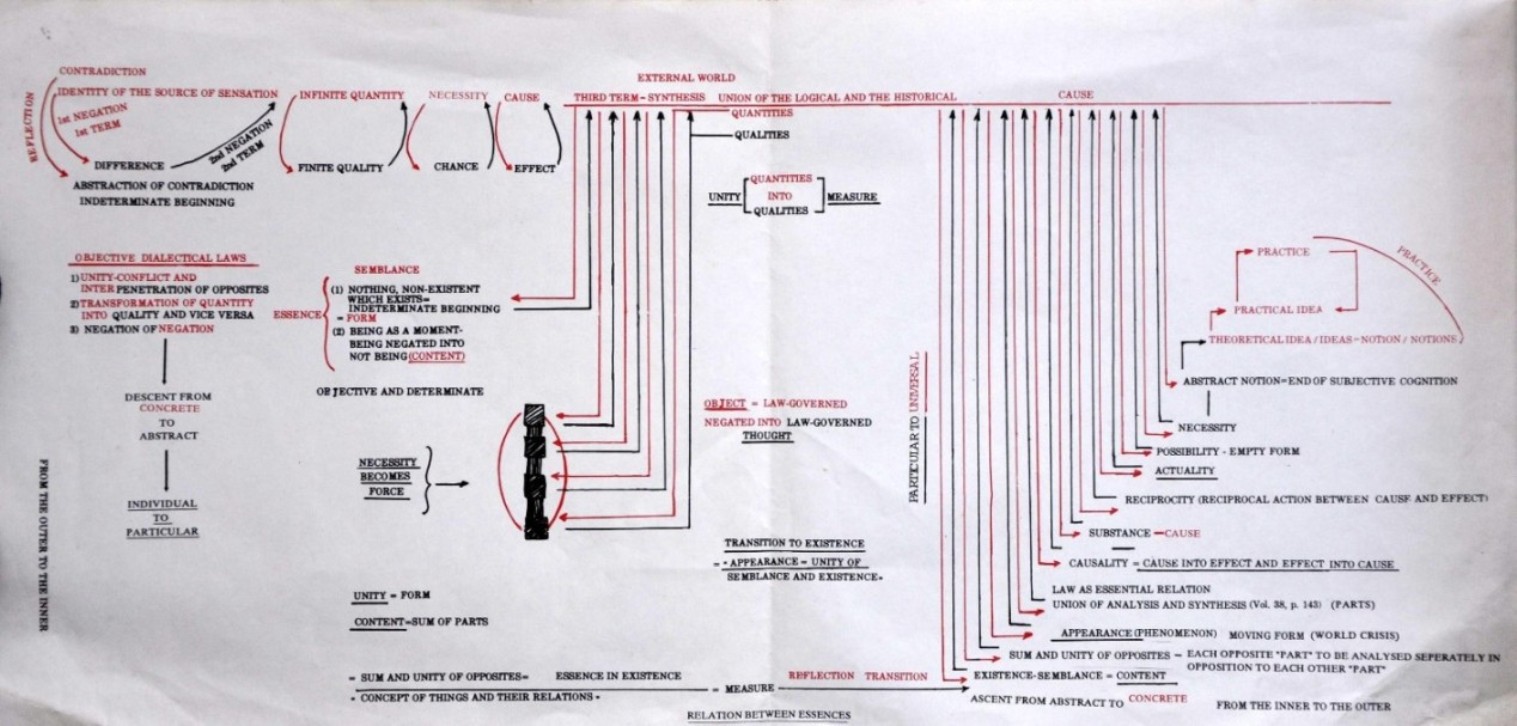
Figure Three: Recently Discovered WRP Suicide Note
[For background to this topic, see Easton (1958), Emmett (1928), MacIntyre (1980), Reé (1984) and Werskey (1988). See also Steele and Taylor (2004).]
At this point, it could be objected that the dice have been heavily loaded in this Essay and at this site against DM and in favour of the author's own idiosyncratic interpretation of HM. Hence, while it is maintained here that workers can't arrive at an understanding of DM solely as a result of their own experience -- meaning that it has had to be foisted on them "from the outside" -- no such strictures or requirements have been placed on HM. But, if HM can't itself be learned by workers as a result of their own experience, then the alleged contrast between DM and HM is unsustainable. Not only that, the phrase "from their own experience" has been interpreted rather narrowly in this work -- plainly in order to rule out workers learning about DM from books, for example. When this constraint is applied to HM, the same conclusions would surely follow.
Or, so it could be maintained.
It is worth recalling that the assertion that workers can't learn about DM from their own experience wasn't an empirical claim on my part -- it was an a priori observation based on the fact that, if DM makes no sense, no one (not Engels, not Lenin, not Trotsky, not Mao, not even Gerry Healy) could arrive at a DM-view of the world by any means whatsoever -- including even 'divine intervention'.
That is because there is no such thing as a DM-view of anything (any more than there is off-side in chess or the cube root of your left foot), let alone of 'reality'. DM is far too confused for it to be described even so much as "a view", still less "a theory". The other considerations (mentioned in the above proffered objection) were introduced solely to illustrate this contention. These strictures, of course, also apply to Theology and the fictional works of Lewis Carroll and Edward Lear -- but they don't apply to HM.
Moreover, reference was made to "workers' experience" simply because this is a phrase in common use among Marxists. However, it isn't to be assumed that the present author endorses its use in philosophical contexts. It has been employed here strictly ad hominem -- that is, this phrase has been used in order to undermine several other ideas based on inferences accepted by DM-theorists.
Of course, the ordinary language use of "experience" isn't in doubt; indeed, it has been used in this Essay several times. Moreover, any who take exception to my use of an ad hominem argument might do well to reflect on the fact that much that is written about this argument form is misguided in the extreme. Indeed, on the Internet it is widely viewed as synonymous with "abuse". Ad hominem has in fact got nothing to do with abuse. Moreover, ad hominem arguments are perfectly acceptable if they expose the inconsistencies in another's position, which is precisely how one such is being used here.
In fact, an ad hominem argument is one that infers from some (assumed or actual) idiosyncrasy, failing or foible in an opponent to the conclusion that their argument is invalid because of that. Ad hominem has nothing to do with personalising a criticism as such, but with what can be 'inferred' from that personalisation. It has nothing to do with abuse simpliciter, either; one can infer, ad hominem, from praise just as much as from abuse. It is the inference that is ad hominem, not the personalisation, the abuse, or even the praise.
Hence, this would be plain and simple abuse: "NN is an idiot" -- but it isn't ad hominem. This is: "NN is an idiot, therefore what he says is false". So is this: "NM is intelligent, therefore what she says is true." [Where in both cases "what he/she says..." refers back to an argument or assertion put forward by an opponent or interlocutor in a debate, etc. On this, see my comments over at Quora, reposted here.]
It is clear, however, that workers' understanding is already pre-disposed toward HM. Few workers need to be informed of most of the following: (i) Class division; (ii) The great disparity of wealth between classes; (iii) The havoc caused by the relentless pursuit of profit; (iv) The de-humanising effect of work; (v) The poor education, housing and healthcare they and their families have to endure (without having to fight for improvements); (vi) The bias and partiality of the Government, the Police, the Media, and the Judiciary; or (vii) Of the need for unions, and so on and so forth. Survey after survey shows this, and anyone who knows workers knows they know it, too.
This isn't to suggest that this awareness is evenly distributed, that it doesn't change over time or from generation to generation; but only the most backward sections of the working-class are ignorant of all or most of the above. Nor is it to suggest that workers don't harbour regressive ideas, or hold beliefs and attitudes that socialists shouldn't challenge --, but, the plain fact is that these can all be confronted using ordinary language.
[On this, see Callinicos and Harman (1987), Callinicos (1987, 1988), German (1996), and Rees (1988). Note, this has nothing to do with the so-called "Dominant Ideology Thesis". More on that in Essay Three Part Three. See also Callinicos (2004), pp.160-68.]
However, in contrast, every single worker would need to be 'informed' that, for example:
(a) Change occurs as a result of 'contradictions' -- even then they would fail to comprehend how the mere "gainsaying" of someone could possibly help a cat move off a mat, let alone how a mere verbal wrangle could possibly have caused the demise of, say, Feudalism;
(b) Flowers negate seeds -- in fact, they would probably have a good laugh at that one, recalling, say, several prize stories about UK Prince Charles talking to his plants, or the childish conversation between the Weed and Bill and Ben in the Flower Pot Men;
(c) Truth is the Whole/Totality -- they would perhaps view this as some sort of New Age nostrum;
(d) Objects and processes are the same and not-the-same, as well as not-not-the-same -- they would surely assume that care in the community had failed whoever invented that gem;
(e) "John is a man" is capable of revealing the essential nature of everything in existence, as Lenin himself believed -- this might prompt them into suggesting that whoever came out with that LuLu cut out the hallucinogens from now on;
(f) Being is identical with but at the same time different from Nothing, the contradiction resolved in Becoming -- they would definitely agree with Lenin that whoever "divined" that pearl of wisdom was a genius; in fact, they would probably associate nothing positive with dialectics from then on...
So, while HM needn't be learned from books (but it can be), DM ultimately can't be 'learnt' in any other way -- or, indeed, at all.
26. This needs qualifying; vaguely analogous ideas were employed by assorted mystics. On this see Essay Fourteen (summary here). See also here and here.
For instance, the sacred text of Hermeticism had this to say:
"For everything must be the product of opposition and contrariety, and it cannot be otherwise." [Copenhaver (1995), p.38. Bold emphasis added.]
Inwood notes, too, that in the ancient world Heraclitus used somewhat similar concepts, and more recently that the arch-mystic Jakob Böhme employed comparable language -- as, indeed, did Novalis (who was Böhme's populariser in 18th century Germany). [Cf., Inwood (1992), pp.63-64.] In Essay Two, we learnt that mystics right across the planet have always used jargon like this.
Indeed, Della Volpe records the employment of somewhat similar language in Semën Frank's work -- Frank was a follower of Nicholas of Cusa (whose ideas will be examined in more detail in Essay Fourteen Part One) --, which is uncannily similar to Hegel's own use of language. [Della Volpe (1980), p.72, note 52.] But, since Frank lived from 1877-1950, his work plainly isn't an example of the ancient use of these vague notions; indeed he might have lifted some or all of them Hegel -- who in turn shared much with Cusa himself.
The truth is, of course, that Hegel had to change the meaning of a perfectly ordinary German word ("Widersprechen" -- "to speak against") to make his point. Ordinary Germans -- that is, those who haven't already been initiated into Böhmean Mysticism, and those not yet corrupted by the Idealism prevalent in German intellectual circles of the day -- wouldn't have been able to understand Hegel's peculiar use of this term.
One Hegel scholar, Stephen Houlgate, has recently tried to defend Hegel's use of language; here is how I have responded to what he had to say in Essay Twelve Part One
We have already seen that Hegel's reference to the implicit speculative nature of the German language is about as genuine as a video showing Rembrandt using his Smartphone to post a list of his favourite DVDs on Facebook.
Nevertheless, Houlgate argues that Hegel was actually using ordinary German words in his Logic, not a specialised vocabulary, in order to reveal its inherently 'speculative' nature (i.e., in effect, that it was really a secret code, a code only perspicuous to a very limited minority --, a minority of one, Hegel). So, while English readers might think that Hegel's argument is obscure, tortuous and opaque because of its language, apparently that isn't the case for those who can read him in the original German, according to Houlgate:
"At this point, those who know Hegel's work only through English translation may be forgiven a distinctly sceptical smile. Hegel uses ordinary vocabulary? Can that be true? Do Germans really go around talking about 'determinateness' (Bestimmtheit) and 'being in and for itself' (Anundfürsichsein)? Well perhaps not precisely in the way Hegel does, but they do use related expressions in everyday speech. Ask a German if he or she thinks national reunification was good thing and you may hear in response 'bestimmt' ('definitely'), or 'an für sich, schon' ('in principle, sure')." [Houlgate (2006), pp.76-77. Italics in the original.]
This flies in the face of the fact that many German speakers -- like, say, Schopenhauer -- find it almost impossible to work out what Hegel was banging on about:
"If I were to say that the so-called philosophy of this fellow Hegel is a colossal piece of mystification which will yet provide posterity with an inexhaustible theme for laughter at our times, that it is a pseudo-philosophy paralyzing all mental powers, stifling all real thinking, and, by the most outrageous misuse of language, putting in its place the hollowest, most senseless, thoughtless, and, as is confirmed by its success, most stupefying verbiage, I should be quite right.
"Further, if I were to say that this summus philosophus [...] scribbled nonsense quite unlike any mortal before him, so that whoever could read his most eulogized work, the so-called Phenomenology of the Mind, without feeling as if he were in a madhouse, would qualify as an inmate for Bedlam, I should be no less right....
"At first Fichte and Schelling shine as the heroes of this epoch; to be followed by the man who is quite unworthy even of them, and greatly their inferior in point of talent -- I mean the stupid and clumsy charlatan Hegel." [Schopenhauer, quoted from here. Links added.]
"But the height of audacity in serving up pure nonsense, in stringing together senseless and extravagant mazes of words, such as had previously been known only in madhouses, was finally reached in Hegel, and became the instrument of the most barefaced general mystification that has ever taken place, with a result which will appear fabulous to posterity, and will remain as a monument to German stupidity." [Schopenhauer, The World as Will and Representation, Volume 2, p.22.]
"Fichte is the father of the sham philosophy, of the disingenuous method which, through ambiguity in the use of words, incomprehensible language, and sophistry, seeks to deceive, and tries, moreover, to make a deep impression by assuming an air of importance in a word, the philosophy which seeks to bamboozle and humbug those who desire to learn. After this method had been applied by Schelling, it reached its height, as everyone knows, in Hegel, in whose hands it developed into pure charlatanism....
"In Germany it was possible to proclaim as the greatest philosopher of all ages Hegel, a repulsive, mindless charlatan, an unparalleled scribbler of nonsense....
"If indeed I now chose to call to mind the way in which Hegel and his companions have abused such wide and empty abstractions, I should have to fear that both the reader and I myself would be ill; for the most nauseous tediousness hangs over the empty word-juggling of this loathsome philophaster....
"It may be said in passing that one can see how important the choice of expressions in philosophy is from the fact that that inept expression condemned above, and the misunderstanding which arose from it, became the foundation of the whole Hegelian pseudo-philosophy, which has occupied the German public for twenty-five years." [Ibid., quoted from here. Link added.]
So, if Schopenhauer, a sophisticated German speaker if ever there was one, found that the language of this verbose waffler-meister was full of "senseless and extravagant mazes of words, such as had previously been known only in madhouses" and "empty abstractions", that it was "incomprehensible", "inept", and amounted to "empty word juggling", what price ordinary Germans?
This confirms much of what has been alleged here: metaphysicians, like Hegel, take ordinary words and use them in radically odd ways, nominalising verbs -- for example, the verb "to be" was transmogrified into "Being"; "is identical with" was reified into "Identity"; the use of the negative particle into "Difference"/"Negativity" -- , which transformed general words into the names of abstract particulars.
[On a personal note: I think Schopenhauer was being rather kind, here.]
This is, of course, quite apart from Marx's own highly critical comments about Hegel's language and 'method'.
Naturally, there is nothing wrong with altering the meaning of a word to suit a particular purpose, but in Hegel's case there were only two reasons for doing this: (i) This new use of "contradiction" followed from a defective analysis of the LOI (on that, see here and here), and (ii) Hegel was situating his ideas in a well-established mystical tradition where this odd way of speaking is de rigeur.
[LOI = Law of Identity; FL = Formal Logic.]
On the other hand, if dialecticians want to re-define the word "contradiction" as "conflict" then their theory would merely become a form of stipulative conventionalism -- since there is nothing in the meaning of either the everyday word "contradiction", nor in its FL-twin, that remotely suggests such a connotation; nor is there vice versa with "conflict".
In that case, it is now clear that this word has been re-defined just to make 'Materialist Dialectics' work. But, we should be no more convinced of the acceptability of that manoeuvre than we would be if, say, an apologist of Capitalism 'defined' it as "natural" and "beneficial to all". If the re-definition of terms provided a "royal road" to truth, those with the best dictionaries would surely win Noble Prizes.
To be sure, one online dictionary lists the following as a definition of the word "contradiction":
"contradiction, n 1: opposition between two conflicting forces or ideas...."
However, dictionaries are repositories of usage, and are neither normative nor prescriptive (except in the senses mentioned below). In this case, the above dictionary is clearly recording the 'dialectical' use of this word -- by Dialectical Marxists! That doesn't imply that this word means anything when used this way -- certainly dialecticians themselves can't tell us what it means!
The same dictionary also defines the word "Nirvana" -- but, which materialist wants to admit that that word actually means anything (that is, apart from its emotional import)?
Indeed, dictionaries 'define' many things
about which dialecticians would have reservations.
For example:
"God: A being conceived as the perfect, omnipotent, omniscient originator and ruler of the universe, the principal object of faith and worship in monotheistic religions.
"The force, effect, or a manifestation or aspect of this being.
"A being of supernatural powers or attributes, believed in and worshiped by a
people, especially a male deity thought to control some part of nature or
reality.
"An image of a supernatural being; an idol.
"One that is worshiped, idealized, or followed: Money was their god...."
And:
"negation n 1: a negative statement; a statement that is a refusal or denial of some other statement 2: the speech act of negating 3: (logic) a proposition that is true if and only if another proposition is false."
No mention here of "sublation" or of the NON, but does that force dialecticians into accepting this 'definition'? Of course not; they pick and choose when it suits them.
[NON = Negation of the Negation.]
Consider, too, the definition of "wage":
"1. Payment for labour or services to a worker, especially remuneration on an hourly, daily, or weekly basis or by the piece.
"2. wages Economics The portion of the national product that represents the aggregate paid for all contributing labour and services as distinguished from the portion retained by management or reinvested in capital goods.
"3. A fitting return; a recompense." [Quoted from here; spelling altered to conform with UK English.]
"An amount of money paid to a worker for a specified quantity of work, usually expressed on an hourly basis." [Quoted from here; spelling altered to conform with UK English.]
Are there any Marxists on the planet who are prepared to accept this definition of what wages really are?
So, dictionaries record ideology just as much as they register use or meaning.
In that case, with respect to "contradiction", the writers of the above dictionary have plainly recorded the anthropomorphic use of this word by DM-fans themselves.
[This isn't to deny that dictionaries set norms of spelling or grammar. There is a useful analysis of Hegel's use of language in Inwood (1992), pp.5-18, and a more extensive one in Cook (1973). This topic will be examined much more extensively in Essays Twelve and Fourteen.]
That is quite apart from the fact that a 'dialectical contradiction' is supposed to be a 'unity of dialectical opposites', such that one opposite can't exist without the other (so that the proletariat, for example, can't exist without the bourgeoisie, so we are told) and each implies the other. Moreover, if the DM-classics are to be believed, these opposites struggle with and then turn into each other. "Conflict" carries none of these implications, which is why Hegel and the DM-classicists nowhere equate conflict with contradiction. If one individual conflicts with another individual, they aren't dialectical opposites and each can surely exist without the other. If you, dear reader, conflict with a policeman, do you turn into that cop, or he into you? If that cop dies, does that mean you're next?
In that case, "conflict" can't mean the same as "dialectical contradiction".
[This forms part of Note 27.]
[It is worth pointing out that the material in this section depends heavily on the evidence and argument presented in other Essays at this site, which have demonstrated time and again that DM makes not one ounce of sense, that its core ideas soon fall apart when examined closely, and, indeed, that they are far too vague and confused to be assessed even for their truth or falsehood. On this, see Essays Three Part One to Eight Part Three. That isn't the case with HM.]
It could be objected that the distinction drawn between DM and HM at this site is completely spurious; hence, the controversial claims made in this Essay are completely misguided, if not downright mendacious.
However, as will be argued in Essay Fourteen Part Two, HM contains ideas that are non-sensical only when they are translated into DM-jargon. The eminent good sense made by HM -- even as that theory is understood by workers when they encounter it (often this is in times of struggle) -- testifies to this fact.
[HM = Historical Materialism; DM = Dialectical Materialism; LOI = Law of Identity.]
The clear distinction that exists between these two theories isn't just a wild idea advanced at this site; it can be seen clearly in the day-to-day practice of revolutionaries themselves. No Marxist of any intelligence would use slogans drawn exclusively from DM to communicate with workers; indeed, few militants would even attempt to agitate strikers, for example, with the conundrums found in DM. On a picket line the alleged contradictory nature of motion or the limitations of the LOI don't often crop up. How frequently does the link between part and whole loom large in the fight against the Nazis? How many times do revolutionary socialists have to explain the distinction, or even the link, between 'quantity and quality' in the fight against, say, austerity?
Consider, for example, the following slogans: "The Law of Identity is true only within certain limits and the opposition to sanctions on Venezuela!" Or "Change in quantity leads to change in quality and the defence of pensions!" https://tinyurl.com/4kcump8j
[Excellent examples of the utter uselessness of the above 'law' can be found here and here.]
Or: "The whole is greater than the sum of the parts and the campaign to keep hospital HH open!" Or even, "Being is identical with, but at the same time different from, Nothing, the contradiction resolved by Becoming, and the fight against the deportation of Abrego Garcia!"
Slogans like these would be employed by militants of uncommon stupidity and legendary ineffectiveness.
In contrast, active revolutionaries employ ideas drawn exclusively from HM -- as that theory applies concretely to the current state of the class war -- if they want to communicate with workers. The vast majority of revolutionary papers, for example, use ordinary language coupled with concepts drawn from HM to agitate and propagandise; rarely do they employ DM-phraseology. [A handful examples of the latter have been considered here.]
As Ian Birchall informs us:
"[Red] Saunders thinks that the IS [which was the forerunner of the UK-SWP -- RL] attracted the best of the 1968 generation through its politics -- 'Neither Washington nor Moscow' -- but also through the accessibility of its publications, it used ordinary language rather than the jargon of other far-left groups." [Birchall (2011), p.422.]
Only deeply sectarian rags of exemplary unpopularity and impressive lack of impact use ideas and terminology lifted from DM to try to educate or propagandise the working class. Newsline (the daily paper of the old WRP) was notorious in this regard; but like the Dinosaurs it resembled, it is no more. [The NON, it seems, took appropriate revenge.]
[NON = Negation of the Negation.]
It could be objected that no one would actually use slogans drawn from certain areas of HM to communicate with or agitate workers. That doesn't mean HM is of no use, so the same must be true of DM. For example, who shouts slogans about "Base and Superstructure", or "Relative Surplus Value" on paper sales? Who tries to propagandise workers with facts about the role of the peasantry in the decline of feudalism? Once more, this shows the distinction drawn in this Essay is entirely bogus.
While it is true that no one shouts slogans about the relation between "Base and Superstructure" on paper sales, or prints strike leaflets reminding militants of the role of the peasantry in the decline of feudalism, they nevertheless still use slogans (often popularised versions) drawn exclusively from HM, or which connect with HM as it relates concretely to current events in the class war. Nearly every article, leaflet or slogan is informed by ideas drawn from HM.
In stark contrast, again, none at all are drawn from DM.
To be sure, revolutionary papers in general casually employ a handful of jargonised expressions drawn from DM (in the vast majority cases, this is confined to the use of the word "contradiction") in some of their articles, but this forms only a very minor part of their output -- even though few, if any, comrades will use such terms in slogans on street sales, on demonstrations or in discussions on the picket line.
Anyway, as will be shown in Part Two of this Essay, the use of DM-terminology like this is merely a nod in the direction of tradition and orthodoxy. Indeed, we are forced to conclude this since no sense can made of such jargon -- as we have seen, for instance, here, here, here and here. Hence, the employment of DM-terminology simply amounts to a declaration, or an admission, of 'orthodoxy' on the part of the individual or group using it -- an 'in-group'/'out-group' marker, as is argued here. DM-jargon does no real work (other than negative) in such circumstances, unlike concepts drawn from HM.
[Claims to the contrary have been neutralised here, here and here.]
So, just like Marx in Das Kapital, revolutionary papers merely "coquette" with Hegelian jargon -- and even then, only "here and there".
Hence, at least at the level of practice, where the party interfaces with the working class and the material world, DM is totally useless.
[As we will also see here, there is no evidence that DM, or any of its jargon, was actively used even by the Bolsheviks in October 1917, or, indeed, for several years after.]
Consequently, tested in practice -- or, rather, tested by being left out of practice -- the status of DM is plain for all to see: At best, it is a hindrance; at worst, it would totally isolate revolutionaries and make them look ridiculous.
This shows that the distinction drawn at this site between DM and HM isn't spurious in the least.
When they communicate with workers, militants draw this distinction all the time.
Nevertheless, it could be argued in response that this attempt to separate HM and DM would fragment and compartmentalise our knowledge of nature and society. Such an approach to knowledge would possess clear, Idealist implications, suggesting that human beings are unique by implying that mind is independent of matter. If mind is dependent on matter (howsoever that link is conceived) there must be laws that span across both of them. And this is partly where DM comes in.
Or, so it could be argued...
But, that isn't so. As noted above, DM is far too vague and confused for it to function in that way. It is incapable of accounting for anything, social or natural (as the Essays at this site demonstrate -- indeed, as we have seen, if DM were true, change would be impossible). Hence, even if there were natural laws that governed these two spheres (and I will pass no comment on that possibility here), and an inventory were drawn up of all the viable alternative theories capable of accounting for the above hypothesised connection, DM wouldn't even make the bottom of the reserve list of likely candidates. It is far too vague and confused.
In response, it could be argued that the above counter-argument is totally unacceptable since it ignores the fact that some of the best class fighters in history have not only put dialectics into practice, they have woven it into the fabric of each and every classic, and post-classic, Marxist text. Indeed, without dialectics there would be no Marxist theory. Indeed, HM would be like "a clock without a spring":
"While polemicising against opponents who consider themselves -- without sufficient reason -- above all as proponents of 'theory,' the article deliberately did not elevate the problem to a theoretical height. It was absolutely necessary to explain why the American 'radical' intellectuals accept Marxism without the dialectic (a clock without a spring)." [Trotsky (1971), p.56. Bold emphasis added. Quotation marks altered to conform with the conventions adopted at this site.]
I have dealt with that objection in Part Two, here, so readers are directed there for more details.
The other claim (concerning matter and 'mind') was tackled in extensive detail in Essay Thirteen Part Three.
28. Again, this isn't meant to question the fact that workers in struggle often learn to see things more clearly -- for example, that the social, political and economic structures of Capitalism are interconnected (etc.). As noted in Essay Eleven Part One, the interconnected nature of Capitalism isn't being questioned here since it is an idea drawn from HM. In that context, sense can be made of the inter-relatedness of human history and its diverse Modes of Production, etc. Given the strictures detailed in the aforementioned Essay, it might be difficult to specify the nature and extent of these interconnections, but that question will have to be left for another day.
Naturally, since we have all descended from the same limited set of ancestors, have lived on the same planet all the while, and have experienced an interlocking series of historical developments and class societies, only a rather benighted (post-modern?), or ideologically-motivated 'scientist' would try to explain human history in a fragmentary way.
The immediacy of HM is not only reflected in the fact that it is possible to express its ideas in ordinary language (even if this can be done more succinctly using the specialist vocabulary of HM itself), it is also confirmed by the way that children above a certain age can be taught HM with relative ease. This also explains why HM seems so plausible to workers i.e., when they are ready to listen to it explained to them, in times of struggle.
28a. Woods and Grant also refer us to another passage of Trotsky's:
"The chicken knows that grain is in general useful, necessary and tasty. It recognises a given piece of grain as that grain -- of the wheat -- with which it is acquainted and hence draws a logical conclusion by means of its beak. The syllogism of Aristotle is only an articulated expression of those elementary mental conclusions which we observe at every step among animals." [Trotsky quoted in Woods and Grant (1995), p.89. A copy is available here (near the bottom of the page). In fact this appears in Trotsky (1973a), p.400.]
Unfortunately, Trotsky failed to say how he knew so much about the logical acumen of these Avian Aristotles -- or why, if animals have known about these things for so long, it took a genius like Aristotle to 'discover' them about 1 million years after we left the animal kingdom proper, and countless million since 'we' branched off from the common ancestor we have with the birds!
And, if chickens are such natural logicians, then perhaps among them there is a Feathered Frege, a Poultry Peano, or a Rooster Russell?
Figure Four: Avian Aristotle, Feathered Frege,
And Rooster Russell?
28b. It could be objected that in the transition from a liquid to a sludge -- and then to a semi-solid, and then perhaps into a full-blown solid as more salt is dumped into the soup -- we would have a clear example of change of quantity into quality. But, even here, this change will be gradual and non-"nodal". If there is a 'nodal' change anywhere here, it occurs in anyone who at some point decides to call this concoction a sludge, but that change will refute this 'Law' since no matter or energy will have been added to that individual. [On that, see Note 28c.]
Moreover, solid soups are still soups, it seems; so no change in that "quality" is applicable here, anyway.

Figure Five: Trotsky In The Soup?
Again, the vague DM-'understanding' of "quality" at work here makes it impossible to decide what is and what isn't a correct application of this 'Law'!
28c. Even if tastes were relational aspects of our sensory modalities --, so that it would be the reaction of the taster to the chemicals in the soup which constitutes its taste --, the experienced taste is manifestly registered in the taster, not the soup. And that is where the change in 'quality' takes place, in the taster, not the soup.
Dialecticians can't afford to allow relational properties like the above to be counted as 'qualities' -- for while that might seem to save this example from easy refutation, it would sink Engels's First 'Law' elsewhere.
Hence, if the relational properties of bodies were to be counted as part of an object's 'qualities', then many things would change qualitatively with no increase or decrease in matter or energy. Several instances have already been listed in Essay Seven Part One, but here are a few more:
NN is watching her friend, MM, walk away from her. As MM recedes into the distance she seems, to NN, to grow smaller. At some point MM disappears. [This is also the case if NN walks away from MM, who remains, maybe, sat on a park bench.] Here we have a change in quality prompted by no increase in quantity.
It is to no avail appealing to the quantity of metres that separate the two, for Engels was quite specific:
"...[T]he transformation of quantity into quality and vice versa. For our purpose, we could express this by saying that in nature, in a manner exactly fixed for each individual case, qualitative changes can only occur by the quantitative addition or subtraction of matter or motion (so-called energy)…. Hence it is impossible to alter the quality of a body without addition or subtraction of matter or motion, i.e. without quantitative alteration of the body concerned." [Engels (1954), p.63. Bold emphases added.]
"Matter or motion" added to a body is the relevant factor here -- not separation distance. And, of course, it is MM who moves in this case; but nothing at all has been added to her, even though her apparent size (perceived by NN) changes in 'quality'.
Still less use would it be appealing to Engels's reference to "motion" here, since he was also clear that he meant by this the addition of "energy". To be sure, it could be argued that it takes energy to make MM move. Maybe so, but unless MM moves to a different height to NN, no energy will have been added to MM in the process (as noted earlier). And, motion itself can't change the apparent size of either party to this tableaux; we can see this if MM covers the same distance as she did before, but this time merely circles NN.
Even so, no energy has been added to NN -- the stationary viewer -- in whom these changes in 'quality' are perceived, or in whom they take place. No one supposes (it is to be hoped(!)) that even if MM were to walk up a hill, thereby adding potential energy to her body, or if she speeded up (adding kinetic energy) she would actually shrink and not just look smaller to NN as a result! Furthermore, if NN accompanies MM up this hill, they don't both grow smaller, as perceived by either of them.
Consider another example: three animals are lined up in a row, a mouse, a pony, and an elephant. In relation to the mouse, the pony is big, but in relation to the elephant it is small. So, here we have change in quality with no matter/energy added or subtracted. There are countless examples of this sort -- with respect to the relations that hold between any object, or set of objects, and the rest of the local (or remote) universe -- here alone.
Someone could object that the mouse-pony-elephant example really involves the perception of an observer, and so this isn't a genuine counter-example, after all.
This can't be correct for it is surely the case, independently of any and all observers, that a pony is bigger than a mouse while it is also smaller than an elephant. Moreover, we have already seen that Engels informed us that this 'Law' applies to thought, too:
"Dialectics, however, is nothing more than the science of the general laws of motion and development of nature, human society and thought." [Engels (1976), p.180. Bold emphasis added.]
Hence, if, as a result of inspecting (or even thinking about) this line-up, someone judges the second larger than the first and the first smaller than the third, that will be covered by Engels's 'Law'.
Moreover, even if this objection were valid, the qualitative change in perception of the alleged observer wasn't the result of any change in quantity in her. So, this is a genuine counter-example, after all.
[And, of course, Trotsky's example of the fox revolves around the alleged perception of the wolf by the fox.]
Still others could object that these animals don't "develop" into one another; maybe so, but that response has already been laid to rest, here and here.
It is also worth recalling that the above example has only been introduced here as a salutary warning to DM-fans concerning the implications for their theory if they decide to water-down their characterisation of "quality" by introducing the relational properties of bodies -- always assuming, of course, that they ever manage to be clear about even this aspect of their 'theory'!
29. The way that Trotsky worded his comment suggests that foxes actually understand parts of Hegel's Logic (at least implicitly)!
This is decidedly odd since it is considerably more that Lenin attributed to some Marxists!
"Even animals arrive at their practical conclusions…on the basis of the Hegelian dialectic. Thus a fox is aware that quadrupeds and birds are nutritious and tasty…. When the same fox, however, encounters the first animal which exceeds it in size, for example, a wolf, it quickly concludes that quantity passes into quality, and turns to flee. Clearly the legs of a fox are equipped with Hegelian tendencies…. [T]he universe throughout is permeated with 'unconscious' dialectics." [Trotsky (1971), pp.106-07. Bold emphases added.]
So, if Marxists, or even workers, can't teach themselves dialectics, foxes clearly can!
Workers of the world unite, you have nothing to lose but your inferiority to Vulpes vulpes!
30. As we saw in Essay Seven Part One, we are still waiting for a clear definition of a dialectical 'node'/'leap' -- or, indeed, any definition at all, clear or otherwise!
31. But, it isn't even that. In this lampoon of Trotsky's parable, we would have an array of animals of relatively stable but different sizes stood in a metaphorical or imaginary line -- no one supposes that such lines really exist, or that prey actually line up for inspection, smallest to largest, waiting to be selected by their predators as part of some sort of crazy Zoological line up -- do they?

Figure Six: Law Of Identity Parade?
32. Again, it could be argued that the example of the lion attacking a larger wildebeest actually illustrates the 'reverse law' that quality can pass over into quantity (in that the superior qualitative nature of the lion is equal to a quantitatively larger but qualitatively inferior prey).
But, nothing "passes over" here, and nothing relevant changes. Both animals are quantitatively and qualitatively the same as they were before they met. No matter or motion has been added or subtracted from either of them. There is no "break in gradualness" here, either.
Anyway, what new 'quality' is supposed to be at work in this case? The ability to hunt and kill wildebeest? That would make this 'reverse law' tautologious.
Incidentally, anyone who still thinks Trotsky is right in what he says about animals should watch these videos, one of which shows an ordinary-sized domestic cat confronting, and then chasing off, two large alligators. A second video shows a domestic cat chasing off a larger dog. Is this another catastrophic failure of Engels's 'Law'?
[Of course, Trotsky didn't have access to YouTube, but his epigones do. In that case, they will no doubt be interested to see footage of rabbits chasing off larger cats and dogs, and a whole host of other non-dialectical animal antics (such as a domestic cat chasing a larger fox away).]
It looks like the animal kingdom is well stocked with very conscious anti-dialecticians!
33. As will be appreciated from the facetious tone of many of the comments in this section of the Essay, it isn't easy to take Trotsky's argument here at all seriously.
In which case, it might be wondered why the members of his personal and political entourage thought it wise not to bring a little good sense to Trotsky "from the outside" -- from the non-dialectical natural world -- and alert him to the risible nature of his own argument.
On the other hand, considering the response James Burnham and Max Eastman received from that great revolutionary, maybe the size of that particular task adversely affected the quality of both their thinking and their intellectual courage -- or, indeed, vice versa.
34. This is in fact an allusion to an idea found in Plato, which features in his work as a mystical doctrine in, for example, the Phaedo, the Meno and the Republic. There, Plato argues that all knowledge is in fact recollection.
Oddly enough, this notion resurfaces in Wittgenstein's work in an anthropological, non-mystical form as part of the idea that we are capable of accessing knowledge only in so far as we have been socialised in a speech community. Recollection (in this sense), therefore, forms part of the possibilities that socialisation opens up, something that enables all those who have been socialised in order to appropriate the collective knowledge of that community (to a greater or lesser extent, distorted, cramped or amplified, of course, by class division, etc.). More importantly, such individuals have access to the full range of distinctions that have been built into that community's historic use of language --, and, even more significantly, most of them will have shared in the collective oppression and exploitation of their class, and they will thus have access to the memory of that class in all its forms.
[This isn't to suggest, though, that this is how Wittgenstein saw things! Nor is it to suggest that the experience of the working class, or its response to exploitation and oppression, isn't uneven. Nevertheless, the connections between this aspect of Wittgenstein's work and HM will become a little clearer in other Essays posted at this site. On Wittgenstein's clear and unambiguous left-wing sympathies and associations, however, see here.]
The following passage from Wittgenstein's later work is relevant to this and other themes explored at this site:
"Our investigation is therefore a grammatical one. Such an investigation sheds light on our problem by clearing misunderstandings away. Misunderstandings concerning the use of words, caused, among other things, by certain analogies between the forms of expression in different regions of language….
"[Philosophical problems] are not empirical problems; they are solved, rather, by looking into the workings of our language, and that in such a way as to make us recognise those workings: in despite of an urge to misunderstand them. The problems are solved, not by giving new information, but by arranging what we have always known. Philosophy is a battle against the bewitchment of our intelligence by means of language….
"What we do is to bring words back from their metaphysical to their everyday use…. The results of philosophy are the uncovering of one or another piece of plain nonsense and of bumps that the understanding has got by running its head up against the limits of language….
"Philosophy simply puts everything before us, and neither explains nor deduces anything. -- Since everything lies open to view there is nothing to explain…. The work of the philosopher consists in assembling reminders for a particular purpose. If one tried to advance theses in philosophy, it would never be possible to debate them, because everyone would agree with them." [Wittgenstein (1958), pp.43-50. Bold emphases added.]
Compare also these two passages:
"What we do is to bring words back from their metaphysical to their everyday use…. The results of philosophy are the uncovering of one or another piece of plain nonsense and of bumps that the understanding has got by running its head up against the limits of language…." [Ibid.]
"The philosophers have only to dissolve their language into the ordinary language, from which it is abstracted, in order to recognise it, as the distorted language of the actual world, and to realise that neither thoughts nor language in themselves form a realm of their own, that they are only manifestations of actual life." [Marx and Engels (1970), p.118. Bold emphases added.]
Of course, these Essays have been aimed (partially) at using and applying these ideas to expose the non-sensical and incoherent nature of DM.
[The relevance of all this is explained here. I have also said much more about this topic, here. For what Wittgenstein meant by "Grammar", see here.]
34a. Some might object that philosophical ideas can't have remained the same for thousands of years, across different modes of production; that supposition runs counter to core HM-concepts.
But, we don't argue the same for religious belief. Marx put no time stamp on the following, for example:
"The foundation of irreligious criticism is: Man makes religion, religion does not make man. Religion is, indeed, the self-consciousness and self-esteem of man who has either not yet won through to himself, or has already lost himself again. But man is no abstract being squatting outside the world. Man is the world of man -- state, society. This state and this society produce religion, which is an inverted consciousness of the world, because they are an inverted world. Religion is the general theory of this world, its encyclopaedic compendium, its logic in popular form, its spiritual point d'honneur, its enthusiasm, its moral sanction, its solemn complement, and its universal basis of consolation and justification. It is the fantastic realization of the human essence since the human essence has not acquired any true reality. The struggle against religion is, therefore, indirectly the struggle against that world whose spiritual aroma is religion.
"Religious suffering is, at one and the same time, the expression of real suffering and a protest against real suffering. Religion is the sigh of the oppressed creature, the heart of a heartless world, and the soul of soulless conditions. It is the opium of the people.
"The abolition of religion as the illusory happiness of the people is the demand for their real happiness. To call on them to give up their illusions about their condition is to call on them to give up a condition that requires illusions. The criticism of religion is, therefore, in embryo, the criticism of that vale of tears of which religion is the halo." [Marx (1975c), p.244. Italic emphases in the original.]
The above remarks applied back in Babylon and
the Egypt of the Pharaohs,
just as they did in Ancient China and the rest of Asia, The Americas, Greece,
Rome and throughout Europe, Africa, Australasia, as they have done right across the planet ever since.
The same is true of the core thought-forms found throughout Traditional
Philosophy -- that there is an invisible world underlying 'appearance', accessible to thought
alone --, especially since Marx also believed that:
"...philosophy is nothing else but religion rendered into thought and expounded by thought, i.e., another form and manner of existence of the estrangement of the essence of man; hence equally to be condemned...." [Marx (1975b), p.381.]
That, of course, helps explain why Marx thought this entire discipline was based on distorted language and contained little other than empty abstractions and alienated thought-forms -- and, indeed, why he turned his back on it from the late 1840s onward.
35. How this solves Lenin's 'problem' will be explored further in Part Two of this Essay.
It is also worth pointing out here (once more!) that this part of Essay Nine doesn't represent a capitulation to naïve humanism, or to a simple-minded faith in workers. Again, more will be said about this in Essay Twelve.
I will address the alleged 'contradictory' nature of workers' 'consciousness' in Part Two of this Essay, and in Essay Three Part Four.
36. Note 36 no longer exists. Its content has now been moved here and here.
"[Hegel's] theories use terms and concepts that are unfamiliar, because they go beyond the understanding of which everyday thought is capable. Ordinary language assumes that things and ideas are stable, that they are either 'this' or 'that'. And, within strict limits, these are perfectly reasonable assumptions. Yet the fundamental discovery of Hegel's dialectic was that things and ideas do change…. And they change because they embody conflicts that make them unstable…. It is to this end that Hegel deliberately chooses words that can embody dynamic processes." [Rees (1998), p.45.]
From this, it is reasonably clear that Rees links ordinary language with "everyday thought". Earlier, he summarised Hegel in the following manner:
"[E]veryday commonsense thought was a mass of contradictions that could only be resolved by moving to progressively greater abstractions." [Ibid., pp.41-42.]
However, as we have seen throughout this site, and in Note 36 above, the truth is that it is in Hegel's work (and derivatively in DM) that "thought" regularly disintegrates.
Nevertheless, in passages like this from TAR it is easy to detect an echo of a familiar theme running through Traditional Philosophy: a depreciation of the experience, language and understanding of ordinary human beings in favour of incomprehensible metaphysical jargon invented by non-workers. [On this, see Conner (2005), and Eamon (1994). See also Note 41a, below.]
Marxists are supposed to be tribunes of the oppressed, not imitators of the oppressor!
More on this in Essay Twelve (summary here).
38. In this regard Rees at least agrees with Engels. Cf., the quotation included in Note 37, and Note 22, above.
Several consequences of the rejection of the LEM were examined earlier. [Cf., Note 36.] However, the genuine limitations of this 'Law' lie elsewhere; cf., Peter Geach's article "The Law of the Excluded Middle", in Geach (1972), pp.74-87.
39. This will be discussed at length in Essay Twelve, and in other Essays published at this site. In the meantime, see here.
40. That is, apart from the last clause (i.e., the one about the capacity of workers to form a revolutionary 'consciousness')!
41. Of course, up to now workers in their hundreds of millions have resisted such attempts to con them in this way, or in this direction, which, thanks to DM, is one of the reasons why Dialectical Marxism has never "seized" the masses. Dialecticians -- blithely ignoring what has actually happened in the real world, and as a result of their determination to give credence to the obscure musings of Mystical Idealists like Hegel (upside down or 'the right way up') --, still think Dialectical Marxism is a resounding success, or it is about to be one any day soon, just you wait...
Naturally, in La La Land, it is.

Figure Eight: 'La La Land' -- The Blessed Country Where
Dialectical Marxism Is A Ringing Success
41a. This will be substantiated in Essay Twelve, where the history of the denigration of ordinary language (promoted by ruling-class hacks, and now, alas, by DM-theorists) will be traced back to its origin in Aristocratic myth and fable in Ancient Greece alongside other ancient class-divided societies.
Until that is published readers are directed to Conner (2005) and Eamon (1994) --, especially Chapters One and Two of the latter, "The Literature Of Secrets In The Middle Ages" and "Knowledge And Power". Eamon's study connects the emphasis on 'secret knowledge' with political and economic power, two areas ruling-class tradition has always inter-linked -- and which, of course, have always been co-opted to further the intellectual, political, economic, social, and 'legal' suppression of 'the unwashed rabble'.
In this case, Eamon connects the novel Renaissance view of nature, which was dressed up as (i) 'empirical knowledge', and as (ii) having been "read from nature" (where have we heard that before?), with (iii) the demise of Feudal authority -- in that the 'new philosophy' of the Renaissance and beyond challenged the prerogative of the Church to control, and dispense, truth --, and on to (iv) the rise of bourgeois 'science' itself (although Eamon himself doesn't put it quite like that!).
[On Giambattista Della Porta, an important figure in the above moves, see here.]
42. This is, of course, an hyperbola, but the work of Gerry Healy can serve as Exhibit B for the prosecution.
With Joseph Dietzgen's writings next on the subs bench, next in line -- or, perhaps even the work of almost any randomly selected HCD.
43. Moreover, Freud's own examples are shown not to work here (the linked page is in German).
44. While the above considerations aren't enough to discredit Freud's work, the following are: Cioffi (1999, 2005), Crews (1995, 1998), Dufresne (2003), Ellenberger (1970/1994), Gellner (1993), Grayling (2002), Grünbaum (1985), Macmillan (1997), Sulloway (1992), Thornton (1986), Webster (1995), Welsh (1994) and Wilcocks (1994).
There is an extensive bibliography of anti-Freud books and articles in Crews (1998). Cf., also the review articles, Borch-Jacobsen (2000), Cioffi (1996), and Gardner (2001). In addition, see here and here.
Althusser, L. (2001), Lenin And Philosophy And Other Essays (Monthly Review Press). [Parts of this book can be accessed here.]
Anderson, K. (2007), 'The Rediscovery And Persistence Of The Dialectic In Philosophy And In World Politics', in Budgen, et al (2007), pp.120-47.
Aristotle, (1984a), The Complete Works Of Aristotle, Two Volumes, edited by J. Barnes (Princeton University Press).
--------, (1984b), Topics, in Aristotle (1984a), pp.167-277.
Ball, T., and Farr, J. (1984) (eds.), After Marx (Cambridge University Press).
Beiser, F. (2005), Hegel (Routledge).
Birchall, I. (2011), Tony Cliff. A Marxist For His Time (Bookmarks).
Blackledge, P. (2006), 'What Was Done: Rediscovering Lenin', International Socialism Journal 111, pp.111-26.
Borch-Jacobsen, M. (2000), 'How A Fabrication Differs From A Lie', London Review of Books, 13/4/2000, pp.3-7.
Brading, K., and Castellani, E. (2003) (eds.), Symmetries In Physics. Philosophical Reflections (Cambridge University Press).
Budgen, S., Kouvelakis, S., and Zizek, S. (2007) (eds.), Lenin Reloaded. Toward A Politics Of Truth (Duke University Press).
Burns, T. (2000), 'Marx And Scientific Method: A Non-Metaphysical View', in Burns and Fraser (2000), pp.79-104.
Burns, T., and Fraser, T. (2000) (eds.), The Hegel-Marx Connection (Macmillan).
Butterfield, J. (1993), 'Interpretation And Identity In Quantum Theory', Studies in History and Philosophy of Science, 24, pp.443–76.
Callinicos, A.
(1987/2004), Making History (Polity Press, 1st ed., Brill 2nd ed.).
--------, (1988), 'Making History: A Reply To John Rees', International Socialism 39, pp.162-71.
Callinicos, A., and Harman C. (1987), The Changing Working Class (Bookmarks).
Carver, T. (1980), 'Marx, Engels And Dialectics', Political Studies 28, pp.353-63, reprinted in Cowling and Wilde (1989), pp.49-60.
--------, (1981), Engels (Oxford University Press).
--------, (1983), Marx And Engels (Harvester Press).
--------, (1984a), 'Marx, Engels And Scholarship', Political Studies 32, pp.249-56.
--------, (1984b), 'Marxism As Method', in Ball and Farr (1984), pp.261-79.
--------, (1989), Friedrich Engels (Macmillan).
--------, (1991) (ed.), The Cambridge Companion To Marx (Cambridge University Press).
--------, (1998a), 'Philosophy And Politics: Marx's Hegel', in Carver (1998b), pp.181-205.
--------, (1998b), The Postmodern Marx (Manchester University Press).
--------, (1999), 'The Engels-Marx Question', in Steger and Carver (1999), pp.17-36.
--------, (2000), 'Hegel And Marx: Reflections On The Narrative', in Burns and Fraser (2000), pp.34-55.
Castellani, E. (1998) (ed.), Interpreting Bodies. Classical And Quantum Objects In Modern Physics (Princeton University Press).
Cioffi, F. (1996), 'Through The Psychoanalytoscope. Review Of Wittgenstein Reads Freud: The Myth Of The Unconscious By Jacques Bouveresse', London Review of Books 18, 25/01/1996, pp.22-23. [Register for free to read the full article.]
--------, (1999), Freud And The Question Of Pseudoscience (Open Court).
-------- (2005), 'Was Freud A Pseudoscientist?'
Cliff, T. (1960), 'Trotsky On Substitutionism', reprinted in Cliff (1982), pp.192-209, Cliff, et al (1996), pp.56-79, and Cliff (2001), pp.117-32.
--------, (1975-1979), Lenin: Four Volumes (Pluto Press). [The first three volumes can be accessed here.]
--------, (1982), Neither Washington Nor Moscow (Bookmarks).
--------, (2001), International Struggle And The Marxist Tradition (Bookmarks).
Cliff, T., Hallas, D., Harman, C., and Trotsky, L. (1996), Party And Class (Bookmarks, 2nd ed.).
Cohen, G. (2000), Karl Marx's Theory Of History. A Defence (Oxford university Press).
Collins, H. and Abramsky, C. (1965), Karl Marx And The British Labour Movement: Years Of The First International (Macmillan).
Conner, C. (2005), A People's History Of Science. Miners, Midwives And "Low Mechanicks" (Nation Books).
Cook, D. (1973), Language In The Philosophy Of Hegel (Mouton).
Copenhaver, B. (1995), Hermetica. The Greek Corpus Hermeticum And The Latin Asclepius In A New English Translation With Notes And An Introduction (Cambridge University Press).
Cornforth, F. (1976), Materialism And The Dialectical Method (Lawrence & Wishart, 5th ed.). [A copy of the 1968 edition is available here.]
Cowling, M., and Wilde, L. (1989) (eds.), Approaches To Marx (Open University Press).
Crews, F. et al (1995), The Memory Wars (Granta Books).
--------, (1998) (ed.), Unauthorized Freud (Viking).
Davidson, D. (2004), Problems Of Rationality (Oxford University Press).
Della Volpe, G. (1980), Logic As A Positive Science (New Left Books).
Dietzgen, E. (1906), 'Joseph Dietzgen: A Sketch Of His Life', in J. Dietzgen (1906), pp.7-33.
Dietzgen, J. (1906), Some Of The Philosophical Essays On Socialism And Science, Religion, Ethics, Critique-Of-Reason And The World At Large (Charles Kerr). [Part of this work can be accessed here.]
Dirac, P. (1967), The Principles Of Quantum Mechanics (Oxford University Press, 4th ed.).
Draper, H. (1971), 'The Principle Of Self-Emancipation In Marx And Engels', Socialist Register.
--------, (1977), Karl Marx's Theory Of Revolution. Volume One: State And Bureaucracy (Monthly Review Press).
--------, (1999), 'The Myth Of Lenin's "Concept Of The Party": Or What They Did To What Is To Be Done?', Historical Materialism 4, pp.187-213.
Dufresne, T. (2003), Killing Freud. Twentieth Century Culture And The Death of Psychoanalysis (Continuum).
Dunayevskaya, R. (2002), The Power Of Negativity. Selected Writings On The Dialectic In Hegel And Marx (Lexington Books).
Eamon, S. (1994), Science And The Secrets Of Nature (Princeton University Press). [Part of this book can be accessed here. (This links to a PDF.)]
Easton, L. (1958), 'Empiricism And Ethics In Dietzgen', Journal of the History of Ideas 19, pp.77-90.
Ellenberger, H. (1970/1994), The Discovery Of The Unconscious (Harper Collins, 1970; Fontana, 1994).
Emmett, D. (1928), 'Joseph Dietzgen, The Philosopher Of Proletarian Logic', Journal of Adult Education 3,1, pp.26-35.
Empson, M. (2005), 'Marxism On The Web', International Socialism 105, pp.164-68.
Engels, F. (1892), Socialism: Utopian And Scientific, in Marx and Engels (1968), pp.375-428.
--------, (1976), Anti-Dühring (Foreign Languages Press).
French, S., and Bigaj, T. (2024), 'Identity And Individuality In Quantum Theory', Stanford Encyclopedia of Philosophy, edited by Edward N. Zalta (Spring 2024 Edition).
French, S., and Krause, D. (2006), Identity In Physics: A Historical, Philosophical And Formal Analysis (Oxford University Press).
French, S., and Redhead, M. (1988), 'Quantum Physics And The Identity Of Indiscernibles', British Journal for the Philosophy of Science, 39, pp.233–46.
Gardner, M. (2001), Did Adam And Eve Have A Navel? Debunking Pseudoscience (WW Norton).
Geach, P. (1956), 'On The Law Of Excluded Middle', Proceedings of the Aristotelian Society 30, reprinted in Geach (1972), pp.74-87.
--------, (1972), Logic Matters (Blackwell).
Gellner, E. (1993), The Psychoanalytic Movement (Fontana, 2nd ed.).
Gentzler, J. (2001) (ed.), Method In Ancient Philosophy (Oxford University Press).
German, L. (1996), A Question Of Class (Bookmarks).
Grayling, A. (2002), 'Scientist Or Storyteller?', Guardian Review, 22/06/02, pp.4-6.
Grünbaum, A. (1985), The Foundations Of Psychoanalysis (University of California Press).
Harman, C. (2010), 'Lenin Rediscovered?', Historical Materialism 18, 3, pp.64-74.
Healy, G. (1990), Materialist Dialectics And The Political Revolution (Marxist Publishing Collective).
Hegel, G. (1975), Logic, translated by William Wallace (Oxford University Press, 3rd ed.).
--------, (1999), Science Of Logic, translated by A. V. Miller (Humanity Books).
--------, (2004), Hegel's Philosophy Of Nature. Part Two Of The Encyclopedia Of The Philosophical Sciences. Part One: Science of Logic (Oxford University Press).
--------, (2015), Georg Wilhelm Friedrich Hegel: Encyclopedia Of The Philosophical Sciences In Basic Outline (Cambridge University Press).
Hilborn, R., and Yuca, C. (2002), 'Identical Particles In Quantum Mechanics Revisited', British Journal for the Philosophy of Science 53, 3, pp.355-89.
Horn, L. (1989), A Natural History Of Negation (University of Chicago Press).
--------, (2001), A Natural History Of Negation (CSLI Publications, 2nd ed. of ibid., (1989))
Houlgate, S. (2006), The Opening Of Hegel's Logic (Purdue University Press).
Inwood, M. (1992), A Hegel Dictionary (Blackwell).
Jackson, T. (1936), Dialectics (Lawrence & Wishart). [This links to a PDF.]
Jordan, Z. (1967), The Evolution Of Dialectical Materialism (Macmillan).
Kaufmann, W. (1978), Hegel. A Reinterpretation (University of Notre Dame Press).
Kettler, D. (2005), Adam Ferguson: His Social And Political Thought (Transaction Books).
Kneller, J., and Axinn, S. (1998), Autonomy And Community: Readings In Contemporary Kantian Social Philosophy (State University of New York Press).
Kuusinen, O. (1961) (ed.), Fundamentals Of Marxism-Leninism (Lawrence & Wishart).
Ladyman, J., and Bigaj, T. (2010), 'The Principle Of The Identity Of Indiscernibles And Quantum Mechanics', Philosophy of Science 77, 1, pp.117-36.
Lenin, V, (1947), What Is To Be Done? (Progress Publishers).
--------, (1961), Collected Works Volume 38 (Progress Publishers).
--------, (1972), Materialism And Empirio-Criticism (Foreign Languages Press).
Levine, N. (1975), The Tragic Deception: Marx Contra Hegel (Clio Books).
--------, (1984), Dialogue Within The Dialectic (George Allen & Unwin).
--------, (2006), Divergent Paths. Hegel In Marxism And Engelsism. Volume One: The Hegelian Foundations Of Marx's Method (Lexington Books).
Lih, L. (2006), Lenin Rediscovered. What Is To Be Done? In Context (E J Brill). [This links to a PDF.]
--------, (2010), 'Lenin Disputed', Historical Materialism 18, 3, pp.108-74.
MacIntyre, S. (1980), A Proletarian Science. Marxism In Britain, 1917-1933 (Lawrence & Wishart).
Macmillan, M. (1997), Freud Evaluated. The Complete Arc (MIT Press).
Magee, G. (2008), Hegel And The Hermetic Tradition (Cornell University Press). [Chapter One can be accessed here.]
Marx, K. (1859), Preface to A Contribution To The Critique Of Political Economy, in Marx and Engels (1968), pp.180-84.
--------, (1968), Wage Labour And Capital, in Marx and Engels (1968), pp.64-93.
--------, (1973), Grundrisse (Penguin Books).
--------, (1975a), Early Writings (Penguin Books).
--------, (1975b), Economical And Philosophical Manuscripts, in Marx (1975a), pp.279-400.
--------, (1975c), A Contribution To The Critique Of Hegel's Philosophy Of Right, in Marx (1975a), pp.243-57.
--------, (1976), Capital Volume One (Penguin Books).
--------, (1983), Mathematical Manuscripts (New Park).
--------, (1989), MECW Volume 24 (Lawrence & Wishart).
--------, (1991), MECW Volume 45 (Lawrence & Wishart).
--------, (1996), MECW Volume 35 (Lawrence & Wishart). [Marxist Internet Archive MECW links are in general now dead, fortunately not this one!]
--------, (1998), MECW, Volume 37 (Lawrence & Wishart). [This links to a PDF.]
Marx, K., and Engels, F. (1968), Selected Works In One Volume (Lawrence & Wishart).
--------, (1970), The German Ideology, Students Edition, edited by Chris Arthur (Lawrence & Wishart).
--------, (1976), The German Ideology, MECW, Volume 5 (Lawrence & Wishart).
McCarthy, G. (1992) (ed.), Marx And Aristotle (Rowman and Littlefield).
McGrath, A. (2005), Dawkins' God. Genes, Memes, And The Meaning Of Life (Blackwell).
Meek, R. (1954), 'The Scottish Contribution To Marxist Sociology', in Meek (1967).
--------, (1967), Economics And Ideology And Other Essays (Chapman & Hall).
Meikle, S. (1995), Aristotle's Economic Thought (Oxford University Press).
Molyneux, J. (1978), Marxism And The Party (Pluto Press).
Novack, G. (1978), Polemics In Marxist Philosophy (Monad Press).
Ollman, B. (1976), Alienation (Cambridge University Press, 2nd ed.).
Quine, W. (1990), Quiddities (Penguin Books).
Reé, J. (1984), Proletarian Philosophers (Oxford University Press).
Rees, J. (1988), 'On Making History', International Socialism 38, pp.83-104.
--------, (1994), 'Engels' Marxism', International Socialism 65, pp.47-82.
--------, (1998), The Algebra Of Revolution (Routledge). [This links to a PDF.]
Reeve, C. (2001), 'Dialectic And Philosophy In Aristotle', in Gentzler (2001), pp.227-52.
Rigby, S. (1992), Engels And The Formation Of Marxism (Manchester University Press).
--------, (1998), Marxism And History (Open University).
--------, (1999), 'Engels After Marx', in Steger and Carver (1999), pp.109-43.
Roberts, W. (2017a), Marx's Inferno: The Political Theory Of Capital (Princeton University Press).
--------, (2017b), 'The Value Of Capital', Jacobin, 27/03/2017.
Rosenthal, J. (1998), The Myth Of Dialectics (Macmillan).
Saunders, S. (2006), 'Are Quantum Particles Objects?', Analysis 66, 1, pp.52-62. [This links to a PDF.]
Sheehan, H. (1993), Marxism And The Philosophy Of Science (Humanities Press).
Skeat, W. (1993), A Concise Dictionary Of English Etymology (Wordsworth Books).
Stanley, J., and Zimmermann, E. (1984), 'On The Alleged Differences Between Marx And Engels', Political Studies 32, pp.226-48.
Steele, T., and Taylor, R. (2004), 'Marxism And Adult Education In Britain', Policy Futures in Education 2, Numbers 3 & 4. [PDF available here.]
Steger, M., and Carver, T. (1999) (eds.), Engels After Marx (Manchester University Press).
Stewart, J. (1996) (ed.), The Hegel Myths And Legends (Northwestern University Press).
Sulloway, F. (1992), Freud. Biologist Of The Mind (Harvard University Press, 2nd ed.).
Thalheimer, A. (1936), Introduction To Dialectical Materialism. The Marxist World-View (Covici Friede Publishers).
Thomas, P. (2009), Marxism And Scientific Socialism: From Engels To Althusser (Routledge).
Thornton, E. (1986), The Freudian Fallacy (Paladin).
Trotsky, L. (1971), In Defence Of Marxism (New Park).
--------, (1973a), The Writings Of Leon Trotsky (1939-40) (Pathfinder, 2nd ed.).
--------, (1973b), Problems Of Everyday Life (Monad Press).
--------, (1986), Notebooks 1933-35 (Columbia University Press).
Voloshinov, V. (1973), Marxism And The Philosophy of Language (Harvard University Press).
Watson, B. (1998), Art, Class And Cleavage. Quantulumcunque Concerning Materialist Esthetix (Quartet Books).
Webster, R. (1995), Why Freud Was Wrong (Harper Collins).
Welsh, A. (1994), Freud's Wishful Dream Book (Princeton University Press).
Welty, G. (1983), 'Marx, Engels And "Anti-Dühring"', Political Studies 31, pp.284-94.
Werskey, G. (1988), The Visible College (Free Association Books, 2nd ed.).
Weston, T. (2012), 'Marx On The Dialectics Of Elliptical Motion', Historical Materialism 20, 4, pp.3-38. [This links to a PDF.]
Wilcocks, R. (1994), Maelzel's Chess Player. Sigmund Freud And The Rhetoric Of Deceit (Rowman and Littlefield).
Wittgenstein, L. (1958), Philosophical Investigations, translated by Elizabeth Anscombe (Blackwell, 2nd ed.). [This links to a PDF.]
Wood, A, (1998), 'Kant's Historical Materialism', in Kneller and Axinn (1998), pp.15-37.
--------, (1999), Kant's Ethical Thought (Cambridge University Press).
Woods, A. (ND), The History Of Philosophy.
[The online copy of the above work contains many serious errors, some of which I have pointed out to its author. It is to be hoped that these will be corrected, since I have learnt that a print edition will be released in the near future.]
Woods, A., and Grant, T. (1995/2007), Reason In Revolt. Marxism And Modern Science (Wellred Publications, 2nd ed., 2007). [The on-line version still appears to be the first edition.]
Latest Update: 28/01/25
Word Count: 85,740
© Rosa Lichtenstein 2025
Hits Since March 2007: