Essay Ten Part One: How Practice And History Refute Dialectical Materialism
Visitors are encouraged to read this Essay in conjunction with Essay Nine Parts One and Two since much of what follows takes their conclusions for granted.
~~~~~~oOo~~~~~~
For some reason I can't work out, Mozilla Firefox, Google Chrome and Microsoft's Edge insist on reproducing this page (but no others at this site) with a pink or light pink background -- it should be light grey -- while leaving the text itself highlighted in light blue, or even light grey (at least on my screen)!
I have tried many times to fix this, but these three browsers aren't responding and stubbornly refuse to correct this fault! The same is the case with Opera (except for the text).
Internet Explorer 11 displays this page as intended, but only if you are still using versions of Windows earlier than 10 or 11.
~~~~~~oOo~~~~~~
This page might take a few seconds to load because of the many videos it has embedded in it.
Unfortunately, Internet Explorer 11 will no longer play these videos. As far as I can tell they play as intended in other Browsers. However, if you have Privacy Badger [PB] installed, they won't play in Google Chrome unless you disable PB for this site.
[Having said that, I have just discovered that they will play in IE11 if you have upgraded to Windows 10 or 11! It looks like the problem was with Windows 7 and earlier versions of that Operating System.]
Furthermore, if you are using Internet Explorer 10 (or later), you might find some of the links I have used won't work properly unless you switch to 'Compatibility View' (in the Tools Menu); for IE11 select 'Compatibility View Settings' and add this site (anti-dialectics.co.uk). Microsoft's browser, Edge, automatically renders these links compatible; Windows 10 and 11 do likewise.
However, if you are using Windows 10 or 11, IE11 and Edge unfortunately appear to colour these links somewhat erratically. They are meant to be mid-blue, but those two browsers render them intermittently light blue, yellow, purple and red!
Firefox and Chrome seem to reproduce them correctly.
Several browsers also appear to underline these links erratically. Many are underscored boldly in black, others more lightly in blue! They are all meant to be the latter.
Finally, if you are viewing this with Mozilla Firefox, you might not be able to read all the symbols I have used; Mozilla often replaces them with an "º'. There are no problems with Chrome, Edge, or Internet Explorer, as far as I can determine.
[DM = Dialectical Materialism/Materialist, depending on the context; HM = Historical Materialism/Materialist, again depending on the context.]
As is the case with all my work, nothing here should be read as an attack either on HM -- a scientific theory I fully accept --, or, indeed, on revolutionary socialism. I remain as committed to the self-emancipation of the working class and the dictatorship of the proletariat as I was when I first became a revolutionary thirty-five years ago. The difference between DM and HM, as I see it, is explained here.
It is worth noting that phrases like "ruling-class theory", "ruling-class view of reality", "ruling-class ideology" (etc.) used at this site (in connection with Traditional Philosophy and DM), aren't meant to suggest that all or even most members of various ruling-classes actually invented these ways of thinking or of seeing the world (although some of them did -- for example, Heraclitus, Plato, Cicero, and Marcus Aurelius). They are intended to highlight theories (or "ruling ideas") that are conducive to, or which rationalise, the interests of the various ruling-classes history has inflicted on humanity, whoever invents them. Until recently this dogmatic approach to knowledge had almost invariably been promoted by thinkers who either relied on ruling-class patronage, or who, in one capacity or another, helped run the system for the elite.
However, that will become the main topic of Parts Two and Three of Essay Twelve (when they are published); until then, readers are directed here, here and here for further details.
[Exactly how and why this applies to DM will, of course, be explained in the other Essays published at this site (especially here, here, and here). In addition to the three links in the previous paragraph, I have summarised the argument -- but this time for absolute beginners -- here.]
~~~~~~oOo~~~~~~
Several sections of this Essay are based on my experience of life inside the UK-SWP (which I left in 1991, although I continued to associate myself with them until the rape allegations crisis of 2012/13, at which point I completely disassociated from them -- on that, see below), but I have no reason to think that what I have to say is unrepresentative of other revolutionary tendencies within Trotskyism in general --, or, indeed, across the entire range of Marxist parties, groups and tendencies. Naturally, readers will have to make up their own minds about that. I have included these specific sections since they represent attitudes and patterns of behaviour representative of the revolutionary left in the UK and across the planet, and are therefore relevant to what I have to say about the much vaunted 'success of revolutionary practice' in this and other Essays.
Update March 2013: The vast bulk of this Essay was written well before the current crisis engulfed the UK-SWP. However, what I have said about that debacle can be accessed here, here, and here. I have, nevertheless, updated several sections of this Essay to take account of these developments.
Furthermore, the claims I make in this Essay about the long-term failure of Dialectical Marxism -- please note the use of the word "Dialectical" here; non-Dialectical Marxism hasn't been road tested yet! -- shouldn't be taken to imply that I am arguing as follows:
Dialectical Marxism is a long-term failure, therefore DM is false.
That isn't my argument.
My argument -- which is also based on conclusions reached in other Essays at this site -- is as follows:
(a) DM is far too vague and confused for anyone to be able to decide whether it is true or false; and,
(b) DM is based on ruling-class, mystical ideas Hegel inflicted on humanity (upside down or 'the right way up'); hence,
(c) It is no big surprise DM has failed us so disastrously for many decades.
I augment the above by introducing the following dilemma:
If truth is tested in practice, then practice has delivered an unambiguous result: DM can't be true. On the other hand, if DM is true, then truth can't be tested in practice.
Either way, DM ends up torpedoed well below the waterline.
I hasten to add that I don't happen to think truth is tested in practice (why I have arrived at that conclusion is one of the main topics of the present Essay!), but DM-theorists do. I merely use that fact against them.
May I also draw the reader's attention to what I have posted on the opening page of this site:
It is important to emphasise from the outset that I am not blaming the long-term failure of Dialectical Marxism solely on the acceptance of the Hermetic ideas dialecticians imported from Hegel.
It is worth repeating this since I still encounter comments from comrades on Internet discussion boards, and I still receive e-mails from those who claim to have read the above words, who still think I am blaming all our woes on dialectics.
I am not.
What is being claimed is that adherence to this 'theory' is one of the subjective reasons why Dialectical Marxism has become a bye-word for failure. [Again, I explain what I mean by that in the material that follows.]
There are other, objective reasons why the class enemy still runs the planet, but since revolutions require revolutionaries with ideas in their heads, this 'theory' must take its share of the blame. Several of these 'objective factors' are discussed in Essay Nine Parts One and Two.
So, it is alleged here that DM has been an important contributory factor.
~~~~~~oOo~~~~~~
Some readers might wonder why I have quoted extensively from a wide variety of DM-sources in the Essays published at this site. In fact a good 10-20% of the material in many of them is comprised of just such quotations. Apologies are therefore owed the reader in advance for the length and extremely repetitive nature of most of these quoted passages. The reason for their inclusion is that long experience has taught me that Dialectical Marxists simply refuse to accept that their own classicists -- e.g., Engels, Plekhanov, Lenin, Trotsky and Mao, alongside countless 'lesser' DM-theorists --, actually said the things I have attributed to them. That is especially the case after they are confronted with the absurd consequences that flow from their words; and that remains the case unless and until they are shown chapter and verse and in extensive detail. In debate, when I quote only one or two passages in support of what I allege, they are simply brushed off as a "outliers" or as "atypical". Indeed, in the absence of dozens of proof texts drawn from many such sources (across all areas of Dialectical Marxism) they tend to regard anything that a particular theorist had to say -- regardless of whether they are one of the aforementioned classicists -- as either "far too crude", "unrepresentative" or even(!) unreliable. Failing that, they often complain that any such quotes have been "taken out of context". Many in fact object since -- surprising and sad though this is to say --, they are largely ignorant of their own theory or they simply haven't read the DM-literature with due care, or at all! The only way to counter such attempts to deflect, reject and deny is to quote DM-material frequently and at length.
Furthermore, because of the highly sectarian and partisan nature of Dialectical Marxism, I also have to quote a wide range of sources from across the entire 'dialectical spectrum'. Trotskyists object if I quote Stalin or Mao; Maoists and Stalinists complain if I reference Trotsky -- or even if I cite "Brezhnev era revisionists". Non-Leninist Marxists bemoan the fact that I haven't confined my remarks solely to what Marx or Hegel had to say, advising me to ignore the confused, even "simplistic", ideas expressed by Engels, Plekhanov, Lenin, Stalin, Mao and Trotsky! This often means I have to quote the lot!
That itself has had the (indirect) benefit of revealing how much and to what extent they (the classicists and subsequent epigones across all areas of Dialectical Marxism) largely agree with each other (despite sectarian rhetoric to the contrary), at least with respect to DM!
Some critics have complained that my linking to Wikipedia completely undermines the credibility of these Essays. When I launched this project on the Internet in 2005, for the vast majority of topics there was very little material easily available on-line to which I could link other than Wikipedia. In the intervening years alternative sites have become available (for example, the excellent Stanford Encyclopedia of Philosophy and the Internet Encyclopedia of Philosophy), so I have been progressively replacing most of the old Wikipedia links with links to these other sources. Having said that, I haven't done so for some of the Wikipedia links -- for instance, any that are connected with geographical, historical, scientific, biographical (etc.) topics, where the relevant areas aren't considered controversial, at least by fellow Marxists. In every instance, I have endeavoured to avoid linking to Wikipedia in relation to key areas of my arguments against DM so that at no point does my criticism of this theory/method depend exclusively on such links.
In addition to the above (as readers will soon see if they consult the Bibliography) I have provided copious references to other published academic and non-academic books and articles (posted on-line or printed in hard copy) in the End Notes to this Essay, which further develop or substantiate anything I argue, claim, allege or propose.
Several others have complained about the sheer number of links I have added to these Essays (because they say it makes them very difficult to read). Of course, DM-supporters can hardly grumble about that since they believe everything is interconnected, which must surely apply to Essays that attempt to debunk that very idea. However, to those who find this does make these Essays difficult to read I say this: ignore the links(!) -- unless, of course, you want to access further supporting evidence and argument related to a particular point, or a specific topic fires your interest.
Still others wonder why I have linked to familiar subjects and topics that are part of common knowledge (such as the names of recent US Presidents, UK Prime Ministers, the names of rivers and mountains, the titles of popular films or the definition of certain words in common usage). I have done so for the following reason: my Essays are read all over the world and by people from all 'walks of life', so I can't assume that something which is part of common knowledge in 'the west' is equally well-known across the planet -- or, indeed, by those who haven't had the benefit of the sort of education that is generally available in the 'advanced economies', or any at all. Many of my readers aren't native English speakers, either, so any help I can give them I will continue to provide.
Finally on this specific topic, several of the aforementioned links connect to web-pages that regularly change their URLs, or which even vanish from the Internet altogether. While I try to update them when it becomes apparent that they have changed or have disappeared, I can't possibly keep on top of this all the time. I would greatly appreciate it, therefore, if readers informed me of any dead or incorrect links they happen to notice. In general, links to Haloscan no longer seem to work, so readers needn't tell me about them! Links to RevForum, RevLeft, Socialist Unity and The North Star also appear to have died.
In addition, it is important to note that a good 50% of my case against DM has been relegated to the End Notes. This has been done to allow the main body of the Essay to flow a little more smoothly. This means that if readers want to appreciate fully my case against DM, they will need to consult this extra material. In many cases, I have qualified my comments (often adding greater detail and additional supporting evidence); I have even raised objections (some obvious, many not -- and some that will perhaps have occurred to the reader) to my own arguments -- which I have then answered. I explain why I have adopted this tactic in Essay One.
If readers skip this material, then my answers to any objections they might have will be missed, as will the extra evidence, qualifications and argument. Since I have been debating this theory with comrades for over 30 years, I have heard all the objections there are!
[I have linked to many of the more recent on-line debates here.]
Two final points: First of all, throughout this site I have employed the term "Dialectical Marxism" in order to distinguish Marxism from the 'dialectical aberration' that has completely dominated revolutionary socialism for over 150 years. So, the terms 'Dialectical Marxism' and 'Dialectical Marxist' are used to refer to the mainstream 'Marxist' tradition that, in one form or another, has accepted the validity of DM, and either applies it to all of 'reality', or restricts it to social development (i.e., it is confined solely to HM). However, I distance Marx himself from this toxic mutation; why that is so has been explained here and here. Furthermore, why this Hegelianised Hybrid (but not Marxism itself) has been an abject failure for well over a century is explained here and below.
Finally, anyone puzzled by the unremittingly hostile tone I have adopted toward DM might find it helpful to read this first.
~~~~~~oOo~~~~~~
As of May 2025, this Essay is just over 81,000 words long; a summary of some of its main ideas can be accessed here.
The material below does not represent my final view of any of the issues raised; it is merely 'work in progress'.
[Latest Update: 17/05/25.]
Anyone using these links must remember that they will be skipping past supporting argument and evidence set out in earlier sections.
If your Firewall/Browser has a pop-up blocker, you will need to press the "Ctrl" key at the same time or these links won't work!
I have adjusted the font size used at this site to ensure that even those with impaired vision can read what I have to say. However, if the text is still either too big or too small for you, please adjust your browser settings!
(c) A Bad Start -- But It Only Gets Worse
(e) Doesn't This Ignore The Dialectical Inter-Play Between Theory And Practice?
(f) Science Converges On The Truth?
(2) Dialectics: Tried And Tested?
(a) Appearances To The Contrary
(b) In Fact, History Refutes Dialectics
(c) Anti-Dialectical Impertinence?
(d) Capitalism Verified In Practice?
(e) Mass Seizure Versus Critical Mass
(f) Practice And The UK Socialist Workers Party
(i) The 'Dialectical Decline' Of The UK-SWP
(ii) Fundraising
(iii) Punching Way Below Their Weight
(iv) Respect Splits
(v) Yet More 'Successful' Practice?
(3) Excuse Central
(a) Dialecticians Have Nothing To Lose But Their Prozac
(b) Excuses, Excuses
(c) Expertly Practiced At Ignoring Practice
(i) Excuse One: Flat Denial Of Failure
(ii) Excuse Two: "Objective" Factors
(iii) Excuse Three: Ignore The Problem
(iv) Excuse Four: "It's Too Early To Tell"
(v) Excuse Five: This Is All Far Too Simplistic
(e) The Silence Of The Dialecticians
(a) The Eclectic Light Orchestra
(b) Lenin's Abstract Theory Of Concrete Objects
(c) Lenin's Impractical Advice
(d) The Relevance Of Relevance
(5) Reductionism And Its Opposite -- HEX
(b) For Whom The Noumenon Tolls
(c) Engels's Divergent 'Realism'
(d) 'Commonsense' To The Rescue?
(e) The Reduction Of HEX To Absurdity
(f) Yet Another Dialectical Inversion
(6) Notes
(7) Appendix A: Examples Of Dialectical Disdain
(8) References
Summary Of My Main Objections To Dialectical Materialism
Abbreviations Used At This Site
At this stage it could be objected that the academic criticisms, accusations, and allegations advanced in the Essays posted at this site not only ignore the plain fact that truth is confirmed in practice. In fact, these Essays appear to be completely oblivious of the fact that practice has actually validated DM, and that over many decades, too.
[TAR = The Algebra of Revolution (i.e., Rees (1998); DM = Dialectical Materialism/Materialist, depending on context. When I refer to DM, I am also including in this a reference to MD -- 'Materialist Dialectics'.]
The idea underlying this oft repeated idea was summarised by Lenin in the following way:
"From living perception to abstract thought, and from this to practice, -- such is the dialectical path of the cognition of truth, of the cognition of objective reality." [Lenin (1961), p.171. Italic emphasis in the original.]
"Knowledge can be useful biologically, useful in human practice, useful for the preservation of life, for the preservation of the species, only when it reflects objective truth, truth which is independent of man. For the materialist the 'success' of human practice proves the correspondence between our ideas and the objective nature of the things we perceive. For the solipsist 'success' is everything needed by me in practice, which can be regarded separately from the theory of knowledge. If we include the criterion of practice in the foundation of the theory of knowledge we inevitably arrive at materialism, says the Marxist." [Lenin (1972), pp.157-58. Bold emphasis alone added. Quotation marks altered to conform with conventions adopted at this site.]
Here, too, is Mao:
"Marxists hold that man's social practice alone is the criterion of the truth of his knowledge of the external world. What actually happens is that man's knowledge is verified only when he achieves the anticipated results in the process of social practice (material production, class struggle or scientific experiment). If a man wants to succeed in his work, that is, to achieve the anticipated results, he must bring his ideas into correspondence with the laws of the objective external world; if they do not correspond, he will fail in his practice. After he fails, he draws his lessons, corrects his ideas to make them correspond to the laws of the external world, and can thus turn failure into success.... The dialectical-materialist theory of knowledge places practice in the primary position, holding that human knowledge can in no way be separated from practice and repudiating all the erroneous theories which deny the importance of practice or separate knowledge from practice. Thus Lenin said, 'Practice is higher than (theoretical) knowledge, for it has not only the dignity of universality, but also of immediate actuality.' [Mao is here quoting Lenin (1961), p.213 -- RL.] The Marxist philosophy of dialectical materialism has two outstanding characteristics. One is its class nature: it openly avows that dialectical materialism is in the service of the proletariat. The other is its practicality: it emphasizes the dependence of theory on practice, emphasizes that theory is based on practice and in turn serves practice. The truth of any knowledge or theory is determined not by subjective feelings, but by objective results in social practice. Only social practice can be the criterion of truth. The standpoint of practice is the primary and basic standpoint in the dialectical materialist theory of knowledge." [Mao (1964b), pp.295-96. Italic emphasis in the original. Quotation marks altered to conform with the conventions adopted at this site.]
Similarly, the author of TAR both asks and answers his own question:
"[H]ow are we to be sure that our theory is correct? The answer is that there is a point where the theory and the consciousness of the working class meet -- in practice." [Rees (1998), p.236.]
Other dialecticians agree; here, for example, is Rob Sewell:
"Marxists have always stressed the unity of theory and practice. 'Philosophers have only interpreted the world, in various ways; the point, however, is to change it', as Marx pointed to in his thesis on Feuerbach. 'If the truth is abstract it must be untrue,' states Hegel. All truth is concrete. We have to look at things as they exist, with a view to understanding their underlying contradictory development. This has very important conclusions, especially for those fighting to change society.... The idealist view of the world grew out of the division of labour between physical and mental labour. This division constituted an enormous advance as it freed a section of society from physical work and allowed them the time to develop science and technology. However, the further removed from physical labour, the more abstract became their ideas. And when thinkers separate their ideas from the real world, they become increasingly consumed by abstract 'pure thought' and end up with all types of fantasies." [Rob Sewell, quoted from here. Paragraphs merged and link added.]
The above comments were underlined by Sewell's comrades-in-arms, Woods and Grant:
"The ability to think in abstractions marks a colossal conquest of the human intellect. Not only 'pure' science, but also engineering would be impossible without abstract thought, which lifts us above the immediate, finite reality of the concrete example, and gives thought a universal character. The unthinking rejection of abstract thought and theory indicates the kind of narrow, Philistine mentality, which imagines itself to be 'practical,' but, in reality, is impotent. Ultimately, great advances in theory lead to great advances in practice. Nevertheless, all ideas are derived one way or another from the physical world, and, ultimately, must be applied back to it. The validity of any theory must be demonstrated, sooner or later, in practice." [Woods and Grant (1995), pp.84-85.]
All this is, of course, just a reiteration of Marx's famous words:
"The question whether objective truth can be attributed to human thinking is not a question of theory but is a practical question. Man must prove the truth -- i.e. the reality and power, the this-sidedness of his thinking in practice. The dispute over the reality or non-reality of thinking that is isolated from practice is a purely scholastic question.
"The philosophers have only interpreted the world, in various ways; the point is to change it." [Marx (1968), pp.28, 30.]1
From this it could be argued that if dialectics has actually been tested in practice and has been verified countless times, then the abstract and academic points raised in these Essays can be seen for what they are -- "sophistry", pure and simple.
However, as we are about to see, far from practice being the Ace-in-the-Hole that DM-fans almost unanimously imagine it to be, it is in fact their Black Spot.
Background: 'Binding' The Future
We saw in Essay Three Part Two that Traditional Philosophers found it impossible to construct laws and principles capable of guaranteeing with absolute certainty the future occurrence of past events; nor could they guarantee that the future would always 'resemble' the past in any recognisable way. In short, they could find no way of guaranteeing the regularity of nature.
[I hasten to add that in what follows I am not voicing my thoughts in this area (sceptical or otherwise), merely recording the fact that Traditional Philosophy has failed to solve this 'problem'. Why that is so will be left to Essay Twelve Part One to answer.]
Some empiricists tried to appeal to mental 'habits' upon which to base their expectation of the future course of nature. These days that approach has often been translated into an implausible probability calculus (the first of these two links connects to a PDF). Unfortunately, the problem with 'habits of mind' is that not only are they are no less the creatures of contingency -- and thus no less incapable of guaranteeing their own future constancy -- but, to state the obvious, the course of nature isn't bound by their many and varied fancies. To continue stating the obvious: Empiricists could find no way of 'leaping out of their heads' to check if their ideas resembled anything in 'the external world', past, present or future. This intractable problem also undermines the reliability of the 'probability calculus' alluded to earlier: probabilities may only be specified where we have knowledge, and since we can't know the future we plainly can't 'bind the future' with any such calculi. More problematic still: nor can we guarantee that these calculi will mean, or imply, tomorrow what they imply, or mean, today. We may express various beliefs and 'certainties' about such things, but they will only ever remain 'subjective' and as unreliable as 'habits' of the mind ever were -- which 'habits', of course, could themselves also change. Repeated confirmation can't guarantee anything about the future, either. All it can show is that the past has been such-and-such, not that the future will resemble it in any way.
Hence, Empiricists found it impossible to guarantee that their own calculi will give the same results tomorrow -- that is, not without making damaging concessions to Rationalism, or even Scientific Realism (disguised perhaps as part of a counterfactual law rooted in Possible World Semantics, or even based on an "inference to the best explanation" -- aka "abduction") --, vitiating the point of the whole exercise. Indeed, as seems plain, whatever is highly probable today could be highly unlikely next week, especially given the fact that every event is, in its own way, quintessentially unique (as Hegel himself pointed out), and hence impossible to regiment in a non-question-begging manner. Short of an appeal to a 'necessary', or 'metaphysical', law of some sort, how could anyone safely conclude otherwise?
In contrast, Rationalists of various stripes appealed to just such 'laws', or to 'the natural light of reason', or to 'logic' -- with the most desperate among them even invoking something called 'dialectical logic' (a bogus discipline based on a set of egregious Hegelian howlers) -- to guarantee the occurrence of these (still) unregimented future contingencies, 'taming' them now as 'law-governed' certainties, hidden 'behind', and 'contradictory of', superficial 'appearances'. The Real thus became Rational and looked as if it had been regimented.
In Essay Three Part Two, we saw that desperate rationalist ploys like this failed to work since their authors found they had to appeal to the necessary connection between 'ideas', or between 'concepts' -- or, to be more honest, and more accurate, they had to appeal to the verbal expression of such 'laws', 'concepts' and 'categories' --, to justify whatever links were imagined to exist between events in the present and those yet to unfold, rendering this approach entirely circular.
[In Essay Seven Part Three, we saw Hegel and Lenin's attempt to provide a 'dialectical-logical' connection (in response to Hume's criticisms) fail badly, too.]
Anyway, 'necessary connections' are just as unreliable as their feckless, contingent cousins ever were. Not only are they stubbornly located in the here-and-now -- even if they are supposed to be aimed at the there-and-then --, when expressed in language, or 'thought', they simply reduced to a series of brute facts about the way certain rather privileged human beings think we all think, or how they imagine we all knit ideas, concepts and words together. But, what guarantees are there that human thought processes, linguistic practices and the use of certain 'self-evident' rules will always remain the same, or that today's certainties won't end up on top of that ever-growing pile of yesterday's discarded fancies?2
Traditional Metaphysicians couldn't solve this 'problem', and it remains in that state to this day. Contemporary forms of Traditional Philosophy are no less susceptible to corrosive 'epistemological acid' like this -- for whatever is offered by way of a 'solution' must of necessity exist in the here-and-now, the there-and-then forever mocking its feeble pretensions.
Unless someone invents a time machine (and the epistemological equivalent of Superglue, powerful enough to convert the contingent deliverances of our minds into the necessary thoughts of a 'deity', where all possibility of error is cast into outer darkness -- while managing to do all that in a language that isn't socially-conditioned, and hence liable to change), even our best laid theories will remain disconcertingly locked in the ephemeral present, formed as they must always be on the back of yet more brute facts about the way that certain human beings think we think. All the while the course of nature takes no heed. The Future even less.
As Baker and Hacker noted:
"Empirical, contingent truths have always struck philosophers as being, in some sense, ultimately unintelligible. It is not that none can be known with certainty…; nor is it that some cannot be explained…. Rather is it that all explanation of empirical truths rests ultimately on brute contingency -- that is how the world is! Where science comes to rest in explaining empirical facts varies from epoch to epoch, but it is in the nature of empirical explanation that it will hit the bedrock of contingency somewhere, e.g., in atomic theory in the nineteenth century or in quantum mechanics today. One feature that explains philosophers' fascination with truths of Reason is that they seem, in a deep sense, to be fully intelligible. To understand a necessary proposition is to see why things must be so, it is to gain an insight into the nature of things and to apprehend not only how things are, but also why they cannot be otherwise. It is striking how pervasive visual metaphors are in philosophical discussions of these issues. We see the universal in the particular (by Aristotelian intuitive induction); by the Light of Reason we see the essential relations of Simple Natures; mathematical truths are apprehended by Intellectual Intuition, or by a priori insight. Yet instead of examining the use of these arresting pictures or metaphors to determine their aptness as pictures, we build upon them mythological structures.
"We think of necessary propositions as being true or false, as objective and independent of our minds or will. We conceive of them as being about various entities, about numbers even about extraordinary numbers that the mind seems barely able to grasp…, or about universals, such as colours, shapes, tones; or about logical entities, such as the truth-functions or (in Frege's case) the truth-values. We naturally think of necessary propositions as describing the features of these entities, their essential characteristics. So we take mathematical propositions to describe mathematical objects…. Hence investigation into the domain of necessary propositions is conceived as a process of discovery. Empirical scientists make discoveries about the empirical domain, uncovering contingent truths; metaphysicians, logicians and mathematicians appear to make discoveries of necessary truths about a supra-empirical domain (a 'third realm'). Mathematics seems to be the 'natural history of mathematical objects' [Wittgenstein (1978), p.137], 'the physics of numbers' [Wittgenstein (1976), p.138; however these authors record this erroneously as p.139, RL] or the 'mineralogy of numbers' [Wittgenstein (1978), p.229]. The mathematician, e.g., Pascal, admires the beauty of a theorem as though it were a kind of crystal. Numbers seem to him to have wonderful properties; it is as if he were confronting a beautiful natural phenomenon [Wittgenstein (1998), p.47; again, these authors have recorded this erroneously as p.41, RL]. Logic seems to investigate the laws governing logical objects…. Metaphysics looks as if it is a description of the essential structure of the world. Hence we think that a reality corresponds to our (true) necessary propositions. Our logic is correct because it corresponds to the laws of logic….
"In our eagerness to ensure the objectivity of truths of reason, their sempiternality and mind-independence, we slowly but surely transform them into truths that are no less 'brutish' than empirical, contingent truths. Why must red exclude being green? To be told that this is the essential nature of red and green merely reiterates the brutish necessity. A proof in arithmetic or geometry seems to provide an explanation, but ultimately the structure of proofs rests on axioms. Their truth is held to be self-evident, something we apprehend by means of our faculty of intuition; we must simply see that they are necessarily true…. We may analyse such ultimate truths into their constituent 'indefinables'. Yet if 'the discussion of indefinables…is the endeavour to see clearly, and to make others see clearly, the entities concerned, in order that the mind may have that kind of acquaintance with them which it has with redness or the taste of a pineapple' [Russell (1937), p.xv; again these authors record this erroneously as p.v, RL], then the mere intellectual vision does not penetrate the logical or metaphysical that to the why or wherefore…. For if we construe necessary propositions as truths about logical, mathematical or metaphysical entities which describe their essential properties, then, of course, the final products of our analyses will be as impenetrable to reason as the final products of physical theorising, such as Planck's constant." [Baker and Hacker (1992), pp.273-75. Referencing conventions in the original have been altered to conform with those adopted at this site. Italic emphases in the original. It isn't being suggested here that these authors agree with the use to which their ideas have been put!]
Hence, Traditional Philosophy can't fail to fail, and not just here.
[Once more, Traditional Theorists' admirably consistent and heroic emulation of the labours of Sisyphus (lasting now for over two thousand years with precious little to show for it, which makes this perhaps the most unsuccessful and wasteful intellectual endeavour in history) are detailed in Essay Twelve Part One.]
As Peter Hacker also noted:
"For two and a half millennia some of the best minds in European culture have wrestled with the problems of philosophy. If one were to ask what knowledge has been achieved throughout these twenty-five centuries, what theories have been established (on the model of well-confirmed theories in the natural sciences), what laws have been discovered (on the model of the laws of physics and chemistry), or where one can find the corpus of philosophical propositions known to be true, silence must surely ensue. For there is no body of philosophical knowledge. There are no well-established philosophical theories or laws. And there are no philosophical handbooks on the model of handbooks of dynamics or of biochemistry. To be sure, it is tempting for contemporary philosophers, convinced they are hot on the trail of the truths and theories which so long evaded the grasp of their forefathers, to claim that philosophy has only just struggled out of its early stage into maturity.... We can at long last expect a flood of new, startling and satisfying results -- tomorrow.
"One can blow the Last Trumpet once, not once a century. In the seventeenth century Descartes thought he had discovered the definitive method for attaining philosophical truths; in the eighteenth century Kant believed that he had set metaphysics upon the true path of a science; in the nineteenth century Hegel convinced himself that he had brought the history of thought to its culmination; and Russell, early in the twentieth century, claimed that he had at last found the correct scientific method in philosophy, which would assure the subject the kind of steady progress that is attained by the natural sciences. One may well harbour doubts about further millenarian promises." [Hacker (2001), pp.322-23.]
Of course, DM-fans might point in the direction of their own books and articles on Philosophy for examples of their well confirmed laws (etc.), but as we have seen (in Essays Two through Thirteen Part Three), if anything, DM is in far, far worse shape than Traditional Philosophy!
Be this as it may, we need merely make note of the alarmingly insubstantial attempts made by dialecticians to solve this knotty 'problem'. Just how do they guarantee that today's 'truths' aren't the content of tomorrow's epistemological trash can? In their case, this question is all the more pressing; that is because of their avowed commitment to universal Heraclitean change, where absolutely nothing remains the same, even for a nanosecond.2a
Again, as we have seen throughout this site, reality hasn't been too kind to these Hermetic Parvenus; no less so here, in relation to practice. Unfortunately, in order to suppress the voracious appetite of this epistemological monster, dialecticians have done the opposite: they sat it down, opened a bottle of Premier Cru, and served it a four-course meal, for their theory places its most important criterion of truth -- practice -- in the future, and hence out of reach! Talk about shooting yourself in the foot!
Predictably, that concedes defeat even before the first course has left the kitchen!
A Bad Start -- But It only Gets Worse
Stepping back now from high theory to examine low dialectics: as we have seen, dialecticians appeal to practice as their most important criterion of truth. But, as we will also discover, as far as Dialectical Marxism is concerned, not only is past practice best wiped from memory (since it has delivered little else but failure), current practice is, if anything, even more depressing.
Worse still, the prospects facing future practice are about as reassuring as a confirmed drug addict's promises to quit.
[PMT = Pragmatic Theory of Truth; COT = Coherence Theory of Truth; CTT = Correspondence Theory of Truth.]
Nevertheless, this unwise reliance on practice means that DM-epistemology has inherited many of the fatal weaknesses that bedevil the PMT. In fact, it is possible to show that the PMT collapses into the CTT, which in turn depends on the COT. And, as is well-known, the COT has always enjoyed a close, if not unhealthily incestuous relationship with Idealism.3
Moreover, as noted above, the idea that truth is confirmed in practice is dependent on the CTT, not the other way round (as several of the earlier quotes, and those reproduced in Note 1, confirm).
That is because, if theory, T, predicts that for some sentence, S, expressing a prediction, P of T, and practice brings it about that what S says actually occurs, then in order to judge that what S says is indeed the case, S would have to be checked against the relevant facts and/or evidence to see if P is indeed true. Manifestly, no one would try to guess whether S is true (i.e., that P is correct); and there is no way that more practice could confirm that S is the case. Hence, the confirmation of the results of practice is dependent on 'correspondence relations', not the other way round (as, indeed, Lenin seems to have acknowledged).4
Consider a more concrete example: Let us suppose that a Marxist party, RR, sets out to help win a strike by, among other things, arranging a series of meetings, distributing leaflets, organising marches, making collections, widening the dispute, advocating active picketing, and so on. If, on the basis of revolutionary theory, they then predict that one or more of these will help win that strike -- and that strike is won as a result --, the fact that those predictions were successful wouldn't itself be confirmed by yet more practice.
[Here "S" would be something like the following (albeit here greatly shortened): "Workers at the YY plant demand a 10% rise in wages and a 35 hour week, and party, RR, advocates the following: 'This strike will only be won if workers organise public meetings, extensive leafleting, well-supported marches, work-place and public collections, rank-and-file organisation, and they call for a widening of the dispute, drawing in other workers and the wider community, all supported by active mass picketing...'".]
A successful outcome would be clear from the way that the world had changed in line with earlier expectations (i.e., if the said workers received the 10% pay award and a 35 hour week, for example). But, who in their left mind would try to ascertain that any of this had taken place by having another march in support of the strike that had just finished (although they might organise one to celebrate that victory)? Not even the most rabid of DM-fans would try to show that this strike had in fact been won by organising yet more pickets, or widening the..., er..., non-strike. Hence, despite what the DM-classics tell us, practice can't serve as a fundamental test of truth -- the CTT is clearly more fundamental.5
Of course, the above example is rather simplistic, but it was deliberately chosen to illustrate the point that even if practice were a criterion of truth, it would still be parasitic on the CTT. So, for instance, if party, RR, at some point in the future puts together a strategy, or series of strategies and tactics aimed at furthering and then winning a revolution (if and when that unfolds!), and it was won as a result, nobody still in command of their senses would attempt to confirm that the said revolution had actually been won by staging more practice --, such as, another mass strike or even another revolution!
And this is all to the good since successful practice isn't a guarantor of truth, anyway.
Here is why:
(1) Incorrect theories often make successful (practical and theoretical) predictions. For example, Ptolemy's system did just that for many centuries. In fact, the allegedly superior Copernican system was initially no more accurate than the older, geocentric theory had been.6 Indeed, Ptolemy's theory had been refined progressively in line with observation for over a thousand years, and it became more accurate as a result. Despite that, it was no nearer to what we might now regard as the 'truth'.7
Furthermore, obsolete Caloric Theory was employed by Laplace to correct Newton's theory of sound, and Laplace's results were so accurate they remained unsurpassed for nearly a hundred years. Who now accepts that defunct theory?
(2) In contrast, correct theories can sometimes fail, and they can do so for many centuries. For instance, Copernican Astronomy predicted stellar parallax, which wasn't observed until 1838 with the work of Friedrich Bessel, three hundred years after De revolutionibus orbium coelestium was published.
Similarly, Darwin's theory of descent through modification made predictions that were at odds with patently obvious facts: the persistence of inherited variations. The latter were inconsistent with Darwin's own "blending"** theory of transmission. Given Darwin's account, new and advantageous variations would be blended out of a breeding population, not preserved or enhanced. It wasn't until the advent of genetically-based** theories of inheritance forty or so years later that Darwin's (modified) theory became viable.
Moreover, this new 'synthetic theory' didn't achieve success by preserving anything from the old blending theory (and, because of this fact, that defunct theory can't be seen as an 'approximation to the truth', toward which later developments more closely inched). Indeed, because of the difficulties his ideas encountered, Darwin found he had to incorporate Lamarckian** concepts into later editions of his classic work in order to rescue his theory. Hence, in the period between, say, 1865 and 1900 there were good reasons to reject Darwinism (as, indeed, many serious biologists did). This means that the development of the most successful theory of the 19th century (and one of the most successful ever) actually contradicts the DM-account of truth by making incorrect predictions.8 [**Links below.]
[DM-fans often appeal to the alleged fact that theory "spirals" in on the truth. That idea has been batted out of the park in Note 8.]
In addition, the ideas that early Darwinists inserted into, or deleted from, their theory didn't move what was left of Darwin's theory closer to the 'truth', either. In fact, these changes achieved the opposite effect, since they relied on openly Lamarckian principles. Even worse, as Darwin himself noted, his theory was 'contradicted by' (and is still 'contradicted by', and might always remain 'contradicted by') the fossil record. This massive obstacle is still largely ignored, downplayed, re-configured, or even explained-away by Darwinians.
[The fact that much of 'orthodox' neo-Darwinism is probably incorrect, however, hasn't stopped Marxists of almost every stripe from hailing it as if it were the biological equivalent of the Holy Grail.]9
(3) Furthermore, some theories make both successful and unsuccessful predictions. For example, Descartes's Vortex Theory not only successfully predicted that all the planets would orbit the Sun (i) in the same direction and (ii) in the same plane, it also predicted there would be (iii) no precession of the equinoxes. In contrast, Newton's theory couldn't explain the first two of these phenomena.
Consider, too, the 'contradictions' between Newtonian Physics and observation -- for example, those that prompted both the discovery of Neptune and the 'non-discovery' of the planet Vulcan (that isn't the planet that features on Star Trek!):
"The arguments which terminate in an hypothesis's positing the existence of some trans-Uranic object, the planet Neptune, and the structurally identical arguments which forced Leverrier to urge the existence of an intra-Mercurial planet, the planet 'Vulcan', to explain the precessional aberrations of our 'innermost' solar system neighbour are formally one and the same. They run: (1) Newtonian mechanics is true; (2) Newtonian mechanics requires planet P to move in exactly this manner, x, y, z,…; (3) but P does not move à la x, y, z; (4) so either (a) there exists some as-yet-unobserved object, o, or (b) Newtonian mechanics is false. (5) (4b) contradicts (1) so (4a) is true -- there exists some as-yet-undetected body which will put everything right again between observation and theory. The variable 'o' took the value 'Neptune' in the former case; it took the value 'Vulcan' in the latter case. And these insertions constituted the zenith and the nadir of classical celestial mechanics, for Neptune does exist, whereas Vulcan does not." [Hanson (1970), p.257; (1971), p.31. Emphases in the original.]
For those interested, there is an excellent YouTube video on this entire episode:
Video One: Neptune Exists, Vulcan Does Not
[More details can be found in Hanson (1962) and Levenson (2015). There are several other examples like this in the History of Science; that claim will be documented more fully in Essay Thirteen Part Two.]
However, we don't have to appeal to the natural sciences for more examples like this; there are plenty to be found in revolutionary practice itself.
For instance, in the late 1980s and early 1990s the UK-SWP argued that the UK Poll Tax could only be defeated by the active involvement of organised labour. A strategy of civil disobedience coupled with demonstrations and meetings was regarded as insufficient to beat this tax. Admittedly, the SWP didn't counterpose these tactics, but argued that both should be built together. [On this, see Birchall (2011), pp.505-07, 511.]
As things turned out, the other strategy won.
Of course, readers who aren't too impressed with the theoretical gyrations of the UK-SWP might find the above considerations irrelevant to whatever it is that their own traditions stand for, or advocate. Any such readers that this Essay finds are encouraged to shelve whatever self-congratulatory feelings they might be experiencing at this point until they have read Essay Nine Part Two, where it will be shown that the failure of revolutionary theory to predict the future successfully, or even underpin successful practice, has spread right across the entire movement of squabbling sects and parties, and affects not just the UK-SWP.
It could be objected that the above examples clearly ignore wider or longer-term factors. In the first case, the Ptolemaic system was finally abandoned because it proved inferior to its rivals in the long run. The same applies to Darwin's theory, which when combined with Mendelian genetics, is closer to the truth, which is also the case with Newtonian Physics and which has therefore been superseded by the TOR.10
[TOR = Theory Of Relativity.]
Furthermore, the Poll Tax simply reappeared in a modified form as the present-day Council Tax. To be sure, the total defeat of such regressive taxes (etc.) must wait for the revolutionary overthrow of Capitalism; there the involvement of the organised working class will be essential.
All this is undeniable, but the above response is unfortunately double-edged: if it is only in the long run that we may determine whether or not a theory is successful, then that theory might never be so judged. As we saw in Essay Three Part Two (briefly summarised above), that is because future contingencies could always arise to refute that theory -- no matter how well it might once have seemed to 'work', or to have been confirmed.
In fact, if history is anything to go by, this has been the fate of the vast majority of previous theories. Even though most, if not all, at one time 'worked', were well-supported, or 'explained' and 'predicted' this or that, the overwhelming majority were later abandoned. As Philosopher of Science, P K Stanford, notes:
"...[I]n the historical progression from Aristotelian to Cartesian to Newtonian to contemporary mechanical theories, the evidence available at the time each earlier theory was accepted offered equally strong support to each of the (then-unimagined) later alternatives. The same pattern would seem to obtain in the historical progression from elemental to early corpuscularian chemistry to Stahl's phlogiston theory to Lavoisier's oxygen chemistry to Daltonian atomic and contemporary physical chemistry; from various versions of preformationism to epigenetic theories of embryology; from the caloric theory of heat to later and ultimately contemporary thermodynamic theories; from effluvial theories of electricity and magnetism to theories of the electromagnetic ether and contemporary electromagnetism; from humoral imbalance to miasmatic to contagion and ultimately germ theories of disease; from 18th Century corpuscular theories of light to 19th Century wave theories to contemporary quantum mechanical conception; from Hippocrates's pangenesis to Darwin's blending theory of inheritance (and his own 'gemmule' version of pangenesis) to Wiesmann's germ-plasm theory and Mendelian and contemporary molecular genetics; from Cuvier's theory of functionally integrated and necessarily static biological species or Lamarck's autogenesis to Darwinian evolutionary theory; and so on in a seemingly endless array of theories, the evidence for which ultimately turned out to support one or more unimagined competitors just as well. Thus, the history of scientific enquiry offers a straightforward inductive rationale for thinking that there are alternatives to our best theories equally well-confirmed by the evidence, even when we are unable to conceive of them at the time." [Stanford (2001), p.9. Emphasis in the original.]
[See also: Stanford (2000, 2003, 2006a, 2006b, 2009, 2011, 2015, 2018, 2023), Chang (2003), Cordero (2011), Laudan (1981, 1984), Lyons (2002, 2003, 2006), and Vickers (2013). (Several of these link to PDFs.) My referencing these works doesn't imply I agree with everything they contain.]
So, if anything, practice shows that practice is unreliable! Indeed, as are past 'explanations' -- and rationalisations.
Even Woods and Grant acknowledge this:
"[T]here are few things in science that are not called into question sooner or later." [Introduction to the e-book edition of Woods and Grant (1995/2007).]
Furthermore, and independently of the above, if it is only in the long run that superior theories win out, or can be judged superior, then for most of the time inferior theories could make (and have made) successful predictions. In that case, we would have no way of telling the good from the bad most of the time.
These observations apply equally well to dialectics. If Dialectical Marxists have to wait for the revolutionary overthrow of Capitalism before they know whether their theory is correct, then they might not only have a long time to wait, they could find that Marx's caveat (reproduced below) in the end refutes everything (i.e., everything but that anti-deterministic pronouncement itself). Clearly, Marx and Engels wouldn't have added this passage to the Communist Manifesto if practice always determined truth, and correct theories invariably worked -- whatever they might appear to have said elsewhere:
"Freeman and slave, patrician and plebeian, lord and serf, guild-master and journeyman, in a word, oppressor and oppressed, stood in constant opposition to one another, carried on an uninterrupted, now hidden, now open fight, a fight that each time ended, either in a revolutionary reconstitution of society at large, or in the common ruin of the contending classes." [Marx and Engels (1968b), pp.35-36. Bold emphasis added.]
Anyway, such long-term promissory notes can't tell us today whether 'Materialist Dialectics' is now correct. Indeed, as noted earlier, this is one of the main weaknesses of pragmatic criteria: they are projective, not simply assertoric. Even DM-die-hard, John Molyneux, has had to admit this:
"In one aspect, however, Marxism has not yet been proved true in practice and ultimately it is the most important aspect of all: the working class has not yet demonstrated in practice its ability to overthrow capitalism...and liberate humanity by creating a classless society." [Molyneux (2012a), p.130.]
Be this as it may, an appeal to the "closer approximation" of a particular theory to the truth would be to no avail, either -- or, at least, it would be of little help to DM-fans. As we have seen throughout this site, in this respect, DM isn't even in the running.
That is partly because DM's own precepts condemn its adherents (and humanity) to infinite ignorance (on that, see below), and partly because its core theses make not one ounce of sense (on that, see Essays Two through Thirteen Part Three).
Of course, speculation about the length of humanity's sojourn in 'epistemological limbo' (inspired by DM) is a separate issue. But, the whole point of the exercise had been to appeal to practice as a crucial test of the truth of theory. It isn't now to the point to refer to yet more theory (i.e., "greater approximation to the truth") to bail out the practice.
Part of the problem with this version of alethic consequentialism is that conditions and circumstances change -- a fact that dialecticians should be the first to acknowledge. But, this minimal point of agreement only serves to weaken their case, for if they continue to pin their hopes on outcomes alone to vindicate their theory, then, as noted above, it might never be vindicated. Indeed, the opposite could turn out to be the case, especially if events unfold in unexpected ways -- a dénouement clearly allowed for by Marx and Engels (as noted above, too).
Naturally, in such circumstances, an appeal would have to be made to mitigating factors to save the theory from whatever awkward facts that might have emerged -- as, indeed, the UK-SWP had to do when the aforementioned rival strategy won in the anti-Poll Tax campaign, and as Marxists in general attempt to do in order to account for the long-term failure of Dialectical Marxism.
[In relation the latter, these 'mitigating factors' have been variously labelled, "objective factors", "failure of revolutionary leadership", "treachery" by this or that group of individuals/parties, or they are blamed on the "misapplication of, or a failure to understand and apply, the dialectical method". I discuss each of these excuses in detail below.]
But, if additional (possibly theoretical) principles like these have to be deployed in order to reinterpret each and every apparently refuting outcome -- aimed at explaining why the latter do not actually disconfirm the theory, but 'conform' to it -- then pragmatic criteria are clearly irrelevant.
Of course, in the Poll Tax dispute, the explanation for the failure of UK-SWP tactics merely underlined the temporary and limited nature of any victory for workers under Capitalism, at the same time as reminding activists that what might otherwise appear to be a victory is really only partial or transient in nature this side of a successful revolution.
Now, there is nothing at all wrong with such claims -- except that the more of them there are the more it becomes apparent that pragmatic criteria are no use at all.
And, this fact should be apparent even to hard-nosed Bolsheviks, if they but thought about their own practice with respect to practice. There seems to be little point in appealing to practice if its results have to be constantly reinterpreted when outcomes fall short of expectations -- as they almost invariably seem to do for us Marxists.11
Indeed, as noted above, when confronted with the long-term failure of Dialectical Marxism, DM-supporters do just this: they deny that it has been tested in practice and thus shown to fail, promptly appealing to "objective factors" (etc.) to account for its long and sorry record. On the other hand, the few successes that Dialectical Marxism has attracted they happily attribute to 'Materialist Dialectics'. In that case, for them, practice can only ever win; failure is never blamed on DM, only successes are attributed to it. Hence, practice and the theory that inspired an emphasis on it need never be altered, since DM can't ever fail. And so this sorry theory staggers on through yet another half-century of defeat and set-back.
Once more, the reason for saying this is that pragmatic theories are hostages to fortune. Because of that, those who appeal to practice as a test of truth should feign no surprise when future contingencies fail to match repeatedly dashed expectations.
To be fair, John Rees did offer his readers several other criteria that supposedly underpin the legitimacy of DM:
"There is no final, faultless, criterion for truth which hovers, like god, outside the historical process. Neither is there any privileged scientific method which is not shaped by the contours of the society of which it is a part. All that exists are some theories which are less internally contradictory and have a greater explanatory power….
"[A theory's] validity must be proven by its superior explanatory power -- [which means it is] more internally coherent, more widely applicable, capable of greater empirical verification -- in comparison with its competitors. Indeed, this is a condition of it entering the chain of historical forces as an effective power. It is a condition of it being 'proved in practice.' If it is not superior to other theories in this sense, it will not 'seize the masses,' will not become a material force, will not be realized in practice." [Rees (1998), pp.235-37.]
[DM-theorists generally argue along similar lines (as the quotations given in Note One confirm).]
In which case, it could be argued that DM-theorists don't just appeal to practice as a guide to truth; in point of fact they argue that there is a dialectical interplay between theory and practice.
Unfortunately, the "other criteria" on offer have also proven to be inadequate, whether taken severally or as a job lot. Despite what Rees says, and as we have seen in Essays Eleven Part One and Seven Part One, DM-theorists can't in fact appeal to greater consistency in support of their theory since they openly admit that the world is fundamentally contradictory. Hence, if DM is to reflect nature faithfully it can't fail to be contradictory, too! Worse still, the closer DM approaches the supposed 'truth' about this avowedly 'contradictory' world the more accurately it should reflect it, hence the more contradictory it should become! So, far from it being the case that increasingly accurate theories should be "less internally contradictory", if DM were correct, they should in fact become more contradictory, displaying less consistency!
Moreover, in view of the fact that, upon closer examination, every single DM-thesis collapses into incoherence with alarming ease -- as has been shown time and again in these Essays -- DM wouldn't even make the bottom of the reserve list of remotely viable theories capable of explaining the development of nature and society.
On top of that, as will be demonstrated in Essay Three (and below), DM-epistemology is radically flawed. Apart from anything else, it would condemn humanity to infinite ignorance about anything and everything.
Given all of this, the alleged 'dialectical-interplay' between theory and practice would be far better described as 'diabolical'.
[Other criteria to which dialecticians appeal in order to validate their theory also appear to depend on the CTT, which will be destructively criticised in Part Two of this Essay. See also here.]
Finally, we have seen that the dialectical process itself is highly suspect -- that is, where any sense can be made of it. This means that even if a DM prediction were (ever) to be validated in practice, we should regard that in the way that astronomers, say, might view any 'successes' astrologers could conceivably report -- i.e., as a sheer coincidence.
Science 'Converges' On 'The Truth'
Again, it could be objected that modern scientific theories are remarkably successful, which must mean that they are closer to the truth -- or that they are converging on it -- and that is why they work. The same is true of DM.
This doctrine has recently been called "Convergent Realism". Central to the latter is the claim that even if certain theories have been rejected or replaced by subsequent research, they are all "approximately true" -- with their replacement theories displaying more 'verisimilitude' --, and hence science is gradually converging on the truth, becoming less and less approximate. As Philosopher of Science, Larry Laudan, pointed out a generation ago:
"I take it that a realist would never want to say that a theory was approximately true if its central theoretical terms failed to refer. If there were nothing like genes, then a genetic theory, no matter how well confirmed it was, would not be approximately true. If there were no entities similar to atoms, no atomic theory could be approximately true; if there were no sub-atomic particles, then no quantum theory of chemistry could be approximately true. In short, a necessary condition -- especially for a scientific realist -- for a theory being close to the truth is that its central explanatory terms genuinely refer." [Laudan (1981), p.35. Italic emphases in the original.]
In which case, it is pertinent to ask: how could Phlogiston theory be 'approximately true' if, in the end, there is no such thing a Phlogiston? We could ask the same about Caloric, the four elements of ancient and early modern Chemistry, the fifth element, the Luminiferous Ether (the existence of which both Engels and Lenin accepted), the humours of Humoral theory, homunculi, the celestial spheres, cosmic vortices, substantial forms, effluvia, miasmas, and so on...
[I have discussed some of these issues in Essay Eleven Part One, and will do so in more detail in Essay Thirteen Part Two (when it is published). In the meantime, the reader is referred to Laudan (1981, 1984). See also here. (This links to a PDF.) In addition, cf., Stanford (2000, 2003, 2006a, 2006b, 2009, 2011, 2015, 2018, 2023), Chang (2003), Cordero (2011), Lyons (2002, 2003, 2006), and Vickers (2013). (Several of these link to PDFs.)]
Independently of this, it is worth pointing out that the success of a theory doesn't imply it is 'nearer the truth'. That is because:
(1) We have already seen that success doesn't imply truth to begin with -- nor does it imply 'approximate truth'. For example, Ptolemy's theory wasn't even approximately true, even though it made successful predictions for well over a thousand years. Neither were many of the other theories mentioned above.
(2) Well, does scientific theory actually "converge on the truth"? To be sure, theories not only have to survive rigorous testing, they evolve over time. But, the fact that certain theories remain viable doesn't imply they are converging on some unspecified, and unspecifiable, 'truth'. The fact that such theories remain viable for some time is down to a further obvious and rather banal fact that they have so far survived. However, that, too, doesn't mean that they are "closer to the truth". Indeed, in order to be able to say they were "closer to the truth", we should have to know what that "truth" is so that any such 'alethic proximity' judgements might themselves be deemed true! Statements of enduring faith to one side, how might that be achieved, for goodness sake?
(3) Furthermore, the survival of a theory no more implies it is closer to the truth than the fact that an organism survives in nature means that it is 'closer to the truth', or closer to its 'true form'.11a
For example, there is no such thing as the true form of a cat, which all cats are evolving toward. Cats just survive. Truth doesn't enter into it. So successful cats don't prove cats are true. Moreover, cats, like theories, could become extinct one day, no matter how well they once survived, or 'worked'. Indeed, most of the species that have ever existed are now extinct. Does that mean that they were unsuccessful when they were around? Hardly. And did that guarantee they would always remain so? Clearly not. And the same goes for any and all theories (as the history of science confirms).
In response it could be objected that theories are not at all like cats, dogs, or any other species; they are either (partially-) true or they aren't. Species can't in any meaningful sense be characterised this way.
Maybe not, but the DM-link between practice and truth makes the analogy with cats all the more apposite, for, on that account theories are true because they work. Now, the reason why some theories work, or survive, and others do not is analogous to the way certain species do in fact survive. There are all sorts of historical, social and ideological pressures on theories and those who develop or advocate for them, which, like the environment impact on organisms, filter out those not suited to that environment.
In that case, the fact that a theory survives, or works, doesn't imply it is true. To be sure, a case for the obverse inference might well be made (i.e., that a 'true' theory will or should work, or survive -- however, we have already seen that this, too, is open to considerable doubt), but not this. Unless we know on independent grounds that a theory is 'true', its survival can't be used to infer its 'truth'. And, as we have seen, practice itself can't discriminate the 'good' from the 'bad', often over many centuries.
(4) There are other reasons for arguing that no scientific theory could be true, even when they make true (and novel) predictions. That isn't because they are all false, or carry an 'indeterminate truth-value', but because they are incapable of being true or false. In fact, as will be shown in Essay Thirteen Part Two, scientific theories are more like rules, and thus they aren't the sort of thing that could be true or false.
[In the meantime, readers are directed here for more details.]
If all this is so, then the emphasis revolutionaries place on practice as a guide to truth is misguided at best --, which is all to the good given the points that are about to be made in the next section.
Appearances To The Contrary...
Despite the above, it could be argued that the actual success of revolutionary practice speaks for itself; this alone shows the above comments are either seriously misguided or are merely "academic" -- or even "sophistical".
Indeed, revolutionaries often appeal to 1917 as just such a success. The Party of 'Materialist Dialectics' won the day, they argue. Here is Trotsky making that very point (in his Open Letter To James Burnham):
"You are not unacquainted with the great role played by Iskra in the development of Russian Marxism. Iskra began with the struggle against so-called 'Economism' in the labour movement and against the Narodniki (Party of the Social Revolutionists). The chief argument of the 'Economists' was that Iskra floats in the sphere of theory while they, the 'Economists,' propose leading the concrete labour movement. The main argument of the Social Revolutionists was as follows: Iskra wants to found a school of dialectic materialism while we want to overthrow Czarist autocracy. It must be said that the Narodnik terrorists took their own words very seriously: bomb in hand they sacrificed their lives. We argued with them: 'Under certain circumstances a bomb is an excellent thing but we should first clarify our own minds.' It is historical experience that the greatest revolution in all history was not led by the party which started out with bombs but by the party which started out with dialectic materialism." [Trotsky (1971), p.100. Bold emphases added. "Iskra" changed to italic emphasis. Spelling adjusted to conform to UK English; quotation marks altered to conform with conventions adopted at this site.]
Trotsky, of course, wasn't, and still isn't, alone in advancing this claim.
However, as we saw in Essay Nine Part Two, such an appeal can't successfully be made by dialecticians since it is clear from the record that the comrades actually involved in the October 1917 revolution did not in fact use DM (or even 'Materialist Dialectics') to propagandise and organise the Russian working class. [As noted above, the evidence for this controversial claim can be found in Essay Nine Part Two; follow the above link for more details.]
Does anyone really think that Bolshevik workers, having to face up to the likes of General Kornilov, were all that interested in the fact that Being is different from but at the same time identical with Nothing, the contradiction resolved in Becoming? Or, that the Totality is a mediated whole? Or, that plants negate seeds? Or even that there are UOs everywhere? Small wonder then that dialectics receives no mention in this period -- nor for several years after.
This is, of course, quite apart from the fact that the 1917 revolution has now gone backwards, confounding the NON.
So, to answer Trotsky, the party that used DM/'Materialist Dialectics' (if it did) also screwed up. Odd that DM-fans fail to mention this glaring and unwelcome fact.11b
[NON = Negation of the Negation; UO = Unity of Opposites.]
In Fact History Refutes Dialectics
Nevertheless, as it turns out, past events do in fact deliver clear testimony; unfortunately for DM-fans, they confirm the long-term failure of Dialectical Marxism.
[Notice the use of the word "dialectical" in front of "Marxism"; I am not claiming Marxism has failed, just the mystical version that has been infected with Hegelism, upside down or 'the right way up'.]
Hence, dialecticians would be well advised to stop appealing to practice as proof of the truth of their theory.
When a list is drawn up of all the 'successes' 'our side' has 'enjoyed' over the last hundred and fifty years or so, it soon becomes clear how depressingly short it is. Worse still: our few 'successes' are greatly out-numbered by our multiple 'failures'. A shortened list of both has been reproduced in Table One, below.
|
'Failures'
|
'Successes' |
|
(1) The Revolutions of 1848. |
(1) Russia, 1917. (Major success, later undermined and then reversed.)
|
|
(2) Paris, 1871. |
(2) Countless strikes. (Rate of exploitation merely re-negotiated.)
|
|
(3) Russia, 1905. |
(3) Revolutionary wars of national liberation; e.g., China 1949, Cuba 1959, Vietnam, 1945-75. (All deflected or now being reversed.)
|
|
(4) Ireland, 1916-21. |
(4) The Anti-Nazi League and successor organisations. (Major success, so far. However, the rise of the BNP in 2009 and other fascist parties and movements (across the globe) since then suggest that this might be a hasty judgement.)
|
|
(5) The United Kingdom, 1919. |
(5) The UK Anti-Poll Tax campaign. (Partial success.)
|
|
(6) Hungary, 1919. |
(6) Numerous popular and anti-imperialist movements; e.g., Venezuela 2002-17 (now rapidly going backwards), Bolivia 2003-09, Georgia 2003, Ukraine 2004-05, Nepal 2006, Lebanon 2006-07, Iran 2009, Egypt 2011. (All either partial/deflected, or it is too early to tell.)
|
|
(7) Italy, 1919. |
(7) Limited democratic and other assorted reforms. (Many now being reversed or seriously undermined.)
|
|
(8) Germany, 1918-23. |
(8) Seattle 1999 and the Anti-Globalisation Movement. (Rapidly petering out.)
|
|
(9) China, 1926. |
(9) The UK Stop the War Coalition, and the international Anti-War Movement, 2002-17. (Equivocal and/or petering-out.)
|
|
(10) The United Kingdom, 1926. |
(10) In the UK: Respect -- which, after a promising start, in October/November 2007, soon split! That might mean this entry is now in the wrong column. [Similar developments have taken place in the rest of Europe.] In addition, as of early 2013, the UK-SWP seems to be fragmenting, which might mean that (4) above will also have to be re-categorised, too.
|
|
(11) Spain, 1936-39.
|
|
|
(12) France, 1936.
|
|
|
(13) East Germany, 1953.
|
|
|
(14) Hungary, 1956.
|
|
|
(15) Poland, 1956.
|
|
|
(17) Czechoslovakia, 1968.
|
|
|
(18) Italy, 1969-70.
|
|
|
(19) Chile, 1972.
|
|
|
(20) Portugal, 1974.
|
|
|
(21) Nicaragua, 1979-90.
|
|
|
(22) Iran, 1978-79.
|
|
|
(23) Poland, 1980.
|
|
|
(24) Palestine, 1987-88.
|
|
|
(25) China, 1989.
|
|
|
(26) Eastern Europe, 1989-90.
|
|
|
|
|
|
(28) Indonesia, 1998-99.
|
|
|
(29) Serbia, 2000.
|
|
|
(30) Argentina, 2000-02.
|
|
|
(31) Countless large and small strikes.
|
|
|
(32) The Stop the War Movement, 2002-17. (Equivocal so far.)
|
|
|
(33) Scores of rebellions, insurrections, uprisings and indigenous movements.
|
|
|
(34) Dozens of national liberation, anti-imperialist and civil wars.
|
|
|
(35) All four Internationals; the Fifth has already split!
|
|
|
(36) Reformism, Centrism, Stalinism, Maoism, Orthodox Trotskyism, Anarchism.
|
|
|
(37) Sectarianism, splits, and fragmentation.
|
|
|
(38) Trade Union Bureaucracy, modern Social-Democratic parties.
|
|
|
(39) Systematic corruption in numerous Marxist parties. [On that, see Essay Nine Part Two.]
|
|
Table One: The Dialectically-Depressing Details
Naturally, this doesn't mean that we can't account for all the set-backs, defeats, catastrophes, screw-ups, tragedies and disasters that have collectively plagued the labour and socialist movement over the last 150 years, but we can only do so if we appeal to yet more theory, not more practice. Nor does this mean that theory and practice should be counterposed. Nevertheless, if we insist on making practice a test of the truth of revolutionary socialism, we would have abandoned Marxism years ago, since our failures greatly outnumber our rather limited successes.
Moreover, attentive readers will no doubt have noticed the relatively massive scale of the defeats our side has suffered compared to the modest, partial, and temporary gains made over the last hundred and fifty or so years. For example, the catastrophic blow delivered by the failure of just two revolutions (e.g., those in Germany and Spain between 1918 and 1939) far outweigh all our successes combined.12
[OT = Orthodox Trotskyist.]
Indeed, John Molyneux had this to say about the German Revolution:
"The single most serious challenge to the world capitalist order in its whole history was that posed by the Russian Revolution of 1917 and the international revolutionary wave that followed in its wake. For a few short years the survival of the system literally hung by a thread and if we were to identify a single moment on which the fate of humanity hinged and when history turned, it would be the failure of the German Revolution in 1923. Obviously there can be no certainty in such matters, but if the German Revolution had succeeded there is an excellent chance that there would have been no Stalin, no Hitler and a fair chance that today we would be living in a socialist society." [Molyneux (2012b), p1. Bold emphasis added.]
It is impossible to disagree with Molyneux on that assessment.
Furthermore, it is only when they are viewed against a sophisticated enough theoretical background that it is possible to classify any of the above events one way or the other. For example, OTs in general regard the 'victory' of North Korea in the 1950s as a 'success', whereas the IST view it as a draw, or a stand-off, between rival imperialisms. Similarly, the IST is also inclined to interpret the events that took place in Eastern Europe twenty-five or so years ago as a 'partial success' (for workers), whereas unreconstructed Stalinists and OTs (as well as others) look upon them as a major defeat for the class.13
Anti-Dialectical Impertinence?
In response, it could be argued that the above list is highly prejudicial since it is padded out with dozens of failures that not only pre-date revolutionary Marxism, but which have nothing whatsoever to do with 'Materialist Dialectics', or even with Marxism in general.
However, if these are filtered out -- along with the corresponding successes enjoyed by these non-revolutionary, non-Marxist movements -- the list would be even more depressing!
As noted above, many of the items in the list are open to re-classification when they are subjected to closer examination, and that includes most, if not all of our 'successes'. Naturally, the validity of that observation itself depends on who makes that judgement and when it is made --; indeed, as Zhou Enlai once remarked concerning the implications of the French Revolution: "It is too early to tell".
For example, although the Anti-Nazi League (ANL) was a resounding success thirty years ago, the resurgence of the BNP (and latterly the EDL, UKIP, Britain First or the Democratic Football Lads Alliance (DFLA)) over the last four or five years could lead to the future re-classification of the ANL's successes as failures. If everything is subject to change (according to DM), so too are judgements and reputations. History is no respecter of the past; no current or future status is locked in permanent stasis -- which is why, of course, pragmatic criteria are so unreliable.
Moreover, several outwardly successful movements could turn out to be the exact opposite of what they seem if they are given an unsympathetic reading. For instance, the massive demonstrations around the world in 2003 failed to stop the invasion of Iraq. Was that a success or a failure?
(a) It was clearly a success if regarded as the high-water mark of the anti-Capitalist movement -- especially if every other relevant political and historical factor involved is taken into account, including (i) how close the movement came to actually stopping the war, (ii) the fact that this movement has so far forestalled, or at least delayed, further imperialist 'adventures', and (iii) how it has drawn in a several new layers of activists and revolutionaries.
[Indeed, it has been argued that the vote against 'allied' bombing of Syria in the autumn of 2013 was a direct result of the anti-war movement. However, the exact opposite could be maintained about the vote in 2015, and now the UK's decision to bomb Syria in 2018.]
(b) On the other hand, it could be viewed as a failure if its explicit aims and intentions are read into the equation -- i.e., stopping that war!
This alone shows that the concepts of success and failure are highly contestable; they are theory-, and context-dependent. No doubt in the long run many 'failures' will turn out to be 'successes', but that just underlines the point being made here: if we have to wait for the future to tell us if Dialectical Marxism is a 'success', and that it is correct as a result, that would be an implicit admission that we can't (on that basis) determine whether it is true now.
Capitalism: Verified In Practice?
In stark contrast to our somewhat 'patchy record', the Capitalist class has been highly successful -- whatever else one thinks of their rotten and unstable system -- on most measures of success.
They have not only conquered virtually every square inch of the planet and won countless revolutions (carrying on into these new centuries what Marx and Engels predicted in The Communist Manifesto) -- as well as practically every major battle they have ever fought (indirectly or directly) against 'our side', even if they had to use, or co-opt, other social forces to that end --, their ideas dominate intellectual life and opinion (even if somewhat precariously at times). The bourgeoisie have clearly transformed the earth in their image, and are continuing to do so.
Hence, if practice were a reliable guide, we would have to declare ourselves supporters of the Capitalist system!
The fact that dialecticians don't do this -- and rightly so -- suggests that in practice they themselves don't believe what they preach, i.e., that practice is a guide to truth.14
But, this can only mean that, based on their own criteria once more --, and since they fail to adopt it in practice --, their theory is defective.
Mass Seizure Versus Critical Mass
The various criteria of truth that John Rees outlined in TAR -- coupled with his theory of scientific knowledge -- unfortunately paint Dialectical Marxism into a corner. Consider the following:
"[I]t is impossible simply to stare at the world as it immediately presents itself to our eyes and hope to understand it. To make sense of the world, we must bring to it a framework composed of elements of our past experience; what we have learned of others' experience, both in the present and in the past; and of our later reflections on and theories about this experience." [Rees (1998), p.63.]
But, if all knowledge depends on just such a "framework", the question naturally arises: How do we know whether this "framework" is itself correct?
In his consideration of Lukács's allegedly "class reductionist" theory, Rees tackled this problem head on:
"In a certain sense, of course, all truth is relative -- it is just that some theorists do not acknowledge this elementary fact. There is no final, faultless, criterion for truth which hovers, like god, outside the historical process. Neither is there any privileged scientific method which is not shaped by the contours of the society of which it is a part. All that exists are some theories which are less internally contradictory and have a greater explanatory power…. [I]f the truth is the totality, then it is the totality of working class experience, internationally and historically which gives access to the truth…. [A theory's] validity must be proven by its superior explanatory power – [so that it is] more internally coherent, more widely applicable, capable of greater empirical verification -- in comparison with its competitors. Indeed, this is a condition of it entering the chain of historical forces as an effective power. It is a condition of it being 'proved in practice.' If it is not superior to other theories in this sense, it will not 'seize the masses,' will not become a material force, will not be realized in practice." [Rees (1998), pp.235-37.]
Nevertheless, several issues arise from these not entirely consistent claims.
(A) Anyone not already convinced of the truth of Marxism could take the last couple of sentences of the above passage as proof that revolutionary socialism is a failure by its own lights. Up to now, our failures not only greatly outnumber our successes, they also dwarf them in significance. The combined failure of the German, Chinese and Spanish revolutions, for example, is of incalculable importance. The reversal of the Russian Revolution was perhaps even more catastrophic. Just one of these far outweighs all our successes put together.
Although we might wish this were otherwise, it is nonetheless a fact that Marxism is the most unsuccessful of all the major political ideologies in human history. This is so glaringly obvious that few Marxists are prepared to acknowledge it, even when it is staring them in the face. Debilitating Dialectical Myopia sadly afflicts most militants.
[I explain why that is so below and in Essay Nine Part Two.]
Not only has the vast bulk of the working-class proven to be highly resistant to our ideas, its "advanced sections" have, too. Even in Russia in 1917 the majority of the population were ignorant of (or resistant to) Dialectical Marxism. True, a large proportion of the proletariat became revolutionary (drawing in behind them for a time significant sections of the peasantry -- who were not, however, "class conscious" Marxists) --, but this fleeting success must be set against the depressing fact that the vast majority of the billions of workers and their families who have lived on earth over the last 150 years or so have known -- and still know -- nothing whatsoever of the DM-tradition. What is more: they show little sign of changing course.
Hence, when Rees says this:
"If it is not superior to other theories…it will not 'seize the masses...", [Ibid., p.237.]
the only conclusions possible are: either (a) Rees's criteria are defective, or (b) DM is an inferior theory.15
This doesn't mean that things can't or won't change -- or even that there is no explanation for this depressing state of affairs (especially given the conclusions derived in Essay Nine Part One). But, the truth is that the overwhelming majority of workers remain 'un-seized' by Dialectical Marxism, which fact alone continues to refute the above claims.
(B) This passage effectively consigns any test of the truth of DM to the future, unwittingly conceding the point made earlier (which was that the veracity of this theory can't be ascertained now, but only when, or if, it "seizes the masses" at some unspecified point in the future). The question Rees, however, avoided was: How do we know if DM is true now?
Again, it could be argued that this isn't so; Rees actually appealed to the "superior explanatory power" of 'Materialist Dialectics', its greater internal "coherence" and capacity for wider "empirical verification", as part of the proof of its superiority. Nevertheless, as he also admitted, all of these will remain academic unless and until this theory is made effective by mass support and successful practice. That is the 'epistemological hook' from which all of Rees's (and all of DM-theorists') other criteria hang. But, as we have seen, this slender support can't bear the weight that is constantly hung from it.
Moreover, we have also seen that, based on internal coherence (as a criterion of correct theory), DM isn't even in the running!
Finally, as far as the other two criteria are concerned (i.e., explanatory power and empirical verisimilitude), what little alleged superiority DM in fact enjoys in this regard derives solely from the scientific nature of HM. Indeed, as will be argued in other Essays, the confused nature of the former only succeeds in undermining the scientific status of the latter. Truth be told: this is the only genuine success Dialectical Marxism can claim for itself: to have based its few successes on HM, not DM!15a
Dialecticians Have Nothing To Lose But Their Prozac
Plainly, the results of "practice" haven't been too kind to Dialectical Marxists. Indeed, they have been even less kind to Dialectical Trotskyists [DTs] -- comrades not known for their 'mass following'. In fact, practice hasn't looked at all favourably on Dialectical Marxists of every stripe for nigh on a hundred years.
Figure One: Great Moments On The Left
To reiterate: all Four Internationals have failed or are failing -- indeed, even the League for the Fifth International has already split!16 The 1917 revolution has been reversed; we are no nearer to (and arguably much further away from) a Workers' State now than Lenin and the Bolsheviks were in 1918. Practically all of the former 'socialist' societies have collapsed (and not a single worker raised his or her hand in their defence; compare that with the way workers the world over have recently fought for, or have defended, even limited forms of bourgeois democracy!). Even where avowedly Marxist parties can claim some sort of mass following (for example, in Nepal and parts of India), it is largely passive and electorally-orientated --, and those parties themselves have openly adopted reformist programmes (despite the contrary-sounding rhetoric).
So, if truth is indeed tested in practice, practice has delivered a rather unambiguous verdict: 'Materialist Dialectics' doesn't work, therefore it can't be true.
But, have dialecticians drawn that obvious conclusion?
Are you joking?!
In fact, it would be far safer to bet on this:

Figure Two: A Dead Cert In Comparison
When confronted with such overwhelmingly disconcerting facts, dialecticians tend to respond in one or more of the following ways:
(1) Denial: They flatly deny that Dialectical Marxism has been an abject failure. Typically, such comrades point to 1917, the handful of remaining 'socialist' states left on the planet, or, perhaps, to the few faint rays of hope there are in the world right now -- i.e., Cuba, but more recently, Venezuela -- however, the Venezuelan economy is tanking now that the price of oil has collapsed (indeed, President Maduro announced a state of emergency in January 2016), difficulties compounded by the ruling socialist party suffering a body blow in the National Assembly Elections in December 2015. Some even argue that the above failures don't refute Marxism, often in the same breath as appealing to practice as proof of their theory!
[Psychologists have called this syndrome "Cognitive Dissonance". More on that in Essay Nine Part Two -- generally here, but more specifically, here.]
(2) Shift The Blame: If Dialectical Marxists admit to any failures, they blame them on "objective factors", or on other Marxist parties. "Objective factors" include a determined, vicious and aggressive response from sections of the capitalist class, a relatively weak, divided or underdeveloped proletariat -- which is either (i) passive, (ii) it has been 'bought-off' (allegedly by 'imperialist super-profits'), (iii) it has been distracted, deflected, or impeded by "false consciousness" (and the like) -- when compared with a well-organised and focused ruling-class (and their ideologues).
Or, indeed, the above is then often linked to the failures in theory, strategy, and tactics adopted by the various revolutionary groups involved in previous debacles.
But, it is worth underlining -- the above fiascos are never the errors of the party to which that particular excuser belongs; it is always "those other guys" who screwed up. They just don't "understand" dialectics, you see...
(3) Nothing To See Here: Many simply ignore the problem. This is the 'head-in-the-sand' syndrome we have met several times already, only now applied to the glaringly obvious, long-term mismatch between theory and practice. DM-fans who adopt this supine approach to the unwelcome results of practice clearly, and thereby, lose all right to appeal to practice as a test of truth.
(4) Whistling In The Dark: Others argue that it is too early to tell. After all, it took many centuries to see the back of Feudalism. If so, it is wildly unrealistic to expect Dialectical Marxism to triumph overnight.
(5) This Explanation Is Far Too Simplistic: That response generally continues as follows: History is far too complicated to reduce to neat formulas like these, that the alleged failure of Marxism can be put down to one cause, and one cause only, DM. Hence the alleged failure of Marxism has no bearing on the truth of DM.
Each of the above excuses will be dealt with below -- but, only after we have taken a brief detour.
Expertly Practiced At Ignoring Practice
There doesn't seem to be much point in dialecticians claiming that 'Materialist Dialectics' guides all they do, avowing that truth is tested in practice, if, when the latter reveals its long-term verdict, it is denied, disregarded or explained away.16a
Look again at these rather uncompromising declarations:
"The question whether objective truth can be attributed to human thinking is not a question of theory but is a practical question. Man must prove the truth -- i.e. the reality and power, the this-sidedness of his thinking in practice. The dispute over the reality or non-reality of thinking that is isolated from practice is a purely scholastic question. [Marx (1968), p.28.]
"From living perception to abstract thought, and from this to practice, -- such is the dialectical path of the cognition of truth, of the cognition of objective reality." [Lenin (1961), p.171. Italic emphasis in the original.]
"Before Marx, materialism examined the problem of knowledge apart from the social nature of man and apart from his historical development, and was therefore incapable of understanding the dependence of knowledge on social practice, that is, the dependence of knowledge on production and the class struggle....
"Marxists hold that man's social practice alone is the criterion of the truth of his knowledge of the external world. What actually happens is that man's knowledge is verified only when he achieves the anticipated results in the process of social practice (material production, class struggle or scientific experiment). If a man wants to succeed in his work, that is, to achieve the anticipated results, he must bring his ideas into correspondence with the laws of the objective external world; if they do not correspond, he will fail in his practice. After he fails, he draws his lessons, corrects his ideas to make them correspond to the laws of the external world, and can thus turn failure into success.... The dialectical-materialist theory of knowledge places practice in the primary position, holding that human knowledge can in no way be separated from practice and repudiating all the erroneous theories which deny the importance of practice or separate knowledge from practice. Thus Lenin said, 'Practice is higher than (theoretical) knowledge, for it has not only the dignity of universality, but also of immediate actuality.' [Mao is here quoting Lenin (1961), p.213 -- RL.] The Marxist philosophy of dialectical materialism has two outstanding characteristics. One is its class nature: it openly avows that dialectical materialism is in the service of the proletariat. The other is its practicality: it emphasizes the dependence of theory on practice, emphasizes that theory is based on practice and in turn serves practice. The truth of any knowledge or theory is determined not by subjective feelings, but by objective results in social practice. Only social practice can be the criterion of truth. The standpoint of practice is the primary and basic standpoint in the dialectical materialist theory of knowledge." [Mao (1964b), pp.295-96. Italic emphasis in the original. Quotation marks altered to conform with the conventions adopted at this site.]
"[H]ow are we to be sure that our theory is correct? The answer is that there is a point where the theory and the consciousness of the working class meet -- in practice." [Rees (1998), p.236.]
"Marxists have always stressed the unity of theory and practice. 'Philosophers have only interpreted the world, in various ways; the point, however, is to change it', as Marx pointed to in his thesis on Feuerbach. 'If the truth is abstract it must be untrue,' states Hegel. All truth is concrete. We have to look at things as they exist, with a view to understanding their underlying contradictory development. This has very important conclusions, especially for those fighting to change society.... The idealist view of the world grew out of the division of labour between physical and mental labour. This division constituted an enormous advance as it freed a section of society from physical work and allowed them the time to develop science and technology. However, the further removed from physical labour, the more abstract became their ideas. And when thinkers separate their ideas from the real world, they become increasingly consumed by abstract 'pure thought' and end up with all types of fantasies." [Rob Sewell, quoted from here. Paragraphs merged and link added.]
"The ability to think in abstractions marks a colossal conquest of the human intellect. Not only 'pure' science, but also engineering would be impossible without abstract thought, which lifts us above the immediate, finite reality of the concrete example, and gives thought a universal character. The unthinking rejection of abstract thought and theory indicates the kind of narrow, Philistine mentality, which imagines itself to be 'practical,' but, in reality, is impotent. Ultimately, great advances in theory lead to great advances in practice. Nevertheless, all ideas are derived one way or another from the physical world, and, ultimately, must be applied back to it. The validity of any theory must be demonstrated, sooner or later, in practice." [Woods and Grant (1995), pp.84-85.]
It might well be wondered, therefore, what sort of practice could possibly constitute a test of dialectics if, whatever the results, it is always either excused or exonerated? What precisely is being tested if the outcome of every 'test' turns out to be the same (i.e., a "success"), the results either ignored or re-configured and re-cast in a more positive light?
Indeed, exactly which example of practice has worked? What permanent successes can our side point to over the last 80 years -- or, indeed, ever? We would hardly need more fingers than are found on a severely mutilated hand to count them.
In view of this, it is clear that not only has dialectics never been tested in practice, dialecticians are well practiced at never actually testing it!
And they are even more adept at refusing to acknowledge this untoward fact.
In that case, why not just declare that Dialectical Marxism is, and always has been, a success, with or without any test at all? There need be no test if no test if ever actually applied.
Those would be more honest and appropriate conclusions based on the sort of practice we have so far witnessed -- i.e., the sort of practice which steadfastly ignores the results of practice!
Recall these earlier words of mine:
From this it could be argued that if dialectics has actually been tested in practice and has been verified countless times, then the abstract, academic points raised in these Essays can be seen for what they are -- "sophistry", pure and simple.
What becomes of this volunteered response if, as we can now see, the results of practice are themselves permanently ignored?
In fact, given the sharp criticisms of DM published at this site, the long-term failure of Dialectical Marxism is hardly surprising.
What else can we expect from a theory that has been so thoroughly compromised by the importation of ruling-class forms-of-thought? Or, from a movement many of whose leading figures have so cynically trampled upon the reputation of Marxism itself?17
However, taking each of the above excuses, one at a time:
Excuse 1: denial
Oddly enough, there actually exist comrades who think Dialectical Marxism has been a ringing success. This is confirmed by the overwhelming number of DM-fans who still appeal to practice as a test of the truth of their theory. They would hardly argue this if they thought Dialectical Marxism was an abject failure. Here, for example, is one of its most enthusiastic proponents:
"With the aid of which worldview, guided by which theory, should we try to change the world? In response to this question it can be said that Marxism has proved, in practice, again and again, that it is by far the best available guide to action...." [Molyneux (2012), p.131. Compare that with what he said a few years earlier when it dawned on him that practice might in fact be telling a slightly different story.]
Unfortunately, such optimists have so far failed to reveal where and how Dialectical Marxism enjoys this blessed condition. Presumably there is a Workers' State on the outer fringes of the Galaxy?
Systematic denial of reality of this order of magnitude is almost impossible to counter -- that is, without professional help. Comrades like John Molyneux (ironically) seem capable of holding two conflicting ideas in their heads; on the one hand they retail the glad tidings that their brand of Marxism is the best guide to action since sliced feudalism, while on the other they bemoan their serial lack of impact on the class war alongside their steadily dwindling numbers. As noted earlier, this is otherwise known as Cognitive Dissonance.
In fact, there is no debating with hardcore Idealism of this sort -- i.e., with a frame-of-mind that re-configures the material world to suit a set of comforting ideas, and which then encourages its adepts to bury their heads in their own idea of sand.

Figure Three: The Search For A Dialectical
Success Story Intensifies
Anyone who can look at the international situation and fail to see that our entire movement is fractured from top to bottom, or that it is in long-term and seemingly endless decline -- and that the vast majority of workers have never been, and are not now "seized" by Dialectical Marxism --, is probably more of a danger to themselves than they are to the ruling-class.18
Some who have read through the above might be tempted to dismiss it with yet another wave of the hand as woefully false at best, malicious at worst. After all, it could be argued, 'Materialist Dialectics' was a major success in Russia in 1917, in China in 1949, in Eastern Europe after World War Two, and has been in various other places since (such as North Korea, Vietnam, Cuba, Venezuela, India, Nepal, and parts of Africa).
The appeal to 1917 to illustrate the success of 'Materialist Dialectics' has already been batted out of the park, here and here. However, the bottom line is that the former USSR [fSU] is no more, and neither are the vast majority of the former 'socialist' states.
Reality has intervened and delivered its own rather clear verdict on both DM and the fSU -- as well the old Communist Block.
Confronted with this, some might be tempted to argue that the failure of 1917 (or the long-term failure of Dialectical Bolshevism in the fSU, etc.) can't be blamed (even partially) on 'Materialist Dialectics'. But, if that is the case, then it can't also be argued that 'Materialist Dialectics' was (even partially) responsible for the success of the 1917 revolution, either. Indeed, if the relatively ephemeral success of 1917 is attributable (even partly) to 'Materialist Dialectics', then so is the long-term failure of Dialectical Bolshevism in the following years. And, that is precisely what we find.
More-or-less the same can be said of the former "People's Democracies" in Eastern Europe. There, the NON received another body blow as history proceeded to 'negate' the heroic work it had (supposedly) done 'negating' Capitalism in the late 1940s courtesy of Russian tanks -- but, plainly, not courtesy of the indigenous working classes. Cuba and Venezuela aren't looking too promising either (on that, see below). DM-fans are welcome to that basket case, North Korea, since it is about as good a recommendation for socialism as Donald Trump is for honesty and truth.
So, it rather looks like history has refuted 'Materialist Dialectics' here, too.
The Following Comments Are Meant Specifically For STDs, MISTs And OTs:
[NON = Negation of the Negation; STD = Stalinist Dialectician; OT = Orthodox Trotskyist; MIST = Maoist Dialectician.]
The alleged ruling-class of the former Communist Block (i.e., workers!) were remarkably passive when those regimes were toppled, having raised not one finger in their defence. Indeed, and in many cases, they joined in tearing them down (on this, see below). Contrast that with the way workers, for example, have fought in Nepal in 2006, or Lebanon, Serbia, France, Greece, Portugal, Italy, Mexico, Argentina, Venezuela, Peru, Burma, Bolivia (and again more recently), Thailand, Kyrgyzstan, Algeria, Tunisia, Egypt, Libya, Syria -- in fact the population of Syria has been resisting the Assad murder machine now for over five years, and have suffered well over 450,000 deaths for their pains --, Hong Kong, and the rest of the Middle East (January 2011-November 2016), to name but a few.
To that list we can add the following (for the period 2016-2019):
Update April 2018: Nicaragua saw tens of thousands on the streets protesting pension cuts -- dozens are killed, and the cuts were then reversed. In the same month, tens of thousands were on the streets of Armenia -- after eleven days of protest they also forced the resignation of their Prime Minister.
Update June 2018: Tens of thousands were on the streets right across Jordan protesting 'austerity' cuts (a tax increase) imposed by the IMF. A day or so later, the Jordanian Prime Minister resigned and the government promised to reverse the IMF-imposed tax hike.
Update March 2019: Massive demonstrations across Algeria prompt the President, Abdelaziz Bouteflika, into declining a fifth term.
Update November 2019: In 2019 alone, since the above was written, we have seen mass demonstrations and protests in the following countries: France (the 'Yellow Vest' protest on-going now for nearly a year), Netherlands, Catalonia, Bulgaria, Romania, Russia (yet again!), Morocco, Sudan, Lebanon, Egypt, Guinea, Ethiopia, Iraq, Kyrgyzstan, Kazakhstan, Hong Kong (where massive protests and demonstrations have been going on virtually non-stop now for over five months), Indonesia, Chile, Peru, Brazil, Ecuador (the protests there were so large that the President had to flee the capital), Honduras (the USA Embassy was even set on fire), Haiti...
And a week or so after the above, Colombia erupts -- and later still even Malta can take no more.
In fact, 2019 has been called "the year of global protest".18a
The above were often in defence even of limited forms of bourgeois democracy -- or were in opposition to various 'austerity' measures -- never mind a defence of what was supposed to be their socialist state.
Compare what happened in the fSU with the way Bolshevik workers responded en masse to the imperialist invasion and White Army counter-revolution in Russia, 1917-22.
Indeed, this is all the more remarkable given the additional fact that the Soviet working class and the Soviet State were supposed to be the most powerful in history, as even Stalin opined:
"At the same time we stand for the strengthening of the dictatorship of the proletariat, which is the mightiest and strongest state power that has ever existed. The highest development of state power with the object of preparing the conditions for the withering away of state power -- such is the Marxist formula. Is this 'contradictory'? Yes, it is 'contradictory.' But this contradiction us bound up with life, and it fully reflects Marx's dialectics." [Political Report of the Central Committee to the Sixteenth Congress of the CPSU(B), June 27, 1930. Bold emphasis added; quotation marks altered to conform with the conventions adopted at this site.]
Indeed, the working class of the fSU in the late 1980s were supposedly in control not only of one of the most powerful military forces on the planet, but also the unions, the police, the party, the state bureaucracy, the courts, and the media -- they were far stronger than they had been in 1917 when they did put their lives on the line (and, I might add, they were then led by Trotsky, not Stalin). Considering the overwhelming force available to them (far in excess of any available to workers at any point in human history), those workers could easily have crushed any attempt to undermine the fSU (or, indeed, any attempt to compromise 'socialism' after Stalin died), had they chosen to do so. More-or-less the same can be said of the 'People's Democracies' in Eastern Europe, as well as the 'socialist' states of Vietnam, Laos, Cambodia..., and now China and Cuba.
On this, see the pictures and media posted on the opening page of this site -- or, indeed, the following video:
Video Two: Moscow 1991 -- Dramatic Scenes As Massed Ranks Of Workers Defend 'Their State'.
[Oops! It's Actually Hong Kong, October 2014.]
In response to this, Stalinophiles often point to opinion polls that seem to suggest that (a decade or so ago) a large proportion of the population of Russia would prefer to go back to the old system (I have dealt with another, here). However, as we know, the results of such polls can be skewed by the options on offer or the questions posed. Had they been asked instead the following: "Do you want to return to a system dominated by mass incarceration, oppression and lack of democratic control, governed by a self-selecting and self-perpetuating elite that lines its pockets at your expense?" I rather think the results would have been different. Of course, that question is itself prejudicial and politically-motivated, so the real test of opinion here isn't simply for the Russian population to express passive opinions about the past, but what they are prepared to do to fight to restore the old system, and what they did in defence of that system when they supposedly had their hands on the levers of so much power.
The answer, of course, is: absolutely nothing.
Others point to a video of a large communist-party-organised demonstration/riot in Moscow a few years later; I have dealt with that response here.
In fact, other than during WW2, the only time that workers have fought in the fSU, E Europe and China was against the system -- for instance, East Germany 1953, Hungary and Poland 1956, Czechoslovakia 1968, Poland again in the early 1980s, E Europe in general in the late 1980s, China in 1989, Hong Kong in 2014 (and again throughout much of 2019 -- links above), to mention just a few examples. [On this, see Haynes (2002) and Kozlov (2002).]
Stalinists, of course, dismiss these incidents as revolts or riots inspired by fascists, the CIA, or 'capitalist roaders' (etc.) -- in short, they disparage them by (what is in effect) the equivalent of the ubiquitous "external agitator" deflection, a rationalisation used the world over by ruling elites of every stripe. We can see this happening again in 2018 as any attempt to criticise or oppose the warmongering moves of the USA and UK are accused of being financed or promoted by Russia (or Russian 'troll farms')! But, again, other than during WW2, can Maoists or Stalinists point to a single example where workers in the former Communist Block fought in the opposite direction, in support of 'their state'? The question answers itself -- they can't.
In fact, if workers were prepared to defend the fSU during WW2 from fascist invaders, why weren't they willing to defend 'their state' against internal 'anti-socialist' forces in 1953 (i.e., after Stalin died there was supposed to have been a 'coup' of sorts against the Soviet State -- or so we are told by hardcore Stalinophiles), 1956 (when Khrushchev exposed the 'crimes of Stalin') or 1991 when the entire system collapsed?
I have raised this with Stalinophiles on the Internet for many years; their only response so far is either to quote a few opinion polls, or deflect attention by changing the subject (a familiar tactic often accompanied by good old-fashioned abuse and personal attack).
Update July 2016: In the last few days an attempted coup in Turkey was defeated. The President, Recep Tayyip Erdoğan, called on the people to take to the streets to save their 'democracy', and in their tens of thousands they responded, confronting tanks and armoured cars, disarming soldiers. Over 250 were killed and over 2000 wounded as a result. Unlike soviet workers, these individuals weren't in control of the army, the police, the media, the press, their party, or the courts, and yet they poured on to the streets to defend even this limited form of bourgeois 'democracy'. If they can do that, why couldn't the proletarians of the former 'socialists' states have done likewise (in 1953, 1956, or 1991) when they had their hands on so much power?
Video Three: Not Soviet Russia In 1953, 1956, Or Even 1991
But Turkey, July 2016
In the following video, a Turkish citizen lies down in front of two tanks in defence even of the corrupt Turkish state (warning, graphic imagery -- the man suffered a damaged right arm, but he survived and was later interviewed on BBC News 24):
Video Four: Are Turkish Workers Braver
Than Soviet Workers?
Fast forward to November and December 2016: we saw hundreds of thousands on the streets of Seoul, South Korea, protesting government corruption, leading to the impeachment of the President. In the same month, tens of thousands poured onto the streets across the USA to show their anger over the election of Donald Trump.
Update 26/03/2017: Compare this, too, with the tens of thousands of ordinary citizens who joined anti-corruption demonstrations in over a hundred towns and cities across Russia, and who faced up to Vladimir Putin's uniformed bully-boys, suffering hundreds of arrests. If they found the courage to do this in 2017, why not in 1953, 1956, or 1991?
Update 01/05/2017: Even more turned out for The Women's March in the US and across the world -- reputedly the largest demonstration in US history, with upwards of five million, in five hundred towns and cities across the planet, there was even a demonstration in Antarctica! -- the day after Trump's inauguration in January 2017. There have been several more since -- for example, a global March for Science and The People's Climate March (both held in April 2017).
Update 14/04/2023: There have been scores of mass protests and strikes around the world since the November 2019 update above.
For example, 2020 saw a year-long series of demonstrations in Chile, which finally resulted in a successful vote to get rid of the fascist, Pinochet Constitution, alongside equally determined and long-lasting demonstrations in Thailand, Poland and Belarus.
2020 also saw something perhaps even more remarkable. During the Covid-19 pandemic we witnessed over 2000 large, medium and small (mostly spontaneous) demonstrations across the US in response to the murder of George Floyd by a US cop. The protests then spread the length of the entire globe (even stretching as far as Antarctica!); in many places they lasted well over three months. This was the most widespread, ethnically diverse, long-lasting series of mass protests in the history of the USA, and hence in the history of the planet.
[This article has reproduced 265 photographs of just some of the protests in the USA that were held between May 26 and June 9, 2020.]
'Unrest' continued into 2023 as French workers entered into a prolonged series of demonstrations, protests, strikes and riots aimed at stopping the French President, Emmanuel Macron, raising the retirement age from 62 to 64! And, as if to cap it all, December 2020 saw the largest mass strike in human history when 250 million Indian workers (that number isn't a typo!) walked off the job.
So workers all around the world are prepared to riot, strike, protest, fight and die even for limited reforms or what might seem like small concessions --, but not apparently 'the mightiest working class' in the fSU and E Europe!
In that case, there appear to be only two possible conclusions to draw from this:
(i) Russian workers, despite (supposedly) being the strongest and most well-organised working class in human history, allegedly in control not only of one of the mightiest military forces on the planet, but of the unions, the police, the party, the state bureaucracy, the courts and the media (etc., etc.), were in fact the most cowardly, diffident and pusillanimous working class ever; or,
(ii) The fSU wasn't socialist and workers were glad to see the back of it. The same can be said about the entire of the old E European 'Communist Block'.
The Following Comments Are Specifically Intended For NOT-, And OT-Dialecticians
Unfortunately, both Stalinism and Maoism have proven to be far more 'successful' than Trotskyism has ever been (despite the glaring and historically massive failures mentioned above), so the demise of the above State Capitalist/Deformed/Degenerated Workers' States is small consolation.
[OT = Orthodox Trotskyist; NOT = Non-OT.]
There is no room for OTs and NOTs to crow over this; to what can they point that is a comparable 'success'?19
~~~~~~oOo~~~~~~
Considering the other states highlighted above: those who think North Korea, for example, is a Workers' State are hardly likely to respond to anything I have to say -- even if they were listening. Anyone who can happily accept the fact that North Korean leaders are treated wit what amounts to religious awe, and where, in what is supposed to be a socialist state, power can be inherited is surely not going to accept anything presented in this Essay, or even at this site.
Video Five: The Miraculous Birth Of Kim-Jong-il
Indeed, anyone who can look at that dysfunctional society, that basket case, while regarding the working class as the ruling-class there, or view its state-form as in any way socialist, is surely way beyond the reach of rational argument.
To be sure, such benighted souls deserve all the grief they will doubtless experience when North Korea, too, 'falls'.
Again, more-or-less the same can be said about China -- even under Mao.20 Of course, we can all see for ourselves what this 'Workers' State' has now become, with its free market 'reforms' and 'socialist billionaires'.
Update January 2016: As 2015 turns into 2016, China is entering a period of economic instability and crisis -- and so it seems is the world economy. Annual GDP growth, at 14% ten years ago, has now dipped below 7%.
As elsewhere, the NON appears quite powerless to prevent the onward 'reactionary' march of history as it undoes the 'progressive' moves of yesteryear in these 'socialist' states.
The question is: Why is history picking on so many 'Dialectical' Workers' States?
Are they just unlucky? Have they been cursed by 'Being', 'Nothing' and 'Becoming'?
Cuba, the one shining light left in the Orthodox DM-Firmament (for all but NOTs) isn't, of course, a Workers' State and never has been (on that, see Note 21), and is now gradually re-structuring its entire economy, adopting market 'reforms'.21
Indeed, we read the following:
"Cuba to open tax free Special Economic Zone
"Chris Arsenault 24/10/2013
"Communist Cuba is the latest country to plan a 'Special Economic Zone', part of an economic model blasted by critics for creating a 'race to the bottom' on wages and corporate taxes. Raul Castro, Cuba's president, signed law 313 in September creating a special development zone in the port of Mariel, 45km west of the capital, Havana, where foreign companies will be able to transfer their profits abroad without paying the usual taxes or tariffs. Laws governing the project come into effect in November although it's unclear exactly when the facility will be operational.
"'I understand in Maribel bay there is going to be a tax holiday for 10 years,' Clive Vokes, director of Market Scoping International, a niche advisory firm specialising in foreign direct investment, told Al Jazeera. 'I think the announcement is consistent with a trend that has been gathering momentum for the last 20 years.'
"One-hundred percent foreign ownership will be allowed for firms operating in the zone, and contracts will be extended to 50 years, up from the current 25. The body will be governed by a special office in the Cuban government and foreign operators will also be exempt from 'tax on the use of the labour force', property tax and local sales tax, according to a legal brief for prospective investors prepared by Jesus Bu Marcheco at the University of Havana....
"Backed by Brazilian capital, the $900m development is set to accommodate up to 1 million containers annually. The zone, covering more than 465 square kilometres, is set to be managed by Singapore-based firm PSA.
"'What the zone is intended for is to create a special climate where foreign capital is going to have better conditions than in the rest of the country,' Cuba's foreign trade and investment minister, Rodrigo Malmierca, said during a visit to Beijing, China's capital, in September.
"Supporters hope firms will ship raw materials into the zone, use Cuban workers to assemble them, and then export finished products to other markets. Fanavid SA, a Brazilian glass company, plans to open a manufacturing facility in the complex to supply markets in the Caribbean and South America.
"A single-party state, Cuba has attempted to liberalise its economy since the collapse of the Soviet Union in 1991 sent its financial system into a tail spin. Growth on the island has lagged behind neighbouring countries, although reasonably strong public education institutions mean it has a domestic biotech and medical industry, unlike some of its competitors.... 'Part of the point of a special economic zone has always been that it is outside the main economic system of the country,' Professor Rhys Jenkins, an expert on transnational corporations in Latin America, told Al Jazeera. 'I don't think there is anything unusual about communist regimes adopting market mechanisms.'
"The average Cuban worker earns about $20 per month, although basic food items, housing and education are heavily subsidised or provided for free by the state. Companies wanting to operate in the zone are expected to pay salaries directly to the Cuban government, rather than to workers themselves, as is the norm for international ventures such as hotels and mines.... Cuba's neighbours, including Jamaica, Haiti and the Dominican Republic, have experimented with similar zones with various degrees of success. But unlike Cuba, these competitors have easy access to the US, the world's most lucrative consumer market.
"'Cuba doesn't have an obvious geographic market,' Jenkins said. 'Where will they export to? Or is this just a way of getting more investment into the country for the domestic market?' To some, it's surprising that Cuba would adopt a development model so closely associated with neoliberalism and corporate control.
"'Rather than supporting long-term structural improvements for working people, trade liberalisation promotes less secure jobs and a 'race to the bottom' where companies move from country to country,' War on Want, a UK-based development organisation, noted in a report. Despite political critiques from some on the left of these zones in general -- de-territorialised spaces where highly mobile capital can exploit cheap labour confined to the nation state -- analysts say there is a broader issue at play.
"In the last 30 years, as oil-fuelled globalisation allowed companies to move production away from areas with strong unions and environmental rules, between 3,000-3,500 of these zones have sprung up across the planet, according to calculations from Market Scoping International, employing more than 60 million people.
"'Sometimes there is a risk in these zones of being islands onto themselves; but the most successful zones are the ones with the potential for spillover benefits, particularly creating supply opportunities for national companies where there is a transfer of knowhow,' Vokes, the trade consultant, said. 'It isn't just about export generation, but it's the ability of zones to act as catalysts for the wider development process.
"'It's impossible to look at China's development over the last 20-30 years without looking at the role of some of these major zones, but there is no magic bullet,' he said, adding that tax incentives alone won't make a zone productive. The free zones in China, South Korea, and Dubai -- where foreign workers can earn tax-free salaries developing software -- have been quite successful. Others haven't been so lucky.
"'A number of African countries have tried these -- Kenya for example -- and it had a limited impact. They haven't been able to attract much investment,' Jenkins said. 'With the information I have at present, I wouldn't put my money into this zone.'" [Taken from here; accessed 31/10/2013. Quotation marks altered to conform with conventions adopted at this site. Links in the original; bold emphases added. Minor typo corrected. Several paragraphs merged.]
And this, from April 2014:
"Cuba's economic reforms: Socialism with neoliberal characteristics?
"Nile Bowie, RT, 16/04/2016
"Havana has prioritized foreign investment and private enterprise, slashed state-sector jobs, while seeking closer cooperation with the European Union. Will Cuba's latest market-based reforms undermine the social gains of the 1959 Revolution?
"Times are complicated in revolutionary Cuba. President Raúl Castro is well into his second term and plans to officially step down in 2018; he is now laying the groundwork for a new generation of leaders to take the reins of the island nation. In an effort to address the stagnating economic conditions that have burdened the country since the collapse of the Soviet Union, President Raúl unveiled reforms in 2010 aimed at moving the island's outdated command economy toward a mixed economy with greater emphasis on market mechanisms and self-employment.
"Cuban authorities have acknowledged the difficulties posed by maintaining massive subsidies across various sectors, and plan to transfer up to 40 percent of the workforce into the private sector by 2015, where workers will be expected to pay taxes on their income for the first time. The state has laid off some 500,000 workers, in addition to eliminating more than 100,000 non-essential jobs in the nation's national health service to cut costs. Havana has simultaneously relaxed prohibitions on small business activity and the individual hiring of labour. Former state-employees are now encouraged to start small businesses by driving taxis, opening barbershops, clothing shops and restaurants.
"The state employs around 79 percent of the 5 million-strong labour force, while around 436,000 Cubans currently work in the private sector, according to government figures. Reforms are becoming bolder and Cuban politicians have recently approved a new law to draw in greater amounts of foreign investment, while tax-free special development zones have also been introduced. In these zones, foreign companies will be able to transfer their tariff-free profits abroad, receive contract extensions for up to 50 years, and retain full ownership entitlements, a drastic departure from decades of Soviet-style central planning.
"Public health indicators suggest that Cuba has some of the highest quality health services in the developing world, which is provided to citizens free of charge. Despite a severe lack of resources due in part to decades of being under an economic embargo imposed by the United States, the country has one of the highest literacy rates in the world and free universal education for its citizens; it has also become one of the world's leading exporters of teachers and doctors. Cuban leaders have acknowledged how the country's traditional state-run economic model can no longer support the across-the-board subsidies that fuel socialist programs and welfare services, giving rise to new legislation that would make the country much more reliant on market mechanisms and foreign capital.
"It may be seen as ironic that Cuba, with its history of sweeping nationalizations of corporations that dominated the economy before the revolution, is now sacking masses of state-sector workers and adopting a capital-friendly growth model intent on cutting down the public sector in favour of private enterprise and profit. Cuba's decision to break from its traditionally closed economy and toward a free market system with neoliberal characteristics is not a signal that the country plans to yield toward unhinged capitalism. In the view of pragmatic thinkers in the Communist Party, these reforms represent an attempt to update the economic model, allowing Cuba to define its own distinct system appropriate to modern developments and external circumstances.
"In essence, the Cuban leadership is attempting to develop a different model of market-socialism better suited to advancing the ideals of the revolution: egalitarianism, social justice, and resistance to imperialism and US dominance. Cuban leaders have acknowledged the negative features of market reforms, which can often exacerbate income disparities and entrench cronyism, and have pledged to maintain its public health services, universal education systems, and other features that do not adhere to the ideology of free market capitalism.
"Cuban workers will have three main avenues of employment to choose from. While the largest portion of workers will run small businesses and shops, the government has prioritized the agricultural sector to promote food self-sufficiency. The state subsidizes land, seeds, and chemical-free fertilizer for farmers and vegetable growers, and agricultural collectives are also seen as a viable career path. Other workers will find employment in sectors that rely on foreign investment. Cuba's newly-passed foreign investment law, which comes into effect in June, offers attractive incentives to foreign companies. Taxes on profits have been reduced from 30 to 15 percent, and companies will be exempt from paying taxes for the first eight years of operation; foreigners doing business on the island would be exempt from paying any personal income tax.
"An exception remains for companies that exploit the country's natural resources, such as nickel or fossil fuels, which will pay taxation rates as high as 50 percent. Foreign investment will reportedly be allowed in all sectors, however investment and marketization will be barred in all fields related to medical services, education and national defense to safeguard the country's socialist system.
"The US unilaterally imposed a near-total embargo on Cuba in 1962 following the nationalization of properties belonging to US citizens and corporations, which remains in place to this day. Washington has kept Cuba on a list of 'state sponsors of terrorism' since 1982, while the embargo has been consistently strengthened under several US administrations despite the United Nations calling for its end for 22 consecutive years. Cuban authorities claim that the economic damages accumulated after half a century as a result of the implementation of the blockade amount to $1.126 trillion, and President Raúl knows he needs erode the foundations of the embargo before significant economic growth can take place. Havana believes that getting the European Union into its corner is the best way to move forward, and negotiations with representatives from Brussels are set to begin in late April. Havana will try to overturn the EU's 'common position' on Cuba enacted in December 1996, which calls for greater human rights and democratic conditions in exchange for improved economic relations.
"The recent visit by French FM Laurent Fabius, the highest-ranking French official to visit the island in 31 years, should be seen in this context. According to diplomatic sources, Fabius was testing the waters prior to the negotiations with EU members. France has interests in winning contracts in markets where French firms are traditionally weak, and understands the regional importance of Cuba as investment pours in from both Brazil and Mexico, who are increasing their presence in the country.
"Normalizing trade relations with the EU would qualify as a major step forward toward bolstering foreign investment, but the alignment of business interests is not expected to have major reverberations on Havana's positions on global political issues, where it is aligned closely to Russia and China. On the eve of Fabius' visit, state-owned media in Cuba published critical commentary of the French municipal elections, criticizing President François Hollande for doing 'exactly the opposite' of what was promised during his election campaign, and for conciliating 'the neoliberal demands of Berlin and Brussels.' The editorial could be seen as subtle way of the Communist Party reinforcing its political nonalignment, or as a way of deflecting criticism from hardliners who would prefer that Cuba maintains its distance from Western powers.
"As more emphasis is placed on making Cuba an attractive destination for foreign investment, Europe is expected to become more vocal in supporting a change in US policy toward the island nation. Cuba's diversification of trade relations also comes at a time when the leftist government of Venezuela faces protests and serious economic difficulties. The leadership in Caracas supplies cheap oil to Cuba and also pays for Cuban doctors and other medical specialists sent to Venezuela, while some economists claim that Cuba receives over $6 billion per year from this arrangement, representing a more significant subsidy than that which the island received from the Soviet Union, which paid above-market prices for sugar and other goods.
"If attempts to enact regime change in Venezuela are realized, it will have detrimental short-term effects on Cuba, which the leadership in Havana seems to be well aware of. Much like other socialist governments that survived the fall of the Soviet Union, Cuba is now reforming its economy to conform to global capitalism, but unlike other countries that have empowered their oligarchical elite through marketization, leaders in Havana claim that the primary objective of attracting foreign capital is to support social programs, the socio-economic development of the country, and the distribution of wealth among all Cuban citizens.
"Marketization may likely exacerbate income inequality and spur elite corruption in the early stages, and these negatives features of capitalism should be kept in check. If state-linked cronies are perceived as being the most advantaged by foreign investment without earnings being adequately channelled to social welfare programs and development, it will have negative political ramifications. If the new economic system can be leveraged to maintain socialist benefits and bolster Cuba's biotechnology, pharmaceutical and renewable energy sectors, the country may be in a position to assert its independence more effectively through a mixed-development model that can be replicated elsewhere." [Quoted from here; accessed 21/01/2016. Quotation marks altered to conform with conventions adopted at this site. Several paragraphs merged; language modified to agree with UK English. Link and italic emphasis in the original; bold added. Minor typo corrected. However, as 2016 unfolded, the situation in Venezuela went from dire to even more dire.]
Concerning some of the above developments, see Gonzalez (2016) -- which adds:
"The economic structures for a capitalist Cuba already exist, from the privatisation of small commerce to the control of state finance and investment in a 'mixed' sector. It will be 'mixed' in the sense that the state will remain a controlling actor in the development of a new Cuban capitalism. To ensure a smooth transition the shape of state power, the role of the party and the concentration of economic, political and military power in a small leadership group will continue just as it was throughout the revolutionary period. This group and its associates today comprise a clear bureaucratic class, a nomenklatura who will be the beneficiaries of the new economic environment. But there are others, the well-known and often dissolute children of the generals, as they are called, who will want power but may not inherit it.
"At the grassroots level, ordinary Cubans will find the expectations that they have grown up with are not met. Social spending has been cut, as have pensions; higher education will no longer be free and universally available; and differentials within the health sector will strike at one of the most cherished achievements of the revolution. The position of Cuba's black population is a time-bomb. The figures given in a wide-ranging 2008 report by Esteban Morales Domínguez on 'The Challenge of the Racial Problem in Cuba' -- problem denied for decades -- are fantastically telling (Morales has since been dismissed from his post). Of the 131 members of the leading state committees, 114 are white and five black; 34.2 percent of black people have jobs as opposed to 63.8 percent of whites; 73 percent of scientists and technicians are white; and there are few black faces in the burgeoning tourist industry. In a 'free market' situation, where over half of the economy is already effectively privatised, the inequalities will grow and the shiny new products global capital will deliver will be inaccessible to a majority population already resentful of the 'dollar shops' to which they cannot gain entry.
"It is several years since Raúl warned in a BBC interview of what was to come when he explained that Cuba was not seeking equality but 'equality of opportunity'. The meaning of this must be clear to all in a neoliberal world. The critical question politically, then, is how those left behind by these new 'opportunities' can organise themselves independently, as workers, to fight discrimination, inequality and exploitation. Marxism and the history of working class struggle will be key tools in building that response. Sadly, Marxism has been devalued for many Cubans as an ideology of power -- and the wide range of debates around Marxist ideas have not been available where often the best that could be obtained, at least until the slow opening of the internet, were dusty Soviet manuals. And as Steve Cushion's careful research has shown, the history of the struggles of the Cuban working class will need to be rediscovered -- to inspire a new generation and open the road to socialism again." [Pp.191-92. Quotation marks altered to conform with the conventions adopted at this site. Gonzalez is here referring to Steve Cushion's book, A Hidden History of the Cuban Revolution: How the Working Class Shaped the Guerrilla's Victory (Monthly Review Press, 2016).]
These 'reforms' and political moves are aimed at (i) Re-integrating Cuba into the world economy, and (ii) 'Normalising' relations with the USA and the EU. Indeed, a year or so later, President Obama did just that. And, in January 2016, the US relaxed trading restrictions with Cuba. Similar moves are taking place in relation to the EU. However, the collapse in the price of oil in 2015/16, and the economic crisis this initiated in Venezuela (on that see below), will mean that its subsidies to Cuba will either be axed or severely cut, and that will only accelerate the above 'reforms'. Again, as Gonzalez notes:
"By the time Raúl Castro assumed full control he had put in place the economic instruments of the transition to the new Cuba. Under the control of his son in law, a military conglomerate called La Gaviota had taken control of much of Cuba's industrial and tourist sector -- sugar having declined to a shadow of its former self. The directors of these companies were interwoven with the upper echelons of the state and the military -- ensuring that the coming move into the global market would benefit but not threaten the state bureaucracy or its political system....
"This reorganisation was in many ways made possible by the rise of Hugo Chávez to power in Venezuela in 1999. The guarantee of cheap oil almost certainly saved the Cuban economy, given that Cuba in the late 1990s had no reliable suppliers and insufficient foreign currency to pay for oil. Chávez's commitment to Cuba, and to Fidel in particular, was unconditional and total. It was the policy of the Bolivarian Revolution to divert oil revenues towards social programmes -- the first of which, Barrio Adentro, brought health provision to Venezuela's poor barrios. Since most of the Venezuelan medical profession was hostile to Chávez, the gap was filled by Cuban doctors. Cuban personnel also filled posts in education, sport, some state departments and, critically, in the military -- particularly in military intelligence. These services were all paid for -- so that Cuba benefitted twice from Venezuelan oil. Cubans were also politically influential; the main political party in Venezuela, the United Venezuelan Socialist Party (PSUV) -- created by Chávez in 2006 -- was quite clearly modelled on the Cuban Communist Party, a party whose high levels of centralisation and command structures were in direct contradiction to the participatory democracy promised by Chávez's '21st century socialism'. The only country permitted to own 100 percent of shares in a Cuban enterprise was Venezuela -- and it is undoubtedly the case that many members of the new chavista bureaucracy have 'invested' state funds there....
"In this context, the timing of the public acknowledgment of Cuba's new relationship with Washington was significant. Chávez died, in Cuba, in March 2013. Three months later, the first formal meetings took place between Cuban and US officials. While nothing changed at the level of rhetoric, Cuban-Venezuelan relations deteriorated from then on. Venezuela's oil shipments were reduced as the world price fell. But although Cuban influences remain significant within the Venezuelan state, relations between the two countries started to cool noticeably, just as they warmed between Havana and Washington.
"The conditions for Cuba's opening to the market, and particularly US capital, had already been laid down. The port of Mariel, from which yachts and makeshift rafts once took refugees across the Florida Straits, is now emblematic of this new engagement. Declared a Special Economic Zone, where normal labour and economic legislation are suspended for foreign investors, its port development is run by Odebrecht, the giant Brazilian engineering firm (now in some trouble as its director has been jailed for corruption) as well as Malaysian and other firms. An Israeli construction company will have a central role in the development of Havana’s Malecón esplanade and seawall (despite Israel's 100 percent record of supporting US calls for a continuation of the Cuban embargo at the United Nations!). US wheat producers lobbied fiercely for the lifting of that embargo and have been exporting food to the island for some time. The Economist felt secure enough to mount an international seminar in New York in December 2015 on economic opportunities in Cuba. Visa, among others, have already declared their intention to move into the Cuban market." [Op cit, pp.190-91. Quotation marks altered to conform with the conventions adopted at this site. Link added.]
Update April 2018: We are now told that four in ten Cubans are employed by 'private enterprises'. [On that, see here (this links to a PDF). which report was written by a non-Marxist.]
Update November 2019: The Cuban people have just ratified the new constitution, which endorses market 'reforms':
"Cubans have overwhelmingly ratified a new constitution that reaffirms that socialism on the island is 'irrevocable' while also legalising modest economic reforms instituted over the last decade. But in an unprecedented display of ballot-box dissent on the Communist-ruled island, more than 700,000 people voted 'no' to the new founding document. 86.85% of those who voted answered 'yes' to the question, 'Do you ratify the new constitution of the Republic'. 9% of voters opposed ratification and 4.15% spoiled or left ballots blank. Turnout was 84.4%.
"The document also gives constitutional backing to cautious pro-market reforms carried out since 2011. Private property is recognised, the rights of multinationals investing with the state are strengthened, and the market is recognised as a fact of life. Analysts estimate that one million Cubans now work in the private sector." [Quoted from here, accessed 07/11/2019. Quotation marks altered to conform with the conventions adopted at this site. Minor typo corrected; bold emphasis added.]
Update November 2021: The above moves to 'liberalise' the economy continued apace into 2021:
"HAVANA, Aug 13 (Reuters) -- Thousands of small and medium-sized Cuban businesses will be allowed to incorporate in the coming months, in one of the most important economic reforms taken by the island's Communist government since it nationalized all enterprises in the 1960s. The reform, details of which came to light this week, will permit small and medium-sized businesses for the first time since 1968, putting an end to the legal limbo in which many have existed for years in the Soviet-style economy.
"The law will also apply to small and medium-sized state firms, paving the way for an important decentralization of some activities and forcing subsidized operations to become profitable or fold, according to Cuban economists. In the food service sector, thousands of government-subsidized eateries will either close, become cooperatives or turn into small businesses, according to a mid-level manager involved in the process who spoke on condition of anonymity. Those it keeps will become small- and medium-sized state-owned businesses competing with them.
"While there have always been private farms and agricultural cooperatives in Cuba, most of the economy was in state hands until the 1990s when heavily regulated small businesses were allowed in a few areas under the rubric of self-employment, limiting their legitimacy and legal standing. The new measures are a key part of the economic reforms undertaken by new Cuban leader Miguel Diaz-Canel over the last year, as the Coronavirus pandemic and tougher U.S. sanctions pushed the shaky economy into a tailspin and shortages of food, medicine and other basic goods reached alarming proportions.
"Economy Minister Alejandro Gil said in a televised presentation Wednesday evening the measures would put state and private business on an equal footing to compete, work together and create joint companies, much as in capitalist countries. 'It is a starting point for a new stage in the diversification of the economy and its development, in order to make the most of its potential,' Gil said, adding that the reform would boost employment and allow the economy to rebound more strongly as the pandemic eased.
Creation of micro, small and medium-sized (MSME) businesses was fast-tracked upon approval in May by Cuba's Council of Ministers.
"The new MSMEs will be able to access the state wholesale system, import and export, set prices and attract foreign investment, but only within a state-dominated business environment where such activities will remain heavily regulated, according to various ministers who appeared with Gil. Companies are limited to no more than 100 employees and individuals can only own a single company, according to a decree law published by the Council of State this month. Nevertheless, it is a welcome step for many entrepreneurs and most economists who have long called for the reform.
'Cuba is moving towards a mixed economic model, at least in terms of employment,' said Pavel Vidal, a former Cuban central bank economist who teaches at Colombia's Pontificia Universidad Javeriana in Cali. 'With this opening, in a few years the non-state sector will represent more than 50% of total employment in the economy,' Vidal said, adding that 'still much more needs to be done.'
"Cuba's economy, which has stagnated for years, contracted by 10.9% in 2020 and declined another 2% in the six months through June, compared with the first six months of last year. The economy remains heavily reliant on tourism and imports. Thousands of people in cities across the Caribbean island took to the streets on July 11 to protest living conditions in what were the biggest anti-government demonstrations since the 1959 revolution. Diaz-Canel has blamed the unrest on the United States, saying protesters were manipulated by U.S.-orchestrated social media campaigns. The private sector in Cuba has gradually expanded since the 1990s to encompass more than 600,000 self-employed license holders in many sectors and includes business owners and their employees, tradespeople and taxi drivers. The so called non-state sector, including agriculture, provides work for a third of the 4.9 million officially employed Cubans in the labor force, with the remainder working for the state." [Quoted from here; accessed 25/11/2021. Several paragraphs merged. Quotation marks altered to conform with the conventions adopted at this site.]
Venezuela is as yet somewhat different. Clearly, only time will tell whether or not it will move forward toward a successful socialist revolution, or the ruling-class will succeed in re-imposing 'order'. Unfortunately, the latter outcome is all the more likely because the Chávez/Maduro regime hasn't really challenged the social and economic power, or even the wealth, of the old ruling elite. One thing is reasonably clear: the working class will need to act independently of the Chávez/Maduro regime (howsoever 'progressive' the latter might seem to be) if socialism is to gain a secure foothold in that country.
[Cf., Sustar (2007) and Gonzalez (2004). See also this interview, as well as this article. The above comments were, of course, written before Chávez's death.]
Update November 2017: Since the oil price collapsed in 2015, the Venezuelan economy has entered into deep recession, reputedly the worst outside of Greece and Syria. Unsurprisingly, therefore, in the elections to the National Assembly in late 2015, Nicolas Maduro's United Socialist Party suffered a shattering defeat. However, the latter won a healthy endorsement in the elections to the newly formed Constituent Assembly in July 2017 (although the opposition boycotted the vote).
[Having said that, it is important to add that I fully support the Venezuelan people's struggle against any US backed attempted coup and their fight to improve their lives.]
~~~~~~oOo~~~~~~
Naturally, some readers might still reject the above comments and conclusions, but as Essay Nine Part Two has shown, such rejections can only be maintained on the back of further heavy doses of 'Materialist Dialectics' -- a 'theory'/'method' which sanctions all manner of conclusions and their opposites --, fortified by no little substitutionist rationalisation. However, since it was alleged (and demonstrated) in Essay Nine Parts One and Two that DM/'Materialist Dialectics' expresses at its core the ideology of substitutionist elements within Marxism, a rejection of the above by OT-, MIST-, or STD-theorists alike would come as no surprise. On the contrary, it is to be expected of such substitutionists.
Hence, the inadvertent confirmation this would provide for the allegations advanced at this site is only to be welcomed.
[On substitutionism, see Cliff (1960).]
Excuse 2: Shift The Blame
It is undeniable that objective factors have seriously hindered the revolutionary movement. These include a relatively well-organised, ruthless, rich, powerful and focussed ruling-class, countless supporting ideologues, a compliant media, imperialism and expanding economies across the globe -- factors seriously compounded by racism, sexism, nationalism and sectionalism among workers --, and so on.
But, dialecticians are quite clear: the veracity of a theory can only be tested in practice. Now, since that requires the subjective input of active revolutionaries (that is, according to them, not me, this means they all employ 'Materialist Dialectics' as a 'guide' to practice), this aspect of practice has plainly failed.
Alternatively, if practice has worked, then the meaning of the word "success" must have 'dialectically' changed into its opposite.
We thus face three possible alternatives:
(A) 'Materialist Dialectics' has never actually been put into practice.
(B) Revolutionaries have actually been using another theory all along (which fact they kept remarkably well hidden).
Or,
(C) The theory they say is central to all they do has indeed been a monumental failure.
Clearly, the truth of either (A) or (B) would constitute a refutation of 'Materialist Dialectics' (in view of what dialecticians themselves say about practice), and (C) would be a fatally-damaging admission, too. Small wonder then that, faced with these options, DM-fans often opt for Excuse 3, below.
However, if and when revolutionaries can be dragged screaming and kicking to acknowledge the 'subjective' side of failure -- that is, the history of their application of DM has returned a resoundingly negative verdict --, they almost invariably blame it on a lack of "revolutionary leadership" (but, this failing is then brazenly attributed to other parties or traditions, never their own), all the while forgetting to note the input of dialectics in all of this. [On that, see here.]
But, to repeat: if DM is as central to Marxism as dialecticians believe, or is as important as they avow, then it can't be unrelated to the long-term lack of success enjoyed by Dialectical Marxism.
Once more: is there a Marxist party on this planet that can legitimately claim the opposite over the last century? Has anyone, anywhere, won the mass of workers to their side? Or, helped create a Workers' State that has remained in place across many generations (and was/is actually representing the interests of the vast majority)? Or, which has recorded even so much as a medium-sized, permanent success?
Despite this, many still maintain that the failure of Dialectical Marxism isn't connected in any way with 'Materialist Dialectics'. In fact, this is one of the most common criticisms made of the Essays published at this site -- that is, critics deny dialectics is even partially (still less, remotely) responsible in any way shape or form for our long-term, abysmal record.
Connected with this, there are those who deny 'Materialist Dialectics' is even central to revolutionary politics! Among these are the aforementioned comrades who berate me for concentrating my fire on this theory. "Why try to slay the already dead?", they ask. Others who join in the denial it is central to Marxism also, in the next breath, then try to defend it! But, why try to defend a useless theory, one that isn't, or hasn't, actually been, used? Or, indeed, which is now a dead duck?
Although, it must be said, those advancing the above criticisms almost invariably ignore the qualifications I include in what I allege (i.e., where I add that DM is only partly to blame in this respect), and they continue to ignore that codicil no matter how many times they are shown it at my site! Naturally, that allows them to attack a 'straw man', thus laying down a welcome mat for yet another generation of failure!
Nevertheless, and despite the above, this is a rather odd objection -- i.e., the claim that DM has nothing to do with the dismal failure that now seems almost synonymous with Dialectical Marxism. After all, isn't everything in the DM-universe supposed to be inter-linked? Who issued Dialectical Marxism with an exception certificate in this regard?
Here is a reasonably representative selection of DM-quotations to that effect:
"Dialectics is the science of universal interconnection…." [Engels (1954), pp.17.]
"The whole of nature accessible to us forms a system, an interconnected totality of bodies, and by bodies we understand here all material existences extending from stars to atoms, indeed right to ether particles, in so far as one grants the existence of the last named. In the fact that these bodies are interconnected is already included that they react on one another, and it is precisely this mutual reaction that constitutes motion. It already becomes evident that matter is unthinkable without motion." [Engels (1954), p.70.]
"[Among the elements of dialectics are the following:].... [E]ach thing (phenomenon, process, etc.)…is connected with every other…. [This involves] not only the unity of opposites, but the transitions of every determination, quality, feature, side, property into every other…." [Lenin (1961), p.221. Original emphases removed, and bold added.]
"Hegel brilliantly divined the dialectics of things (phenomena, the world, nature) in the dialectics of concepts…. This aphorism should be expressed more popularly, without the word dialectics: approximately as follows: In the alternation, reciprocal dependence of all notions, in the identity of their opposites, in the transitions of one notion into another, in the eternal change, movement of notions, Hegel brilliantly divined precisely this relation of things to nature…. [W]hat constitutes dialectics?…. [M]utual dependence of notions all without exception…. Every notion occurs in a certain relation, in a certain connection with all the others." [Ibid., pp.196-97. Original emphases removed, and bold added.]
"The world being in constant motion, we must consider phenomena in their mutual relations, and not as isolated cases. All portions of the universe are actually related to each other and exert an influence on each other…. All things in the universe are connected with an indissoluble bond; nothing exists as an isolated object, independent of its surroundings….
"In the first place, therefore, the dialectic method of interpretation demands that all phenomena be considered in their indissoluble relations; in the second place, that they be considered in their state of motion….
"Since everything in the world is in a state of change, and indissolubly connected with everything else, we must draw the necessary conclusions for the social sciences…." [Bukharin (1925), pp.65-76. Bold emphases added; italic emphases in the original.]
"Contrary to metaphysics, dialectics does not regard Nature as an accidental agglomeration of things, of phenomena, unconnected with, isolated from, and independent of, each other, but as a connected and integral whole, in which things…are organically connected with, dependent on, and determined by, each other.
"The dialectical method therefore holds that no phenomenon in Nature can be understood if taken by itself, isolated from surrounding phenomena….
"The dialectical method therefore requires that phenomena should be considered not only from the standpoint of their interconnection and interdependence, but also from the standpoint of their movement, their change, their development, their coming into being and going out of being…." [Stalin (1976b), pp.837-40. Bold emphases added.]
"Dialectical materialism appears at first sight to be a return to the original Greek view of the world from which philosophy started. And, indeed, like this Greek materialism, it sees the world as a single interconnected whole in endless motion….
"Every 'thing' is itself vastly complicated, made up of innumerable sides and aspects, related in various ways to every other thing." [Guest (1939), pp.38, 53. Bold emphases added.]
"The material base of this law lies in the actual interdependence of all things in their reciprocal interactions…. If everything that exists has a necessary and sufficient reason for existence, that means it had to come into being. It was pushed into existence and forced its way into existence by natural necessity…. Reality, rationality and necessity are intimately associated at all times…." [Novack (1971), pp.78-79. Bold emphasis added.]
"Its world-conception is Materialist alike in its Objectivity and in its Activity -- in that the world is conceived as a totality, and by means of its inseparably connected and never ceasing interacting movements.
"And it is Dialectical in that these inter-acting movements are recognised as begetting, of necessity, a perpetual self-transformation of the Universe as a whole -- a universally inter-connected series of processes in which old forms, formations, and inter-relations are constantly being destroyed and replaced by new forms…." [Jackson (1936), p.626. Bold emphasis added.]
"Contrary to metaphysics, dialectics does not regard nature as just an agglomeration of things, each existing independently of the others, but it considers things as 'connected with, dependent on and determined by each other.' Hence, it considers that nothing can be understood taken by itself, in isolation….
"The dialectical method demands, first, that we should consider things, not each by itself, but always in their interconnection with other things." [Cornforth (1976), pp.71-72. Bold emphases added.]
"The material world is not only a developing, but also a connected, integral whole. Its objects and phenomena do not develop of themselves, in isolation, but in inseverable connection or unity with other objects and phenomena….
"One of the most important aims of materialist dialectics is the study of the world as an integral connected whole, the examination of the universal connections of things." [Afanasyev (1968), pp.84-89. Bold emphases alone added.]
Not much grey area there -- everything is interconnected. So, any dialecticians who are tempted (even if only momentarily) to be a little more honest than the rest, who acknowledge that Dialectical Marxism has failed (in howsoever small or attenuated a capacity that is deemed to be), are faced with a dilemma: either (a) they reject universal interconnectedness, or (b) they continue to accept this neo-Hegelian doctrine and admit that the failure of Dialectical Marxism is connected in some way with 'Materialist Dialectics'.
On the other hand, those who still reject any connection at all between 'Materialist Dialectics' and the long-term failure of Dialectical Marxism can't claim in one breath that everything is inter-related, and in the very next deny it!
If they maintain this denial, then the long-tern failure of Dialectical Marxism and 'Materialist Dialectics' must be the only two things in the entire universe that aren't inter-connected!
It now seems that the only conclusion possible here is that -- whether or not there have been "objective" factors that have blocked our path --, practice itself has refuted the subjective, or theoretical, side of Dialectical Marxism: 'Materialist Dialectics'.
[One or two critics have been puzzled by the phrase "subjective side of Dialectical Marxism", even though "subjective dialectics" seems to create few such problems when Engels refers to it. One suspects a differentially critical eye at work here since these critics are quite happy with the latter, but query the former. The "subjective side of Dialectical Marxism" means no more than that DM not only has to be, it has been, employed by individuals who claim to be Marxist revolutionaries. Or so they claim; but see the next point. Nevertheless, their application of this theory has plainly failed the movement right across the board -- indeed, as we have seen.]
Moreover, since the Essays published at this site show that DM is not so much false, as far too confused even to be assessed for its truth or falsity -- and hence that it is incapable of being put into practice --, the long-term failure of Dialectical Marxism is no big surprise. Indeed, because this theory imported concepts and forms-of-thought from a long line of card-carrying ruling-class hacks and mystics (for example, Heraclitus, Plotinus, Spinoza, Boehme, and Hegel), this is doubly no surprise.
Under such circumstances, had Dialectical Marxism been a success, that would have been the surprise!
Faced with this, and as noted above, some comrades argue that DM doesn't really play a part in the day-to-day deliberations of revolutionaries; but even if it did, the above argument would be misguided anyway. If, as these Essays claim, DM is far too confused to put into practice, it can't have played even a partial or subsidiary role in the alleged long-term failure of Dialectical Marxism. So, even on its own terms, the Essays published at this site are doubly misguided.
Or, so it might be maintained.
However, as Essay Nine Part Two has shown, DM has in fact been used (rather like the incomprehensible dogmas of Christianity are still being used -- for example, in times of war, in opposition to a woman's right to choose, or to attack, limit or undermine LGBT rights) to manipulate opinion, and thus deflect revolutionary cadres away from revolutionary socialism itself. Even a totally incomprehensible 'theory'/'method' can be employed to that end, especially one as obscure as DM -- which, because it pictures the world as fundamentally contradictory, sanctions any and all contradictory conclusions that can be derived from it, and their opposites.
[Evidence supporting those controversial allegations can be found here.]
However, comrades who argue that DM isn't central to Marxist practice are clearly at odds with Engels, Plekhanov, Lenin, Trotsky, and a host of other DM-luminaries. Consider Trotsky's viewpoint, for example, recorded by George Novack:
"[O]ur discussion glided into the subject of philosophy…. We talked about the best ways of studying dialectical materialism, about Lenin's Materialism and Empirio-Criticism, and about the theoretical backwardness of American radicalism. Trotsky brought forward the name of Max Eastman, who in various works had polemicized against dialectics as a worthless idealist hangover from the Hegelian heritage of Marxism.
"He became tense and agitated. 'Upon going back to the States,' he urged, 'you comrades must at once take up the struggle against Eastman's distortion and repudiation of dialectical materialism. There is nothing more important than this….'
"I was somewhat surprised at the vehemence of his argumentation on this matter at such a moment. As the principal defendant in absentia in the Moscow trials, and because of the dramatic circumstances of his voyage in exile, Trotsky then stood in the centre of international attention. He was fighting for his reputation, liberty, and life against the powerful government of Stalin, bent on his defamation and death. After having been imprisoned and gagged for months by the Norwegian authorities, he had been kept incommunicado for weeks aboard their tanker.
"Yet on the first day after reunion with his cothinkers, he spent more than an hour explaining how important it was for a Marxist movement to have a correct philosophical method and to defend dialectical materialism against its opponents!" [Novack (1978), pp.169-70. Bold emphases added. Spelling changed to conform to UK English.]
The accuracy of Novack's memory is supported by the following comment of Trotsky's:
"...It would not be amiss, therefore, to refer to the fact that my first serious conversation with comrades Shachtman and Warde, in the train immediately after my arrival in Mexico in January 1937, was devoted to the necessity of persistently propagating dialectic materialism. After our American section split from the Socialist Party I insisted most strongly on the earliest possible publication of a theoretical organ, having again in mind the need to educate the party, first and foremost its new members, in the spirit of dialectic materialism. In the United States, I wrote at that time, where the bourgeoisie systematically in stills vulgar empiricism in the workers, more than anywhere else is it necessary to speed the elevation of the movement to a proper theoretical level. On January 20, 1939, I wrote to comrade Shachtman concerning his joint article with comrade Burnham, 'Intellectuals in Retreat':
'The section on the dialectic is the greatest blow that you, personally, as the editor of the New International could have delivered to Marxist theory.... Good We will speak about it publicly.'
"Thus a year ago I gave open notice in advance to Shachtman that I intended to wage a public struggle against his eclectic tendencies. At that time there was no talk whatever of the coming opposition; in any case furthest from my mind was the supposition that the philosophic bloc against Marxism prepared the ground for a political bloc against the program of the Fourth International." [Trotsky (1971), p.142. Bold emphases added.]
Trotsky also added this comment:
"...Dialectic training of the mind, as necessary to a revolutionary fighter as finger exercises to a pianist, demands approaching all problems as processes and not as motionless categories. Whereas vulgar evolutionists, who limit themselves generally to recognizing evolution in only certain spheres, content themselves in all other questions with the banalities of 'common sense.'" [Ibid., p.70.]
Blind faith in this theory isn't confined to the past; here is part of the Preface to the new edition of RIRE:
"Ted Grant was an incorrigible optimist all his life. Marxists are optimistic by their very nature because of two things: the philosophy of dialectical materialism, and our faith in the working class and the socialist future of humanity. Most people look only at the surface of the events that shape their lives and determine their destiny. Dialectics teaches one to look beyond the immediate, to penetrate beyond the appearance of stability and calm, and to see the seething contradictions and ceaseless movement that lies beneath the surface. The idea of constant change, in which sooner or later everything changes into its opposite enables a Marxist to rise above the immediate situation and to see the broader picture." [Woods and Grant (2007), p.13; quoted from here. Bold emphases added.]
[RIRE = Reason In Revolt, i.e., Woods and Grant (1995/2007).]
Similarly, such comrades risk becoming eclectic opportunists and/or narrow-minded dogmatists, according to Lenin:
"The gist of his theoretical mistake in this case is substitution of eclecticism for the dialectical interplay of politics and economics (which we find in Marxism). His theoretical attitude is: 'on the one hand, and on the other', 'the one and the other'. That is eclecticism. Dialectics requires an all-round consideration of relationships in their concrete development but not a patchwork of bits and pieces. I have shown this to be so on the example of politics and economics....
"A tumbler is assuredly both a glass cylinder and a drinking vessel. But there are more than these two properties, qualities or facets to it; there are an infinite number of them, an infinite number of 'mediacies' and inter-relationships with the rest of the world....
"Formal logic, which is as far as schools go (and should go, with suitable abridgements for the lower forms), deals with formal definitions, draws on what is most common, or glaring, and stops there. When two or more different definitions are taken and combined at random (a glass cylinder and a drinking vessel), the result is an eclectic definition which is indicative of different facets of the object, and nothing more.
"Dialectical logic demands that we should go further. Firstly, if we are to have a true knowledge of an object we must look at and examine all its facets, its connections and 'mediacies'. That is something we cannot ever hope to achieve completely, but the rule of comprehensiveness is a safeguard against mistakes and rigidity. Secondly, dialectical logic requires that an object should be taken in development, in change, in 'self-movement' (as Hegel sometimes puts it). This is not immediately obvious in respect of such an object as a tumbler, but it, too, is in flux, and this holds especially true for its purpose, use and connection with the surrounding world. Thirdly, a full 'definition' of an object must include the whole of human experience, both as a criterion of truth and a practical indicator of its connection with human wants. Fourthly, dialectical logic holds that 'truth is always concrete, never abstract', as the late Plekhanov liked to say after Hegel. (Let me add in parenthesis for the benefit of young Party members that you cannot hope to become a real, intelligent Communist without making a study -- and I mean study -- of all of Plekhanov's philosophical writings, because nothing better has been written on Marxism anywhere in the world.)" [Lenin (1921), pp.90-93. Bold emphases added; quotation marks altered to conform with conventions adopted at this site.]
"It is impossible completely to understand Marx's Capital, and especially its first chapter, without having thoroughly studied and understood the whole of Hegel's Logic. Consequently, half a century later none of the Marxists understood Marx!!" [Lenin (1961), p.180. Bold emphases alone added.]
Hence, according to Lenin, this theory is so central to Marxism that a failure thoroughly to study and understand even Hegel's Logic would prevent anyone so reckless from understanding Das Kapital.
Countless other passages from the DM-classics (and other DM-texts) could be quoted in support of the centrality of this theory to practicing revolutionaries [for example, Molyneux (2012) is largely built around the argument that DM is not only central to Marxism, it occupies a key role in the formation of strategy and tactics -- although Molyneux's only examples of the 'practical application' of DM were actually drawn from HM, not DM). Hence, the finger of blame for the long-term failure of Dialectical Marxism must point -- at least, partially -- in no other direction.
Nevertheless, concerning those comrades who insist that DM has no practical implications, they should be among the last to complain if this 'theory is totally excised from Marxism. But, they are often among the first to object.
Is this yet another 'dialectical contradiction' we must simply "grasp"?
Excuse 3: Ignore the problem
This is probably the safest excuse for dialecticians to adopt: completely ignore the problem -- or, failing that, explain it away. It is certainly the option that inadvertently furthers the interests of the ruling-class, since it prevents the serious philosophical and political problems our movement faces from being addressed, helping guarantee another century of failure.

Figure Four: Dialectical Alertness -- 101
Indeed, the ruling-class itself couldn't have designed a theory that was better suited to screw with our heads if they had tried, initiating in our movement a monumental waste of time as our very best theorists and activists vainly try to grapple with Hegel's fluent Klingon in order to make some sort of sense of it -- unsurprisingly, not much evidence of that so far!
Furthermore, as pointed out several times, even if this weren't the case, and success were indeed an unfailing criterion of truth, since there is as yet no socialist society on earth, we will only know if DM is correct after the event. So, this criterion can't tell us whether DM is valid now.
[Incidentally, that partially disposes of Excuse Four.]
In fact, as noted earlier, the following declaration could itself become true:
"Freeman and slave, patrician and plebeian, lord and serf, guild-master and journeyman, in a word, oppressor and oppressed, stood in constant opposition to one another, carried on an uninterrupted, now hidden, now open fight, a fight that each time ended, either in a revolutionary reconstitution of society at large, or in the common ruin of the contending classes." [Marx and Engels (1848), pp.35-36. Bold emphasis added.]
According to this, the "contending classes" could wipe each other out --, or at least the class war could result in their "common ruin", which outcome itself isn't at all easy to square with the NON (why that is so will be explored in Essay Three Part Five).
However, judging by the way that dialecticians themselves disregard the deliverances of practice, this suggests that even they don't accept this criterion -- in practice.
For, in practice, they ignore it!
Again, as pointed out above, pragmatic theories like this are hostages to fortune; any who adhere to them shouldn't act surprised if history pays little heed of their dialectically-compromised day-dreams, and delivers decade after decade of refutation.
There are other, much better ways of validating of HM. [These will be explored in an Additional Essay to be published at this site at a later date.]
Excuse 4: It is too early to tell
This we might call the 'Whistling In The Dark' option.
Now, to state the obvious, it isn't easy being a revolutionary. Not only are we in the overwhelming minority, we face unremitting hostility from the capitalist media -- but, more often, even worse (venomous) hostility from other (supposed) revolutionaries --, and our ideas are openly rejected or ignored by the vast majority of workers (except in times of struggle when a small minority sometimes pay attention). On top of that, we have to face up to the depressing fact that our side has seen little other than failure for many generations -- and that is the case even if we go back as far as the English and French revolutions!
So, in the face of all that it is hardly surprising that dialecticians tell themselves comforting stories to maintain, or restore, their morale.
But, rather like the Second Coming, the future seems continually to mock each and every consoling hope anchored in the present, or hived off into a past seen through rose-tinted glasses.
Nevertheless, Christians at least try to appeal to something tangible to convince themselves they aren't in the grip of an irrational delusion of some sort (be this the 'signs of the times', or personal experiences of 'god', or whatever).
But, to what can beleaguered dialecticians appeal?
Well, perhaps this: dialecticians tell us, year in year out, that Capitalism is in crisis (but, there are far too many references to that end for me to quote them all here and hope to have space for anything else -- in fact, readers should visit this site, type the word "crisis" in the search box, and see just how many results emerge), and they have been doing this now for well over a hundred and forty years!

Figure Five: Back By Popular Demand And
Now Entering Its
Second Glorious Century
But, how much of this is merely crying wolf?21a
[Most of what follows was written before the 2008/09 international financial catastrophe and the recessions that followed. I have added several comments about that below. I have left it up (with a few edits) in the interests of transparency!]
Well, according to one source (now badly dated!), this is an odd sort of crisis:
"23. Global GDP has doubled in the last ten years. The combined growth in the world capitalist economy over the three years 2003-5 has been the biggest for 30 years. GDP growth in 2004 was the highest in more than decade. The same year South America experienced its highest growth for nearly 20 years.
"24. In the first five years of the 21st century growth in global per capita GDP has reversed the decline of the previous 20 years. This is because the rapid growth of capitalism in the youthfully populated countries of Asia has more than compensated for continued per capita GDP decline in the ageing OECD and because the bourgeois statisticians measured the addition of the former workers states to the world capitalist market as a decline in capitalist production, rather than an increase in it.
"25. The current upturn in the business cycle has surpassed (or will soon surpass) the peaks of the last business cycle. Profits as a share of GDP in 2004/5 in the USA were at a 75-year high and a 25-year high in Japan and Eurozone. Industrial capacity utilisation in the USA is in excess of 80%. for example. The unemployment rate in the OECD and EU is less than 10-15 years ago, the proportion of the population in work is greater." [Quoted from here.]
So, according to the above, it looks like Capitalism is nowhere near the end of its capacity to develop the productive forces.
Another source posts this 'crisis-ridden' graph (which, as we now know, proved to be wildly optimistic):
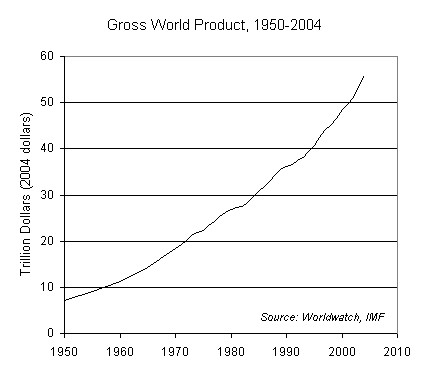
Figure Six: World Growth -- Sick, Sick, Sick...
Here is another:
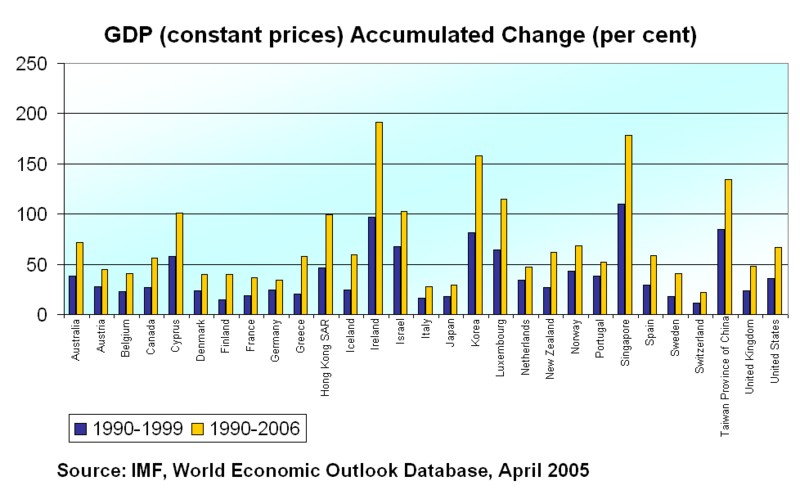
Figure Seven: Crises, Crises, Everywhere!
And, future prospects don't look too 'good', either:
"The International Monetary Fund's (IMF's) forecast for the growth of the global economy for the year has been raised. The IMF predicted a 4.9% global growth rate in April but has now revised this figure to 5.2% for both this year and the year to follow, based on the impact of several rapidly expanding economies worldwide.
"Central to the increased prediction is the accelerating growth seen in the Chinese, Indian, and Russian economies, which together represent over one half of the 5.2% global economic growth projected for this year. China alone has seen its growth forecast increase from 10% to 11.2%, making it the biggest factor in global economic growth, for the first time. The Eurozone area's growth estimate has increased from 2.3% to 2.6%." [Quoted from here. Some paragraphs merged.]
A leader in a recent edition of The Guardian newspaper poured even more cold water on the looming crisis in 'crisis' claims:
"It is becoming increasingly difficult to turn on the radio or television or open a newspaper without being deluged with evidence of an international crisis. Whether it is another City pundit spelling out the apocalyptic consequences of the sub-prime lending crisis in the US, fresh write-offs by investment banks, rogue trading in France or yet more evidence of a UK housing recession, the message is almost universally gloomy. Evidence of recession is everywhere except one place: the economic statistics themselves.
"Yesterday the National Institute, an independent research body, after considering the effects of the international crisis, cut its prediction for growth in the UK in 2008 from 2.2% in October to 2%. Hardly a crisis. In fact it would be a very happy outcome considering what is supposed to be happening around us. Remember, at both ends of the 1980s the UK suffered not a mild slowdown, but negative growth. The figure of 2%, according to the NI, is a shorthand way of saying there is a 75% chance of growth being in the range 1% to 3% and a 25% chance of it being outside that range. Either way, as the NI's Ray Barrell said on Radio 4's Today programme yesterday, 'there is no clear evidence that the economy is slowing down sharply'. John Kay, the independent-minded economist, hinted on the same programme that most of the media pundits these days were from the City and may be producing gloomy forecasts because that was a better way to pursuade (sic) the Bank of England to reduce interest rates, rather than complaining about falling profits....
"You might think from the headlines that there had been a collapse in house prices: yet the latest figures from Nationwide show that house prices in January were 4.2% above a year ago, or double the rate of consumer price inflation. It could equally well be reported as a continuing boom, albeit at a lower pace.
"Nor is there evidence of collapse elsewhere. The French and German economies are doing quite well and, for all the talk of recession in the US, the latest GDP figures show expansion of 0.6% in the fourth quarter of 2007 after 4.9% in the third quarter. That is getting close to an official recession (two successive quarters of negative growth) but it is not there yet and there is a stimulation package planned. As for the whole world, the IMF recently downgraded its forecasts and now expects global growth of 4.1%, with a warning that it could be worse because of 'financial market turmoil'. How much City woes will affect the real economy that the rest of us live in is unclear. For instance, there is evidence that US sub-prime borrowers are defaulting on mortgages (especially when they are higher than the property's value) rather than taking a hit on their credit cards as in earlier recessions. They are letting banks take the strain." [The Guardian, 02/02/2008, p.32. Quotation marks altered to conform with conventions adopted at this site.]
To be sure, there could be a slump around the corner [Callinicos (2007), Geier (2008)] -- indeed, Financial Markets across the world are decidedly jittery as this is being written (but read this, and Anonymous (2007)).
And if you are used to whistling in the dark, you are probably telling yourself this right now.
However, we can only keep "crying wolf" for so long before even we begin to smell a rat.
[Apologies for that mixed metaphor!]
Update 2010: Sure enough, the 'crisis' arrived, but since Dialectical Prophets have been predicting crisis after crisis for many years, they were always bound to be right sooner or later! However, as the boy who cried wolf eventually found out: Who now believes that Dialectical Economists know any more than Bourgeois Economists what is actually going on? Indeed, as we will see, there were several 'mainstream economists' who predicted this slump, and they did this without an ounce of 'dialectics' to slow them down.
[Several more comments about this latest 'crisis' can be found in Note 21a.]
Update January 2012: As Carchedi (2011) and Choonara (2009, 2011) have shown, there is as yet no generally accepted Marxist explanation of the 'crisis' that hit Capitalism four years ago, but then again there is no settled Marxist view of any of the crises that have hit capitalism since the late Eighteenth Century!
However, in the last year or so, the situation has been seriously aggravated by the 'debt crisis' in the Eurozone, which has prompted several governments imposing widespread and savage cuts in workers' living standards across Europe and, indeed, across the globe. Naturally, this has elicited a fierce reaction from workers in the UK, Spain, Italy, Greece, Portugal, and elsewhere. [On this, see Callinicos (2012), Kimber (2012), Hardy and Budd (2012), Durgan and Sans (2011), Webber (2011), Thomas and Loudos (2011), and Gasper (2011). See also here and here.]
Of course, as Lenin pointed out, if the working class is prepared to pay the price of this and any other crisis, the system can always recover.
Update November 2017: It looks like the world economy is slowly recovering (the international working class clearly having paid the price, although the Coronavirus Pandemic has seriously halted this recovery):
|
Region/Year |
2006 |
2007 |
2008 |
2009 |
2010 |
2011 |
2012 |
2013 |
2014 |
2015 |
2016 | 2017 | 2018 | 2019 | 2020 |
|
World Average |
5.4 |
5.6 |
3.1 |
-0.1 |
5.4 |
4.3 |
3.5 |
3.4 |
3.5 |
3.4 |
3.3 |
3.8 |
3.6 | 2.8 | -3.1 |
|
Advanced Economies |
3.0 |
2.7 |
0.1 |
-3.4 |
3.1 |
1.7 |
1.2 |
1.3 |
2.0 |
2.1 |
1.7 | 2.0 | 2.0 | ||
|
Eurozone |
3.2 |
3.0 |
0.4 |
-4.5 |
2.1 |
1.5 |
-0.9 |
-0.3 |
1.2 |
2.0 |
1.7 | 1.7 | 1.6 | ||
|
USA |
2.9 |
1.9 |
-0.1 |
-2.5 |
2.6 |
1.6 |
2.2 |
1.8 |
2.5 |
2.9 |
1.6 | 2.4 | 2.9 | ||
|
Developing Countries |
8.1 |
8.6 |
5.8 |
2.9 |
7.4 |
6.3 |
5.4 |
5.1 |
4.7 |
4.2 |
4.1 | 4.5 | 4.8 |
Table Two: Percentage Growth In World GDP, 2006-2017 (Source1, Source 2)
[The above Sources have stopped giving regional figures, so, clearly, I can't quote them!]
To be sure, this 'recovery' has been a-typically sluggish (the higher world growth figures of twelve or thirteen years earlier are now merely a fond memory), and the system is still experiencing serious problems, not the least of which is the dead weight of global debt --, which, according to one source, stands at 313% of world GDP, i.e., $233tn!. A more recent source (August 2018) puts it at $247tn, 250% of global GDP; but it is now quite obvious that the meltdown of global capitalism failed to materialise. Indeed, world GDP dipped only 0.1% in 2009, bouncing back with a 5.4% increase the following year. So, this was hardly a crisis of 1930s' proportions!
Of course, this isn't to minimise the seriousness of the near fatal problems that hit the Financial Sector in 2008-09, or the eye-watering amounts of money governments around the world found they had to throw at financial and banking institutions in order to 'rescue' them, but the plain fact is that (except in Greece) the economic crisis of 2008-10 was relatively minor compared to global calamity of the 1930s:
|
Indicator/Country |
USA |
UK |
France |
Germany |
|
Industrial Production |
-46% |
-23% |
-24% |
-41% |
|
Wholesale Prices |
-32% |
-33% |
-34% |
-29% |
|
Foreign Trade |
-70% |
-60% |
-54% |
-61% |
|
Unemployment |
+607% |
+129% |
+214% |
+232% |
Table Three: This Is What A Real Depression Looks Like;
Economic Indicators 1929-32 (Source)
On this, see Harman (2009b).
Update November 2014: The global economy appears to be heading toward yet another recession (although, anyone who actually believes a single economic forecast deserves all they get) -- but, it is worth adding that DM-theorists seem to be no more clued-in about its cause(s) (indeed, if it indeed has one such -- or many) than their bourgeois counterparts are.
Update January 2018: The above crisis failed to materialise; the World Bank now says that world growth has finally returned to pre-crisis levels (it has taken the best part of ten years!) -- projected to be 3.1% (later adjusted to 3.8%) in 2018. Although, as Joseph Choonara points out, world growth is still disappointing and patchy. [Choonara (2018).]
Update August 2018: A recent source has highlighted what appear to be growing signs of another impending recession -- which is to be expected since it is nearly ten years since the last one!
~~~~~~oOo~~~~~~
So, any DM-fans who are tempted to reach for Excuse Four should pause for thought -- and that thought should centre around one or both of the following considerations:
(1) Is there anything in the history of Dialectical Marxism to suggest dialecticians won't continue to screw up?
(2) Is it really too early to decide that Dialectical Marxism inspires about as much confidence as a drug addict's promises to quit?
[Recall, the above isn't meant to question the revolutionary character of the working class or throw doubt on the falling rate of profit. Far from it. It is to raise serious reservations over whether or not dialecticians should be trusted either with the further development of Marxist theory or with reversing the trend in workers' fading allegiance to Marxist politics. Or, indeed, whether workers will trust Dialectical Marxists ever again!]
Independently of the above, there is another nagging doubt: How do we know that 'Materialist Dialectics' is valid?
Not in the future, but right now?
An appeal to practice can't answer that question (as we have already seen); an appeal to yet more 'Materialist Dialectics' would be rather like feeding Strychnine to a patient recovering from Pneumonia (as we have also seen).
In fact, the only thing to which we can legitimately appeal is HM -- and to an HM stripped of all those consoling and contradictory phrases lifted from the confused writings of the Godfather Of Ersatz Opiates: Hegel.
Excuse 5: This Is All Far Too Simplistic
This isn't strictly speaking an excuse, it is more a way of rejecting the entire approach adopted in this Essay and at this site. The counter-argument often goes something like this:
History is far too complicated to reduce to neat formulas like these, that the alleged failure of Marxism can be put down to one cause, and one cause only, DM. Hence the alleged failure of Marxism has no bearing on the truth of DM.
In response, it is worth making the following points (yet again!):
(1) Nowhere is it being claimed that Dialectical Marxism has failed because of one cause, its adherence to a certain theory. I even added this comment to the opening page of this site:
It is important to emphasise from the outset that I am not blaming the long-term failure of Dialectical Marxism solely on the acceptance of the Hermetic ideas dialecticians have inherited from Hegel.
It is worth repeating this since I still encounter comments on Internet Discussion Boards, and still receive e-mails from those who claim to have read the above words, who still think I am blaming all our woes on dialectics. I am not.
However, no matter how many times I repeat the above caveat, the message will not sink in -- and this is after several years of continually making that very point!
It seems this is one part of the universe over which the Heraclitean Flux has no power!...
What is being claimed, however, is that adherence to this 'theory' is one of the subjective reasons why Dialectical Marxism has become a bye-word for failure.
There are other, objective reasons why the class enemy still runs the planet, but since revolutions require revolutionaries with ideas in their heads, this 'theory' must take some of the blame.
So, it is alleged here that dialectics has been an important contributory factor.
(2) Undoubtedly, historical events and processes are in general highly complicated and have no one single underlying cause, but one might well wonder what the point is of constantly being told that 'truth is tested in practice' if in the end that not only isn't being done, it hasn't ever been!
(3) Finally, I reject the neat formula that 'truth is tested in practice', but DM-supporters most certainly don't. So, if the truth of DM can't actually be tested in practice (or, rather, if DM is never allowed to be so tested by its fans), then it should be dropped. Either DM has had some role to play in the long-term failure of Dialectical Marxism (and has therefore been tested and now stands refuted), or truth is in no way tested in practice.
That seems to be a suitably ironic 'either-or' dilemma for DM-fans to ponder.
The Silence Of The Dialecticians
Truth is "tested in practice", so we are told, but, practice has faltered badly for much of the last 150 years.
[DIMs = Dialectical Marxists.]
So, what is the DIM response in general?
Easy: dialectics is a monumental success!
And, the evidence for that is, er..., um..., well..., er..., what?
Deathly silence...
Cue tumbleweed; cue rustling leaves; cue distant church bell...

Figure Eight: The Evidence Just Keeps Stacking Up...
Lenin's Theory Takes A Tumble
The, shall-we-say, shaky connection between dialectics and practice doesn't stop there. In the section of TAR that deals with Lenin's contribution to DM-epistemology, John Rees refers his readers to a passage that expresses Lenin's (avowed) attempt to counter something he [Lenin] called an "eclectic" tendency in the Bolshevik Party.
According to Lenin, this particular 'deviation' involved certain comrades -- to wit, Bukharin and Trotsky -- who supposedly viewed policy, strategy and tactics from disparate or disconnected angles, displaying an "on the one hand this, on the other that" frame-of-mind. In response, Lenin advocated the 'dialectical method' as a necessary corrective.
The flexibility this introduces would help prevent tactical "rigidity", so we are told. That is because it:
"Requires an all-round consideration of relationships in their concrete development but not a patchwork of bits and pieces." [Lenin (1921), p.90.]
It is at this point that Lenin comments about a hapless tumbler:
"A tumbler is assuredly both a glass cylinder and a drinking vessel. But there are more than these two properties and qualities or facets to it; there are an infinite number of them, an infinite number of 'mediacies' and inter-relationships with the rest of the world." [Ibid., pp.92-93.]
While Lenin went on to mention a handful of these interconnections, their "infinite number" means it is impossible to itemise them all -- as, indeed, Lenin admitted:
"[I]f we are to have true knowledge of an object we must look at and examine all its facets, its connections and 'mediacies'. That is something we cannot ever hope to achieve completely, but the rule of comprehensiveness is a safeguard against mistakes and rigidity….
"[D]ialectical logic requires that an object should be taken in development, in change, in 'self-movement' (as Hegel sometimes puts it). This is not immediately obvious in respect of such an object as a tumbler, but it, too, is in flux, and this holds especially true for its purpose, use and connection with the surrounding world." [Ibid., p.93. Italic emphasis in the original.]
However, as we are about to see, there are serious problems with the above comments, problems that threaten completely to undermine DM-epistemology.
An Abstract Theory Of Concrete Particulars
Lenin famously asserted:
"One of the basic principles of dialectics is that there is no such thing as abstract truth, truth is always concrete." [Lenin (1976), p.276.]
"[D]ialectical logic holds that 'truth is always concrete, never abstract', as the late Plekhanov liked to say after Hegel". [Lenin (1921), p.93.]
The obvious question is: Are the above true? Presumably, Lenin (and Leninists) would want to say they are. In that case, the next question quickly follows: Ok, but are they concrete? Answer: Hardly! They are abstract principles, par excellence. In which case, they can't be true --, since the first sentence tells us that "There is no such thing as abstract truth", and that "truth is always concrete." But, there is no way that "There is no such thing as abstract truth, truth is always concrete" is itself concrete.
Here are several attempts (made by those who like to use such terms) to tell us what they mean by "concrete", beginning with Hegel:
"To say 'This rose is red' involves (in virtue of the copula 'is') the coincidence of subject and predicate. The rose however is a concrete thing, and so is not red only: it has also an odour, a specific form, and many other features not implied in the predicate red. The predicate on its part is an abstract universal, and does not apply to the rose alone. There are other flowers and other objects which are red too. The subject and predicate in the immediate judgment touch, as it were, only in a single point, but do not cover each other.... In pronouncing an action to be good, we frame a notional judgment. Here, as we at once perceive, there is a closer and a more intimate relation than in the immediate judgment. The predicate in the latter is some abstract quality which may or may not be applied to the subject. In the judgment of the notion the predicate is, as it were, the soul of the subject, by which the subject, as the body of this soul, is characterised through and through." [Hegel (1975), p.237, §172. Bold emphases added.]
"It seems correct to begin with the real and the concrete…with e.g. the population…. However, on closer examination this proves false. The population is an abstraction if I leave out, for example, the classes of which it is composed. These classes in turn are an empty phrase if I am not familiar with the elements on which they rest…. Thus, if I were to begin with the population, this would be a chaotic conception of the whole, and I would then, by further determination, move toward ever more simple concepts, from the imagined concrete towards ever thinner abstractions until I had arrived at the simplest determinations. From there the journey would have to be retraced until I had finally arrived at the population again, but this time not as the chaotic conception of a whole, but as a rich totality of many determinations and relations…. The latter is obviously scientifically the correct method. The concrete is concrete because it is the concentration of many determinations, hence the unity of the diverse." [Marx (1973), pp.100-01.]
"The feature of such elementary ideas is that they have a concrete, sensuous content, because to them correspond objects directly perceptible to the senses.... Can we form ideas to which no directly perceptible object corresponds? Yes, of course, we can, and we do. For example, men are directly perceptible objects, and their properties of being tall, short, thin, fat, and so on, are directly perceptible properties. But we also think of men in terms other than these, although nothing directly evident to the senses corresponds to what we think about them....
"One needs only to point to a fat man, and someone running, and say 'I mean a man like that is doing that'. If, on the other hand one says 'The capitalist exploits the workers', one is still referring to certain familiar sensible objects (men), but one is at the same time making a generalisation about them which refers to a relationship between them which is not open to immediate observation but which requires a very elaborate definition in terms of other relationships. One cannot explain what one means by 'capitalist' and 'exploitation' in the same way as one can explain what one means by 'fat' and 'running'... It is to such ideas that the term 'abstract' is commonly applied." [Cornforth (1963), pp.58-60. Quotation marks altered to conform with the conventions adopted at this site. Bold emphases added, some paragraphs merged.]
"The abstract and the concrete. The concept of 'the concrete' is used in two senses. First, in the sense of something directly given, a sensuously perceived and represented whole. In this sense the concrete is the starting point of cognition. But as soon as we treat it theoretically the concrete becomes a concept, a system of scientific definitions revealing the essential connections and relations of things and events, their unity in diversity. So the concrete appears to us first in the form of a sensuously observable image of the whole object not yet broken down and not understood in its law-governed connections and mediations, but at the level of theoretical thought it is still a whole, but internally differentiated, understood in its various intrinsic contradictions. The sensuously concrete is a poor reflection of phenomena, but the concrete in thought is a richer, more essential cognition." [Spirkin (1983), pp.233-34. Italic emphases in the original; bold emphasis added.]
"In popular usage, the adjective 'abstract' often means 'vague' or 'removed from reality'. The sense in which the term is used here is different; an abstract concept, or an abstraction, isolates in thought a one-sided or partial aspect of an object. [In a footnote, Sayer adds 'My use of "abstract" and "concrete" is, I think, equivalent to Marx's' (p.277, note 3).] What we abstract from are the many other aspects which together constitute concrete objects, such as people, economics [I'm sure Sayer means economies here -- RL], nations, institutions, activities and so on. In this sense an abstract concept can be precise rather than vague; there is nothing vague about abstractions such as 'temperature', 'valency', 'gender', 'income elasticity of demand', or 'the circuit of money capital'. And the things to which these abstractions refer need be no less real than those referred to by concrete concepts. Hence the abstract and the concrete should not be aligned with the distinction between thought and reality.
"The concept of 'concrete objects' does not merely concern 'whatever exists' but draws attention to the fact that objects are usually constituted by a combination of diverse elements or forces. As a concrete entity, a particular person, institution or whatever combines influences and properties from a wide range of sources, each of which (e.g. physique, personality, intelligence, attitudes, etc.) might be isolated in thought by means of abstraction, as a first step towards conceptualizing their combined effect.
"In other words, the understanding of concrete events or objects involves a double movement: concrete → abstract, abstract → concrete. At the outset our concepts of concrete objects are likely to be superficial or chaotic. In order to understand their diverse determinations we must first abstract them systematically. When each of the abstracted aspects has been examined it is possible to combine the abstractions so as to form concepts which grasp the concreteness of their objects.
"Before proceeding it should be noted that not all concrete objects are empirically observable, nor are all abstract aspects of objects unobservable. Concept-dependent phenomena apart, they exist regardless of whether anyone happens to be able to observe or otherwise know them. Abstractions need not be seen as 'idealizations', nor are they merely heuristic devices for ordering observations. As concepts, abstractions are obviously different from material objects to which they may refer, but this applies to empirical observations and concrete concepts no less than to abstractions: all of them can refer to real objects...". [Sayer (1992), pp.87-88. Bold emphases alone added. Quotation marks altered to conform with the conventions adopted at this site. Link added. The page numbering is completely different in the Second Corrected Edition, i.e., Sayer (2010), pp.59-60]
"By 'concrete' we mean something real, but not something which is reducible to the empirical: we mean far more than just 'factual'. The concrete object is concrete not simply because it exists, but because it is a combination of many diverse forces or processes. In contrast, an abstract concept presents a one-sided or partial aspect of an object. For example, if we conceptualise an object such as a factory simply in terms of its outward appearance, the concept will be abstract in the sense of one-sided even though it refers to something which can be empirically observed. To make this a concrete concept we would have to specify all the relationships in which the factory is involved: with its workforce; its suppliers and buyers; its creditors and competitors, etc. These diverse determinations are not simply listed and 'added up', but are synthesised; that is, their combination qualitatively modifies each constituent element. However, in order to understand this combination, we normally have to isolate each element in thought first, even though they do not and sometimes could not exist in isolation in reality. It's important to note that whether the concrete is observable (and hence an empirical object for us) is contingent (i.e., neither necessary nor impossible). The concepts 'concrete' and 'empirical' are not equivalent." [Sayer (1981), p.123. Bold emphases alone added.]
[I have said much more about this topic in Essay Three Part One.]
From the above it is impossible to see how "There is no such thing as abstract truth, truth is always concrete" could itself be concrete. [If anyone thinks differently, I'd appreciate it if they'd contact me with some sort of an explanation.] In which case "There is no such thing as abstract truth, truth is always concrete" can't itself be true!
Be this as it may, Lenin certainly extolled the virtues of concrete analysis -- in, for example, the 'tumbler' passage we met earlier. However, what he had to say there is clearly abstract; that is, his comment involved generalisation, which is surely impossible to validate in this case. Indeed, how is it even conceivable that humanity will ever be able to validate the assertion that "All truth is concrete"? Especially in view of the fact that Lenin argued that in order for something to be considered concrete it would require the completion of an infinite epistemological enquiry or search. Even more perplexing: if it were possible to confirm the truth of the claim that "All truth is concrete", that would automatically refute it, in that it would involve confirming the truth of an abstraction, which, we have just been, told can't be true!
Of course, Lenin didn't even so much as gesture at making what amounted to a feeble attempt to confirm the truth of this abstraction of his; the testimony of Hegel and Plekhanov clearly being quite enough for him. In fact, Lenin made no attempt at all to substantiate his main point, that any randomly-chosen object is connected with everything in the entire universe (i.e., "the rest of the world"), or that it possesses what seems to be an infinite, or indefinitely large finite, number of "mediacies".
Strike that! The size of the above number is in fact infinite; that is confirmed by the following:
"'Fundamentally, we can know only the infinite.' In fact all real exhaustive knowledge consists solely in raising the individual thing in thought from individuality into particularity and from this into universality, in seeking and establishing the infinite in the finite, the eternal in the transitory…. All true knowledge of nature is knowledge of the eternal, the infinite, and essentially absolute…. The cognition of the infinite…can only take place in an infinite asymptotic progress." [Engels (1954), pp.234-35. Bold emphasis alone added; paragraphs merged.]
"Cognition is the eternal, endless approximation of thought to the object." [Lenin (1961), p.195.]
"Knowledge is the reflection of nature by man. But this is not simple, not an immediate, not a complete reflection, but the process of a series of abstractions, the formation and development of concepts, laws, etc., and these concepts, laws, etc., (thought, science = 'the logical Idea') embrace conditionally, approximately, the universal, law-governed character of eternally moving and developing nature.... Man cannot comprehend = reflect = mirror nature as a whole, in its completeness, its 'immediate totality,' he can only eternally come closer to this, creating abstractions, concepts, laws, a scientific picture of the world...." [Ibid., p.182. Bold emphasis alone added.]
"A tumbler is assuredly both a glass cylinder and a drinking vessel. But there are more than these two properties and qualities or facets to it; there are an infinite number of them, an infinite number of 'mediacies' and inter-relationships with the rest of the world." [Lenin (1921), pp.92-93. Bold emphasis added]
"Dialectics requires an all-round consideration of relationships in their concrete development…. Dialectical logic demands that we go further…. [It] requires that an object should be taken in development, in 'self-movement' (as Hegel sometimes puts it)…." [Ibid., p.90. Bold emphases added.]
That view isn't confined to the DM-classicists, either; here, for example, is Henri Wald:
"A 'concrete' truth is a logical system of abstractions multilaterally reflecting the real concrete. One truth is more concrete than another to the extent to which it reflects more essential traits of the investigated object. Concrete truth like absolute truth, can only be reached asymptotically ad infinitum." [Wald (1975), p.35. Quotation marks altered to conform with conventions adopted at this site. Italic emphases in the original.]
So, the above idea seems to be about as definitive a DM-thesis as, for example, the doctrine of change through 'internal contradiction'.
Be this as it may once more, none of those listening to Lenin (in the above meeting) challenged him -- that is if the record is to be believed --, which is especially puzzling since Lenin himself had declared that no scientific theory is a finished and complete article --, and, worse still, that all knowledge is "limited":
"Dialectical materialism insists on the approximate, relative character of every scientific theory of the structure of matter and its properties; it insists on the absence of absolute boundaries in nature, on the transformation of moving matter from one state into another." [Lenin (1972), p.312.]
"'Here once again we find the same contradiction as we found above, between the character of human thought, necessarily conceived as absolute, and its reality in individual human beings with their extremely limited thought. This is a contradiction which can only be solved in the infinite progression, or what is for us, at least from a practical standpoint, the endless succession, of generations of mankind. In this sense human thought is just as much sovereign as not sovereign, and its capacity for knowledge just as much un-limited as limited. It is sovereign and unlimited in its disposition..., its vocation, its possibilities and its historical ultimate goal; it is not sovereign and it is limited in its individual expression and in its realisation at each particular moment....'
"'Truth and error, like all thought-concepts which move in polar opposites, have absolute validity only in an extremely limited field, as we have just seen, and as even Herr Dühring would realise if he had any acquaintance with the first elements of dialectics, which deal precisely with the inadequacy of all polar opposites. As soon as we apply the antithesis between truth and error outside of that narrow field which has been referred to above it becomes relative and therefore unserviceable for exact scientific modes of expression; and if we attempt to apply it as absolutely valid outside that field we really find ourselves altogether beaten: both poles of the antithesis become transformed into their opposites, truth becomes error and error truth'.... Here follows the example of Boyle's law (the volume of a gas is inversely proportional to its pressure). The 'grain of truth' contained in this law is only absolute truth within certain limits. The law, it appears, is a truth 'only approximately'.
"Human thought then by its nature is capable of giving, and does give, absolute truth, which is compounded of a sum-total of relative truths. Each step in the development of science adds new grains to the sum of absolute truth, but the limits of the truth of each scientific proposition are relative, now expanding, now shrinking with the growth of knowledge." [Ibid., pp.150-51, quoting Engels (1976), pp.108-09, 114. The on-line and published translations are slightly different. Quotation marks altered to conform with the conventions adopted at this site. Bold emphases and link added.]
If no scientific theory is complete, then that must also be true of DM. Why then do DM-fans treat it as gospel truth, a mark of 'orthodoxy'? Especially when it falls apart so readily and enjoys so little, if not no, empirical support?
Why was this? If science and Bolshevism are supposed to be joined at the hip, as it were, one would have thought that someone should have asked Lenin how he could possibly know all this about an innocent glass beaker. How could Lenin possibly know that all objects are inter-related in the way he alleged -- or, that their connections are infinite in number (or even bigger than, say, 10100000)?22
More puzzling still: Why on earth does DL require it if it is indeed a fact?
Do scientists require light to be a wave/stream of photons, or demand that Copper conducts electricity?
Independently of the above rather 'academic' considerations, a more pressing question for revolutionaries to consider, surely, is whether or not Lenin's methodological criteria are at all practicable. Is it even sensible to take everything (or even most things) into consideration before any course of action is contemplated, let alone carried out? As should seem obvious to anyone who has ever had to make a decision, it is impossible to take Lenin seriously here. His advice wouldn't actually prevent rigidity, as had been its stated aim; on the contrary, it would encourage endless prevarication, and hence suicidal inaction.
Consider the following unlikely (and fictional!) scenario: In late 1917, when Lenin was pressing the case for an insurrection, on the night before the decisive move, couldn't a rather confused comrade have argued as follows?
"Comrade Lenin is being presumptuous and dogmatic -- his analysis will undoubtedly lead to serious mistakes. We can't stage the action he suggests until we have first of all considered its connections with everything in the universe, as he himself recommends.
"In that case, I suggest we wait until we have received all the data from the recent study of Proxima Centauri, the report on the latest archaeological dig in Luxor, the total height and weight of comrade Bukharin's ancestors (initially stretching back at least 250,000 years), the detailed report on the mating habits of Stag Beetles in the UK (in August 1609), the average length of every wombat born in the Southern Hemisphere in the last ten thousand two hundred and fifty-five years, ten months, three days, twelve hours, ten minutes and 34.75 seconds, a comprehensive analysis of the dietary habits of Mohawk Indians in the early spring of 1636, the exact distance between the centres of mass of Sirius and Betelgeuse (measured to the nearest yoctometre) at precisely 23:15:42.55 on 25 of June 1406, the result of the three thirty at Belmont…".
Of course, such an intervention would have been regarded as completely crazy, and would rightly have been laughed off as totally ludicrous, possibly deranged. But -- and this is the point --, it could only be repudiated by those who disagreed with Lenin's advice about the absolute necessity of taking into account the connections everything has with the rest of the universe before anything is undertaken -- and that includes proposed insurrections.
The Relevance Of Relevance
Clearly, the 'intervention' above was farcical because it raised issues that were patently irrelevant to the matter-in-hand. But, Lenin didn't mention relevance. Comrades who doubt this might like to re-check what Lenin actually said about that tumbler, and everything else, to see if they inadvertently missed that particular word the first time around:
"A tumbler is assuredly both a glass cylinder and a drinking vessel. But there are more than these two properties and qualities or facets to it; there are an infinite number of them, an infinite number of 'mediacies' and inter-relationships with the rest of the world…. [I]f we are to have true knowledge of an object we must look at and examine all its facets, its connections and 'mediacies'. That is something we cannot ever hope to achieve completely, but the rule of comprehensiveness is a safeguard against mistakes and rigidity…." [Lenin (1921), pp.92-93. Bold emphases added; paragraphs merged.]
Clearly, the word "relevant" appear nowhere in this passage; Lenin failed to mention it. Nor is it implied, which was the point of this remark: "That is something we cannot ever hope to achieve completely...."
And, as if to make things worse, Lenin didn't regard this as an optional extra:
"[D]ialectical logic requires that an object should be taken in development, in change, in 'self-movement' (as Hegel sometimes puts it). This is not immediately obvious in respect of such an object as a tumbler, but it, too, is in flux, and this holds especially true for its purpose, use and connection with the surrounding world." [Ibid., p.93. Bold emphasis alone added]
"Dialectics requires an all-round consideration of relationships in their concrete development…. Dialectical logic demands that we go further…. [It] requires that an object should be taken in development, in 'self-movement' (as Hegel sometimes puts it)…." [Ibid., p.90. Bold emphases added.]
Clearly, according to Lenin, DL "requires", or "demands", such an infinitary checking process. Moreover, no subsequent Leninist has even so much as tried to correct Lenin on this point; hence, it seems that every Leninist (present author excepted, of course) agrees that this isn't an optional extra. it is a core idea.
Furthermore, had Lenin mentioned relevance it would have made his other comments rather pointless. Why, for example, insist that consideration must be given to the infinite connections that every object and process allegedly has -- that this was a "demand" and a "requirement" that can't be side-stepped -- if the overwhelming majority of them are totally irrelevant and should therefore be ignored?
"[I]f we are to have true knowledge of an object we must look at and examine all its facets, its connections and 'mediacies'." [Ibid. Bold emphasis added.]
Lenin didn't say we "must" examine most of an object's facets, connections and "mediacies", nor yet just 10%, but "all" of them.
However, let us suppose for the moment that relevance is implicit in what Lenin said, and that no reasonable interpretation of his words would conclude otherwise -- even though Lenin said it was a "demand" and a "requirement" that every connection should be taken into consideration! Even then, this wouldn't solve the problems the above passage presents. For example, who is to decide what counts as relevant? As seems clear, it would always be open to comrade, NN, to accuse fellow comrade, MM, of "rigidity" if the former's set of 'relevant connections' was more inclusive than the latter's.
And, these annoying difficulties don't stop there. Extending the picture: As the circle of relevant considerations is allowed to increase, the number of borderline cases (each of which would now surely become the occasion for further accusations of "rigidity", if they were to be ignored) will increase even more rapidly.
That claim is based on the observation that if borderline cases of relevant/non-relevant considerations are to be found anywhere, they will occur along the outer margin of these ever-expanding 'circles' of interconnections (if we extend this metaphor a little), as the links that each non-"rigid" comrade is actively considering are expanded 'outwards'. Since these regions of relevant/non-relevant considerations are in effect 'annular rings', their areas will increase in direct proportion to the square of the difference between the radii of the surrounding circles. Plainly, this means that as the supposed interconnections widen, borderline cases of 'relevance' will increase even faster, being proportional to the square of the aforementioned radial differences.

Figure Nine: Annular Ring Showing The Many 'Irrelevant' Interconnections
That 'Rigid' Comrades Might Foolishly Ignore
Given Lenin's analogy, this would mean that the more interconnections a given comrade includes -- in order to lower his or her 'non-rigidity coefficient', as it were, he/she will have to increase the radius of the inner of the two surrounding circles, thereby also increasing the radius of the outer circle (otherwise the area of this outer ring will decrease to zero, meaning there would now be no irrelevant facts!) --, the more (i.e., squared more!) borderline cases there will be for them to have to ignore because of issues of relevancy, or, indeed, because of time constraints.
In which case, the charge of "rigidity" would become increasingly applicable as greater numbers of such borderline cases were progressively ignored because of their alleged irrelevance. So, the less 'rigid' a comrade appeared to be (because they had taken more such borderline facts into consideration than perhaps anyone else), the more 'rigid' they would in fact become (since they will have to ignore (squared) more borderline cases in this ever expanding ring); the more anyone heeds Lenin's advice, the more "rigid" they would automatically appear to be! Plainly, that is because (of necessity) they would have to ignore a much larger number of borderline cases than would any other comrade who rejected Lenin's advice and who incorporated fewer connections in their analysis on the basis of stricter 'relevancy' clauses -- or face the prospect of taking into consideration every borderline case, no matter how far removed from the centre they proved to be, stretching off into infinity(!) -- and, of course, because of the reasonable demands of "sound common sense".
Indeed, if the two-dimensional concentric circles mentioned above are replaced by three-dimensional concentric spheres (which is a more realistic image of the all-round development of knowledge, one would have thought), the situation would become even worse. Here, the volume of each annular shell containing the next set of controversial 'irrelevances' would increase in proportion to the cube of the difference in their radii. [There is a pictorial illustration of the three-dimensional example in Note 23.]23
And, if we hit this 'problem' with all our metaphorical might, and move into n-dimensional 'knowledge space' (which option we could only exclude if we, too, want to be accused of "rigidity", even here!), the situation would be worse still, and to the nth power!
Hence, the wider we expand the circle of relevant considerations, the faster borderline cases will stack up, only to be ignored -- perhaps by the next allegedly "rigid" comrade in line. Ironically, the more Lenin's advice is taken -- and the wider the 'relevancy net' is cast -- the greater this 'rigidity' will become, as ever-increasing numbers of marginal cases pile up that have to be omitted on grounds of alleged "irrelevance".
Wags might even call this "the law of increasing marginal returns".
Now, it surely goes without saying that tactical inflexibility is a luxury revolutionaries will only ever 'live' to 'enjoy' the other side of a failed revolution! Even so, it is possible to ignore Lenin's advice without implying any such rigidity. Indeed, if revolutionaries had to spend an infinite (or even a large finite) amount of time considering everything before they did anything, they would of course do nothing, rigidly or non-rigidly. That doesn't mean revolutionaries shouldn't take relevancy into account. But Lenin's structures would completely undermine any such approach, as we have just seen.
This means that we would be well-advised to base revolutionary activity on criteria that are far less suicidally impractical than those proposed by Lenin. Indeed, as noted above, his suggestion invites hyper-prevarication as more 'inclusive' (i.e., less "rigid") comrades introduced ever more obscure "mediacies", which must be considered first before any given action is contemplated (a tactic taken to the extreme by the confused comrade mentioned earlier). And this would surely happen unless tactical deliberations were hedged about with endlessly controversial and increasingly recondite relevancy/irrelevancy clauses. Naturally, no revolutionary in his or her left mind would do this, or even contemplate doing it. In practice, activists rightly ignore Lenin's criteria -- advice not even he could have followed.
Small wonder then that there is no evidence he ever did.24
Reductionism -- Or 'Inflationism'?
Surprising as it might seem, Lenin's comments (recorded above) are also connected with 'reductionism'.
John Rees and DM-theorists in general invariably depict reductionism in negative terms, while DM-holism is offered as up an effective bulwark against it.25 For example, the part/whole relation is often depicted in the following way:
"One important point to note about this approach is that it is, by its very nature, opposed to reductionism." [Rees (1998), p.5.]
That is because it:
"…presupposes the parts and the whole are not reducible to each other. The parts and the whole mutually condition, or mediate, each other. And a mediated totality cannot form part of a reductionist philosophy because, by definition, reductionism collapses one element of a totality into another without taking account of its specific characteristics." [Ibid., pp.8-9.]
The validity (or otherwise) of Rees's argument isn't of immediate concern here (however, it will be in Essays Eleven Part Two and Three Part Three), but his attempt to counterpose his own approach to what has been called "CAR" -- an alternative which involves something that is perhaps more accurately to be re-labelled, "Hegelian Expansionism" [henceforth, HEX], but which others call "Inflationism" --, is.26
[CAR = Cartesian Reductionism; follow the link for an explanation.]
Now, several consequences of a HEX-like methodology were outlined in the passages from Lenin and Engels quoted earlier:
"'Fundamentally, we can know only the infinite.' In fact all real exhaustive knowledge consists solely in raising the individual thing in thought from individuality into particularity and from this into universality, in seeking and establishing the infinite in the finite, the eternal in the transitory…. All true knowledge of nature is knowledge of the eternal, the infinite, and essentially absolute…. The cognition of the infinite…can only take place in an infinite asymptotic progress." [Engels (1954), pp.234-35. Bold emphasis alone added; paragraphs merged.]
"Cognition is the eternal, endless approximation of thought to the object." [Lenin (1961), p.195.]
"A tumbler is assuredly both a glass cylinder and a drinking vessel. But there are more than these two properties and qualities or facets to it; there are an infinite number of them, an infinite number of 'mediacies' and inter-relationships with the rest of the world." [Lenin (1921), pp.92-93.]
"Dialectics requires an all-round consideration of relationships in their concrete development…. Dialectical logic demands that we go further…. [It] requires that an object should be taken in development, in 'self-movement' (as Hegel sometimes puts it)…." [Ibid., p.90. Bold emphases alone added.]
Which was, of course, a mystical dogma propound by Hegel (and I can only wish the reader 'Good luck! trying to get her head around this gobbledygook):
"The truth is the whole. The whole, however, is merely the essential nature reaching its completeness through the process of its own development. Of the Absolute it must be said that it is essentially a result, that only at the end is it what it is in very truth; and just in that consists its nature, which is to be actual, subject, or self-becoming, self-development. Should it appear contradictory to say that the Absolute has to be conceived essentially as a result, a little consideration will set this appearance of contradiction in its true light. The beginning, the principle, or the Absolute, as at first or immediately expressed, is merely the universal. If we say 'all animals', that does not pass for zoology; for the same reason we see at once that the words absolute, divine, eternal, and so on do not express what is implied in them; and only mere words like these, in point of fact, express intuition as the immediate. Whatever is more than a word like that, even the mere transition to a proposition, is a form of mediation, contains a process towards another state from which we must return once more. It is this process of mediation, however, that is rejected with horror, as if absolute knowledge were being surrendered when more is made of mediation than merely the assertion that it is nothing absolute, and does not exist in the Absolute." [Hegel (1977), p.11; section 20. Bold emphases added. Quotation marks altered to conform to the conventions adopted at this site.]
So, HEX holds out the prospect of an infinite task ahead of anyone rash enough to take it seriously. HEX-type investigations proceed in the opposite direction to those taken by CAR-like enquiries -- that latter of which are intimately connected with reductionism itself. Among the avowed aims of reductionism are the following: (i) The re-description the properties of objects and processes in terms of their more basic (perhaps elementary) parts, and (ii) Accounting for the latter with as few laws as possible.26a
Now, the problem with reductionism is that while it is possible to make some sort of a start, it isn't possible to bring it to an end. [Why that is so won't be entered into here.] By way of contrast, the situation with HEX is much worse. While it is also impossible for HEX to reach a conclusion (since it is avowedly infinitary), it can't in fact begin. The reason for saying that is bound up with the fact that instead of seeking increasingly fundamental units, HEX-theorists aim to discover ever wider, more involved and inclusive connections, all of which must be explored before any attempt to depict the "specific characteristics" of anything in particular can even begin. [On that, see Essays Three Part One, and Eleven Part Two.]
This, of course, stops the dialectical roller-coaster in its tracks because no element in this metaphysical wild goose chase is ascertainable before all the rest have been -– meaning, of course, that none ever will be. Since one half of this open-ended meander through endless epistemological space involves the completion of an infinite (or endless) task, neither option is viable. Therefore, the entire process can't end, and it can't even begin.
Consider an attempt to say something 'concrete' about a given object, designated by "A":
D1: A is F(1).
D2: A is G(1).
[Where "F(1)" stands for a predicable that expresses at least one of A's 'mediacies', and where "G(1)" stands for a predicable or relational term (depending on one's philosophical logic) that expresses at least one of A's inter-connections. The reason for the numbering will soon become apparent. A predicable is an expression that becomes a predicate when it is actually used in a proposition/sentence.]
But, according to Lenin's requirement that we should take into consideration every 'mediacy' and interconnection before we can know anything concrete about an object, D1 and D2 must be modified, perhaps along the following lines:
D3: A is also F(2), and F(3), and F(4),..., and F(n).
D4: A is also G(2), and G(3), and G(4),..., and G(m).
[Where "F(k)" stands for a predicable that expresses at least one of A's 'mediacies', and n is indefinitely, possibly infinitely, large -- and "G(k)" stands for a predicable or relational term that expresses at least one of A's interconnections, and m is indefinitely, possibly infinitely, large.]
But, we don't yet know what F(2) or G(2) are, at least in 'concrete' terms. So, again, according to Lenin's requirement that we should take into consideration every 'mediacy' and interconnection before we can know anything concrete about an object (or, indeed, anything), D3 and D4 must be modified, perhaps along the following lines:
D3: F(2) is also H(1), and H(2), and H(3),..., and H(n).
D4: G(2) is also J(1), and J(2), and J(3),..., and J(m).
[Where "H(k)" stands for a predicable that expresses at least one of F(2)'s 'mediacies', and n is indefinitely, possibly infinitely, large; and "J(k)" stands for a predicable or relational term that expresses at least one of G(2)'s interconnections, and m is indefinitely, possibly infinitely, large.]
And so on, forever...
[The above obviously takes a few liberties with logical syntax, in that it uses predicate expressions as subject terms, but, as we saw in Essays Four Part One and Eight Part Three, DM-theorists should be the last ones to lodge that complaint given the fact that they mix such things up all the time.]
It takes very little non-dialectical logic (and even less common sense) to see that with this off-the-wall approach to 'logic' we wouldn't know anything at all. Nothing would be 'informative' since we couldn't say anything about anything until everything had been ascertained about it.
According to DM, since the entire nature of the part is determined by its relation to the whole -- and vice versa --, and since we do not and never will know the whole, we can't and never will know the part.
HEX-theorists themselves admit that their approach delivers only "partial" truths (at best). To be sure, the latter are supposed to edge humanity ever-closer to "absolute truth" (when tested in practice). Nevertheless, the infinitary (or endless) nature of the task ahead of them completely undermines the whole exercise. Each element in the Totality in effect lies at the centre of a set of 'concentric circles' (or 'spheres', if we move into a metaphorical 'third dimension', once more) with infinitely expanding regions of ever-broader interconnections and 'mediacies' stretching outward from that centre. [As we saw earlier.]
Unfortunately, the indefinite expansion of the radii of each of these circles of "partial knowledge" would have no discernible effect on the remaining level of ignorance about any particular object (or, indeed, anything whatsoever) caught in the dialectical-machinery. That is because the difference between a large finite number of facts (representing the current state of "partial knowledge") and the infinite number of facts constituting "Absolute" knowledge, is itself infinite.
If a finite cardinal of arbitrary size is subtracted from the smallest transfinite cardinal, the latter remains the same size (always assuming, of course, that post-Cantorian cardinal number theory is itself correct -- I will pass no comment on that here).
Hence, the following would be true (for arbitrarily large, finite n):
|
Ào - 10n = Ào |
[Unfortunately, Mozilla Firefox has replaced the relevant symbol (Aleph Zero) with an inflected Ao! It can be read correctly using Internet Explorer, Edge, or Google Chrome.]
So, even if humanity accumulated knowledge (in terms of facts, 'mediacies', connections, or theories) comparable to that depicted by the real number above (i.e., the power of ten), the difference between that number and the smallest 'infinite' cardinal would itself be infinite.27
["Ào" (pronounced aleph zero) is the 'smallest' transfinite cardinal, so we are told.]
As we have seen, Engels concurred with Lenin:
"'Fundamentally, we can know only the infinite.' In fact all real exhaustive knowledge consists solely in raising the individual thing in thought from individuality into particularity and from this into universality, in seeking and establishing the infinite in the finite, the eternal in the transitory…. All true knowledge of nature is knowledge of the eternal, the infinite, and essentially absolute…. The cognition of the infinite…can only take place in an infinite asymptotic progress." [Engels (1954), pp.234-35. Italic emphasis in the original; paragraphs merged.]
But, this means that no matter how far science advances humanity would still be no nearer "absolute knowledge" than it is at present, or than it was 20,000 years ago. In that case, clearly, the "asymptotic progress" metaphor is a highly (i.e., an infinitely) misleading picture of the progress of scientific knowledge.
[On that, see the next sub-section.]
In the final analysis, therefore, DM possesses its own version of Kant's unknowable Noumenon -– albeit one that has been given a temporal twist, kicked down the road and projected into the 'infinite' future.
To repeat a point made earlier: according to DM, since the entire nature of the part is determined by its relation to the whole -- and vice versa --, and since we do not, and never will know the whole, we can't, and never will know the part. In which case, Engels should have said (rather like the character, Manuel, from Fawlty Towers): "Fundamentally, we know nothing" -- or, "Fundamentally, we are infinitely ignorant".
Videos Six And Seven: 'Dialectical' Manuel Confesses All
In which case, there seems to be little point bragging about the ability of DM to penetrate to the heart of reality -- or even the claim that it enables its adepts to grasp the "thing-in-itself" -- if it now emerges that episodes of hyper-inflated dialectical-bravado like this have to be postponed forever.
Hence, if the road to 'Epistemological Nirvana' is paved with such god-like intentions, human ignorance will always remain infinite.27a
Engels's Divergent 'Realism'
Again, the process of 'increasing knowledge' was also summarised for us by Engels in the following way:
"The identity of thinking and being, to use Hegelian language, everywhere coincides with your example of the circle and the polygon. Or the two of them, the concept of a thing and its reality, run side by side like two asymptotes, always approaching each other but never meeting. This difference between the two is the very difference which prevents the concept from being directly and immediately reality and reality from being immediately its own concept. Because a concept has the essential nature of the concept and does not therefore prima facie directly coincide with reality, from which it had to be abstracted in the first place, it is nevertheless more than a fiction, unless you declare that all the results of thought are fictions because reality corresponds to them only very circuitously, and even then approaching it only asymptotically." [Engels to Schmidt (12/03/1895), in Marx and Engels (1975), p.457. Italic emphasis in the original.]
Reading between the lines here it is quite clear that Engels himself sort of half understood the implications of what he was saying: this approach to knowledge in fact undermines itself since human beings will forever remain infinitely ignorant of everything, and thus of anything (by the Wholist principle, outlined earlier), including these claims themselves!
In the face of this, as elsewhere, Engels's reaction is instructive: he just ignored the problem, even though, on this view, no matter how much human beings might like to think they know about anything, that supposition itself would advance them not one nanometre closer to the Holy Grail of 'Absolute Knowledge' about that 'anything', or, indeed, 'everything'.
Nevertheless, even this way of depicting things is misleading. The idea of an asymptotic approach in mathematics is connected with the concept of a limit -- if, and this is a crucial point, the limit concerned can be shown to exist. But, if a given series has no limit, or can't be shown to have a limit, then no set of its partial sums can in fact "approach" anything at all. Such a series is said to be divergent, not convergent. But, Engels's argument depends on knowledge converging on a limit which he manifestly neglected to show exists.
[Yes, I know that mathematicians have 'shown' that certain divergent series, those that are Cesàro summable, do 'have a sum', but this area of mathematics is controversial and it is far from clear that it will be of any help to Engels. That is because these series produce notoriously paradoxical and ridiculously implausible results -- such the following: 1 + 2 + 3 + 4 + 5 +... = -(1/12) -- no misprint! If any DM-fans want to go down that route, I can only wish them good luck.]
Moreover, and as far as can be ascertained, not one single DM-theorist (even those who are familiar with mathematics and logic, or who are competent mathematicians) has noticed this fatal defect in Engels's 'theory'/metaphor, let alone attempted to resolve it.28
Naturally, this means that the asymptotic approach metaphor is either completely misguided, or it is inimical to DM-epistemology itself. One or both of those is clearly the case. Either that, or Engels knew there was a limit, constructed it, but forgot to write the proof in the margin of the above letter -- a bit like Pierre Fermat, perhaps.
However, before anyone hurries off in search of the proof of 'Engels's Last Theorem', it might be far wiser for them to conclude that this claim is just another example of Engels's fondness for such a priori and dogmatic approaches to knowledge -- for instance, that there is indeed such a limit, or that humanity is endlessly approaching it --, a dogma ultimately derived from the HEX-pert himself, Hegel, and one that has been dutifully and uncritically swallowed by generations of the DM-faithful ever since.
In that case, another annoying dialectical inversion now confronts DM-fans: human knowledge is not, in fact, asymptotically convergent on an absolute limit, it is divergent. Worse still, in this part/whole DM-system -- where the nature of each part is completely conditioned by the whole (and vice versa) -- what is known about anything is also qualified, or limited, by what is not. If that is so, what little is 'known' implies that human beings will forever remain trapped in a bottomless pit of infinite ignorance -- even supposing we could assert that much with any confidence, which, if HEX were correct, we couldn't!
This means that the sum total of what we now 'know' about the "specific characteristics" of any part of the Whole is overwhelmingly outweighed by the black hole of infinite ignorance around which humanity must forever orbit, and whose grip we can never shake off. Given HEX, this dark pool of ignorance will never evaporate, diminish, dissipate or vanish.
It might be objected to the above that a function might map results that could then lie asymptotically close to a limit in one sense, but infinitely distant from it in another. For example, the graph of y = 1/x lies close to, but still infinitely far from, the x-axis, when, say, x = 1 x 10100000000000, also given that the function maps the output value closer to that axis as x→+∞.
However, as pointed out above, that analogy only works if the limit can be shown to exist (as x→+∞, and y→0). Once again, Engels failed to demonstrate this with respect to the 'limit' implied by his metaphor.
It could be countered that it is reasonable to assume there is a limit toward which human knowledge is tending. However, if Engels is to be believed, then that assumption will itself be infinitely far from the truth, which because of that means that belief stands an infinite probability of being false.
Again, it could be argued that certain iterative functions in mathematics might yield infinite sequences, and yet that doesn't mean that the distance between any intermediate value given by partial sums of that function and the point toward which it is converging is itself infinite. For example, the sequence: 1 + 1/2 + 1/4 + 1/8 +...+ 1/2n-1 converges on 2 (as n→+∞), and yet none of the rational numbers (formed from the partial sums of this series) is infinitely far from 2.
That isn't correct (the mathematical distance between any two rational numbers is itself infinite), but even if it were incorrect, the above would have been an effective response had Engels bothered to prove that the limit he claimed exists (implied by the asymptote metaphor) actually does exist. But since he didn't, it isn't.
The only way the sceptical conclusion reached in this Essay can be neutralised would be to deny that the search for 'Absolute Knowledge' is in any way infinitary. Clearly, that would place a condition on the object of knowledge before we knew what it was!29
But, given what Engels and Lenin said, that denial itself would be infinitely far from the truth, and would thus carry with it an infinite probability that it, too, is false!
And that is why HEX can't begin. Given HEX, which implies we are infinitely ignorant of every element in the Totality until we know everything about everything, we are clearly in no position to assert anything about anything with any degree of confidence; and if the above metaphor is correct, we may only do so with a confidence level close to zero! Whatever is said about any object or process has an infinitely high probability of being completely wrong, given the great "cloud of unknowing" that forever surrounds everything. That would be true even concerning the humblest of objects found in this fathomless Whole -- such as that tumbler (again, always supposing we could assert even that much!).
[I hasten to add that I don't accept this sceptical conclusion; the point of the exercise was to show that DM collapses into scepticism thanks to HEX.]
There is little point directing our attention to what we know already, since, on this view, not only would we know nothing about anything, we would be infinitely and permanently ignorant of everything. But, if nothing said about any object is even remotely correct (indeed, on this view, if it is 'infinitely' incorrect), then any reference to 'it' will itself surely be problematic. In fact, given this bleak view, each putative 'it' might not in fact be an 'it', since, of course, any assertion that 'it' was indeed an 'it' must itself be infinitely wide of the mark!
And yet, this is the Dialectical Mangle into which Engels and Lenin happily fed Marxism!30
It could be objected here that if we begin with the naïve beliefs of the common man or woman (indeed, as Lenin himself suggested) then we would have a secure basis from which to begin our search for more accurate, or even increasingly complete, knowledge:
"Our sensation, our consciousness is only an image of the external world, and it is obvious that an image cannot exist without the thing imaged, and that the latter exists independently of that which images it. Materialism deliberately makes the 'naïve' belief of mankind the foundation of its theory of knowledge." [Lenin (1972), p.69; cf., p.279. Emphases in the original. Quotation marks altered to conform with conventions adopted at this site.]31
But, given Engels's 'asymptotic approach' metaphor, this response stands no chance of being correct itself. Unless we possessed the entire truth about something as insignificant as a tumbler, for example, we could only assert with infinite lack of confidence that there was indeed just such a set of truths about, or "mediacies" relating to, 'it' --, or, to anything else for that matter. Indeed, statements about the naive beliefs of mankind themselves are also infinitely far from the truth, and hence stand an infinite probability of also being false.
And, as far as Engels's metaphor itself is concerned, we are certainly in no position to conclude that humanity is approaching a single unified limit, as opposed to countless thousands of limits, or none at all, about anything --, or, indeed, whether human knowledge isn't catastrophically diverging to infinity.
It could be objected that we must be getting some things right about the world, otherwise the human race would have died out tens of thousands of years ago. However, even this claim (that humanity has actually survived) has a infinitely high probability of being false, too, if Lenin and Engels are be believed.
Unfortunately, as noted above, if Lenin is to be believed, then (i) All we would have available to us (as a basis for knowledge) are "images", and hence (ii) We have no way of knowing, or even showing, that these "images" aren't just figments of the imagination. This means that the "survival" argument (i.e., that humanity must have got some things right or they wouldn't have survived) is no help at all. That is because, and once again, if Lenin were right, all we would have are "images" of the survival of an "image" of the human race!
"All knowledge comes from experience, from sensation, from perception. That is true. But the question arises, does objective reality 'belong to perception,' i.e., is it the source of perception? If you answer yes, you are a materialist. If you answer no, you are inconsistent and will inevitably arrive at subjectivism, or agnosticism, irrespective of whether you deny the knowability of the thing-in-itself, or the objectivity of time, space and causality (with Kant), or whether you do not even permit the thought of a thing-in-itself (with Hume). The inconsistency of your empiricism, of your philosophy of experience, will in that case lie in the fact that you deny the objective content of experience, the objective truth of experimental knowledge." [Lenin (1972), p.142. Bold emphasis alone added.]
"For instance, the materialist Frederick Engels -- the not unknown collaborator of Marx and a founder of Marxism -- constantly and without exception speaks in his works of things and their mental pictures or images..., and it is obvious that these mental images arise exclusively from sensations. It would seem that this fundamental standpoint of the 'philosophy of Marxism' ought to be known to everyone who speaks of it, and especially to anyone who comes out in print in the name of this philosophy.... Engels, we repeat, applies this 'only materialistic conception' everywhere and without exception, relentlessly attacking Dühring for the least deviation from materialism to idealism. Anybody who reads Anti-Dühring and Ludwig Feuerbach with the slightest care will find scores of instances when Engels speaks of things and their reflections in the human brain, in our consciousness, thought, etc. Engels does not say that sensations or ideas are 'symbols' of things, for consistent materialism must here use 'image,' picture, or reflection instead of 'symbol,' as we shall show in detail in the proper place." [Ibid., pp.32-33. Bold emphases added. Quotation marks altered to conform with the conventions adopted at this site.]
"[S]ensation is an image of the external world...." [Ibid., p.56. Bold emphasis added.]
"Our sensation, our consciousness is only an image of the external world…." [Ibid., p.69. Bold emphasis alone added.]
"The doctrine of introjection is a muddle, it smuggles in idealistic rubbish and is contradictory to natural science, which inflexibly holds that thought is a function of the brain, that sensations, i.e., the images of the external world, exist within us, produced by the action of things on our sense-organs." [Ibid., p.95. Bold emphasis added.]
"The sole and unavoidable deduction to be made from this -- a deduction which all of us make in everyday practice and which materialism deliberately places at the foundation of its epistemology -- is that outside us, and independently of us, there exist objects, things, bodies and that our perceptions are images of the external world." [Ibid., p.111. Bold emphasis added.]
"Thus, the materialist theory, the theory of the reflection of objects by our mind, is here presented with absolute clarity: things exist outside us. Our perceptions and ideas are their images." [Ibid., p.119. Bold emphasis added.]
"For the materialist the 'factually given' is the outer world, the image of which is our sensations." [Ibid., p.121. Bold emphasis added. Quotation marks altered to conform with the conventions adopted at this site.]
"[S]ense-perception is not the reality existing outside us, it is only the image of that reality." [Ibid., p.124. Bold emphases alone added.]
Notice that Lenin
argued that: "All knowledge comes from experience, from sensation,
from perception." And we have already been told that "Our sensation, our consciousness is only an
image of the external world...."
So, if all knowledge comes from sensation, and sensation is an 'image' of the world, the only conclusion possible is that all we have available to us as a basis for knowledge, according to Lenin, are 'images'.
And, it is no good appealing to practice, either, or even to "commonsense" -- or, indeed, to "experience" --, as Lenin attempted to do:
"Verification of these images, differentiation between true and false images, is given by practice." [Ibid., p.119. Bold emphasis added.]
"The 'naïve realism' of any healthy person who has not been an inmate of a lunatic asylum or a pupil of the idealist philosophers consists in the view that things, the environment, the world, exist independently of our sensation, of our consciousness, of our self and of man in general. The same experience (not in the Machian sense, but in the human sense of the term) that has produced in us the firm conviction that independently of us there exist other people, and not mere complexes of my sensations of high, short, yellow, hard, etc. -- this same experience produces in us the conviction that things, the world, the environment exist independently of us. Our sensation, our consciousness is only an image of the external world, and it is obvious that an image cannot exist without the thing imaged, and that the latter exists independently of that which images it. Materialism deliberately makes the 'naïve' belief of mankind the foundation of its theory of knowledge." [Ibid., pp.68-69. Bold emphases alone added. Quotation marks altered to conform with the conventions adopted at this site.]
That is because, once again, if Lenin is to be believed, all we would have are "images" of practice and "images" of what we take to be "commonsense" and "experience".
Anyway, Lenin shot that response down in flames (in a reply to an argument put forward by Vladimir Bazraov):
"You are muddling things, Comrade Bazarov! You have substituted for the question of the existence of things outside our sensations, perceptions, ideas, the question of the criterion of the correctness of our ideas of 'these things themselves,' or, more precisely, you are hedging the former question with the help of the latter. But Engels says explicitly and clearly that what distinguishes him from the agnostic is not only the agnostic's doubt as to whether our images are 'correct,' but also the agnostic's doubt as to whether we may speak of the things themselves, as to whether we may have 'certain' knowledge of their existence. Why did Bazarov resort to this juggling? In order to obscure and confound what is the basic question for materialism (and for Engels, as a materialist), viz., the question of the existence of things outside our mind, which, by acting on our sense-organs evoke sensations. It is impossible to be a materialist without answering this question in the affirmative; but one can be a materialist and still differ on what constitutes the criterion of the correctness of the images presented by our senses.
"And Bazarov muddles matters still more when he attributes to Engels, in the dispute with the agnostic, the absurd and ignorant expression that our sense-perceptions are confirmed by 'experience.' Engels did not use and could not have used this word here, for Engels was well aware that the idealist Berkeley, the agnostic Hume and the materialist Diderot all had recourse to experience....
"'Sense-perception is the reality existing outside us'!! This is just the fundamental absurdity, the fundamental muddle and falsity of Machism, from which flows all the rest of the balderdash of this philosophy and for which Mach and Avenarius have been embraced by those arrant reactionaries and preachers of priestlore, the immanentists. However much V. Bazarov wriggled, however cunning and diplomatic he was in evading ticklish points, in the end he gave himself away and betrayed his true Machian character! To say that 'sense-perception is the reality existing outside us' is to return to Humism, or even Berkeleianism, concealing itself in the fog of 'co-ordination.' This is either an idealist lie or the subterfuge of the agnostic, Comrade Bazarov, for sense-perception is not the reality existing outside us, it is only the image of that reality. Are you trying to make capital of the ambiguous Russian word sovpadat? Are you trying to lead the unsophisticated reader to believe that sovpadat here means 'to be identical,' and not 'to correspond'? That means basing one's falsification of Engels à la Mach on a perversion of the meaning of a quotation, and nothing more." [Ibid., pp.123-24. Quotation marks altered to conform with conventions adopted at this site. Bold emphases alone added.]
But, as should seem obvious, Lenin had no way out of the solipsistic hole into which his theory had dumped him (except he keeps asserting, without any proof, that we can know "the thing-in-itself").
Nor is it any use arguing that only a 'madman' or an 'idiot' would conclude any of this, since, if Lenin were right, all anyone (the 'mad' and the sane) would have are "images" of madmen and "idiots" -- and, indeed, "images" of what is thought about what one or other of these two groups of individuals might or might not believe.
Hence, Lenin's imposition of a layer of images between the 'knower' and the 'known' only succeeded in undermining the 'objectivity' he elsewhere claims (without substantiation) for his ideas. Lenin's theory traps humanity (in fact it traps him) in a world of "images".
Of course, this means that Lenin was in no position to point accusatory fingers at the assorted Idealists and 'Machists' he excoriated in MEC, for his theory puts him in exactly the same predicament as they placed themselves: he had no way of showing that the 'objective' world exists (other than by appealing to faith -- or, by banging the table!).
[The above is a summary of a much longer argument in Essay Thirteen Part One (parts of which have been reposted above) -- where I show, among other things, that Lenin's theory soon collapses into solipsism. I hasten to add: these aren't my views; I am simply spelling out the disastrous consequences that result from Lenin's unwise attempt to base knowledge on "sensation" and "images".]
Returning to Engels's metaphor, even if it could be demonstrated that there is such an infinitary process of knowledge with respect to everyday objects and processes, that would still be of no help to the beleaguered dialectician.
First of all, the argument presented earlier would in fact undermine Engels's metaphor. That is because, at least here (in relation to the above conclusion about this infinitary process itself), a 'concept' will have coincided with its 'object' -- namely this one --, contrary to the metaphor itself! That is, if Engels were correct, then what he had to say will coincide with its object, otherwise we would be wise to reject that 'concept' out of hand. But, if his metaphor is faulty in this case, if one 'concept' can be shown to violate Engels's own protocols (and hence, contrary to what he had to say, if one 'concept' can, and does, 'coincide' with its 'object'), what faith can we have that anything he says captures anything worthwhile to begin with?
"The identity of thinking and being, to use Hegelian language, everywhere coincides with your example of the circle and the polygon. Or the two of them, the concept of a thing and its reality, run side by side like two asymptotes, always approaching each other but never meeting. This difference between the two is the very difference which prevents the concept from being directly and immediately reality and reality from being immediately its own concept. Because a concept has the essential nature of the concept and does not therefore prima facie directly coincide with reality, from which it had to be abstracted in the first place, it is nevertheless more than a fiction, unless you declare that all the results of thought are fictions because reality corresponds to them only very circuitously, and even then approaching it only asymptotically." [Engels to Schmidt (12/3/1895), in Marx and Engels (1975), p.457. Italic emphasis in the original; bold emphasis added.]
Secondly, if we are infinitely ignorant of everything (including tumblers -- and metaphors) then we are in no position to assert that any of the naïve beliefs of humankind are correct -- for instance, that this or that 'object' is in fact a 'tumbler'! Or even worse, that there are any 'objects' out there let alone any ordinary human beings, with or without naive beliefs, to begin with!
Once again, to do so would undermine the metaphor itself, for here, at least two 'concepts' (i.e., tumbler, and ordinary human being) would coincide with their 'object'.
[Once again, it is important to emphasise that the above does not in any way express my view on the matter; it is merely aimed at drawing out the absurd consequences of Engels's and Lenin's theory of knowledge.]
So, the unwise introduction of an infinitary process supposedly conditioning knowledge doesn't support -- it actually undermines -- naïve 'commonsense', and alarmingly quickly, too. It certainly doesn't confirm it -- or even conform with it. In fact, given a sufficiently large increase in 'partial knowledge', most (or all?) of the deliverances of 'commonsense' could turn out to be completely mistaken.
Consider just a few examples of 'commonsense'/'widely-held'/'pre-scientific' beliefs that were at one time held to be true, but to which we no longer give credence -- and this is so after only the finite advance in knowledge humanity has experienced over the last couple of thousand years (in fact, in most cases, over the last three or four centuries):
Whales aren't fish; chairs, tables and floors aren't really solid; the earth isn't stationary, nor is it flat or located at the centre of the universe -- nor is it even supported by a huge turtle --; it isn't even a perfect sphere; the Sun is not yellow; the Milky Way doesn't represent the entire Universe (nor is it spillage from the breast of Hera, Zeus's wife); madness isn't caused by demon-possession or phases of the moon; socially-isolated spinsters aren't witches, and their cats aren't instruments of the Devil; comets aren't messengers of the gods, and neither are dreams, rainbows, diseases, earthquakes, eruptions, birth defects, tea leaves, the flight of birds, animal entrails, wars, famines, droughts, plagues or madness; apes and humans aren't unrelated; the continents aren't fixed and motionless; mountain ranges aren't either; there might not be seven continents, there probably are only six; planets aren't unblemished heavenly beings propelled along by angels, nor do they move in circles attached to crystalline spheres; terrestrial motion isn't rectilinear; motion itself isn't maintained by the constant application of a force; there is no 'natural place' that matter seeks out (and gravity isn't even a force); 'intelligence' isn't inherited, and neither is madness; the sky isn't really blue; grass isn't even 'objectively' green (in fact colour isn't an 'objective' property of anything, and neither are heat, taste or sound); life isn't a 'vital force'; fossils aren't 'sports of nature', nor were they planted by 'God' to test our faith; light doesn't emerge from our eyes to hit objects we look at; slavery isn't natural; poverty is neither deserved nor undeserved; tobacco isn't healthy, neither is cocaine; animals aren't divine beings, nor are they merely 'machines'; left-handedness isn't a sign of the Devil, and neither are birthmarks, congenital defects, cleft pallets, or albinism; women aren't sub-human and neither are other 'races' (in fact, there is only one race, the human race); blood-letting doesn't cure disease, and disease itself isn't caused by an imbalance of humours (or even by a 'miasma'); 'flu isn't the result of cosmic 'influence'; fire isn't caused by a substance (Phlogiston) escaping from an object; there is no such thing as the evil eye; kings and queens aren't descended from the 'gods' (nor are they their representatives on earth); kings and queens can't cure the sick by mere touch; birth defects aren't caused by pre-natal influences on the mother; light doesn't always travel in straight lines; parallel lines can both intersect and diverge; there are negative numbers, and, indeed, 'imaginary' numbers; one is a number (Greek mathematicians denied it was!), and so is zero; some numbers are irrational; all four legs of a galloping horse are out of contact with the ground at some point (see Video Eight, below); males and females can become a different gender (after suitable surgery, etc.); bats aren't blind; ostriches don't bury their heads in sand; human cells don't contain 48 chromosomes, they have 46 (this error wasn't corrected until 1956); hysteria isn't caused by a wandering womb; bumps on the head don't reveal character, neither does the shape and aspect of a face; it isn't the function of the brain to cool the blood; the human appendix might not be vestigial, after all; metals can't be transformed into gold; mass isn't conserved, and neither is energy; velocity isn't absolute, neither are space and time; atoms aren't indivisible, nor are they like diminutive planetary systems; there aren't exactly five elements (earth, air, fire, water, and quintessence); life isn't divided into just two 'kingdoms', there are in fact six (Bacteria, Protozoa, Chromista, Plants, Animals, and Fungi); scratch that, scientists might have discovered a new form of life; hair and fingernails do not continue to grow after death; we don't just use 10% of our brains; sugar doesn't cause hyperactivity; Lemmings do not commit mass suicide; Julius Caesar wasn't born by caesarean section; despite The Book of Genesis, women do not have one more rib than men; glass doesn't flow (for example in Medieval windows) at ordinary temperatures; heat isn't a fluid (Caloric), neither are magnetism and electricity; bad luck doesn't come in threes; lightning can strike the same place, and not just twice; old dogs can be taught new tricks; Saddam Hussein didn't possess WMD, and Tony Blair isn't to be trusted...; and so on...32
Video Eight: Eadweard Muybridge -- A Film That Confounded Artists
As a BBC article noted about this topic:
"Eadweard Muybridge's famous 'Motion Studies' was the product of the wealth and the whim of the railroad baron, Leland Stanford. Stanford came to Muybridge because he had a rich man's problem. A passionate race horse breeder, he wanted to prove that a horse lifted all four feet off the ground when it trotted -- something that had evaded human perception for millennia. On a specially whited out section of track, Muybridge placed a row of 24 cameras with electric shutters, which would be triggered in sequence, four every second, as the horse passed by. By this means, Muybridge did more than freeze the moment; he took a scalpel to time itself. 'Muybridge's photographs were the first source of accurate information about the gait of a horse, and it's the beginning of this change where suddenly the camera allows human beings to see faster than our own eyes, to break down the world and dissect motion. It's part of that intrusion into the flow of time. For Stanford, the project was always about horses, whereas Muybridge understood that this was potentially about everything he could possibly find and really create an encyclopaedia of zoological motion.' Rebecca Solnit." [Quoted from here; accessed 10/04/2015. Quotation marks altered to conform with conventions adopted at this site. On this, see Solnit (2004). Links added; paragraphs merged.]
With such a list (here greatly shortened), and with the support of this ill-advised and infinitary epistemological 'theory', who could point to a single 'commonsense' or scientific belief and claim it will remain eternally secure? Especially given the fact that for thousands of years human beings believed some or all of the above (and more) -- and given the additional fact that humanity's infinite traipse toward the mythical asymptotic finishing tape of 'Absolute Knowledge' has hardly left the epistemological starting blocks.33
Indeed, if we now count the above 'journey' as having begun slightly before the advent of civilisation (approximately 10,000 years ago), then, compared with the length of time that anything recognisably human has been on the planet (i.e., approximately 2,500,000 years), this epistemological expedition has been underway for about 0.25% of human existence. In addition, if we regard the most significant part of this journey as having begun with the scientific revolution in the 17th Century, that figure itself would shrink to under 0.02%. Furthermore, if we assume that human beings might last until the Sun becomes unstable (in about 5 billion years time) -- if we don't destroy ourselves or the planet in the meantime! -- and we introduce that immense time interval into the equation, then even that tiny percentage (i.e., 0.02) would begin to look rather large in comparison. That being so -- and given the asymptotic metaphor (along with the rest of DM-epistemology, for example, that all we have access to are "images") -- who could say with any confidence that any of our presently held 'commonsense' or scientific beliefs will survive for that long -- including belief in the existence of tumblers?
[Once again, the above do not represent my views. I am still working out the absurd consequences of DM-epistemology.]
Admittedly, DM-theorists believe that human knowledge is relatively transient, even if dialectically cumulative. They would be among the first to admit the insecurity of 'commonsense' beliefs. Despite this, they also maintain that the connection between erroneous ideas adopted in the past and the more accurate scientific beliefs that replaced them isn't accidental; the two are 'dialectically linked' by social and technological progress. On that basis, it could be argued that it would be wrong to conclude that the incorrect 'commonsense' beliefs of previous generations are totally without merit, and even more erroneous to saddle DM-theorists with such a view. Since these beliefs were a product of their time, they surely helped prepare the ground for the more objective theories of today -- as, indeed, the latter will in turn help create or motivate even more accurate and universally applicable theories in the future. Furthermore, a material account of the circumstances surrounding the creation of superstitious and mystical beliefs (but not just these) also shows how and why they are, or were, related to the specific Modes of Production, etc., in which they originated.
Or so it might be argued.
Few of the points made in the previous paragraph will be challenged here (or anywhere else, for that matter) by the present author (although the language in which they were expressed might very well be subject to revision); indeed, this approach to knowledge will be used to great effect in several Essays posted at this site in order to construct a novel analysis of the origins of Metaphysics, and thus of the ideological roots of DM (i.e., in Essay Nine Parts One and Two, and in Essays Twelve, Thirteen and Fourteen).
Despite this, it is clear that DM-theorists are actually claiming something quite different about 'commonsense' beliefs. [However, a detailed analysis of this topic will be postponed until Essay Thirteen Part One.]
Nevertheless, the picture painted above (even if it is a little sketchy in places) has in fact been undermined -- not confirmed -- by DM-epistemology. That is because one implication of Engels and Lenin's theory is that humanity is, and always will be, infinitely ignorant of everything. That doesn't just question or compromise 'commonsense' and "naive realism", it obliterates them.
Indeed, and far worse, it throws into doubt all that has ever been written or said (about anything) by dialecticians themselves.
Of course, it could be argued that the progress of knowledge will never show that copper doesn't conduct electricity, for example, but if DM is to be believed, anyone who accepted that fact now would have an infinite probability of being wrong. Worse still, they would have good reason to doubt there actually is a metal called copper -- or even that there are any metals at all!
Indeed, given the DM-theory of knowledge, we would now have no good reason to believe that there is such a thing as 'Absolute Truth', or that we are approaching it, or that 'truth is the whole', or even that Lenin wrote MEC, or that Engels and Hegel even so much as existed -- and a host of other (now dubious) banalities.
Infinite ignorance cloaks all in unrelenting stygian gloom.
Conversely, we would have no good reason to disbelieve the deliverances of any theory that contradicted DM. Quite the contrary in fact --, there would be excellent reasons to accept any such theories willingly in preference to DM, and that is because it would at least allow us to hold some true beliefs! DM denies us any at all!
Thus, for each DM-thesis there is an infinite gap separating it from 'final truth' (if indeed there is such an epistemological terminus). Hence, we will always have an infinitely good reason to reject DM-epistemology in favour of any theory not advocating such a crazy view of knowledge -- since, once more, the opposite of DM-epistemology at least allows us to form, or hold, some true beliefs.
In that case, the rejection of DM-epistemology is strongly recommended by DM-epistemology itself!
Hence, it seems we may accept DM-epistemology only on condition that we are prepared to reject it; DM-invites its own repudiation in order to save humanity from irredeemable scepticism.
[MEC = Materialism and Empiro-Criticism (i.e., Lenin (1972)); QM = Quantum Mechanics.]
Compare the above sorry tale with what might be revealed by some form of mitigated reductionism practiced in science: the latter has actually produced astounding results in every field in which it has been applied. From Genetics to QM, Organic Chemistry to Geology, Medicine to Computing, detailed descriptions and explanations of countless processes and phenomena (in nature and technology) have been constructed over the last two or three centuries in this way.
In stark contrast, HEX has yet to provide anyone with a single scientific explanation of anything.
Now, this isn't meant to deny the importance of holistic explanations in science -- nor yet to endorse metaphysical reductionism --, but HEX isn't the same as scientific holism. HEX postulates an infinite system of interconnections; scientific holism simply makes do with a large finite set.
In addition, it doesn't unwisely claim that:
"…[T]he entire nature of the part is determined by its relationships with the other parts and so with the whole. The part makes the whole, and the whole makes the parts." [Rees (1998), p.5.]
Admittedly, there are scientists who are holists (in a quasi-Hegelian, or even a DM, sense of that word), but that is a philosophical theory they bring to science.
As we have seen, this means that humanity will always remain ignorant of the nature of any part until they knew the full details of every connection it had with the Whole, and vice versa. But, since the former will never happen, the latter can't even begin. Indeed, in view of the fact that the Whole will forever remain unknown, human beings will never be in a position to say what the Whole's connections with 'its' parts are, or what relationship each part had with any other part, and hence what each of them actually is -- given that the entire nature of each part depends on its relation with other parts and with the Whole (and vice versa). [More on that, here.]
Yet Another Dialectical Inversion
This Essay began by reminding readers that theorists (and not just dialecticians) have yet to find a way of guaranteeing that their theories about the contingent present can in some way bind the future course of events with any certainly, or with any kind of necessity. Traditional answers were cast into outer darkness in Essay Three Part Two, but in the present Essay we have seen that the DM-'answer' is in an infinitely worse condition.
Dialectical HEX-ologists claim to be able to see the infinite in the finite, the Absolute in the conditioned. According to them, general words employed in either ordinary or scientific contexts imply that there is just such as an Absolute -- a 'We-Know-Not-What', which is in reality a 'We-Will-Never-Know-What' --, in connection with each and every object and process in existence.
Knowledge, they claim, is edging ever closer to this Absolute Limit. But, as we have discovered, that endless meander implies its opposite: infinite ignorance.
DM-theorists make much of their ability to explain connections, history, causation and development. However, when we examine the assembled article -- and ignore the glossy brochure -- we find that, given 'Materialist Dialectics', human knowledge would become lost in the bottomless holes of their nebulous Totality -- the Ideal Absolute of DM's failed inversion of Hegel.
1. Here are a few dialecticians who say more-or-less the same sort of thing:
"The fundamental principle of scientific thinking lies in the following: a proposition is true if one can prove that it applies in certain specific conditions, or if there is an acknowledged precedent for its having been so applied. This principle may be termed the principle of 'realisability'. Through the realisation of an idea in practical action knowledge is measured against, compared with, its object and reveals the actual degree of its objectivity, the truth of its content. The veracity of a principle can be proved only by its successful practical application. Any proposition which is directly or indirectly confirmed in practice, or which may be effectively realised in practice, is correct. If a person compares his concept of things with other concepts that have been practically tested, he thereby indirectly, through this correct image, compares his own concept with the object itself. Correspondence between a concept and its object is fully proved only when one can find, reproduce or create such an object, corresponding to the concept that one has formed. The truth of a theory is the necessary guarantee of its realisability. For example, the practice of launching artificial earth satellites confirmed the correctness of the theoretical propositions and calculations on the basis of which these satellites were built." [Spirkin (1983), pp.215-16. Bold emphasis added.]
"The laws according to which the planets move were first set forth by the astronomer, Kepler. I test their correctness and the degree of their exactitude by observing the course of the planets. One of the best ways of determining whether I actually know things is experiment research. If I wish to know whether I have truly discerned that water consists of two elements, of oxygen and hydrogen, which are combined in certain proportions of weight, how do I determine that my contention is correct? Through experiment -- of two kinds: first, by bringing oxygen and hydrogen together under certain conditions of temperature and of pressure, and thus producing water; second, by reducing water, through chemical means, into hydrogen and oxygen. Through this experiment I discover that this idea is no delusion but corresponds to the actual nature of the thing. Such experiments are made on a small scale in the chemical laboratory; they are made on a large scale in industry. Industrial practice is likewise a test of the truth of my perception. Such experiments are not only appropriate in nature, but also in society. Politics in the last analysis is nothing but a series of experiments in the realm of society. If, for example, I set up the law that the small farmers must be won for the revolution in order to partition the land of the great landed proprietors among them, this can be false or true. I learn whether it is true by putting the matter to a test.
"We now conclude: practice, the activity of man, is the test of the possibility and extent of his knowing things. If from oxygen and hydrogen I can compose water, then to this extent I have correct knowledge of the nature of water." [Thalheimer (1936), p.153. Bold emphasis added.]
"Dialectical materialism is a philosophy of practice, indissolubly united with the struggle for socialism....
"...This is the source of all its teachings, and in that service its conclusions are continually tried, tested and developed." [Cornforth (1976), p.125. Bold emphases added.]
2. In short, given this approach, not even 'thought' can guarantee the constancy, nature or reliability of its own future deliberations.
Again, this shouldn't be taken to mean I am a sceptic; I am merely sceptical of the a priori theories concocted by Traditional Philosophers. [More on this in Essay Twelve Part One.]
On the 'problem of induction', see, for example, Lipton (2004), pp.5-20.
2a. This conundrum is even more problematic for those who -- like dialecticians -- believe that everything is in the grip of universal change; for if everything is in flux, then not even the belief in universal change itself will remain the same for long, if at all.
If so, will the doctrine of universal change develop into its opposite? It should if the DM-classics are to be believed.
On the other hand, if that theory does remain the same (as it seems to have done now for over two millennia), then, plainly, not everything is subject to constant change, which means, of course, that if this doctrine itself is still held to be true, it will have to change -- because it would now actually be false, since at least one thing, namely this dogma, hasn't changed!
But, what could it change into? Evidently: the contrary thesis that not everything is in the grip of universal change.
[The 'relative stability' argument has been put to the sword here.]
3. If truth is tested by outcomes (in practice), then clearly the latter must be identified correctly; that is, propositions reporting outcomes should themselves have to be known to be true, or they should be capable of being validated in some way. For that to happen, they must 'correspond' with those outcomes and expectations. But, that just means that the PMT is dependent on the CTT (as several of the quotations given earlier and in Note One seem to acknowledge, anyway).
Plainly, outcomes can't be tested by reference to further outcomes. At some point, certain propositions and projections must be compared with how things turn out. So, when the latter correspond with the former they will be judged correct. But, once again, that means that the PMT collapses into, or is parasitic upon, the CTT.
A good example of this can be found in Lars Lih's analysis of what he describes as Lenin's predictions (in 1917):
"I am going to talk about the fate of the 'four wagers' made by Lenin in 1917. They are: the wagers on international revolution, on soviet democracy, on steps toward socialism, and on what I call 'peasant followership'.
"First I will look at them in 1917, and then assess how Lenin thought they were turning out. By late 1918-early 1919 he is still very confident that most of them are paying off, but then he begins to realise in several ways that they are not. Then I will move ahead to 1922-23 and Lenin's final writings, where I think he achieves a shaky synthesis of sorts.
"I should say that the term 'wager' which I use is not meant to imply in any way something adventurous or risky. It comes from Pyotr Stolypin's peasant policy, known as a wager, or betting, on the strong. In other words, it refers to a policy intended to produce certain results, based on the prediction that events will turn out in a certain way....
"I will not speak much about Kautsky in this talk, but I will begin with a Kautsky quote from 1904:
'The practical politician, if he wishes to be successful, must attempt to see into the future much like the theoretical socialist. Whether this foresight takes the form of a prophecy will depend on his temperament. But he must at the same time always be prepared for the appearance of unexpected factors which will frustrate his plans and impart a new direction to developments, and he must always be ready to change his tactic accordingly.'
"And that is how I am approaching this subject: Lenin is making predictions and when he sees they are not working he tries to deal with the new situation.
"My source for all this -- since Lenin wrote little in terms of lengthy texts during this period -- is his speeches. That was a big element of Lenin's role in power: he made speeches to mainly party or sympathising audiences, where he would pound home the big message about what was happening. I think he was sincere in what he was saying, so when he started to recognise things were changing this was reflected in his speeches. There is a human drama in this: you can see his painful disappointment coming right to the surface." [Quoted from here. Formatting and quotation marks altered to conform with conventions adopted at this site. Bold emphases added.]
This is partly where the modified, or paired-down, pragmatic theory that Lenin advocated interfaces with the material world: i.e., in predictions that must be compared with what actually happens. Hence, according to the above, Lenin not only made predictions, he adjusted his ideas when they failed to materialise, indicating, of course, that practice isn't the sole determinant of truth. Lenin nowhere used these false predictions to question his version of Marxist theory, which, if practice were the determining factor, he would have done. Recall what he said:
"From living perception to abstract thought, and from this to practice, -- such is the dialectical path of the cognition of truth, of the cognition of objective reality." [Lenin (1961), p.171. Italic emphasis in the original.]
"Knowledge can be useful biologically, useful in human practice, useful for the preservation of life, for the preservation of the species, only when it reflects objective truth, truth which is independent of man. For the materialist the 'success' of human practice proves the correspondence between our ideas and the objective nature of the things we perceive. For the solipsist 'success' is everything needed by me in practice, which can be regarded separately from the theory of knowledge. If we include the criterion of practice in the foundation of the theory of knowledge we inevitably arrive at materialism, says the Marxist." [Lenin (1972), pp.157-58. Bold emphasis alone added. Quotation marks altered to conform with conventions adopted at this site.]
It is possible to try to block this objection by claiming that "correct" doesn't mean "truth-by-correspondence" (but the above quote from Lenin scuppers that response: "For the materialist the 'success' of human practice proves the correspondence between our ideas and the objective nature of the things we perceive"), but "in-agreement-with" -- or even, "in accord with relevant criteria". However, if that were so, then the PMT would collapse directly into the COT, cutting out the middleman. Moreover, since it is possible to show that all theories of truth collapse into the COT, anyway, the suggested response above would at least have the merit of speeding up the whole process. [The aforementioned collapse will be demonstrated in Essay Ten Part Two.]
This means that if we rely on philosophical theories of truth, the route back to Idealism is ineluctable. In this respect, at least, Hegel was correct -- all philosophical truth is Ideal:
"Every philosophy is essentially an idealism or at least has idealism for its principle, and the question then is only how far this principle is carried out." [Hegel (1999), pp.154-55; §316.]
Which is, of course, just one more reason to reject it.
[I explain more fully why that is so in Essays Twelve Part One and Thirteen Part One.]
It could be objected that practice is still a criterion of truth, since the outcomes of practice told Lenin to make adjustments to his theory. He didn't just sit around contemplating society in blissful isolation; he and the Bolsheviks were actively engaged in changing history. Maybe so, but that still doesn't affect the point at issue, which is that this part of DM collapses into, or depends on, the CTT. After all, had Lenin not compared his expectation with actual outcomes, practice would have told him nothing at all. Moreover, as pointed out above, Lenin didn't modify his core theory as a result of such failures, but he did alter his practice (or as much as he was able given the objective circumstances and his health).
It could be countered that practice is merely a guide. This is how Phil Gasper puts it (commenting on a passage taken from Marx's Theses on Feuerbach, quoted below):
"Commentators who deny that Marx was a realist claim that this passage shows that he defined truth in terms of practical success, not in terms of some kind of correspondence with independent reality, and that he rejected arguments about whether thought actually does correspond with reality as 'scholastic'. But this is to misread Marx's (admittedly somewhat obscure) formulation. His claim is that practical success is a guide to truth, not that truth is literally no more than practical success, and what he rejects as scholastic is not the question about whether thought corresponds to reality, but the attempt to answer that question purely theoretically, without reference to practice. In fact there are numerous passages where Marx explicitly accepts a correspondence view of truth. In the Afterword to the second German edition of Capital, for instance, Marx says that an adequate description is one in which 'the life of the subject-matter is ideally reflected as in a mirror', and he adds that 'the ideal is nothing else than the material world reflected by the human mind, and translated into forms of thought'." [Gasper (1998), p.141.]
However, this attempt to read the CTT into the vague and Idealist metaphor of the mirror won't work; a reflection theory of truth (if that is what Marx was advocating) isn't a correspondence theory -- or, rather, if it is, we are still owed some sort of proof of that alleged fact. Mirrors can't reflect what isn't there, but correspondence theories allow some of our beliefs to be false. Reflection theories can't cope with falsehood.
It could be argued that something is false if it isn't reflected in our 'consciousness'. But, that approach would have judged it false back in, say, the fourteenth century, that diseases are caused by, among other things, bacteria and viruses, just as it would make it 'false for you', dear reader, that Julius Caesar died in 44BC unless you were there to experience it. Presumably, also, there are things that are in fact true now that we have no awareness of.
[This might be seen as a caricature of Reflection Theories of Knowledge, so I will say more about this topic in Essays Three Part Four and Ten Part Two. In the meantime, readers are directed here for more details. See also Note 5.]
Anyway, independently of this, Marx was quite clear:
"The question whether objective truth can be attributed to human thinking is not a question of theory but is a practical question. Man must prove the truth -- i.e. the reality and power, the this-sidedness of his thinking in practice. The dispute over the reality or non-reality of thinking that is isolated from practice is a purely scholastic question." [Marx (1968), p.28. Bold emphasis added.]
Notice that? "Man must prove the truth...in practice." A "guide" isn't a "proof".
Indeed, Lenin viewed things the same way:
"From living perception to abstract thought, and from this to practice, -- such is the dialectical path of the cognition of truth, of the cognition of objective reality." [Lenin (1961), p.171. Italic emphases in the original.]
However, in an e-mail, Phil pointed out that the sort of proof he meant isn't the sort of demonstrative proof one finds in mathematics or in some areas of science:
"You probably won't be surprised to hear that I don't accept your criticism of my interpretation of the second thesis. I think you are confusing 'proof' in the sense of a mathematical or logical demonstration with 'proof' in the sense of a test (as in 'the proof of the pudding is in the eating'). I take 'proof' in the second thesis to be intended in this second sense. So what Marx is saying is that the test of whether an idea is true is its practical success. If an idea is practically successful, that is evidence (although not decisive evidence, since it may be outweighed by other factors) that it is true (i.e. that it corresponds to reality). In other words, practical success is a guide to truth." [Quotation marks altered to conform with conventions adopted at this site.]
This is a valid criticism, but not of anything I have argued. Not only have I nowhere referred to, or compared proof in relation to dialectics with mathematical or logical proof, it isn't too clear how such proofs would be relevant anyway, even if I had! Moreover, it isn't too clear if a theory can be compared with a pudding. Theories make predictions and, plainly, can be used to help explain the world -- and in the case of Dialectical Marxism, help change it. That isn't so with puddings. It might be thought possible with recipes, but recipes are rules, which can't be true or false, only followed or not followed. So, it isn't easy to see how a recipe could be "proved". They might be shown to be practical or impractical, better or worse than other recipes, and so on. Indeed, when Phil talks about "practical success", that can only mean that he believes that the predictions of a theory must correspond with events as they turn out for that theory to be counted as a success, and hence it must rely on some form of confirmation. Clearly, this means that this rather vague version of the PMT depends on the CTT, after all.
Anyway, this doesn't affect the negative conclusions drawn in this Essay, since, as we have seen, practice isn't just an insecure guide, when we move beyond everyday banalities, it is more often than not an unreliable guide to truth; and, what is more, it is even less dependable when it comes to revolutionary practice, as we will also see.
[By "everyday banalities" I have in mind prosaic situations where common sense explanations prove to be correct. For example, someone might test their theory that a neighbour's car won't start because the battery is flat. If, after fitting a new battery, the car starts, we should say that the said theory had been confirmed in practice. But, when we leave everyday situations like this behind we find ourselves on much less secure ground concerning how, where, or why a correct theory might fail to 'work' when it turns out that an incorrect theory actually 'worked' in its place -- indeed, as we are about to see in the main body of this Essay. But, even then, this approach would still depend on the CTT.]
Finally, it is worth pointing out that Phil seems to agree that even the modified PMT depends on the CTT. [On that, see Note 5. Although, this shouldn't be taken to mean that Phil accepts the PMT!]
John Molyneux tried to counter some of the issues raised above and in the main body of this Essay. After pointing out a few superficial weaknesses of the CTT (which defects only serve to undermine the case he wished to make, as we will see), he argued as follows:
"Marx cuts through these difficulties by insisting the question of truth is essentially a practical question. On the one had, if an idea or theory works in practice this can only be because this idea of theory corresponds to certain aspects of reality -- even though it does not, and cannot give an exhaustive account of the whole of reality." [Molyneux (2012), p.127. Bold emphasis added.]
As we will soon find out, not only can 'incorrect' theories "work in practice", 'correct' theories (or those we subsequently take to be 'correct') sometimes don't. Moreover, Molyneux concedes that his 'pragmatic theory' in the end depends on the CTT, which he had just undermined!
Molyneux then proceeds to argue that further advances in knowledge depend on human practice pushing the boundaries of knowledge by testing earlier theories against expectations:
"This leads to the development of new ideas and theories which in turn need to be tested and 'proved' in practice. Thus there is a continual development: practice - theory - practice - theory - practice." [Ibid., p.126. Quotation marks altered to conform with the conventions adopted at this site.]
As we will also discover as this Essay unfolds, this is a very rosy (and, ironically, not at all accurate) picture of the development of knowledge. But, at every stage in the 'development' that Molyneux describes -- even if we accept it as accurate for the purposes of argument --, the CTT must play its part. So, practice isn't a criterion of truth, it just produces outcomes, which themselves depend on the CTT for their presumed, alleged or actual truth.
4. Note, this isn't to suggest that I accept the CTT; but, as we will see in Essay Three Part Three (and as several of the above quotations confirm, anyway), DM-theorists certainly do appear to accept it (or, at least, a 'dialectically-modified' version of it, perhaps along the lines indicated at the end of the previous Note). But, see also Note Five.
5. It could be objected that this is a caricature of revolutionary practice. Even the quotations given in this Essay show that no dialectician of any intelligence would argue that practice alone is a criterion of truth. Successful practice coupled with the CTT (i.e., when the results of practice are compared with the facts, and are viewed in the light of other criteria) establishes the truth of DM.
Maybe so, but the point of this section is merely to undermine the claim that practice is any sort of test of truth (that is, if we ignore banal examples), even when it is linked with, or buttressed by, additional criteria. [Anyway, these other criteria will be examined later on in this Essay (for example, here and here), as well as in several other Essays.]
Be this as it may, it could be argued that even in relation to the example given in the main body of this Essay -- about that hypothetical strike -- successful practice had actually confirmed the correctness of the background theory. I return to consider this riposte later in this Essay, but for present purposes it is worth reminding anyone tempted to reach for this response that the only point being made here is that ascertaining whether or not practice has been successful depends on the CTT, not more practice.
6. Naturally, this puts considerable weight on the interpretation of the word "work", but that just underlines the weakness of theories that share any concepts with the PMT. As noted above, the term itself isn't easy to define (philosophically -- or, indeed, in any other way) without importing concepts from the CTT, and hence the COT.
7. As we now know, the universe can be described in countless different ways -- just so long as we are prepared to make the enough adjustments elsewhere.
So, for example, according to Physicists, it doesn't matter whether we hold the earth to be stationary, and make the rest of the universe move relative to it, or otherwise. [On that, see here. Please note that I am not advocating this view, merely reporting it!]
Naturally, for reasons of "simplicity" we might reject such an approach; but who says the universe has to work according to our notions of "simplicity"? And who says anyone knows what anyone else means by "simplicity" in such contexts? Of course, some might be tempted to appeal to Ockham's razor here, but Ockham's razor is a methodological rule aimed at pruning the amount of work scientists have to do. Unfortunately, it also allows rank amateurs to think they are qualified to judge in such matters. Worse still, it has no clear a priori or a posteriori rationale to recommend it, despite the almost religious awe in which many seem to hold it. [This topic is examined in more detail here.]
On Copernicus, stellar parallax and Ockham's razor, see here.
The background details to this will be fully referenced in Essay Thirteen Part Two. Until then, readers should consult Kuhn (1957).
8. On this, see, for example, Depew and Weber (1995), Desmond and Moore (1992), and Gayon (1998). [On the weaknesses of Neo-Darwinism, see here, and Essay Thirteen Part Three.]
Of course, it could be argued that these developments are actually consistent with the DM-account of scientific progress -- i.e., that (i) scientific theories sooner-or-later have to face experience or (ii) at some point they encounter contradictions, some or all of which are later resolved by means of a superior theory. Hence, we are told that science, or human knowledge, "spirals" in on the truth:
"Human knowledge is not (or does not follow) a straight line, but a curve, which endlessly approximates a series of circles, a spiral. Any fragment, segment, section of this curve can be transformed (transformed one-sidedly) into an independent, complete, straight line, which then (if one does not see the wood for the trees) leads into the quagmire, into clerical obscurantism (where it is anchored by the class interests of the ruling classes). Rectilinearity and one-sidedness, woodenness and petrification, subjectivism and subjective blindness -- voilà the epistemological roots of idealism. And clerical obscrutantism (= philosophical idealism), of course, has epistemological roots, it is not groundless; it is a sterile flower undoubtedly, but a sterile flower that grows on the living tree of living, fertile, genuine, powerful, omnipotent, objective, absolute human knowledge." [Lenin (1961), p.361. Italic emphases in the original.]
That argument will be destructively analysed in Essay Thirteen Part Two; however, for present purposes it is sufficient to note that this response is also future-orientated, and is thus susceptible to the serious problems outlined earlier in this Essay.
Be this as it may, it is worth asking: In what way was, say, the demon possession theory of madness part of a "spiral" on the truth? Or, the idea that bleeding is a good way to treat disease? Or, that women can give birth to rabbits? Or, that children can be born with gold teeth? Or, that comets are a sign from 'god'? Or, that Piltdown Man was one of our ancestors? Or, that miasmic theories of infection gave a 'relatively accurate' account of disease? Or, indeed, many of the other defunct ideas that were once considered scientific, listed here and here?
The spiral metaphor itself plainly relies on continuity if it is to 'work', but the history of science shows major breaks in continuity, alongside theories which can't be grafted onto a spiral of any description since they are so radically different from anything that had gone before, and, indeed, from that which later emerged. Such theories stand out as testimony to idiosyncrasies in the human intellect. Many of these can be found outlined, for example, in Grant (2006) -- such as the odd idea that the moon is a cause of madness (hence the word "lunacy"), or the theory that we live inside a hollow Earth.
It could be argued that odd theories like these aren't part of 'mainstream science'. But, such a response is in danger of becoming circular: only those theories that fit the spiral analogy are part of mainstream science and that is because those that don't fit aren't!
But, this isn't even the case; many such theories were part of 'mainstream science' (howsoever that is finally defined(!)) -- for example, miasmic and 'demon possession' theories. [This is quite apart from the fact that DM itself isn't part of 'mainstream science'!]
Consider another example: the rivalry between Descartes's Vortex Theory and Newton's Gravitational Theory of the Solar System. These two theories were radically different; other than the fact that they both saw the planets revolving around the Sun, they are as unlike as any two theories could be. Indeed, the transition from Descartes's system to Newton's involved what has been called "cognitive loss". That is because, while Descartes's ('false') theory could explain why all the planets moved in the same direction around the Sun and in the same plane, Newton's couldn't. Hence, the displacement of the former by the latter represented a step backwards. These phenomena remained inexplicable (in Newtonian terms) until the advent of the Kant-Laplace Nebular Hypothesis a hundred or so years later. Even then, many facts about the solar system still remained unexplained (see below). [On this, see Laudan (1996), p.117.]
Of course, modern versions of the Kant-Laplace theory are now under serious attack, too.
This means, of course, that the development of science in no way resembles a spiral. Indeed, the progress of science looks rather more like a Rube Goldberg contraption than a spiral!
Figure Ten: Scientific Progress -- A Spiral?
9. On this, see Schwartz (1999). Also see here, and the essay links here.
This shouldn't be taken to mean I reject either evolution or Darwinism! [See Note 8, above.] It is just that the history of science has taught us not to treat everything that scientists tell us as gospel truth since they constantly change their minds. [More on that in a Essay Thirteen Part Two. In the meantime, see here, here, here, and below.]
10. To be sure, it could be argued that the incorrect aspects of Darwinism were responsible for these erroneous predictions.
But, this isn't entirely true; natural selection (which is presumably correct) when coupled with the blending theory (presumably incorrect) predicted that 'beneficial' variations would disappear. Of course, in the long-term, this mis-match between theory and observation became more obvious, but, as is argued in the main body of this Essay, if it is only in the long-term that we can tell whether or not a theory is valid (in whole or in part), then that would leave us with no way of deciding whether it enjoys that status now.
11. It could be objected that this ignores the 'dialectical interplay' between theory and practice. That objection will be neutralised presently.
11a. I have, of course, borrowed this argument from van Fraassen (1980). It has been criticised in Leplin (1997), to which I will respond in Essay Thirteen Part Two (not yet published). In the meantime, the reader should consult Kukla and Walmsley (2004). This particular analogy is expanded in greater detail in Hull (1988).
However, I don't agree with everything that either Hull or van Fraassen have to say, and I certainly wouldn't want to explain the success or failure of various scientific theories on Darwinian lines. Since such theories have been invented by human beings (obviously!), an account of their rise or fall should in fact be far more Lamarckian than it would be Darwinian -- or as Rose and Rose put it:
"The publication of Thomas Kuhn's Structure of Scientific Revolutions [i.e., Kuhn (1996) -- RL] in 1962 marked the beginning of a long process of change in the theory of science.... In brief, science was no longer neutral [Rose and Rose (1976)]. Today science theory sees the boundaries of nature and culture as under constant negotiation, with scientific knowledge as both reflective of, and constitutive of, both culture and society. In this co-production of science and the social order, social institutions, subjectivities, political practices, biological theories and constructs are produced together, with the natural and the social orders mutually sustaining one another [Jasanoff (2006)]." [Rose and Rose (2010), p.92.]
Apart from wanting to lose the word "subjectivities", the only changes I would make to the above would be to replace "biological theories" with "scientific theories in general", and "the social orders mutually sustaining one another" with "the social orders mutually sustaining one another, leading to the rise and demise of such theories."
This argument also appears in a different form in Kuhn (1996), and has been subjected to criticism in Renzi (2009), to which there is an effective reply in Reydon and Hoyningen-Heuene (2010). They point out that Kuhn isn't arguing that Darwinian evolution and the development of science proceed by the same mechanism, but that the former shows that progress needn't be goal directed. This also underlines the fact that scientific progress itself needn't be goal directed, either.
The problem with this reply is that, rightly or wrongly, scientists and scientific realists certainly believe that the development of science is goal directed, aimed at finding increasingly accurate and 'objective' theories about nature, and, in the ideal limit, perhaps at developing the Final Theory, a Theory of Everything.
However, both Reydon and Hoyningen-Heuene and Kuhn (along with practically everyone else) clearly believe that Darwin banished teleology from evolution, and that assumption lies at the heart of this analogy. But, as we will see in Essay Thirteen Part Three, that isn't so. Darwinian theory is shot-through with teleological concepts. Not only does this completely undermine Kuhn's analogy, it also appears to undermine the argument presented here (in that the latter appeals to Lamarckian notions of social evolution, as pointed out above -- and Lamarck's theory was notoriously goal-directed).
But, that isn't so, either. The argument in this Essay is based on progress as it is perceived by scientific realists. They certainly regard Darwin's theory as non-teleological, and that assumption is here being used against them to point out that if that were so, not all progress would be goal-directed, including the development of science. Of course, as already noted, scientific realists certainly believe that the progress of science is goal-directed, but as we will see in Essays Twelve Part Four and Thirteen Part Two, that is because they too have bought into an ancient metaphysical picture of 'reality', which is itself based on an older, theological view of 'Being', neither of which 'pictures of reality' have they completely shaken-off. That is, they are still committed to an over-arching idea that there is a 'rational' world hidden behind 'appearances', which is more real than the material world we see around us, accessible to thought alone, that a Final Theory would perfectly 'reflect'.
[On this see Guy Robinson's essays, posted at this site with his permission and that of his son. However, I am not suggesting that Guy sees things the way I do!]
Of course, scientists base their theories on evidence, but the meta-theory that science is converging on a Final Truth of some sort isn't itself a scientific theory, and it most certainly isn't based on any evidence. [In fact, as we have seen, it flies in the face of the available evidence.]
So, the argument here is that if scientific realists are correct about Darwinian evolution, then not all progress is goal-directed. On the other hand, if the progress of science is goal-directed then that can't be explained along Darwinian lines, but must be accounted for in Lamarckian terms. However, since the latter is itself predicated on a meta-theory imported from religious mysticism, convergent realism is thereby also dependent on ideas drawn from that seriously compromised source.
Which isn't surprising given Marx's comment that the ideas of the ruling class are always the ruling ideas.
[This argument will be developed more fully in Essay Thirteen Part Two.]
11b. The usual replies prompted by these controversial allegations have all been rebutted below.
12. On the German Revolution, see Harman (1982); on Spain, see Durgan (2007) and Beevor (2006).
13. Practice And The UK Socialist Workers Party
The 'Dialectical' Decline Of The UK-SWP
[This forms part of Note 13.]
[I have focussed on the UK-SWP for the reasons outlined here. This shouldn't be taken to mean that other revolutionary parties are, by way of contrast, synonymous with success. Quite the opposite, in fact. (On that, see here.) Much the same story can be told about the vast majority of failed far-left parties, tendencies and initiatives, so I am not just picking on the UK-SWP. Indeed, I target the IMT and the US-SWP, here -- others, in the Introductory Essay.]
As far as the practical successes of the UK-SWP itself are concerned things are little clearer, but, mercifully, only slightly less depressing. [That was, of course, written before the UK-SWP's recent implosion and precipitous decline.]
However, and in general, the success of revolutionary theory is interpreted in a far more concrete, if not mundane terms by SWP activists and theorists. Among other things, this involves the discussion of tactical issues at branch level (which are often, but not exclusively, related to current opportunities for intervention), at the national conference, special caucuses and meetings, or annually at "Marxism" (etc.) -- alongside whatever prospects there are for building the party and furthering the struggle. In addition, this includes a consideration of the possibilities for spreading revolutionary propaganda, or for initiating agitation --, depending on the level of struggle at the time, or, indeed, the self-confidence of any workers involved. Nevertheless, the criteria for practical success in such circumstances are notoriously unclear; they appear to be based largely on anecdotal reports and impressionistic analyses, often published (until recently) on the same page of Socialist Worker each week (i.e., p.12).
Like other revolutionary parties, the UK-SWP publishes few statistics. Indeed, it is unclear whether any accurate data are ever scientifically collected; naturally, by default, this means that anecdotal information becomes disproportionately important.
This is (partly) why the leadership can get away with the following response to the recent crisis in the SWP (almost rivalling The White House's attempts to talk up President Trump's meagre achievements in his first 100 days):
"For almost a year the Socialist Workers Party (SWP) has been seized by deep division. It has not stopped us acting as a revolutionary organisation. We have had successes and recruited hundreds of new members. The trade union conferences saw some of the biggest party fringe meetings ever and near-record sales of Socialist Worker. The paper and the party responded very effectively to the death of Margaret Thatcher. We rightly supported the rank and file candidate Jerry Hicks in the Unite leadership election and helped make his campaign a success. We have placed ourselves at the centre of the movement against the bedroom tax in many areas and supported numerous struggles in the workplaces and communities. As part of Unite Against Fascism we played a crucial role in blocking the revival of the English Defence League after the killing of Lee Rigby in Woolwich." [Kimber and Callinicos (2013), quoted from here. There is an effective reply to this self-serving propaganda by Dave Renton, here. Links added.]
No evidence is offered for these rather incredible claims -- considering the material I have posted below --, but we are used to DM-fans seeing the world as the opposite of the way it really is. Indeed, the above two (remarkably) argue that:
"The real test of any revolutionary organisation comes in practice." [Ibid.]
In fact, and as we are about to see, the result of UK-SWP 'practice' has delivered a rather uncomplimentary verdict. Indeed, the party has shrunk from a figure of about 10,000 to an estimated 1500-1000 in the last twenty years or so.
On this in general see Tony Cliff's recent autobiography, Cliff (2000); see also Birchall (2011). Despite its many other excellent qualities, Cliff's book is full of impressionistic 'analyses' like the above. This is a rather odd feature of a movement that prides itself in its otherwise scientific credentials: churning out anodyne, quasi-statistics in place of primary, or even scientifically established and processed, data. Of course, the reason given for the SWP's default secrecy is that such data -- even supposing some had been collected -- could fall into the wrong hands. Why that is important is unclear; as if MI5 and Special Branch don't already know! Much of their internal deliberations are regularly leaked on the Internet by rank amateurs. Goodness knows what genuine spooks have been able to access. Indeed, in a review of a recent book on the UK 'security' services, one author had this to say:
"This nicely contextualises the farcical attempts of Socialist Workers Party apparatchiks to keep strictly private the internal e-discussions and factional arguments which have recently convulsed the organisation. But from whom exactly? It is blindingly obvious that the security services would have been able to access to [sic] every email, every discussion post, every telephone conversation or note and -- depending on the level of agent penetration or the technology deployed -- every important face-to-face discussion from the central committee down. As pointed out at the beginning of this article, this leaves the real security targets for the leaders of groups like the SWP (whose leaders are intelligent enough to know the huge reach of the state) first its own members, then the broader left and the workers' movement as a whole." [Mark Fischer, reviewing Undercover by Rob Evans and Paul Lewis. Quoted from here. Bold emphases added.]
If, as noted above, the "wrong hands" are meant to be rival revolutionary groups or other political parties (of the soft left, the centre, or the right), they already attack the UK-SWP for its diminutive size, paranoia and implausible propaganda. As Mark Fischer points out, the main reason for such secrecy is to keep the figures from the members, releasing instead massaged 'data' that only supports the 'tested in practice' mantra.
Clearly, based on its own data (such as it is) this means it is impossible definitively to tell whether or not UK-SWP practice is a success --, unless, that is, we naively swallow this self-serving propaganda.
Be this as it may, given the reasonably clear fact that the party is now a fraction of the size it had been in, say, the 1990s (when the SWP was claiming it had 10,000 members (Birchall (2011), p.517)), it seems the UK-SWP isn't exactly the non-existent deity's gift to success.
However, a relatively recent BBC Radio Four programme (aired across two 15 minute slots in April 2008, entitled "From Trotsky to Respect") uncritically reported the assertion that the current membership was in fact 7,000. Based on the above comments, as well as those further down this page, this is almost impossible to believe. That figure might include inactive or 'phantom members', as well as non-fee-paying members (but, see below). Anyway, no information was forthcoming about how the data had been collected, or precisely to what exactly this number related.
The above deflationary assessment was echoed in an article written by Mark Steel (who left the SWP at about the same time as the above programme was being made), in an Internal SWP Bulletin (in November 2007):
"For by whatever criteria you wish to use, our party has shrunk to a shadow of the size it was even a few years ago. In many areas where the SWP once represented a chaotic pump of activity that connected with all that was vibrant, energetic and rebellious in the city, now the meetings are tiny, bereft of anyone under forty and attended out of duty. Not many years ago, in most towns you were never far from a line of hastily slapped-up Socialist Worker posters, so they were almost an accepted part of any city centre, and there must be people who supposed the council was obliged to ensure they stayed up, on grounds of maintaining local heritage. But you'd have to conduct a diligent search now to find anything of the sort." [Quoted from here.]
[Steel's views have been expressed more extensively in Steel (2008); but, see also Callinicos (2008a).]
The above impressions were further confirmed by Sue Blackwell, also a former member of the UK-SWP:
"The party continuously advocates the principle 'never lie to the class'. [Blackwell is quoting what were in fact Tony Cliff's words -- RL.] But in Birmingham we have witnessed the most flagrant of lies by party members that have been defended by the leadership. The party has also espoused another principle: never tell the truth to members regarding membership figures. It has been years since these have been revealed (even when they were, anyone who had been a branch membership secretary knew they tended to be grossly inflated). The reason for this, we believe, is that the party membership has declined enormously from about the mid-1990s -- we estimate its size to be about a third to a half of what it was then. The same is true for the numbers attending the annual 'Marxism' event -- numbers seem to have inexorably fallen. A democratic, accountable, organisation would regularly reveal the true membership figures to its members as of right, and if they have fallen, provide an explanation for this. It would also enable ordinary members to demand accountability and, if need be, allow for the removal of CC members deemed responsible. But alas, none of this happens and SWP members quietly accept what is not given to them....
"The activist comedian Mark Thomas, in a fiery polemic in the New Statesman, referred to the 'fastest growing party in the country', namely ex-SWP members. Actually the charge is a serious one. As we have said, membership appears to have declined sharply, and we also think that the average age of members has shot up. Why this should be so has never been discussed in party circles -- another great taboo subject. At one level, which Lenin was well aware of, one would expect membership of revolutionary organisations to be minimal in periods of low class struggle. Given that in Britain, strike statistics for almost 10 years have been the lowest since records began, this is bound to hit revolutionary organisations sharply -- the political terrain has been very tough indeed. Nonetheless, at another level, the party should take responsibility for the 'revolving door' nature of its membership. The record for retaining members is a very poor one -- and we argue that a crucial reason for this is that so many members are alienated by the absence of democracy and accountability, and resent being treated as paper-selling fodder, to be harangued and bullied by full-timers." [Quoted from here; quotation marks altered to conform with conventions adopted at this site; link added. More details can be found here.]
[I hasten to add that the reader shouldn't conclude I agree with everything expressed in the above article, or posted at the second of the two links included at the end of it. They have been quoted since they proved to be remarkably prescient, and not just because they anticipated the almost panicky internal debate over party democracy a few years later, reported here. Had they been acted upon sooner, the Respect debacle (see below) might have been avoided, as might the even more recent catastrophic events surrounding allegations of rape and sexual harassment levelled against a leading member of the SWP's CC (incidentally, who has now resigned from the party -- probably to avoid having to answer to yet more accusations of rape!).
Update February 2012: The party has now started publishing limited recruitment statistics on the Internet. Even so, there is a difference between what the UK-SWP count as 'members' and what they call 'fee-paying' (i.e., genuine) members.
[When I was in the party (in the late 1980s and early 1990s), non-fee paying 'members' (i.e., 'phantom members') would most definitely not have been called members.]
From figures published in 2011, it looks like the number of 'fee paying members' has fallen below 3000. [But, see the next paragraph.]
Update November 2012: A Preconference Internal Bulletin [IB] (this links to a PDF) has published more detailed recruitment and membership figures (pp.5-6), but it is still difficult to decide how many of these are active and how many are in effect just 'phantom members' (see the previous paragraph but one). Indeed, one contributor to the same IB even went as far as to allege the following about the party's 'inflated' recruitment figures:
"Firstly, the membership lists. Considering the central importance of maintaining a reliable membership list within a revolutionary organisation, it is terrifying how few comrades trust them. It is well known that the majority of people on the lists are not members (many never were), and that it is easier to squeeze blood from a stone than getting people taken off. These lists are then used as a basis for an assessment of our organisations size, which is clearly going to be completely distorted.
"I was told recently that Leeds had 153 members. If this is the case, the district must have ten more branches that I'm not aware of (maybe I've just stumbled across our underground membership?), or we are employing the age old method of kidology." [IB2, pp.24-25, quoted from
here; contributed by 'Paris' of Leeds, who was subsequently expelled from the party for his pains -- although it is reasonably clear that that wasn't just for comments like this. Bold emphases added. Some paragraphs merged.]
It is, of course, impossible to verify (or falsify) such allegations without access to primary data. [Although these figures have been published at Socialist Unity. Given that we are told that only 32% are in fact due paying members (as of Autumn 2012), this means that the number of committed members of UK-SWP is probably now below 3000.]
Update January 2013: One ex-member of the SWP, who tells us he had once been part of the leadership of the party, had this to say about the membership:
"[A]n Internal Bulletin article...massively over inflated the membership figures (the reality is around 2,500, they claimed 7,500)...." [Quoted from here.]
Another added the following comment:
"In 2007, when they [the UK-SWP -- RL] were in another crisis in which Callinicos claimed the very existence of the party was at stake, they did their 'witch hunt petition'. After weeks of contacting everyone in and out of the party, they only had something like 1,200-1,400 signatures. This tells you that the number of people who feel like members is in the 1500-2000 range. I'd say the lower end of that range." [Taken from here; quotation marks altered to conform with conventions adopted at this site. Link added. Paragraphs merged.]
All this is, of course, academic, since it now looks like the UK-SWP is about to implode.
Update March 2013: Anna Chen, another leading ex-member, added these thoughts about the membership figures:
"When I saw the print-outs in late 1997, it was shockingly far fewer than 2,000 once you took out all the multiple-inclusions and people who, when you did the ring-rounds, told you to '**** off [expletive deleted -- RL], I keep telling you, take my name off your list!'. I did inform [John] Rees and Pat [Stack? -- RL] among plenty others...that I found the double, triple and quadruple counting and massaging of figures badly in need of a clean up, especially as we weren't supposed to lie to the class. But when I offered to do this, did they let me? Or get someone else to do it? 'Fraid not.
Update May 2013: The UK-SWP has just experienced a serious haemorrhage of members, losing most, if not all, of its student sections over the handling of rape allegations levelled against a leading member. At least 400 individuals have just resigned, with another 600 threatening to do likewise as the summer wears on. It is isn't easy to see how the rump that has been left behind can survive for long. Further splits seem unavoidable.
Update July 2013: Ian Birchall has just posted the following comment about the membership roll:
"Some years ago we were told the SWP had 10,000 members. Now, judging from the CC's own figures, we have around a thousand. We may indeed have 'an influence on so many important campaigns out of all proportion to our size', but if we continue to shrink that influence will not be all that great." [Quoted from here.]
He adds:
"In 50 years' membership I have never seen losses as substantial and disastrous as those of the last few months, not even at the time of the split with Jim Higgins in 1975." [Ibid. Link added.]
As noted above, we are about to see another mass resignation from the Party.
One comrade expressed himself as follows:
"I was in north London district from the mid-90s when I began teaching at City and Islington until 2007 when I left and moved to S.W. London. At the beginning of that period we had a series of effective functioning branches -- I was in Highbury branch. By the beginning of the new century -- we had moved to small branches, then to micro-branches and then by post 9/11 to no branches at all. Eventually we moved to Marxist forums -- I was in the Islington one that had an attendance of about 8-10 on average, generally oldish people. So we had gone from a reasonably healthy large district to tiny meetings in the space of a decade. It wasn't that the outside world was barren. There was the huge political upsurge in the wake of 9/11 and the growth of Stop The War. (I was active in Newington Green StW [i.e., Stop the War -- RL]). And of course there was the Socialist Alliance and Respect. For most of that period I went to district aggregates. Certainly by about 2002 the conversation before and after aggregates was about the idiocy of the dissolution of the branches. Yet in the aggregate's discussion most comrades avoided the topic or engaged in circumlocutions. It was rare for comrades to speak out -- I can think of a few who occasionally did -- but for the most part I was, not so much scared, but ill-at-ease at challenging the CC. So we all kept quiet. Some Bolshevik I was. This helps explain to me at least why the party failed to grow in the huge political upsurge following 9/11. We had no branches to bring contacts to just the occasional public meeting. So there was no regular debate between comrades in branch meetings, no opportunities to discuss perspectives and our implementation of them." [Quoted from here, comments section. Minor typos corrected. Link added.]
Current estimates (i.e., in mid-2013) put the party membership figure at around 1100. Depending on whose figures are to be believed, this represents either an 80% or a 90% reduction over the course of four or five years!
The above figures were suggested by the fact that in the run-up to a Special Conference held in March 2013 (and called to discuss the growing crisis in the party), the CC was able to muster just over 500 signatures in support of their line, while the opposition collected close on 600. This means that about 1100 members care enough about the party to put their names on a piece of paper! If so, the total membership can't be much higher than 1100 -- either that, or the rest just do not care enough about their party even to add their names.
Since then, several hundred more have decamped from the party (more details here and here).
Update December 2013: In relation to recent SWP-'successes', we read this from a prominent (former) member:
"Any activist can always test their own success in whatever role they have found for themselves by simply seeing what happens when they finish and someone else has to take over from them. If the organisation they leave behind is strong, if more people are involved then, they can be proud of themselves. The CC will tell us that UAF [Unite Against Fascism -- RL] and UtR [Unite the Resistance -- RL] have been glowing successes. They will never tell us how few members either campaign actually has than it used to, what funds they have raised, how many fewer people are involved than were 5 years ago. All of us can see with our own eyes that UtR is less than it was, while UAF is decreasingly capable of mobilising anyone outside the SWP's ranks. Even the number of comrades willing to turn out for either campaign is fewer than it was as recently as 12 months ago. These 'united fronts' have taken more and more of the party's resources to get less and less impressive results." [Dave Renton, quoted from here; accessed 08/12/2013. Links added, quotation marks altered to conform with conventions adopted at this site. Paragraphs merged.]
To which he added:
"The SWP has suffered the worst year in the party's history. We have had to have three conferences in one year, the numbers attending Marxism [the annual SWP theoretical event/conference -- RL] have fallen by half, and the party has suffered hundreds of resignations. Everywhere in the organisation, we see ageing and decay. If the SWP is to survive, we desperately need to change course." [Quoted from here; accessed 08/12/2013. Bold emphasis added. Dave left the UK-SWP soon after writing this.]
I have just read the SWP's Second Pre-Conference Internal Bulletin for 2013 (this link no longer works!). There, the CC have published detailed recruitment figures (p.21). They also summarise membership numbers for the last few years:
"Our total membership now stands at 7,180. This is down 217 from the number last year but up on 2011's figure of 7,127, the 2010 figure of 6,587, the 2009 figure of 6,417 and 2008's of 6,155. The number of subs paying members is 2,147 -- 30 percent. This is slightly down on last year." [p.12.]
This means that: (i) 70% are paper members only (i.e., they don't pay subs), and (ii) As noted above, of the 30% who do pay subs, only 7% (approximately 500) supported the CC in the recent rape allegations debacle; a slightly higher number sided with the opposition (just over 600). The rest of the subs-payers (about 1000, or 14% of the total and 46% of the fee payers, if the CC's figures are to be believed) clearly couldn't be bothered -- or they didn't care enough about 'their party' -- to support either side. This suggests that there were at the time approximately 1100 genuine party members left in the SWP, a figure confirmed by the rather anaemic response to the 2013 Appeal.
Update January 2014: Tom Walker, a comrade who resigned from the SWP in 2013, sums up the current state of the UK far-left:
"The SWP's membership figures are much disputed, but while there may still be a higher number paying subs, I feel reasonably confident from reported aggregate attendances that its active membership is now below 1,000 -- and likely to shrink further. Its closest 'competitor', the Socialist Party, is generally thought to be slightly smaller than that. There is little else of any size.... The far left, then, is small -- much smaller than we previously believed it to be." [Taken from here; accessed 03/01/2014. Quotation marks altered to conform with conventions adopted at this site. Paragraphs merged.]
The above comments are ironic given the fact that the Socialist Party has also just imploded (August 2019).
Update November 2014: We now read the following about the latest membership roll for 2014 (in an article in Weekly Worker devoted to the SWP's 2015 Preconference Bulletin 2):
"The handful of comrades who consider they have anything worthwhile to say contrasts sharply with the official membership figure -- an absurdly exaggerated 5,868. Admittedly, 'This is down from 7,180 last year,' concedes the CC -- partly because 'some people left the party in the early part of the 2014' and partly as a result of the 'thoroughgoing re-registration of party membership', which was carried out at the beginning of 2014. As a result of this re-registration, the CC declared in IB No1, 'We have taken over 1,000 names off our database', so 'We now have a much more accurate picture of the party membership, and we hope branches will now have confidence in their membership lists.' This re-registration exercise had been forced on a reluctant leadership by the constant complaints from local organisers (not to mention exposure in the Weekly Worker) that the majority of so-called 'registered members' were actually ex-members or mere contacts -- they may once have signed a membership application form, but they never actually attend SWP events or support SWP actions.
"Of course, the CC could not be expected to come completely clean and so it continues to inflate the figure of actual members by a factor of four or five. This is illustrated by the admission last year that, of the claimed 7,180 members in 2013, only 2,147 -- fractionally under 30% -- paid regular dues. But even amongst these comrades there are hundreds who are really more like supporters -- yes, they make a small, regular donation, but that is all. This year the central committee does not reveal the proportion who pay dues, but it does state in a document headed 'Building the party': 'Overall about 36% of our members are on direct debit.' Does this mean 36% of the claimed 5,868 (which would translate into a little over 2,000), or 36% of the real membership? It is impossible to say, since, although the CC refers the reader to the 'full figures at the end of the document', unfortunately such figures are nowhere to be seen.
"However, despite the concession that the partial purge of the 'registered membership' lists represents, the SWP practice of constantly replenishing those lists with yet more phantom 'members' continues unabated. So we read that up to the end of September no fewer than 569 new recruits had joined since the beginning of 2014: 'We are hopeful that, if last year is a guide, we should reach about 800 recruits' by the end of the year. A bit down on the average of 1,000 'recruits' who had allegedly joined the SWP in each of the last five years then, most of whom have, of course, disappeared into the ether. Once again, it has to be stressed that overwhelmingly these are people who have merely expressed an interest in the SWP by filling in a form." [Quoted from here; accessed 07/11/2014. Quotation marks altered to conform with conventions adopted at this site. Minor typo corrected. Italic emphases in the original; bold added. Paragraphs merged.]
My supposition that there had been a disappointingly low level of recruitment during this period (i.e., 1999-2008) has now been confirmed by (i) this document (written by John Rees -- who is no longer a member of the SWP), (ii) this one (whose author is John Molyneux), (iii) this one (written by the late Chris Harman), and (iv) this one (by Alex Callinicos). Another document (written by Neil Davidson, and commented upon by several of the above) puts the 2008 membership at over 6000, which is hard to reconcile with the facts given earlier in this Essay (unless, of course, this includes 'phantom members', as opposed to fee-paying, genuine members, or even active members.]
Indeed, here is a video of Davidson giving his take on the situation as he saw things in late 2013 -- a few weeks before he, too, resigned from the party:
Video Nine: Neil Davidson Surveys The Sinking Ship
John Rees also made the following point (a couple of years before he also left the UK-SWP):
"The result of not following this course is that the party structure and the active membership are in a worse condition than at any time since the early 1980s. Preconference aggregates involved perhaps a sixth of the membership. It is unlikely that total branch attendance is any greater on average. There is a division in the membership and the active membership is in crisis." [Quoted from here.]
Update November 2016: I can find no evidence there was an SWP Conference in 2016 (as far as I can tell, there was no mention of one in Socialist Worker, which always reports on them), but pre-Conference Bulletin for 2017 puts the membership at 5936, about which we read the following:
"[T]hat membership figure is 'very slightly up from last year', so things are coming along. The CC states in a contribution entitled 'Can the SWP build and grow in the era of Corbynism?' that, 'So far this year 435 people have joined the SWP, of whom 404 have remained members...' So what happened to the other 31? Surely they can't all have resigned so quickly? In fact, that statement helps throw light on what the CC means by 'members'. They are people who have filled in one of the application forms SWP cadre are encouraged to hand out to any activists or campaigners they come across. I suspect that the 31 are largely made up either of people who could not be contacted or of those who do not actually consider themselves to be members.
"And that, in turn, gives you an idea of the numbers of those who make up what a Leninist organisation would consider the genuine membership -- comrades who not only pay a subscription, but regularly engage in activity under its discipline. Well, the CC says that, of those 5,936 'members', 'Just over 2,000…pay a regular subscription'. So, taking into account the likelihood that a good number of those are actually just supporting donors, the real figure for genuine, active members probably stands at less than a thousand. The SWP's actual recruitment process results in a kind of 'revolving door' -- an extremely high turnover of 'members' -- and this leads the leadership to state: 'Even recruiting 12 or 13 means that your district is at very best standing still, but in reality is going backwards.'" [Quoted from here; accessed 25/11/2016. Quotation marks altered to conform with the conventions adopted at this site. Bold emphases added. Paragraphs merged.]
This means that close on 4,000 of the above are 'phantom members'!
Update November 2017: The already depleted SWP, it seems, might now be losing recruits, or even members, to Corbyn's re-vamped Labour Party:
"If the CC's main perspectives document, entitled 'Corbyn, anti-racism and debates around capitalism', is anything to go by, the SWP's continuing loss of membership has been exacerbated by the Corbyn phenomenon. According to the CC:
'[T]here is now a massive pull towards joining the Labour Party. Many people, who may have joined us previously, have instead joined or are seriously looking at Labour. So how can a revolutionary party not only remain relevant in this period, but also grow? Here we can be our own worst enemies. If we start from assuming that we cannot recruit to the SWP, then this can become a self-fulfilling prophecy. Far too many branches have got out of the habit of even asking people to join the SWP (or in some places even having forms at meetings or on sales).'
"Nevertheless, 'So far this year 505 have joined the SWP', but the leadership warns that 'Winning people to revolutionary and Marxist ideas takes politics and attention to detail to ensure that new members are won to our ideas and involved in activities.' No, you did not misread that. First of all, SWP cadre are supposed to recruit anybody and everybody, and only then try to win them to 'our ideas' and get them 'involved in activities'. IB [Internal Bulletin -- RL] No2 will no doubt reveal the current official membership figures, but it goes without saying that the vast majority of such 'members' are little more than names on a contact list, who never attend meetings or pay dues." [Quoted from here, accessed 15/11/2017. Several paragraphs merged. Bold emphasis added.]
Update April 2018: The same pattern was repeated after the 2018 Conference, about which we read the following (published in Weekly Worker, in an article entitled Not Even Menshevism):
"The Socialist Workers Party annual conference took place over the weekend of January 5-7 in London and, according to the SWP's Party Notes (January 9), 'hundreds of delegates' were present. So what is the SWP's actual membership and how committed are they to the organisation? Well, the 'post-conference special' which came as an attachment to Party Notes states:
'Our total party membership currently stands at just under 6,000, with just under 2,000 paying a regular sub. During 2017, 511 joined the party, with 128 of those taking out a regular sub by direct debit.'
No, you did not misread that. Only around one third of SWP 'members' pay a subscription, while the proportion for comrades recruited in 2017 was even worse, standing at almost exactly a quarter. The obvious question this poses is, just how real are those 6,000 members? How committed to the SWP are they? In fact, as just about every local organiser could tell you, the majority never attend a meeting or take part in local actions, such as selling Socialist Worker or helping to run a stall. They are 'paper members' -- comrades who have usually done no more than fill in an application form."
The article then pointed out how Lenin proposed to distinguish party members from non-party members:
At the famous 2nd Congress [of the Russian Social Democratic labour Party -- RL] a dispute over membership criteria split the Iskra grouping. Lenin proposed the following formulation: 'A party member is one who accepts the party's programme and supports the party both financially and by personal participation in one of its organisations.' Martov sought a somewhat looser arrangement; hence his formulation: 'A member of the Russian Social Democratic Labour Party is one who accepts the party's programme, supports the party financially, and renders it regular personal assistance under the direction of one of its organisations.' Martov -- with the help of seven Bundists and economists who went on to leave the congress -- won the day. The delegate vote was 28:23. Either way, what was at issue was not the programme (the SWP eschews drawing up a programme). Nor was it paying dues. It was whether members should act under the discipline of one of the RSDLP's organisations.
"Throughout this year the SWP has been making much -- too much -- of its commitment to the Bolsheviks and the heritage of October 1917. The reality is that the SWP has very little, if anything, in common with the Bolsheviks. Indeed it would be an insult to call them Mensheviks. Obviously the leadership has been under some pressure from rank-and-file activists. They resent the whole farrago of being forced by Charlie Kimber, Amy Leather and the whole SE11 apparatus to recruit people who know bugger all about the politics of the SWP, have no intention of paying a penny to the SWP and will certainly never act under the discipline of the SWP. And yet formally these non-member 'members' are entitled to turn up at a membership aggregate and cast their vote!"
It rather cruelly added the following barbed comment (highlighted in bold):
"But the SWP works on the basis of full-timers, branches and districts fulfilling their quota of recruits. And branches and districts (and their full-timers) are deemed to have failed if membership figures stagnate, let alone fall. Quantity is what counts. Not quality. It is, in fact, eerily reminiscent of the sort of 'planning' that used to operate in the Soviet Union after the first five-year plan. Bending to rank-and-file pressure, the leadership stipulated before the conference (for the first time, as far as I know): 'Please note that all delegates to conference must be paying a regular sub to the SWP' (Internal Bulletin No3, December 2017 -- original emphasis). And a similar change has now been agreed in relation to 'party council', the SWP's national delegate body that usually meets twice a year. The same bulletin explained: 'In recent years the delegate entitlement has been two per branch or student group.' However, the central committee recommended that 'in future the delegate entitlement should be based on subs-paying members' (my emphasis -- i.e., the original article's emphasis -- RL)." [Quoted from here; accessed 22/04/2018. Quotation marks altered to conform with the conventions adopted at this site. Italic emphases in the original. Bold emphasis and links added; several paragraphs merged. The rest of the first half of the article is relevant, but I have chosen not to quote it all.]
~~~~~~oOo~~~~~~
The unofficial (or semi-official, but still anecdotal) statistical foundations upon which the UK-SWP bases what it takes to be successful practice -- in addition to any other considerations mentioned above -- usually include one or more of the following: (a) the number of papers sold, (b) new comrades enrolled, (c) "contacts" recorded and interventions initiated, (d) the number of workers -- or, the ratio of workers to non-workers -- attending certain demonstrations, particularly if these are party members, (e) how much money was raised in the latest Socialist Worker appeal (how fast it rolled in and from where it came -- on that, see below), (f) how many prominent, semi-official, or official union branches and representatives signed or supported the latest petition, lobby, open letter or appeal, (g) the proportion of workers to non-workers in the party, and so on. As Richard Seymour pointed out:
"...Party Notes consists of two elements. The first is a description of the successes of the party in recent days. How many demonstrated here, how many copies of Socialist Worker were sold; how many attending this steering committee meeting; how 'warmly received' a Central Committee member was at a meeting on Marxism and Feminism." [Quoted from here; accessed 22/01/2013.]
Of course, all of these have to be part of the way a revolutionary party relates to the working-class and the class war -- at least, even if only as a means of assessing the subjective mood of the proletariat. But, since no clear data are collected, assessment of the nature and extent of the party's successes remains fixed at the impressionistic and anecdotal level. Hence, based on what the party itself says, it isn't possible to confirm scientifically the effect of UK-SWP activity, or, indeed, test the claim that it is successful.
Nevertheless, as we have just seen, since the UK-SWP appears to be at most half the size it was 20 years ago -- or, at least, a tenth of its former size --, this suggests that the party's practice hasn't been -- ahem..., should we say -- synonymous with success.
There are, however, several other clear indications that the UK-SWP 'dialectical practice' isn't going too well:
(A) The annual theoretical conference, Marxism, currently lasts for only five days (in fact, it is more like three full-, and two half-days), as opposed to an entire week, which was the case several years ago, certainly when I was a member. So, the one planned for 2008 was scheduled to last 3 full-days, and two half-days, too -- while Marxism 2010 lasted four-and-a-half days; the same appears to have been the case in 2012.
I attended Marxism 2007 (this was the first time I had been to this event since 1990), and it was a rather sad and depressing affair compared to the one I attended 17 years earlier. For example, in 1990 there were (literally) hundreds of comrades milling about outside for much of the day, making their way to meetings, just conversing or hanging out; in 2007, there were at most a few dozen.
However, after the party's near fatal internal crisis (in the first half of 2013), many non-SWP speakers withdrew from attending that year, or they boycotted the entire event. External observers put the attendance at between two and three thousand, compared to the four to five thousand who used to attend.
As if to confirm the above gloomy picture, the official attendance figure for Marxism 2014 was put at "over 2600", approximately 43% of the figure touted for the same event in July 2000 (at 6000); in 2015, it was "over 2700", and "around 2700" in 2016. The figure for 2017 was put at "around 2500". Not much growth obvious, here.
Despite this, the official reports published in SWP publications invariably paint a rosy picture -- rather like the band on the Titanic, which kept playing jolly tunes while the ship sank. Witness the report from 2015, for example: "Marxism 2015 reflects new mood for resistance". In 2017 we were informed that "There was a confident atmosphere and a mood to fight -- alongside deep anger at the system.... Activists went away energised for the fights ahead."
And the band played on...
Compare the above with the same up-beat and breathless comments in IMT publications (even as that party stagnated and then split!), posted here.
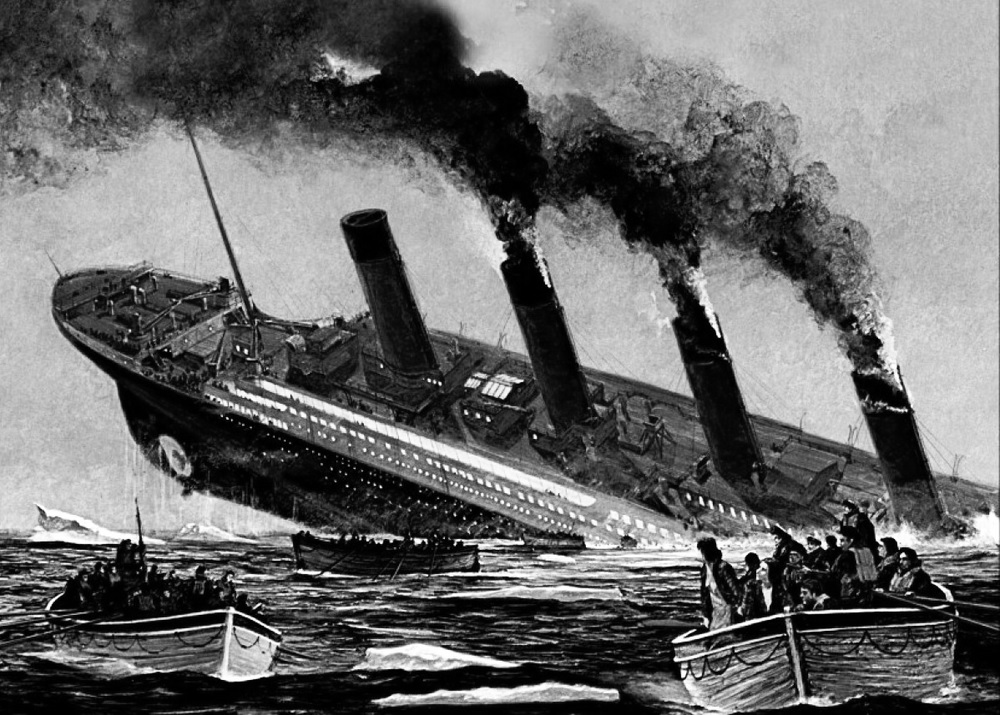
Figure Eleven: RMS Titanic Enjoying A Far More Successful Career
Than Dialectical Marxism
Non-SWP DM-fans can take little pleasure from this for at least two reasons:
(i) Non-SWP organisations often try to recruit members from around the edges of the UK-SWP (there used to be dozens of comrades from several other revolutionary parties (most notably the Spartacists) frequenting the four Marxisms I attended (1987-1990), haranguing us as we went from meeting to meeting); this can only mean that their own pool of recruits will also shrink.
(ii) Many of the above comments could very well be applied to them, too. [On that, see here and here, for example.]
(B) The other jamboree at Skegness (each Easter) was axed in the early 1990s. [Rumour has it that Tony Cliff objected to all the 'cottaging' going on in the toilets!]
(C) The meetings and events section in Socialist Worker (almost invariably published on page 12) is a fraction of its former size.
[This is a continuation of Note 13.]
(D) A recent fund-raising drive (in early 2007) failed badly to meet its target, which is the first time I can recall this happening in over 30 years (but check out the results for 2013, 2015 and 2016, below). The next drive (this time, in autumn 2007) also dragged its feet; mention of it was dropped from Socialist Worker in early 2008. Issue Number 2083 (12/01/2008) says that £126,279 had been raised (the target had been set at £150,000); the next issue (2084, a week later) doesn't even mention the final amount. Had the target been reached one feels certain that would have been reported. The next fundraiser, in Autumn 2008, began to falter early on, too. After three-and-a-half months it had struggled to reach £140,087 (Socialist Worker 2132, 20/12/2008, p.3), well short of the £150,000 target, once more. As usual, it kicked off in early September, but by mid-October it had reached £75,053 (Socialist Worker 2122, 11/10/2008, p.3), by mid November the total was £119,357 (Socialist Worker 2127, 15/11/2008, p.3), the rate of increase falling off dramatically as that month came and went. The 2009 appeal was somewhat similar. However, the 2010 drive went slightly better, the target of £150,000 being reached just before Xmas; the 2011 drive also met its target, as far as can be ascertained, and the 2012 target was reached sometime in late December.
However, the 2013 Appeal (the first after the implosion of the UK-SWP) didn't go at all well, as might have been expected. The amount raised by mid-October was £55,513 (Socialist Worker 2375, 19/10/2013, p.16), whereas the figure at the same point a year earlier, in 2012, had been £94,083 (Socialist Worker 2325, 20/10/2012, p.16), which represented a 41% reduction over twelve months. Compare that with the 2008 Appeal: by mid-October it had reached £75,053 (Socialist Worker 2122, 11/10/2008, p.3), while the figure for mid-October 2013 was £43,833 (Socialist Worker 2374, 12/10/2013, p.16) -- a 42% reduction on what was in effect a bad year (which was itself a consequence of the Respect debacle). However, by mid-December 2013 the total had reached £100,198 (Socialist Worker 2383, 14/12/2013, p.16); compare that with the amount for the same week in 2012: £146,113 (Socialist Worker 2333, 15/12/2012, p.16), a £45,915 shortfall, which represents a 31.4% decrease on the previous year, for the same week. The 2012 Appeal had in fact passed the £100,000 mark nearly two months faster. It isn't easy to see how the party faithful will be able to spin this into yet another 'dialectical' success story.
[Still, we all know that 'appearance' contradicts underlying 'essence'. Does this mean that in 'essence' the UK-SWP met its target, even if it didn't?]
By the 1st of February 2014 the total for the 2013 Appeal had reached £143,016, £6,984 short of its target (Socialist Worker 2388, 01/02/2014, p.16), a figure which had been exceeded six or seven weeks earlier than that in the 2012 Appeal; by mid-December that total had reached £146,113 (Socialist Worker 2333, 15/12/2012, p.16). After that, no more figures were published for the 2013 fund drive, which suggests the target might have been reached sometime in mid-February 2014, two months slower than the previous year. Then again, maybe not...
The 2014 Appeal was even worse; for example, £60,201 had been raised by the beginning of November (Socialist Worker 2427, 01/11/2014, p.16), compared to £113,033 at the same stage in November 2012 (Socialist Worker 2327, 03/11/2012, p.16), and £68,590 in November 2013 (Socialist Worker 2377, 02/11/2013, p.16). Even so, the paper still described this uninspiring result as "a great start". [What was that again about 'appearances' contradicting underlying 'essence'?] By the second week in November the total was £70,127 (Socialist Worker 2428, 08/11/2014, p.16), compared to £119,881 at the same point two years earlier (Socialist Worker 2328, 10/11/2012, p.16), and £71,851 the previous year (Socialist Worker 2378, 09/11/2013, p.16). However, by the 20th of December the running total had recovered somewhat, reaching £121,023 (Socialist Worker 2434, 20/12/2014, p.16), but this was still close on £25,000 short of the amount two years and one week earlier -- £146,113 (Socialist Worker 2333, 15/12/2012, p.16). Finally, Socialist Worker (2437, 25/01/2015, p.5) announced that the total had been reached, a month later than 2012, but a couple of weeks earlier than the 2013 Appeal.
The 2015 Appeal didn't fair too well, either. By the end of November the total had reached £83,167 (Socialist Worker 2481, 28/11/2015, p.16) compared to £96,240 for the same period one year earlier (Socialist Worker 2431, 29/11/2014, p.16), £84,594 for 2013 (Socialist Worker 2381, 30/11/2013, p.16), and £135,322 for 2012 (Socialist Worker 2331, 01/12/2012, p.16). In fact, this latest appeal had gone so disastrously badly that by early 2016 we were told that the Appeal was being closed, a good £40,000 short of its target -- the grand total having reached £106,264 by the second week of January (Socialist Worker 2485, 09/01/2016, p.16). The next issue of Socialist Worker announced that the final total had reached £119,954, over £30,000 short of the target (Socialist Worker 2486, 16/01/2016, p.3).
The 2016 fundraiser opened with Issue Number 2521 of Socialist Worker (14/09/2016, p.3), but with a reduced target. The paper is no longer looking for £150,000, but for £125,000. Perhaps this should be viewed as the UK-SWP's equivalent of Ai Ssu-chi's "Retreat is not retreat" (sic) doctrine we met in Essay Nine Part Two -- that is, a retreat to a lower target figure isn't in this case a retreat, but is in fact 'clear evidence' of a 'dialectical', revolutionary advance. [Those pesky 'appearances' again, telling the opposite story!] By early November, the total had reached £82,979 (Socialist Worker 2528, 02/11/2016, p.3), which is much better than both 2015 (£56,438 by the end of October -- Socialist Worker 2477, 31/10/2015, p.16), and 2014 (£60,201 -- Socialist Worker 2427, 01/11/2014, p.16), but still way off the 2012 figure (i.e., £113,033 -- Socialist Worker 2327, 03/11/2012, p.16). However, there was no mention of the results of this fundraising drive in the first few January 2017 issues of Socialist Worker, which probably means that even the lower total hadn't been achieved -- otherwise we would have been told.
[I haven't bothered to follow UK-SWP fundraising beyond 2016; I am sure this section has put what few readers it might have found soundly to sleep.]
Finally, in relation to these figures, here is what long-standing UK-SWP member, Ian Birchall -- aka Grim and Dim, who left the UK-SWP in 2013 because of the way it handled the rape allegations levelled against a leading member --, had to say about such figures (in his recent and lengthy analysis of the 'Delta' debacle):
"A renewed leadership would need to urgently address the question of membership figures. Despite recent tightening up, there is still a huge disparity between the claimed numbers and those who actually participated in, for example, the aggregates prior to the special conference (intensively and legitimately whipped by both sides). It is hard to see the point of this; who do the CC think they are lying to? The members (except perhaps some very naïve new recruits) don't take these figures seriously, and nor does the movement outside the party. (Any revolutionary knows that lying is sometimes justified. The problem is who is being lied to.) And the result is that other figures given by the party (for example the amount contributed to the Appeal) will be regarded with a certain scepticism." [Quoted for here; accessed 15/12/2014. Bold emphasis added.]
Lack Of Impact -- The Far-Left Punching Way Below its Weight
[This is a continuation of Note 13.]
Considering the fact that the SWP has played such a leading role in the anti-war movement since 2002 (and was also an integral part of Respect, from 2004-2008), suggests that recent "party-building" has been an abject failure. Under such circumstances the party should have faired far better than it has in fact done. Indeed, as several comrades noted about the far-left in general:
"There is no question that the global recession on the back of the constant 'war on terror' has produced a radicalisation. Anti-capitalism is widespread. Evidence comes from the sheer scale of popular mobilisations over the last decade. Once, achieving a demonstration of 100,000 in Britain was regarded as an immense achievement. When grizzled lefties looked back on the demo of that size against the Vietnam War in October 1968, tears welled in their eyes. Now a London demo has to be counted in hundreds of thousands, to be a success.
"Yet this radicalisation, in Britain at least, has not been accompanied by the growth of any of the political currents which you would expect to benefit from this anti-capitalism. And I mean any, even those who reject the label 'Party'. The situation the left finds itself in is worse than when it entered the new century....
"No other period of radicalisation in British history has experienced this lack of any formal political expression. It's not that people opposing austerity, war and much else are without politics. They are busy devouring articles, books, online videos and much else." [Chris Bambery, quoted from here. Quotation marks altered to conform with the conventions adopted at this site. Bold added. Some paragraphs merged.]
"Let's start with a simple observation: the revolutionary left is not growing. Indeed I am perhaps being generous in referring merely to stagnation rather than decline... Yet we live in an age in which many revolutionary socialist groups predict a growth in the revolutionary left -- including whatever their own organisation is -- and indeed sometimes speak as if it's already happening. So for someone from within the revolutionary left -- like me -- to make this comment may be somewhat uncharacteristic.
"There are two reasons why this stagnation might surprise people and therefore requires explanation. One is historical precedent. Previous periods of systemic crisis -- whether the First World War, the 1930s or the post-1968 era -- have led to a growth in the revolutionary left or in other sections of the Left (or both). So shouldn't that be happening now?
"The second reason is that it's not like we have a shortage of resistance to capitalism, or particular aspects of capitalist crisis, in the current period. Shouldn't such phenomena -- Arab revolutions, Occupy, general strikes in southern Europe, a widespread anti-establishment mood etc -- find expression in the growth of the revolutionary left?" [Alex Snowden, quoted from here. Link added. Bold added. Some paragraphs merged.]
[Again, in Essay Nine Part Two I have explained why this happened.]
Earlier in the decade, back in 2005, the failure of the UK-SWP to capitalise on the widespread radicalisation we have witnessed since the late 1990s was underlined by party loyalist, John Molyneux:
"The reality is that we face a somewhat perplexing paradox. Since the end of the 90s, in particular since Seattle, we have argued that a process of political radicalisation was occurring internationally and nationally. We have responded to this radicalisation with three major strategic initiatives: enthusiastic participation in the international anti-capitalist movement, the Stop the War Coalition and Respect. Moreover, each of these responses has met with remarkable, at times truly spectacular, success. Yet after all this the fact is that the SWP not only hasn't grown (despite innumerable urgings to do so), but is now numerically and organisationally weaker than it was in the 90s.
"How do we explain this paradox? Unfortunately we do not have a coherent explanation because we have not really faced the fact that the problem exists.
"Precisely because we have not so far squarely faced the facts, it is probably necessary, at this point, briefly to justify the assertion that we are 'numerically and organisationally weaker'. At some point in the 90s -- I think about 1994 -- we announced that we had 10,000 members. We stuck to this claim, reiterating it again and again, into the new century. However, at the last conference in November 2004 we were told that we had 4,000-plus registered members and 4,000-plus unregistered members.
"Unless the last year has seen a mass registration of the unregistered (and if so, why haven't we heard about it?) this means we have about 4-5,000 members. So somewhere during this period of radicalisation and outward success the party appears to have lost up to 5,000 (50%) of its membership (without ever acknowledging that this was happening). In addition to this there is the evidence of one's eyes of attendance at successive Marxisms, party conferences and councils and NC meetings, the anecdotal evidence about the state of the branches and the figures for Socialist Worker sales (about 7-8,000 per week or less)....
"It was Trotsky who said: 'It is the first duty of a revolutionary party to look reality in the face'.
"It was Tony Cliff who made this principle central to the International Socialist/SWP tradition from its foundation. It was crucial to the theory of state capitalism, to the non-catastrophist economic perspective of the permanent arms economy, to our attitude to the pseudo-Fourth Internationals and to the analysis of the downturn in 1979-80. 'Revolutionaries must tell the truth to the working class'; 'Don't lie to the class, don't lie to ourselves'. How often did Cliff repeat these maxims?
"Yet somewhere along the line -- I think it was particularly in the 90s -- we started to lose sight of them. It was in relation to the membership figures that the departure from reality was most stark: we continued to claim 10,000 long after it was virtually impossible that we had that size of membership. But it was not just over membership -- a similar veil was thrown over the sales of Socialist Worker. Every week Party Notes would report excellent sales here and excellent sales there, but the overall figures were never given, never even spoken about in private.
"The habit of talking things up and exaggeration (of the size of demos, meetings, Marxism, etc) became part of the culture of the leadership, all to sustain the morale of the members. For a period this seemed, on the surface, to work, with overt enthusiasm being maintained, but in the long run it proved counterproductive. A layer of the membership simply dropped out, while others sank into passivity and cynicism." [Taken from here. Quotation marks altered to conform with conventions adopted at this site. Bold emphases added. Some paragraphs merged.]
And yet Molyneux still argues along the following lines:
"With the aid of which worldview, guided by which theory, should we try to change the world? In response to this question it can be said that Marxism has proved, in practice, again and again, that it is by far the best available guide to action...." [Molyneux (2012), p.131. Bold emphasis added.]
It is ironic, therefore, for Molyneux to say this and point out that the UK-SWP "have not so far squarely faced the facts", quoting Trotsky, too: "It is the first duty of a revolutionary party to look reality in the face", since he is an expert when it comes to ignoring facts, and refusing to look "reality in the face" where it contradicts the 'dialectical worldview', failing to note Dialectical Marxism's dire record, exposed in this Essay and in Essay Nine Part Two, and here -- but plain for all to see, otherwise
Molyneux's words were underlined by Richard Seymour (who, like many others, resigned from the UK-SWP in March 2013):
"The 'strategic perplexity' of the left confronted with the gravest crisis of capitalism in generations has been hard to miss. Social democracy continues down the road of social liberalism. The far left has struggled to take advantage of ruling class disarray. Radical left formations have tended to stagnate at best." [Seymour (2012), p.191. Quotation marks altered to conform with conventions adopted at this site. Bold emphasis added.]
Of course, as Seymour goes on to note, there were, at the time, three notable exceptions to this generalisation -- the gains made by the electoralist left in Germany, Greece and France --, but it is far from clear that the 'Dialectical Left' have benefitted (or will benefit) from this in any way. Indeed, a movement that maintains an incessant war inside its own parties, and an internecine battle between parties, isn't likely to grow to a size that will threaten even a handful of bosses or local police chiefs, let alone the capitalist class in general.
Nor is it ever likely to impress radicalised workers.
[In fact, Die Linke, the German Left Party, seems to be going backwards, too. In 2009 they received 11.9% of the vote in the Federal elections, but only 8.6% in 2013, the same in 2017, and 9.2% in 2021. Almost by way of contrast, 2014-15 witnessed the meteoric rise of Syriza in Greece and Podemos in Spain, left-reformist parties not known for their allegiance to DM. However, much of the air was taken out the left's sails by the catastrophic compromise with the European Union signed by the Syriza government soon after, and which was punished for that betrayal in the July 2019 election. Yet again we see that it isn't even possible to create Social Democracy in one country, for goodness sake!]
[Update 12/11/2022: It looks like Die Linke has now entered into a death spiral.]
The UK far-left is becoming increasingly irrelevant and ineffective -- or so it seems --, but comrades still refuse to think like the radicals they claim to be. Indeed, the site from which some of the above comments were taken has barred me from posting there, even when I am not banging on about dialectics!
Be this as it may, here is what I have written in Essay One about this and other crises on the far-left:
Sad though it is to say, but Trotskyism's one and perhaps only major 'success' has been to split more times than a schizophrenic Amoeba on speed, which is, of course, one reason why it has been such a long-term failure.
Believe it or not, there are comrades who will bemoan this fact in one breath, but in the very next will refuse even to entertain the idea that their core theory ('Materialist Dialectics'), alongside the class origin and current class position of their 'leadership', has anything to do with it! They won't even consider these as a remote possibility -- nor yet even as a microscopic fraction of a partial explanation why our side has witnessed 140+ years of almost total failure. The possibility itself is rejected out-of-hand -- and often with no little vehemence and scatological abuse thrown in for good measure.
[Why they all do this is explained in detail here. Incidentally, anyone who doubts the above allegations should check out the hostile responses I received here, here, and here for merely suggesting these as possible contributory factors (unfortunately, these links are now dead!). Or, indeed, dear reader, take note of the response you will receive, too, if you try the following experiment for yourself: Suggest the theoretical possibility -- even so much as tentatively advance the idea -- that DM might be a remote and partial reason for just some of our woes. The hostility, abuse and vituperation that will surely greet you should convince you that the above allegations aren't all that wide of the mark.]
One wonders, therefore, what would become of us Dialectical Dissidents in the unlikely event that fellow Trotskyists ever managed to secure real power. The vitriol, hostility, lies and smears I have had to face now for many years suggest I, for one, wouldn't last long in such circumstances!
[Please note, I am not complaining about this; I expect this level of vitriol. If I hadn't received it, I would have concluded I had gone wrong somewhere!]
For example, in an e-mail exchange a few years ago, one prominent Marxist Professor of Economics -- Andrew Kliman no less -- expressed the fervent hope I should "Eat sh*t and die!" -- either that or quaff some Hemlock -- simply because I had the temerity to question the 'sacred dialectic'. I had asked him to explain exactly what a 'dialectical contradiction' is, which he signally failed to do. His DM-vitriol was subsequently repeated in October 2013, here (in the comments section -- again, this link is now dead!), but it was deleted by the moderators because of the violent and intemperate nature of the language the good Professor thought to use. Another SWP comrade (implicitly) accused me of being worse than the Nazis, and for the same reason! Incidentally, this particular comrade has now left the UK-SWP. Apparently, he still thinks that 'truth is tested in practice'.
Of course, this isn't a novel feature of the far left, or even of the UK-SWP, as the late Colin Barker noted in a recently re-published debate with Ian Birchall:
"Sectarianism is the greatest possible danger in the present situation. We have to accept people as they are, if we are to change them. A personally friendly and open style of behaviour is required, with a stress on those areas on which there is agreement rather than disagreement. We have to be able to exploit disagreements and differences within the ranks of those who oppose us, and to be very sensitive to small changes in attitude. No one must be condemned simply as a 'Stalinist' or a 'social democrat' or a 'centrist,' and left to rot in his theoretical iniquity. We have to abandon that destructive tradition, developed by Trotsky's epigones, of personal unpleasantness as a means of expressing political differences. Had this been the tradition of the Bolsheviks -- the tradition of 'ultra-hardness' that the SLL [Socialist Labour League, precursor of the WRP -- RL] in particular delights in -- the Bolsheviks would never have conquered state power." [Quoted from here; accessed 18/02/2019. Bold emphasis added.]
That clearly went in one ear and out the other without engaging with a single brain cell belonging to the far left along the way.
Stalinism and Maoism are, it would seem, far less fragmentary; but that is only because they both have a long and bloody record of imprisoning, torturing or murdering those who stray too far from the 'path of righteousness' -- as opposed merely to expelling DM-infidels from the party.
[Again, anyone who thinks this poisonous tradition is confined to Trotskyism should read this and then perhaps think again.]
And yet this is the movement that is supposed to herald a new and better era for humanity!...
[Witness, too]...the rapidity with which former 'friends' and 'comrades' regularly resort to lying, gossip-mongering, and smearing one another -- for example, in the recent collapse of UK-Respect (but not just there).
Indeed, until recently, a good place to sample much of this 'comradely banter' was over at the Socialist Unity website -- aptly so-named, presumably, because it unwittingly, perhaps even 'dialectically', managed to do the opposite -- its 'owner' is, or used to be, a huge fan of the 'dialectic'. A large proportion of its space was devoted to highlighting every negative factoid (of dubious provenance) it could lay its hands on to rubbish the UK-SWP and/or its 'leaders' -- and now, Leninism in general. Many of the contributions in the comments section at the end of each article are, if possible, even more hostile and uncomradely. The level of abuse and vitriol aimed at fellow socialists has to be seen to be believed. Small wonder then that very few female comrades ventured there -- especially given the content of the next couple of paragraphs.
Update September 2012: The aforementioned 'comradely' acrimony and vitriol over at Socialist Unity re-surfaced in the late summer of 2012 concerning the controversy around Julian Assange and his alleged rape of two Swedish women -- which controversy was seriously compounded by the offensive remarks George Galloway subsequently made about rape; on that see here and here (especially in the comments section). [See also, here, here, here, here, and here.]
Readers will no doubt have noticed that Socialist Unity has degenerated to such an extent that it attempted to defend Galloway and brush aside his remarks on rape as a 'mis-statement'. This about someone who is supposed to be one of the left's most eloquent speakers?! The controversy prompted the resignation of two of Respect's leading female members.
[In Essay Nine Part Two I examine several HM-reasons why this sort of thing keeps happening, right across the left, and not just the Marxist left, and has been happening for well over a century.]...
Update January 2013: As one ex-UK-SWP-er, Tony Collins, noted in relation to the latest crisis in the UK-SWP:
"The problem is, there is a certain way of seeing any discussion of the far-left that's started by someone who isn't a part of it. He must by definition be an enemy and we must therefore believe he's trying to destroy the left.... That's what happens on the far-left. We sort of have these instinctive reactions. You can see glimpses of this all over the net right now, with SWP members openly attacking each other, something I've not seen ever. There's a cult-like hatred of people who used to be allies." [Quoted from here; accessed 14/01/2013. Bold emphasis added. Paragraphs merged.]
Of course, vitriol like this isn't just confined to Marxists circles, it is also found among certain feminists, and has been for years (especially in relation to transgender issues and 'Intersectionality'):
"Yet even as online feminism has proved itself a real force for change, many of the most avid digital feminists will tell you that it's become toxic. Indeed, there's a nascent genre of essays by people who feel emotionally savaged by their involvement in it -- not because of sexist trolls, but because of the slashing righteousness of other feminists. On January 3, for example, Katherine Cross, a Puerto Rican trans woman working on a PhD at the CUNY Graduate Centre, wrote about how often she hesitates to publish articles or blog posts out of fear of inadvertently stepping on an ideological land mine and bringing down the wrath of the online enforcers. 'I fear being cast suddenly as one of the "bad guys" for being insufficiently radical, too nuanced or too forgiving, or for simply writing something whose offensive dimensions would be unknown to me at the time of publication,' she wrote....
"Further, as Cross says, 'this goes to the heart of the efficacy of radical movements.' After all, this is hardly the first time that feminism -- to say nothing of other left-wing movements -- has been racked by furious contentions over ideological purity. Many second-wave feminist groups tore themselves apart by denouncing and ostracizing members who demonstrated too much ambition or presumed to act as leaders. As the radical second-waver Ti-Grace Atkinson famously put it: 'Sisterhood is powerful. It kills. Mostly sisters.'
"In 'Trashing: The Dark Side of Sisterhood,' a 1976 Ms. magazine article, Jo Freeman described how feminists of her generation destroyed one another. Trashing, she wrote, is 'accomplished by making you feel that your very existence is inimical to the Movement and that nothing can change this short of ceasing to exist. These feelings are reinforced when you are isolated from your friends as they become convinced that their association with you is similarly inimical to the Movement and to themselves. Any support of you will taint them…. You are reduced to a mere parody of your previous self.'
"Like the authors of #Femfuture, Freeman was trashed for presuming to represent feminism without explicit sanction, in this case of the group she'd founded with Shulamith Firestone. It began, she told me, when the left-wing magazine Ramparts published a neck-down picture of a woman in a leotard with a button hanging from one breast. The group decided to write a letter to the editor. Four members drafted one without Freeman's knowledge, and when they presented it to the rest of the group, she realized it was too long and would never be printed. Freeman had magazine experience, and she decided to write a pithier letter of her own under her movement name, Joreen. When Ramparts published it but not the other one, the women in her group were apoplectic, and Freeman was excoriated at their next meeting. 'That was a public trashing,' she says. 'I was horrible, disloyal, a traitor.' It went beyond mere criticism: 'There's a difference between trashing someone and challenging them. You can challenge someone's idea. When you're trashing someone, you're essentially saying they're a bad person.'
"For feminists today, knowing that others have been through similar things is not necessarily comforting. 'Some of it is the product of new technologies that create more shallow relationships, and some of it feels like this age-old conundrum within feminism,' Martin [this is feminist activist, Courtney Martin, mentioned near the beginning of this article -- RL] says. 'How do we disentangle what part is about social media and what part is about the way women interact with one another? If there's something inherent about the way women work within movements that makes us assholes to each other, that is incredibly sad.'" [Michelle Goldberg, quoted from here; accessed 30/01/2014. Quotation marks altered to conform with the conventions adopted at this site; some links added. Spelling adjusted to UK-English. Bold emphases added.]
[More-or-less the same can be said of the extreme vitriol on the left around the debate over LGBTQ gender identity (although intimidation, threats and physical violence are coming from one side only). In relation to this, it is hard to see how those who complain that trans women have been told they aren't 'real women' can possibly be consistent when they also claim that there are no 'real' women anyway.]
Naturally, in this particular case, DM is hardly to blame (in fact, as I have pointed out, where DM does show its face, it only makes a bad situation worse). The class origin and current class position of some feminists is, however, a much more significant factor.
As noted above, somewhat similar, but often much more acrimonious verbal punch-ups have taken place in connection with 'Intersectionality' (on that, see, for example, here and here).
Update July 2013: The crisis in the UK-SWP seems to be building again, with the level of vitriol and back-biting cranked up a few more notches (or, so we have been told):
"Symptomatic of this, the atmosphere in the SWP is becoming fractious and poisonous. Accusations of the hacking of opposition email accounts and epithets like 'malignant tumour' and 'systematic liar' are thick in the air. The responsibility for this criminal, sectarian vandalism lies exclusively with the leadership; the comrades of the opposition, whatever our disagreements with them, are rebelling against a crass bureaucratic regime of an unaccountable, apparatus power. They deserve the solidarity of all partisans of the workers movement." [Quoted from here. I have no way of knowing whether or not these allegations are true, but if they are, it wouldn't surprise me; 'defending our tradition' in such a climate amounts to doing whatever it takes to rubbish, demean, misrepresent or trash 'the opposition'. We saw something similar in the 2016 Labour Party Leadership Election.]
Several more examples of vitriol and personal abuse directed at UK-SWPers by SWPers and ex-members can be found here, in the main article and in the comments section....
Update October 2013: The leadership of the UK-SWP have just attempted to mount a rearguard defence of their conduct (on that, see here); for a response, see here.
Update December 2013: The UK-SWP held their 2014 annual conference several weeks early because of the growing crisis in the party. From Twitter feeds it looks like at least another fifty members have resigned (including long-standing member, Ian Birchall -- check out his measured resignation letter --, Dave Renton, Jonathan Neale, Charlie Hore, Pat Stack, Neil Davidson, and Colin Wilson), partly as a result of certain things that were said from the platform and the motions that were passed. It is highly likely that several hundred more will soon follow in their train.
Even more shocking, this was reported to have been said at the conference:
"We aren't rape apologists unless we believe that women always tell the truth -- and guess what, some women and children lie." [Quoted from here. Several other sources on Twitter confirmed this allegation.]
What is worse, it received a round of applause!
Update 30/12/2013: Indeed, there has now been a mass resignation of 165 comrades from the SWP....
Witness, too, the animosity and personal abuse also apparent in the 2007 split that fractured the US Communist League, and the even more recent feud (in February 2008) in the Maoist RCP-US. In 2007/08, a similar, dialectically-fuelled bust-up is underway (this link now appears to be dead!) in the US wing of the ICFI. The 2009/10 split (this link also appears to be dead!) in the IMT/WIL was no less rancorous.
The following is a revealing comment about the above split by the IMT:
"The Venezuelan comrades of the IMT held their re-founding Congress in Caracas, taking the opportunity to launch their new paper, Lucha de Clases (Class Struggle). The comrades have had to deal with very difficult internal conditions over the past year but have been able to re-found the Venezuelan section of the IMT with great enthusiasm and optimism. The unanimous feeling was that the organisation was now on a qualitative higher level than before. Having purged the organisation of harmful ultra-left and sectarian deviations, they are prepared to play a decisive role within the PSUV and the Venezuelan revolution." [Quoted from here. Bold emphasis added. (On the reaction of their former comrades in the Militant Tendency, see here.)]
Notice how splits and expulsions somehow manage to 'strengthen' the movement! Gerry Healy, DM-Guru par excellence, was well known for holding similar views. Here are his comments soon after he was expelled from the WRP for raping several women in the party:
"A new WRP is already well under way to replace the old. Its cadres will be schooled in the dialectical materialist method of training and it will speedily rebuild its daily press. It will be a new beginning, but a great revolutionary leap forward into the leadership of the British and the international working class. It will be a revolutionary leap forward for the [ICFI]." [Healy's 'Interim Statement' 24/10/1985. reproduced in Lotz and Feldman (1994), pp.335-36. Quotation marks altered to conform with the conventions adopted at this site. Bold emphases added.]
Compare the above with the way some members of the IST responded to the crisis that engulfed the UK-SWP in 2012/13:
"[We] on the German revolutionary left...have followed the developing crisis in the SWP with a mix of great concern and a bit of hope. There is an immense danger that this crisis will result in a substantial, long-term weakening of the SWP and have destructive effects on the entire International Socialist Tendency.... However, this crisis also presents the possibility of a democratic renewal of the SWP and the IST -- and with it a strengthening of the entire revolutionary left." [Florian Wilde, quoted from here; accessed 31/01/2013. Bold emphasis and link added.]
And here is what ex-UK-SWP-er, Ian Birchall, had to say about this debacle:
"Initially I, and a great many comrades, were deeply depressed and stunned. If the CC had shown some willingness to reassess the situation, to look for reconciliation and compromise, I am sure that many of us would have responded positively. But the CC seemed concerned only to prove how tough it was. One CC member told me that it would be a good thing if the party lost members, since that would strengthen it politically. He compared the situation to the 1975 split -- of which he appeared to know little. I asked him if agreed with the late Gerry Healy's axiom that 'with every defection the party grows stronger'. At this he did demur." [Quoted from here; accessed 15/12/2014. Paragraphs merged; quotation marks altered to conform with the conventions adopted at this site. Bold emphases added.]
[Again...], this is clearly the Trotskyist equivalent of the Maoist idea that "retreat is attack" (believe it or not, this odd idea was 'justified' by an appeal to the 'unity of opposites') put about by the Maoist Guru, Ai Ssu-ch'i, in the 1930s (on that, see here). How and why comrades come out with such contradictory doctrines is -- as should seem obvious by now -- a direct result of the contradictory theory which has them in its thrall.
[More details here, here, and here.]
As I have pointed out in Essay Nine Part One:
Here lies the source of much of the corruption we see in Dialectical Marxism. If your core theory allows you to justify anything you like and its opposite (since it glories in contradiction), then your party can be as undemocratic as you please while you argue that it is 'dialectically' the opposite and the very epitome of democratic accountability. It will also 'allow' you to claim that your party is in the vanguard of the fight against all forms of oppression, all the while covering up, ignoring, justifying, rationalising, excusing or explaining away sexual abuse and rape in that very same party. After all, if you are used to 'thinking dialectically', an extra contradiction or two is simply more grist to the dialectical mill!
And if you complain, well you just don't 'understand' dialectics...
One thing is clear: we can expect much more of the same before we finally allow the ruling-class to turn our planet into a cinder, courtesy of our own studied idiocy....
[Since the above was first written, the rancorous implosion of the US-ISO in April 2019 amply confirms that prediction. There will be more. Indeed, there have been; the next largest revolutionary party in the UK, the Socialist Party, has just imploded with equal rancour and hostility (August 2019).]
It is difficult, therefore, to disagree with much of the following:
"British politics urgently needs a new force -- a movement on the Left to counter capitalism's crisis
"Capitalism is in crisis, but its opponents are writhing around in an even bigger mess. The largest far-left organisation in Britain, the Socialist Workers Party, is currently imploding in the aftermath of a shocking internal scandal. After a leading figure was accused of raping a member, the party set up a 'court' staffed with senior party members, which exonerated him. 'Creeping feminism' has been flung around as a political insult. Prominent members, such as authors China Miéville and Richard Seymour, have publicly assailed their party's leadership. Activists are reported to be in open rebellion at their autocratic leadership, or are simply deserting en masse.
"This might all sound parochial, the obscure goings-on out on the fringes of Britain's marginal revolutionary left. But the SWP has long punched above its weight. It formed the basis of the organisation behind the Stop The War Coalition, for example, which -- almost exactly a decade go -- mobilised up to two million people to take to the streets against the impending Iraqi bloodbath. Even as they repelled other activists with sectarianism and aggressive recruitment drives, they helped drive crucial movements such as Unite Against Fascism, which recently organised a huge demonstration in Walthamstow that humiliated the racist English Defence League. Thousands hungry for an alternative to the disaster of neo-liberalism have entered the SWP's ranks over the years -- many, sadly, to end up burnt out and demoralised....
"But the truth is that Britain urgently needs a movement uniting all those desperate for a coherent alternative to the tragedy of austerity, inflicted on this country without any proper mandate.... The history -- and failures -- of the radical left are imprinted on my own family, spanning four generations: my relatives had wages docked in the 1926 General Strike and joined failed projects ranging from the Independent Labour Party to the Communists. My parents met in the Trotskyist Militant Tendency in the late 1960s; my father became their South Yorkshire organiser, and striking miners babysat my brothers while he fought (unsuccessfully) for revolution....
"Neither would I argue for yet another party of the left to be built, Leninist or not. Britons are becoming poorer with every passing year; the wealthy elite continues to boom -- the increase in the fortunes of the richest 1,000 since 2008 eclipses our annual deficit; and Labour's leaders are still to offer a genuine alternative to austerity. But parties challenging Labour for the mantle of the left languish, as they have almost always done, in political oblivion. In the by-election in Manchester Central back in November, for example, the catchily titled Trade Union and Socialist Coalition won an embarrassing 220 votes and was even beaten by the Pirate Party. If not now, comrades, then when?... But it is absurd that -- as we live through a Great Reverse of living standards and hard-won rights -- the opponents of austerity are scattered and fragmented. Even as their poison drives up debt, poverty and long-term unemployment alike, the High Priests of Austerity remain perversely united.
"Ugly forces are more than happy to benefit from a widespread mood of revulsion at the political establishment. Nigel Farage has benefited from a ubiquitous presence on our TV screens -- so much for a left-wing conspiracy at [the BBC] -- but Ukip is thriving too as a collective middle finger stuck up at our rulers. If the left cannot pull itself together half a decade after global capitalism started to totter, the populist right knows a vacuum when it sees one." [Owen Jones, The Independent, 20/01/2013. Several links added, and some paragraphs merged. In 2015, Jones was a prominent and vocal supporter of Jeremy Corbyn; in 2016, he performed a U-turn, and, during the Labour Leadership election campaign, he lent his support to Owen Smith, a Labour MP who overnight discovered he had a few left-wing ideas. Jones then became one of the more vocal anti-Corbyn critics. Could it be that his parent's Trotskyism taught Jones enough dialectics to enable him to 'justify' his 'contradictory' behaviour? Update September 2016: Jones now appears to have performed yet another U-turn! Update November 2019: UKIP have now all but vanished to be replaced by Nigel Farage's new, right-wing party, Brexit.]
Just when the most concerted and vicious attack on workers' living standards the world has witnessed in many a generation -- perhaps ever -- gains momentum, the far-left has shot itself in the head. At a time when the far right and the fascists are mobilising throughout much of Europe and the USA, we have fatally compromised our ability to resist and fight back! How many more self-inflicted wounds can our movement take?
Are we just unlucky? Or, are there deeper structural and ideological reasons for our serial screw-ups, failures and set-backs?
Hence, no material fact (no matter how obvious, blatant, or damning) is allowed to count against the fixed idea that Dialectical Marxism has been, still is, and always will be a ringing success.
This is one belief over which the infamous Heraclitean Flux has no hold; it seems to be the only belief that remains rock solid, locked in Parmenidean stasis, year in, year out.
Any who doubt this need only read the up-beat, hyperventilated reports in most revolutionary papers, and on the vast majority of 'dialectical websites' (with few notable exceptions): everything is always coming up roses. Major set-backs are quietly ignored, and the smallest success is hyped out of all proportion, hailed as if it were of cosmic significance....
So, when a dozen or so hard-boiled, leather-necked, brick-faced Bolsheviks gather together in some 'god'-forsaken hotel or pub in the suburbs, we are regaled with the glad tidings that this marks a significant advance for the world-wide proletariat! Except, of course, no one bothered to tell all five billion of them, and the latter happily returned the complement by ignoring these numpties in their billions. A month later and what do we find? This 'party of the working-class' has split, with one half expelling the other -- and, as if to rub it in, even that outcome is hailed as a major advance for the toiling masses (as, indeed, we saw above with the IMT and Gerry Healy)!...
The situation in the USA, with respect to the ISO, seems to be somewhat similar, as one comrade recently pointed out:
"And there is, finally, the question of the group's size and impact. A lot of games have been played with the categories of 'quantitative' and 'qualitative' since Convention, as if these have nothing to do with one another. In particular, while it is now basically admitted that the ISO has shrunk over the last several years, the leadership faction claims that the group's 'quality' has improved. Now it is theoretically possible for a group to decline in numbers and grow in strength -- if, for example, ten 'random' comrades quit and we recruit five people in a single important workplace, we probably would be stronger -- but the implications of what comrades are saying in the concrete context are really quite chilling. That is, it is being argued that shedding cadre is neither bad nor even neutral, but a positive good.
"In truth, the ISO has declined quantitatively and qualitatively since 2008, just like the international left generally. The fact that this has happened to basically everyone indicates that powerful 'objective' factors are engaged; the decline in itself is arguably not a sin. What is a sin -- always and under any circumstances -- is lying to oneself about it." [Quoted from here; accessed 03/11/2014. Quotation marks altered to conform with the conventions adopted at this site; link in the original. Bold emphases alone added. Just how much of an 'advance' this proved to be can be seen from the fact that, as noted above, the ISO has now imploded.]
The conclusion above is even more revealing given the fact that DM was used (in the shape of the law of the transformation of "quantity and quality") to reconfigure (i.e., 'spin') a serious set-back as its opposite (again, this is the equivalent of Maoist idea that "retreat is attack" -- justified by an appeal to the 'unity of opposites' --, as noted earlier, this was an idea concocted by DM-fan, Ai Ssu-ch'i, in the 1930s; on that, see here).
[Here is another excellent example of the above 'contradictory' phenomenon.]
Self-deception of this order of magnitude is clearly pathological.
The reader is invited to check for herself the rabid optimism that (up until recently) swept, for example, through Respect, and then Respect Renewal (the 'breakaway' party), especially here (where even the cake that was served was "marvellous"!) --, and this after yet another split! Three hundred or so bedraggled comrades roll up over a century-and-a-half after the Communist Manifesto was first published and that is somehow something to shout from the rooftops! Of course, all this rabid optimism has since melted away, replaced by fragmentation and bitter recrimination -- currently being camouflaged somewhat behind illusions in a revived Labour Party under Jeremy Corbyn -- indeed, as we saw above.
And, what is worse: these comrades still refuse to be told!
It seems that single-celled organisms learn far faster.
To be sure, not everyone involved in the above split was a fan of 'the dialectic' (even though significant sections were); once again, the social-, or the class-origin and current class-position of the vast majority of those involved were also key factors, for it is in this petty-bourgeois soil that sectarianism festers -- aggravated, of course, by this mystical 'theory', DM....
[The best account so far of the UK- SWP split, from a neutral standpoint, can be found here. The best UK-SWP version (to date) can be accessed here as well as, here. Several more examples of the uncomradely behaviour of Dialectical Disciples are being added to the Appendix as they come to light.]
"Tested in practice"?
Indeed, and almost to destruction...
[This is a continuation of Note 13. The following is in addition to the comments made about Respect earlier in this Essay.]
September 2007 saw a serious crisis erupt in Respect; by late October it had become pretty clear that that Party was doomed, or would, at best, emerge significantly weaker as a result. I won't enter into what, or who, was to blame for this latest debacle. We can simply chalk it up as yet another failure of the left if, as seems likely, Respect fragments. [However, see below.]
November 2007: In fact, by early November 2007 Respect had split. Here is the case for the defence -- an analysis with which I largely agree, I might add, except for the use of the hyperbole "witch hunt", a phrase which it seems was inspired by John Rees, even though these contentious words are now being 'avoided' by those SWP-ers who used them quite freely at the time -- now that Rees has resigned from the SWP!
By early December 2008, this crisis had spread to the heart of the SWP, itself. [On that, see here.]
Yet More 'Successful Practice'?
[This is a continuation of Note 13.]
The 2001 expulsion of the US franchise of the IST -- the International Socialists -- for reasons that still remain unclear (on this, see Birchall (2011), pp.547-49), hasn't helped. Currently, the IST has no co-ordinated representation in the USA (now that Left Turn has resigned from the IST). This means that right at the heart of the beast, the USA, the IST is without an organisational presence!
[Many of the documents relating to the aforementioned expulsion can be accessed here. An alternative view of this, the most damaging recent split, and the slow decline of the IST alongside its international fragmentation, can be found here, but I don't know enough about this to say whether it is correct or not. Another account of the split, this time from a hostile OT sect (not known for its own ability to avoid fragmentation) can be found here.]
[OT = Orthodox Trotskyist.]
At the time of writing the above, much of the UK-SWP's activity revolves around the promotion of their half of what remains of the Respect split: the Left List in the 2008 London Mayoral and local elections. Hence, success in this regard will be interpreted in limited (but not exclusively) electoral terms.
Update Autumn 2008: Unsurprisingly, the Left List performed remarkably badly in the May elections this year. For example, in the London Mayoral contest, their candidate polled 16,796 first preference votes (0.68%) -- which was in fact under a quarter of the BNP's total -- and less than a half of the Christian People's Alliance!
Fielding fourteen candidates in the London Assembly constituency election, the Left List gained a total of 33,438 votes (1.4%), just behind the Nazi National Front, but twice the fascist BNP's figure. In the Additional Member vote the Left List gained 22,583 votes (0.9%), just short of one tenth of the Green Party, but almost one sixth of the BNP (who won a seat!), and less than a half of Respect Renewal (which gained 59,721 -- or 2.4%). Nationally, the picture was equally depressing.
Respect Renewal didn't do too well nationally, either; although Socialist Unity tried manfully to put some sort of a gloss on these poor results.
Yet another 'dialectical' success story?
Nevertheless, figures from 2007 suggested that Respect was already beginning to falter a year earlier. In the July 2007 Southall bi-election, for example, Respect received 1.6% of the vote in a predominantly Asian area. It was then too early to tell whether or not this was just a freak result. However, the subsequent Shadwell bi-election painted the opposite picture -- where Respect won the seat with 43% of the vote.
Update Autumn 2009: The SWP in Belfast has just split from the IST. Calling themselves International Socialists, they later aligned themselves with Counterfire (the new group subsequently set up by those around John Rees and Lindsey German). Something similar happened in New Zealand.
Update February 2010: John Rees and Lindsey German, along with 58 other members, have just resigned from the SWP. [However, see also here.]
Update Summer 2010: In the UK General Election, in the face of a terminally unpopular Labour government and the prospect of deep cuts both to the Welfare State and working class livings standards, the left's front parties -- Respect-Unity Coalition (the old Respect Renewal) and the Trade Unionist and Socialist Coalition (TUSC, to which the UK-SWP were affiliated) -- received a derisory number of votes: 33,251 and 12,275, respectively, compared to 564,331 for the fascist BNP. [The Green Party received 285,616.] In view of all the recent in-fighting, that was no surprise.
[A similar pattern of hate-fuelled fragmentation and decline was witnessed in Scotland around the Tommy Sheridan/SSP debacle, 2006-2010.]
Update Autumn 2010: Apparently, the US and UK wings of the ISO/IST are now on friendlier terms!
Update April 2011: Long-standing CC member, Chris Bambery, alongside several dozen Scottish members, have just resigned from the SWP. They have now set up the International Socialist Group (Scotland), which is closely aligned with Counterfire. [See also here.]
Now, this might be another sheer coincidence, but the precipitous decline in the UK-SWP's fortunes -- exacerbated by the above splits --, began after its 're-discovery' of DM in the mid-1980s. [Details can be found here.]
How many more 'coincidences' do we need to see before we draw the appropriate conclusion? Dialectical Marxism promotes about as much cohesion as an IED. The recent steep decline of the UK-SWP and the IST has also been detailed here. It was alleged in Essay Nine Part Two that DM aggravates the inherent sectarianism of petty-bourgeois elements in Dialectical Marxism. These events seem to provide further confirmation.
Update March 2012: Respect Renewal (now known as Respect once more!) has just won a historic victory in a by-election in Bradford West, overturning a healthy Labour majority, with 18,341 votes, representing 56% of the total.
The above result failed to get even so much as a mention in Socialist Worker in the run-up to the actual vote. However, a few column inches were devoted to it in the first edition of Socialist Worker published after the above vote -- Socialist Worker 2296, 31/03/2012, p.2 --, a notice that had clearly been written before the result had actually been announced. The on-line edition, though, does give this win its due prominence. [Analysis here.] In the next couple of weeks the victory was given extensive coverage (here and here), with a major article in the May edition of Socialist Review.
Update May 2012: Respect has just won five council seats in Bradford in the May 2012 local elections.
However, in the 2015 General Election, many of the gains made between 2012 and 2014 were reversed, and by 2016, Respect was almost non-existent in Bradford, and the performance of the party in the 2016 London Mayoral elections (in the shape of George Galloway) was decidedly anaemic, receiving a meagre 1.4% of the vote.
Update November 2016: The microscopic US outfit, Keep Left, now appears to be affiliated (at least unofficially) with the IST.
Update June 2017: The 2017 General Election saw the (non-dialectical) UK Labour Party performing far better than expected. Their leader, Jeremy Corbyn, ran a remarkable campaign with scores of public meetings up and down the country, each attracting thousands, with many overflowing into the street. It was patently obvious that when the media had to report his message unfiltered (by law in the UK, TV election coverage has to be balanced; the print media is still heavily pro-Tory and, predictably, rabidly anti-Corbyn), voters liked what he had to say and moved toward Labour in their millions. At the beginning of the campaign opinion polls predicted Labour would be lucky to win more than 25% of the vote, but by the close they received 40.0%, with a total of 12,878,858 (in 2015, the pre-Corbyn Labour Party gained only 9,347,273 votes, or 30.4%). The far right party, UKIP, saw its vote collapse (in 2015 they won 3,881,099 votes compared with 594,068 in 2017), while the Nazi BNP vote collapsed catastrophically (in 2010 they gained 564,331; in 2017, 4,580). Respect gained zero votes; they stood zero candidates.
[This is a continuation of Note 13.]
Even if it were possible to check practice against theory -- to state the obvious --, the interpretation of practice isn't a given.
For example, as noted above, UK-SWP recruitment figures are an unreliable indicator of success. That is partly because of the untoward haste with which many new members are actually enrolled. Indeed, it used to be a joke on the non-SWP left that all you had to do was look at a Socialist Worker seller to be recruited. In fact, so easy was it to be recruited to the UK-SWP that back in 2004 it was revealed that two BNP activists had joined the party and had been promoted to the role of 'student activists'!
It is also partly because many of these new recruits remain largely ignorant of revolutionary socialism -- that is, beyond the basics -- for the entire duration of their membership (which is, alas, often very short -- a fact that is itself not unconnected with this very point).
[That particular, entirely subjective, anecdotal observation of mine should, of course, be regarded as no more, nor no less, reliable than 'official' anecdotal claims themselves are -- even those to the contrary.]
Despite this, up until a few years ago recruitment figures appeared regularly in Socialist Worker, where they were not only seen as a measure of success, they clearly served as a morale booster. Naturally, the rate of recruitment to revolutionary parties will be sensitive to the vicissitudes of the class struggle just as much as it will be to the relative strength of the 'official' left. However, having said that, the fact that so many comrades drop out soon after joining could and should be interpreted as a failure.
Now, up until recently, the SWP was one of the most successful post-war revolutionary parties in the UK, so the above comments reflect rather badly on the many groups and tendencies on the revolutionary left I haven't mentioned. They, too, are hardly shining examples that "prove" the truth of DM in practice. As I pointed out in Essay Nine Part Two:
So, despite the fact that every last one of these myopic individuals continually strives to "build the party", after 140 years of such impressive 'building', few revolutionary groups can boast membership rolls that rise much above the risible. In fact, all we have witnessed since WW2, for example, is yet more fragmentation, but still no mass movement.
[Anyone who doubts this should look here, here, here and here -- or, now, here -- and then, perhaps, think again. Here, too, is a diagram of the main branches of, and links between, the leading US Trotskyist parties/tendencies.]
Has a single one of these individuals made this connection?
Are you kidding!?
You clearly don't 'understand' dialectics.
It seems that the long-term failure of Dialectical Marxism and its core theory, DM, are the only two things in the entire universe that aren't 'interconnected'.
To be sure, the general direction of events during a major class upheaval may be obvious to most revolutionaries, but outwith that the phrase "tested in practice" -- regularly intoned by Dialectical Marxists -- is about as reliable as the average bourgeois election promise.
It won't do, either, to appeal to the success of revolutionary theory in 'predicting' or explaining, after the event, the course of Capitalist development over the last 150 years or so. That is because that, too, will depend on yet more theory for its interpretation.
For example, the regular booms and slumps that afflict Capitalism appear to occur cyclically, and they seem to have imposed on them several subordinate waves of different periodicities and amplitudes. The exact status of all this is controversial and a matter of some dispute among Marxist (and, indeed, non-Marxist) economists. These so-called "Kondratieff cycles" appear to 'fit' large-scale economic phenomena, even though they don't appear to have any obvious revolutionary implications. Clearly, the analysis of complex data sets like this should be carried out with some degree of theoretical sensitivity and mathematical sophistication. Even so, any empirical evidence introduced in order to help discriminate between rival interpretations of this data will itself already be theoretically slanted/coloured, too.
As the late Chris Harman noted [Harman (1984), pp.132-36; cf., also Mandel (1975 and 1995)], the long waves postulated by Kondratieff can be completely re-drawn if other statistical techniques are employed. But, that just confirms something mathematicians have been aware of since at least Leibniz's day: through a finite number of points a potentially infinite number of curves can be drawn. So, that fact alone can't be used to disprove or discredit a given theory, since all theories are subject to those constraints. The data themselves can't determine which line or curve fits them -- and simplicity isn't a 'natural' given, either, as noted above.
[I hasten to add that the above should not be taken to mean that I accept the validity of Kondratieff cycles! I am merely making a point about the predictive success rate of Marxist economists.]
Furthermore, SWP-theorists have themselves found it necessary to modify Marx's original theory to explain postwar economic development. This has included the introduction of entirely novel theories of the fSU, Imperialism, Monopoly Capitalism, Nationalism, The Permanent Revolution, and the Permanent Arms Economy, which were constructed in order to help explain, among other things, long-term booms, periods of stagnation, protracted crises, and the course and nature of the many struggles that have flared-up internationally in the intervening years -- not to mention the theory of State Capitalism, where competition between capitalist units has been augmented by the introduction of considerations related to military competition between certain states, among other things.
However, this re-vamped theory isn't without its own problems. For example, it faces the not inconsiderable task of accounting for the rather strange behaviour of Capitalism over the last thirty years or so. At present parts of the world economy are growing strongly, and have been doing so for a record number of years.
[The above was written in 2007. The current 'worldwide crisis' has been commented upon below, and in Note 21a.]
In an article in 1999, for example, Rob Hoveman (who was later expelled from the UK-SWP) noted that the US economy had witnessed its longest post-war period of growth [Hoveman (1999b)], but his explanation for this phenomenon didn't include a reference to increased military spending (a key component of earlier UK-SWP economic theory). Similarly, articles by the late Chris Harman also attempted to account for the boom in the USA (and the aforementioned crisis) in terms that also failed to include any reference to the Permanent Arms Economy (except, perhaps, as it appeared to operate up until the mid-1980s), either. Even so, Harman pointedly referred to other factors to explain the odd behaviour of the economy -- these included inflated stock prices in the USA, the increased rate of exploitation of workers, and the growth of credit (etc.). [E.g., Harman (1999, 2000a, 2000b, 2001a, 2001b, 2005, 2007a, 2007b, 2008a, 2009b); cf., Callinicos (1999). See also Kidron (1967, 1970, 1974), and Cliff (1957).]
Having said that, Harman (2009a) returned to explaining the long boom (in the twenty-five or so years following WW2) by appealing once more to the Permanent Arms Economy, but not apparently in relation to the current crisis. The same seems to be true of Callinicos (2009). [See also Kliman (2009).]
No doubt, the state of the world economy will be satisfactorily explained by SWP-theorists -- one day. At any rate, it is worth pointing out that rival theories aren't fairing much better. either! But, even if the SWP's 'theory' were performing well, that still wouldn't imply it was the 'right' theory. The entire set of theories could be defective. We need criteria other than predictive, or even post hoc, explanatory power and "practice" to decide whether or not this area of Marxist theory is 'correct'. [I will attempt to outline what these "criteria" might be in a later Essay.]
Of course, there are Marxist economists who claim that the standard Marxist explanations for the crisis that hit the world economy post 2008 don't apply -- for example, this one. In the present Essay, however, I will take no stance on this topic; I will merely point out that our theory in this area is in total disarray.
[I blame dialectics -- but then I would, wouldn't I?]
Incidentally, the 'scare' quotes around some occurrences of the word "theory" above were deliberate -- the descriptor "The Theory of the Permanent Arms Economy" is misleading. When it is compared with other sophisticated economic theories, the detail (factual, mathematical and theoretical) in support of it is rather thin, to say the least. Chris Harman does an excellent job spreading it as far as it will go (in, for example, Harman (1984)) --, but calling it a "theory" is a little premature. Of course, this doesn't of itself mean that it is a bad hypothesis, or that it is misguided (or even that I disagree with it!); but, it does mean that much more work will need to be done before we can flatter it with the title "theory". [On this, see Kidron (1977), and Harman (1977).]
Robert Brenner's recent attempt to construct a theory of modern Capitalism was (rightly or wrongly) given short shrift by UK-SWP theorists, but, in the main their criticisms are themselves analytic and theoretical, not factual. Where their criticisms have looked factual, the dispute actually centred on the interpretation and significance of certain data sets, not the data themselves. [Cf., Brenner (1998, 2002, 2006), Callinicos (1998, 1999), Harman (1999, 2004), and Hoveman (1999a). See also the discussions here and here -- as well as Choonara (2009), which contains a very useful survey of the (dare I say it!) "contradictory" state of current theory on the Marxist left. See also Hardy (2016).]
Are these yet more 'dialectical success' stories?
If only there were some sort of pattern here...
14. It could be objected that this is ridiculous; the success of Capitalism doesn't prove it is 'true', nor does it establish its superiority. Capitalism is a decaying and dying social system that has reached the end of its 'progressive' phase.
Maybe so, but since that claim is itself a hostage to fortune it can't be used to show Capitalism will always fail, or indeed that Marxism must prevail in the end. The plain fact is that, to date, the long-term 'success' of Capitalism stands in stark contrast to the meagre gains our side has made over the last century-and-a-half. We may only re-configure that depressing state-of-affairs (in the here-and-now) if we are prepared to drop these useless pragmatic criteria.
[This should hardly need stating, but my reference to the 'success' of Capitalism is meant to be taken in more-or-less the same way that Marx and Engels depicted it in Chapter One of The Communist Manifesto.]
Again, it could be objected that Capitalism is actually failing right now. Such an objector might even point to, say, the current semi-permanent state of economic instability and the manifest evils we see around the world (among many other things) as evidence of that fact. But, it is always open to a supporter of the present system to claim that the successes so far chalked up by Capitalism mean that these "evils" can be, and are being, eradicated (or, at least, ameliorated) by more and better Capitalist development -- indeed, several of its apologists (erroneously) claim precisely this.
As we know, this is completely false. But, to what practice (and to which successes) -- not to which theory -- can we point in order to counter that response?
Capitalism is far more successful (in terms of its achievements and practicalities) than anything our side has so far managed to cobble-together. Indeed, as far as revolutionising the forces of production is concerned, it surpasses anything this planet has ever seen, and by several orders of magnitude.
Once more, it could be argued that the success of Capitalism is in fact down to the working-class, not the bourgeoisie.
Doubtless this is largely correct, but supporters of this rotten system would merely point out in response that not only did it take Capitalism to organise the working class, the latter have in fact resisted Dialectical Marxism for nigh on 150 years.
This isn't to excuse Capitalism; it is simply to point out that the above claims can only be countered factually or theoretically, not pragmatically.
Indeed, and in view of our abysmal track record, an appeal to practice here would be tantamount to an admission of defeat!
15. Some might object and point out that Rees puts these comments in the future tense:
"If it is not superior to other theories…it will not 'seize the masses'…." [Rees (1998), p.237.]
That response will be addressed presently.
15a. It could be argued that if all these failures refute DM, then they surely refute HM, too. That being so, the spurious distinction between DM and HM promoted in these Essays is unsustainable.
However, HM has never been tested apart from DM, so this objection is itself misplaced.
[On the distinction between HM and DM, see here.]
It is also worth reminding the reader -- but it should be obvious from the content of this Essay! -- that I don't believe that the truth of a theory is tested in practice; I merely use this particular DM-thesis to embarrass those who do.
16. Is this the Sixth International in the making? Must we run out of ordinal numbers before workers 'wise up' and start joining, en masse, this ever-growing pile of dead dialectical ducks?
Or, before we finally figure out that they aren't the least bit interested in these mystical versions of Marxism?
16a. Of course, there are those who deny dialectics features prominently, or at all, in the day-to-day activity of revolutionaries.
If so, they won't mind if this theory is completely excised from Marxism, will they?
However, and oddly enough, when they are confronted with that option in 'debate', and when DM is under attack, many of them adopt the opposite view. An excellent recent example of this can be found in the responses thrown at me here.
Even so, the idea that our core theory -- which is supposed to govern everything Marxists both think and do -- has nothing to do with how things have turned out is bizarre in the extreme.
[On that rather desperate, if not pathetic, defence, see here.]
17. These allegations have been substantiated throughout this site; the former more specifically in Essay Twelve Part One (as well as here), the latter in Essay Nine Part Two.
18. This shouldn't be taken to mean that I think that things can't change!
After all, that is largely why I began to write these Essays!
18a. It is salutary to underline a point already made: that many of these battles have been fought in defence of limited bourgeois democratic and economic demands. The fact that workers in their hundreds of thousands are prepared to face down billy clubs, tear gas, pepper spray, live fire, tanks, heavily armed police and soldiers in pursuit of such limited objectives throws into stark relief the failure of workers in the former 'socialist' countries to do likewise in defence of something supposedly more important: their state, their revolution, their 'socialist' society. I think we can all draw the appropriate conclusion, here.
19. On the fSU and the 'People's Democracies' see Cliff (1950, 1996, 2003). See also, Binns (1986), Binns and Hallas (1976), and Harman (1988).
20. Sceptical readers are referred to Nigel Harris's book Mandate of Heaven for more details. [Harris (1978); see also, Hore (1987, 1991).]
21. The evidence supporting these allegations can be found in Binns and Gonzalez (1980), Binns, et al (1980), Binns (1983) and Gonzalez (2016). However, even those who still think Cuba is a socialist state will be dismayed by the creeping marketisation of its economy, begun in late 2010 by Raul Castro. [On that see, for example, here, here, here, here and here.]
Yet another 'dialectical' success story?
21a. The current state of confusion on the left (i.e., when this was written in January 2008) about whether it is appropriate even to use the word "crisis" to depict the present state of Capitalism can be gauged from the discussion at Louis Proyect's site, here. Even now (i.e., Summer 2010), opinion is divided as to whether or not the global economy will go into "meltdown".
The dire record Marxists have of 'predicting' crises was noted by Robert Brenner:
"Marxist economists are famous for having accurately predicted seven out of the last one international economic crisis. Perhaps for that reason, many in recent times have been unusually cautious about once again 'crying wolf,' even as the evidence of international economic dislocation has mounted around them. Today, however, prediction is no longer necessary. The international economy, outside of the United States and Europe -- perhaps 50% of the world -- is already experiencing an economic downturn that is worse than any that has occurred since the 1930s." [Robert Brenner. Bold emphasis added; quotation marks altered to conform with conventions adopted at this site. Paragraphs merged.]
Unfortunately, the above was written in September 1998, the last time we were told a looming recession was the "worst since the 1930s". It looks like Brenner was also "crying wolf" back then --, indeed, something he now admits to having done:
"I would have been a bit embarrassed, but not really surprised, if I had used the term crisis carelessly at that moment and even, unintentionally, left myself open for a catastrophist interpretation. In early October 1998, roughly the time I was writing this piece -- the financial economy was freezing up, and the international financial system seemed on the verge of collapse. For a good inside view of the scene at the time, and how it appeared and felt, see the opening pages of the book The Fed by the leading financial journalist Martin Meyer. Describing the subjectivity of the several thousands of bankers and central bankers and financiers and finance ministers who had just descended on Washington for a meeting of the World Bank and IMF, Meyer writes 'It turned out to be an experience they will never forget as long as they live, a weekend of pure terror, as though an asteroid were descending on earth.' Meyer does not hesitate to go on to use the term crisis (and panic) to characterize the economic situation in general, and the financial meltdown in particular. So -- I thought to myself -- writing pretty soon after this moment -- after the NY Fed had been obliged to bail out that hedge fund and Greenspan to cut interest rates outside the regular meetings of the Fed -- I could easily have used the word crisis misleadingly and without sufficient thought." [Robert Brenner. Quotation marks altered to conform with conventions adopted at this site. Link added.]
Fortunately, we are blessed with 20/20 hindsight. Even so, one thing I have learnt over the last 30+ years is never believe or trust a single economic prediction, no matter from whom or where it originates. Weather forecasts are ridiculously accurate in comparison. [For example, here is another Marxist assessment of the 2013-14 'recovery' in the UK.]
To be sure, traditional economists fare little better, but when it is recalled that Marxists are supposed to be applying the correct method in this area, that is nothing much to crow about, nor is it something we should be shouting from the rooftops. [On this topic in general, see the timely warnings floated in Faulkner (2009).]
Nevertheless, the current "crisis" could turn out to be "the biggest since the 1930s" (or even the 'worst' since the last incorrect prediction!) -- but, just like someone who predicts rain every day, when it finally rains, that 'success' can't count to their credit.
Even so, it seems that this "crisis" might be the worst for 70 years; here, for example, is one recent survey, published in August 2008. Plainly, only time will tell whether or not this is yet another example of "crying wolf".
Update October 2008: It now looks pretty clear that this is a "crisis" of unique proportions, with several major banks and financial institutions around the world -- particularly in the USA -- failing, or having to be nationalised (making George W Bush and Barak Obama the greatest US 'socialists' in the history of that country!). As I write, the Senate and House of Representatives are deciding on whether to buy up 'toxic debts' to the tune of $700 billion, and it is far from clear that even this will restore confidence. [On this, see Callinicos (2008b), and Harman (2008).]
Nevertheless, as I noted above, if our side constantly predicts a "crisis", it is hardly surprising if we get it right in the end.
Unfortunately, however, this "crisis" was also predicted by bourgeois economists (except, and unlike DM-fans, they didn't run their mouths off predicting a '"crisis" around every corner' at every turn; hence, they didn't predict this "crisis" on the basis of a 'scatter gun' approach to economics) -- for instance, Pettifor (2006) predicted this "crisis" -- as well as several others, for example, Dean Baker, Steven Keen and Vince Cable (a leading figure in the UK Liberal Democrats and currently Business Secretary in the UK-Coalition Government), are said to have also predicted it.
In fact, it now turns out that there were many such warnings (see, for example, here, here, here, and here). The Guardian newspaper carried a story (24/01/2009) about economist Nouriel Roubini who likewise predicted this "crisis". [Brockes (2009); see also the Wikipedia article on Roubini.] The Guardian also carried another story (31/10/2008) about an assistant editor at the Financial Times, Gillian Tett, who gained no little notoriety and opprobrium for her prediction of the looming "crisis"; indeed, we are told that she was even denounced from the stage at the economic forum at Davos in 2007:
"One of the most powerful people in the US government at the time stood up on the podium and waved my article, the article that predicted the problems at Northern Rock, as an example of scaremongering." [The Guardian, G2 Supplement, 31/10/2008, p.12. See also here, pp.21-25. (This links to a PDF.)]
Finally, here is another individual who had been warning about the looming "crisis" since 2003.
Does this prove that non-Marxist economic analyses are correct, too?
I think not...
Indeed, John Rees now admits:
"The current economic crisis did not begin with the collapse of Lehman Brothers in September 2008. It was obvious at least from the collapse Northern Rock a year ago. There is no theoretical agreement on the CC [Central Committee -- RL] about the likely depth and length of the recession. In the course of attacking me for saying that the SWP had been late in responding to the recession Chris Harman told the last NC [National Committee -- RL] that we had no idea how deep the recession would be on the very day that Lehman Brothers collapsed. Just a day later Martin Smith opened a joint CC and local organisers meeting with the words 'we've been late on the recession.' In the Manchester pre-conference aggregate Alex Callinicos admitted that he had been late in seeing the depth of the recession because he did not want to seem like one of those Marxists who are always claiming there is going to be a crisis of capitalism." [Quoted from here, 14/12/2008. Bold emphasis and link added.]
So, not only have non-Marxists predicted this "crisis", prominent Marxists failed to appreciate its real nature.
Andrew Kliman also acknowledged the following:
"Because Marxists are famous for 'predicting five out of the last three recessions', I need to point out two things before continuing. First, the term crisis does not mean collapse, nor does it mean slump (recession, depression, downturn). A crisis is a rupture or disruption in the network of relationships that keep the economy operating in the normal way. Whether or not it triggers a collapse or even a slump depends upon what happens next." [Kliman (2008), p.61. Bold emphasis added; quotation marks altered to conform with conventions adopted at this site.]
Comrades, it seems, are no more accurate in this regard than non-Marxists. However, what Kliman says about the use of the word "crisis" does not in fact align with the way it has generally been employed by most Marxists. As we have already seen, this over-used term is constantly applied to everything and anything by comrades who are inveterate 'crisis-junkies'. Indeed, and ironically, since everything in Capitalism is constantly in "crisis" (after all, when does the system work 'normally'?), Marxists can't in fact claim to have predicted this particular one. Or, no more than the boy who cried "Wolf!" can be credited with foreseeing the eventual attack.
22. The real source of Lenin's 'semi-divine' knowledge of the alleged existence of infinite inter-connections, which everything supposedly has with everything else, is no mystery. It has been exposed here.
23. Here is a pictorial representation of three dimensional, annular spheres:
Figure Twelve: Concentric Spheres Of 'Irrelevance'
24. In fact, had they taken Lenin's advice seriously, the Bolsheviks would still be discussing the October insurrection (with its infinite "mediacies")! Their meetings would surely have begun to resemble those of the "People's Front of Judea (Official)", portrayed in Monty Python's Life Of Brian.
Video Ten: PFJ (Official) -- Weekly Aggregate Meeting
Unsurprisingly, even Lenin omitted the infinite "mediacies" he told us this hapless tumbler enjoyed. There is no evidence (in the written record of the meeting during which Lenin raised this (dare we say) irrelevant epistemological requirement) that he went on to list the infinite "mediacies" of anything -- or even so much as one million "mediacies" of a single thing in his entire life.
Even less surprising: Those who pay lip-service to the letter of Lenin's advice have yet to list so much as 0.1% of the large finite number of "mediacies" -- mentioned in the last sentence (i.e., one million) -- about anything relevant to issues of concern to dialectics, let alone about sundry items of glassware.
25. From dialectical writings in general -- and from TAR in particular -- it is unclear whether or not every form of reductionism is to be deprecated, or only certain versions of it.
Nevertheless, whatever successes reductionist strategies have (or haven't) enjoyed in the natural sciences, they are, of course, glaringly unsuccessful when applied in the social sciences. Why that is so will not be entered into here -- but, it has nothing to do with the sorts of reasons outlined in TAR. On reductionism in general, cf., Nagel (1961). [More on this in Essay Three Part Three.]
26. DM-Holism has been examined in detail in Essay Eleven Parts One and Two.
26a. Of course, there are many different forms of reductionism, but it seems that as far as DM is concerned they can all be lumped together as a job lot. [However, see Note 25.]
27. Concerning the "infinite", see Blay (1998), Hunter (1996), Lavine (1994), Moore (2001), and Robinson (2003). For a clear outline of Wittgenstein's views on this topic, see Moore (2011), Rodych (2000, 2018), and Shanker (1987), pp.161-219.
27a. It could be objected that even partial truths are still partially true. In which case, DM in no way implies scepticism. The comments in this Essay seem to want to ignore that simple fact.
Or, so it could be argued.
However, the above alleged fact (i.e., that even partial truths are still partially true) is itself infinitely far from the truth(!) -- if Engels is to be believed --, and, as such, it stands an incalculably high probability of being completely wrong. Moreover, it will always remain in that state this side of an endless dialectical-meander through infinite epistemological space, a search that will have actually to reach Dialectical Valhalla before DM-fans may finally declare it an 'absolute truth' about partial truths!
Short of that, they can't say this is even a "partial truth" about the nature of partial truths!
For example, in MEC (and in PN), Lenin declared that the Ether was "objective", but that alleged fact turned out to be no such thing; there is no Ether (so scientists tell us). If Lenin could be so completely wrong here, then that putative fact can't even be declared partially true. After all, which part of the claim that there is just such an ether is 'partially true'?
[There is more on this in Essays Eleven Part One and Thirteen Part One.]
Of course, much of this is connected with Hegel's criticism of what he calls a "bad infinity" -- or, a "spurious infinity", Hegel (1999), pp.137, 139 -- a criticism that must itself apply to Engels and Lenin's epistemology, it is worth noting -- in contrast to what he described as a "genuine infinity"; but Hegel's solution (if such it may be called) is unavailable to Marxists -- or, at least, it is to those of us who are determined to reject Idealism with a little more consistency than DM-fans seem able to muster.
I will say more about this in Essay Twelve Parts Five and Six. [For Hegel's views on infinity, see Houlgate (2006), pp.370-435, and Inwood (1992), pp.139-42. See also, here.]
28. Objections to this particular line-of-argument have been neutralised here, and will also be dealt with presently in the main body of this Essay.
29. Anyway, this would mean that several important passages in the DM-classics (quoted in the main body of this Essay) would need to be revised, ignored, or ditched, along with the above 'asymptote' metaphor, since they plainly do imply an infinitary task. Indeed, they go further, they actually say it is infinite, and "demand" we regard it in no other way.
30. Of course, these conclusions are completely crazy -- but that is why they constitute an effective reductio of Engels and Lenin's theory.
31. The following is (partly) how this passage of Lenin's will be handled in Essay Thirteen Part One:
Before we examine whether Lenin's argument is successful in its own right, it is worth pointing out to the many dialecticians who question the deliverances of 'commonsense' (which I take to be the same as "naive realism", referred to by Lenin) -- and who also regale us with the 'appearance/reality' distinction -- that 'commonsense' can't in fact be called into question if it is to act as a basis for the Lenin's theory of knowledge.
[Those who think this an unfair criticism of Lenin should read on before they rush to that conclusion.]
Despite this, and given the other complexities that DM introduces, Lenin's alleged foundation stone soon starts to crumble into dust. According to DM-epistemology, knowledge depends on the completion of an infinite process (the precise nature of which still awaits clear exposition) before the very first thing can be known about anything in the DM-"Totality" with anything other than infinite uncertainty.
We have already seen that this approach to knowledge means that nobody would be in any position to say what even a simple tumbler was before everything about everything was known first.
In response, it could be argued that the above picture is just another unfair caricature of dialectical epistemology. In reply to that, it is worth emphasising that any objector who raises this point would similarly be in no position to assert it successfully -- unless and until we are given a clear account of DM-epistemology. After over 150 years, we are still waiting...
Indeed, given DM-epistemology itself, no one would be able to assert that this is being unfair to DM and Lenin, and hope to be correct until they too had completed the aforementioned infinite pilgrimage to Dialectical Mecca!
This means that dialectical 'knowledge' of any sort is permanently locked in Sceptic Hell, if Engels and Lenin are to be believed....
Despite this, it is worth reflecting on the sort of response that, say, a Phenomenalist might make to Lenin's claim that his theory begins with the "naïve" beliefs of ordinary folk, and builds from there.
"The 'naïve realism' of any healthy person who has not been an inmate of a lunatic asylum or a pupil of the idealist philosophers consists in the view that things, the environment, the world, exist independently of our sensation, of our consciousness, of our self and of man in general. The same experience (not in the Machian sense, but in the human sense of the term) that has produced in us the firm conviction that independently of us there exist other people, and not mere complexes of my sensations of high, short, yellow, hard, etc. -- this same experience produces in us the conviction that things, the world, the environment exist independently of us. Our sensation, our consciousness is only an image of the external world, and it is obvious that an image cannot exist without the thing imaged, and that the latter exists independently of that which images it. Materialism deliberately makes the 'naïve' belief of mankind the foundation of its theory of knowledge." [Lenin (1972), pp.68-69. Bold emphases alone added. Quotation marks altered to conform with conventions adopted at this site.]
She (the supposed Phenomenalist) might wonder what, for instance, the word "image" is doing in such prosaic surroundings. Indeed, she might even suggest that if we were to ask the average man/woman about what he/she knows of the world, the word "image" would appear nowhere in the reply.
Hence, not only is the aforementioned dialectical meander through infinite epistemological space counter-productive (since it implies permanent and infinite ignorance of everything and anything), it begins in the wrong place! 'Commonsense'/"naïve realism" -- whatever it is -- neither starts nor ends with images. [To be sure, certain forms of phenomenalist psychology might do this, but 'commonsense' does not. Or, if it does, I'd like to see the evidence. (Which 'evidence' would be worthless, anyway, since it, too, would merely consist of, or would have been based on, yet more 'images'!)]
It is worth pressing this point home: there is no evidence that the "naïve" beliefs of anyone -- not even the naïve beliefs of DM-fans -- are based on imagery of any sort; but there is much to suggest that they aren't. Hence, there is no evidence that either ordinary people or sophisticated socialists believe any of the following (that is, before they encountered the DM classics):
"Our sensation, our consciousness is only an image of the external world…." [Lenin (1972), p.69. Italic emphasis in the original. Bold added.]
"The gist of his theoretical mistake in this case is substitution of eclecticism for the dialectical interplay of politics and economics (which we find in Marxism). His theoretical attitude is: 'on the one hand, and on the other', 'the one and the other'. That is eclecticism. Dialectics requires an all-round consideration of relationships in their concrete development but not a patchwork of bits and pieces. I have shown this to be so on the example of politics and economics....
"A tumbler is assuredly both a glass cylinder and a drinking vessel. But there are more than these two properties, qualities or facets to it; there are an infinite number of them, an infinite number of 'mediacies' and inter-relationships with the rest of the world....
"Formal logic, which is as far as schools go (and should go, with suitable abridgements for the lower forms), deals with formal definitions, draws on what is most common, or glaring, and stops there. When two or more different definitions are taken and combined at random (a glass cylinder and a drinking vessel), the result is an eclectic definition which is indicative of different facets of the object, and nothing more.
"Dialectical logic demands that we should go further. Firstly, if we are to have a true knowledge of an object we must look at and examine all its facets, its connections and 'mediacies'. That is something we cannot ever hope to achieve completely, but the rule of comprehensiveness is a safeguard against mistakes and rigidity. Secondly, dialectical logic requires that an object should be taken in development, in change, in 'self-movement' (as Hegel sometimes puts it). This is not immediately obvious in respect of such an object as a tumbler, but it, too, is in flux, and this holds especially true for its purpose, use and connection with the surrounding world. Thirdly, a full 'definition' of an object must include the whole of human experience, both as a criterion of truth and a practical indicator of its connection with human wants. Fourthly, dialectical logic holds that 'truth is always concrete, never abstract', as the late Plekhanov liked to say after Hegel...." [Lenin (1921), pp.90-93. Bold emphases alone added; quotation marks altered to conform with conventions adopted at this site.]
In order to see this, consider the following example; suppose worker, NN, asserted the following:
L1: "That policeman hit me over the head with a truncheon."
Now, only a rather desperate defender of the Police would respond with this comment:
L2: "You are mistaken. What you experienced was in fact only an image of a policeman clubbing you."
We can be reasonably sure that this worker doesn't need to wait for the asymptotic-train-of-knowledge to hit the absolute-buffers-of-eternal-certainty before he/she can claim to know what happened on the picket line when the Police attacked it. Indeed, such a worker would rightly feel angry if told that his/her knowledge of these uniformed assailants was only relative and partial, and that he/she had failed to consider all those pesky "mediacies" before arriving at that rash conclusion. In fact, we can be quite certain now (without the presence of an accompanying image -- and even before the epistemological train leaves the dialectical sidings on its endless meander to nowhere-in-particular) that this worker knows he/she was hit on the head and who was responsible for it.
Indeed, this would be the line Socialist Worker and other revolutionary papers would take if one of its correspondents witnessed Police violence -- in cases like the Police riot in Chicago in 1968, or in Red Lion Square London in 1974, or in relation to the death of Blair Peach in Southall 1979, the UK Miners' Strike, the picketing at Wapping in 1986, the march against the Nazis at Welling a few years later, the Police riots in Trafalgar Square in 1990, those in London in April 2009, those in Genoa in 2001 and 2003, those in New York and San Francisco in 2003, or even those in 2011 to clear the Occupy Movement off the streets, etc., etc. In fact, their readers would know precisely when they could stop trusting Socialist Worker and other Marxist papers: just as soon as they began reporting events in the way that Lenin characterised "objectivity", or if they ever started referring to the "images" in people's heads as evidence supporting claims made about Police violence, as opposed to the incidents themselves, to video footage, witness statements and medical reports (etc.) --, or if they were foolish enough to insist that every "mediacy" had to be taken into account before anyone could decide what had happened on a picket line or a demonstration, and what to do about it.
Unsurprisingly then, in the Miner's Strike, for instance, the actual incidents were reported in Socialist Worker and other Marxist papers and articles (and the same is true of subsequent analyses presented in their more theoretical journals and books); they wisely omitted all reference to "images", and to "partial" or "relative knowledge", let alone to any obvious "asymptotes" that might otherwise only be of interest to sundry Idealists.
In practice, not one single revolutionary paper, book or article begins with "images" (nor do they bang on about concepts converging on reality, to eternity) -- not even the very worst union bureaucrat in the history of the labour movement would come out with this sort of excuse for further prevarication!
In fact, it is more than a little surprising that die-hard supporters of Lenin's theory never point out to the editors of Socialist Worker and other Marxist papers, journals and books where they are going wrong by foolishly reporting events in the real world. Why hasn't a single admirer of MEC written to these papers (or these authors) to insist that reports of, say, neo-Nazi violence be replaced with descriptions of images in victims' heads? Whatever one thinks of the letters in Marxist papers, unless they are heavily censored, not a single one ever points out that their reports are defective because they foolishly recorded the actual events in the world, recklessly ignoring images inside the skulls of observers and victims alike -- or that they fail even to mention those pesky "mediacies".
Anyway, despite what he said, Lenin himself didn't actually begin with the "naïve" beliefs of mankind. In fact, he did quite the opposite: he undermined them from the start -- indeed, he began with the theories of various ruling-class hacks, even if he modified and adapted them to his own ends. He did this by reducing ordinary belief (partially or completely) to images. The same can be said of any socialist (reporter or otherwise) who might think to do likewise -- for example, by writing about the images of Police brutality inflicted on the images of miners, which image of events occurred in their image of Orgreave, in an image of 1984 --, in their paper (or image of it).
[And it is little use being told that Lenin argued that such 'images' reflect 'objective' reality; the point at issue here is whether he began with the naive beliefs of ordinary people. Whether or not these 'images' actually reflect 'objective' reality will be considered below.]
DM-theorist's actual starting point is consistent with what was alleged earlier: the open and egregious denigration of the vernacular -- and that includes the lazy depreciation of the experience of ordinary workers (since they have supposedly been 'bought-off' by super-profits, or are mesmerised by the 'banalities' of 'commonsense', and have been hypnotised by 'formal thinking'/'commodity fetishism') --, which patronising frame-of-mind they have imported into Marxism from the work of the aforementioned ruling-class hacks.
[There is more on this in Essay Twelve (summary here). It needs adding at this point that there is little evidence that Lenin adopted this patronising attitude toward workers -- except, perhaps, where he promoted the idea that there is a 'labour aristocracy' that has been bought-off by super-profits, or the idea that our knowledge consists of 'images'. Although, it is worth also noting that he nowhere distanced himself from what Engels had to say about the 'banalities' of 'commonsense'.]
Clearly this is the real "copy theory of knowledge": (i) Reproduce the ideas and thought-forms of ruling-class thinkers, and (ii) Make sure your theories are an exact image of theirs!
It could be argued that Lenin was in fact interested in relative truth and objective knowledge, whereas the above comments would abolish both of these. In response, it is worth pointing out (again!) that DM-epistemology (as outlined by Engels and Lenin -- and their epigones) implies that knowledge will always be infinitely removed from 'the truth'. So, far from Lenin being interested in 'relative' truth, his own comments show that what he was actually talking about was almost total error.
Now, I am neither a relativist nor a postmodernist. Philosophically, as I pointed out in Essay One, I am a nothing-at-all-ist -- and that shouldn't be taken to be the same a Nihilism. In fact, just like Marx, my stance represents a total rejection of all philosophical theories as just so much hot air. Hence, the above allegation is itself hopelessly wide of the mark.
32. Plenty more examples can be found here and here. See also Ward and Edwards (2012) for over 450 pages of extra examples.
My linking to the above lists does not, of course, imply I either accept or agree with with every example! Far from it.
Update September 2012: We now read the following from the New Scientist:
"Truth decay: The half-life of facts
"Much of what we believe to be factual has an expiration date, but the good news is that we can see it coming
"In dental school, my grandfather was taught the number of chromosomes in a human cell. But there was a problem. Biologists had visualised the nuclei of human cells in 1912 and counted 48 chromosomes, and it was duly entered into the textbooks studied by my grandfather. In 1953, the prominent cell biologist Leo Sachs even said that 'the diploid chromosome number of 48 in man can now be considered as an established fact'.
"Then in 1956, Joe Hin Tjio and Albert Levan tried a new technique for looking at cells. They counted over and over until they were certain they could not be wrong. When they announced their result, other researchers remarked that they had counted the same, but figured they must have made a mistake. Tjio and Levan had counted only 46 chromosomes, and they were right....
"It is obvious that scientific knowledge is continually updated through new discoveries and the replication of studies, but until recent years little attention had been paid to how fast this change occurs. In particular, few had attempted to quantify how long it would take what we know at any given moment to become untrue, or replaced with a closer approximation of the truth.
"Among the first groups to measure this churning of knowledge was a team of researchers at Pitié-Salpêtrière hospital in Paris, France. To get a handle on it, Thierry Poynard and his colleagues chose to focus on medical fields in which they specialised: cirrhosis and hepatitis, two areas related to liver diseases. They took nearly 500 articles in these fields from over 50 years and gave them to a panel of experts to examine. Each expert was charged with saying whether the paper was factual, out-of-date or disproved (Annals of Internal Medicine, vol 136, p.888).
"Through doing this, Poynard and his colleagues were able to create a simple chart that showed the amount of factual content that had persisted over the previous decades (see diagram). They found something striking: a clear decay in the number of papers that were still valid. Furthermore, it was possible to get a clear measurement for the 'half-life' of facts in these fields by looking at where the curve crosses 50 per cent on this chart: 45 years....
"We can't predict which individual papers will be overturned, of course, just like we can't tell when individual radioactive atoms will decay, but we can observe the aggregate and see that there are rules for how a field changes over time. The cirrhosis and hepatitis results were nearly identical to an earlier study that examined the overturning of information in surgery. Two Australian surgeons found that half of the facts in that field also become false every 45 years (The Lancet, vol 350, p. 1752)....
"To understand the decay in the truth of a paper, we can measure how long it takes for people to stop citing the average paper in a field. Whether it is no longer interesting, no longer relevant or has been contradicted by new research, this paper is no longer a part of the living scientific literature. The amount of time it takes for others to stop citing half of the literature in a field is also a half-life of sorts. Through this we can begin to get rough estimates of the half-lives of many fields. For example, a study of all the papers in the Physical Review journals, a cluster of periodicals of great importance to physicists, found that the half-life in physics is about 10 years (arxiv.org/abs/physics/0407137).
"Different publication formats can also have varied half-lives. In 2008, Rong Tang of Simmons College in Boston looked at scholarly books in different fields and found that physics has a longer half-life (13.7 years) than economics (9.4), which in turn outstays mathematics, psychology and history (College & Research Libraries, vol 69, p.356)....
"Extinct in a blink
"It's easy to mistakenly assume that some of the facts in our heads are absolute, especially those learned in the textbooks of our youth.... As a child, I loved learning about dinosaurs. But I have since discovered an incorrect fact that I had lived my childhood assuming was accurate: the name Brontosaurus.
"The four-legged saurischian, with its long neck and tiny head, is iconic. And yet its name is actually Apatosaurus. Why? In 1978, two palaeontologists noticed that the skeleton used to identify the Brontosaurus species had been graced with the skull of a different plant-eating dinosaur. The body belonged to the Apatosaurus. The Brontosaurus never existed. Since then, scientists have promoted the name change, and it has gained some currency. Nevertheless, the Brontosaurus myth continues to endure in popular knowledge and books -- no doubt aided by people who missed the expiry of this fact." [Arbesman (2012b), pp.37-39. Emphases in the original. Some links added, several paragraphs merged. Quotation marks and formatting altered to conform with conventions adopted at this site.]
[More details are given in Arbesman (2012a). I have found it difficult to resist contacting the New Scientist with the following riposte: So, how long will the above remain true? Not long it seems since, as of 2015, the Brontosaurus has made a stunning come-back!]
33. Recall, once more, that this way of analysing knowledge is diametrically opposed to the approach I would normally adopt. It is patently unworkable and is merely being aired here as an informal reductio ad absurdum of the incoherent 'theory' under review -- DM.
[This topic is examined again in much more depth in Essays Eleven Parts One and Two, and Thirteen Part One.]
Appendix A -- Dialectical Disdain
I added this comment to Introductory Essay to this site:
The thought then occurred to me that perhaps this paradoxical situation -- wherein a political movement that avowedly represents the interests of the overwhelming majority of inhabitants of this planet is ignored by all but a few -- was linked in some way to (i) The contradictory theory at its heart, DM, and (ii) The class origin and class position of its leading members and theorists.
Could the above considerations at least form part of the reason why all revolutionary groups remain small, fragmentary, and lack significant impact or influence? Indeed, could these factors be related to the unprincipled (if not manipulatively instrumental) way that Disciples of the Dialectic tend to treat, use and abuse one another?
Maybe this also had something to do with the rapidity with which former 'friends' and 'comrades' regularly resort to lying, gossip-mongering, and smearing one another -- for example, in the recent collapse of UK-Respect (but not just there).
I will post several more examples here of the above trend (drawn from right across the far left). I have already added several examples here.
Here are the first few:
"The crisis inside the SWP has long been peppered with calls to conduct the debate in a comradely fashion inside the organisation. What goes unsaid is just how difficult this has been made. It takes two to tango, and the leadership has expended considerable effort destroying any possibility of a reasoned debate on the events of the past year. Its interventions on the subject are more akin to the smear tactics found in tabloid newspapers than the kind of debating you would expect to have amongst comrades. I take here the Charlie Kimber/Alex Callinicos article in the most recent ISJ as an example of this sort of behaviour. I stress that this is only that of an example, for the writings of the SWP leadership on the crisis are riddled from top to bottom with the wilful distortions that characterise their approach to 'debate'. That this is their modus operandi only goes to show that their aim is not to convince their opponents so much as it is to discredit them. They aim to publicly sow confusion in order that the relevant facts are accorded a degree of ambiguity in the minds of their readers....
"As Kimber and Callinicos say themselves 'controversy over the case [sic]' has become 'surrounded by a fog of gossip, innuendo, distortion and plain lies.' Indeed, not only the two cases but, additionally, the entire array of disagreements that have become enmeshed with them are subject to these. The source of many of these distortions and plain lies has not been the bourgeois press or 'the internet' so much as it has been the SWP CC itself. Their latest article repeats some already well-rehearsed lies, but also peddles some fresh ones. Kimber and Callinicos only discredit themselves and perhaps, most regrettably, the ISJ by extension by publishing such intellectually dishonest work.
"They offer us platitudes of 'comradely debate but instead provide learn-by-rote: repeating basic axioms of Marxism over and over alongside claims that their opponents deny these, thereby creating new 'truth' in the process. This is through the three pillars of their method: Argument by diversion, distortion and omission. They omit important details in order to charge others with errors that are actually their own. The views of their targets are distorted quite plainly and openly, attributing to them positions that they are not demonstrated to actually hold. All of this is done in order to shift the discussion away from territory on which they do not have a leg to stand on, and back on to more comfortable ground. The result avoids dealing with the thorny issues head on. Instead, rudimentary orthodoxies are reasserted in order that the targets become less comrades with something of value to contribute and more heretics to be exorcised.
"Kimber and Callinicos must learn that their evasiveness is futile. Thanks to the internet we do not have to wait three months until the next ISJ to set the record straight on their tangled web of deceit. Their readers can be informed immediately as to their falsifications. I hope they will return in the future with a stronger effort that engages in the same conversation that everybody else is having, rather that one of their own choosing." [Quoted from here; accessed 18/10/2013. Quotations marks altered to conform with conventions adopted at this site. Link and bold emphases added.]
One ex-UK-SWP-er, Tony Collins, also noted the following in relation to the above crisis in the UK-SWP:
"The problem is, there is a certain way of seeing any discussion of the far-left that's started by someone who isn't a part of it. He must by definition be an enemy and we must therefore believe he's trying to destroy the left....
"That's what happens on the far-left. We sort of have these instinctive reactions. You can see glimpses of this all over the net right now, with SWP members openly attacking each other, something I've not seen ever. There's a cult-like hatred of people who used to be allies." [Quoted from here; accessed 14/01/2013. Bold emphases added.]
The following comment comes from the CPGB:
"Symptomatic of this, the atmosphere in the SWP is becoming fractious and poisonous. Accusations of the hacking of opposition email accounts and epithets like 'malignant tumour' and 'systematic liar' are thick in the air. The responsibility for this criminal, sectarian vandalism lies exclusively with the leadership; the comrades of the opposition, whatever our disagreements with them, are rebelling against a crass bureaucratic regime of an unaccountable, apparatus power. They deserve the solidarity of all partisans of the workers movement." [Quoted from here. Bold emphasis added. Again, I have no way of knowing whether or not these allegations are true, but if they are, that wouldn't surprise me; 'defending our tradition' in such a climate amounts to doing whatever it takes to rubbish, demean, misrepresent or trash 'the opposition'. We are seeing something similar in the 2016 Labour Party Leadership election.]
This comment comes from disaffected members of the now defunct breakaway grouplet from the UK-SWP, the ISN [International Socialist Network]:
"At issue here is not just the conduct or content of recent discussions or even the political direction of the ISN, but the question of making a habitable culture of discussion on the Left. When some of us recently wrote an article criticising a politics of anathema within the ISN, we were derided by opponents who denied any such thing exists. Unfortunately, it does. One SC [Steering Committee? -- RL] member has recently publicly insisted that 'no one is being targeted personally'. The very same SC member recently seconded a denouncement on Facebook, by another SC member, of several of us as 'arrogant fucks' and 'bad rubbish' to whom 'good riddance'. One leading member expressed a desire on Facebook to strangle one of us -- referring to her as a 'nauseating tosser' -- and not one of the SC members to whom she said this suggested it was an inappropriate comment to make. Several SC members openly expressed their agreement with a status referring to us as 'parasites'. Another SC member wrote 'they should count themselves lucky they haven't been expelled' -- particularly galling to two of the 'Facebook Four' involved in our thread. There are further examples, but this culture is one in which we can no longer work: we also would like comrades to consider whether left organisations can hope to attract a new generation of members if they treat each other in this way.
"We look forward to working in a left culture that has ended certain practices inherited from the SWP. These include moralistic browbeating; the implicit claim that various controversial topics are inappropriate for discussion; that certain comrades can not be argued with on them; and that dissenters from these nostrums deserve to be attacked in personalised terms. We know many ISN members look forward to this with similar enthusiasm." [Quoted from here. Accessed 26/01/2014. Bold emphases added.]
The ISN finally voted to disband in April 2015, about which, Richard Seymour, one of the founding members of the ISN, had this to say (in February 2017):
"Those
of us who left the party [the UK-SWP -- RL] were simultaneously dazed by the
experience, and left desperately trying to work through what it all meant. That
this could happen, surely said so much. We had to go back to first
principles [ha! some hope! -- RL], review our entire political tradition, rethink our attitude to
feminism, read up, form new alliances, and digest all the emerging ideas about
'intersectionality' and 'privilege' politics. Above all, we tried to begin the
process of rebuilding. The SWP was surely dead as a viable organisation, we
reasoned, and so it should be. Something else -- more democratic, more
intellectually open, more honest, more feminist, less bureaucratic, less
defensive, less dogmatic -- would have to emerge. Why? Because the field of the
British left, at that point, was not exactly crowded with effective, democratic
organisation. And without something like that, the rump SWP, with its funds and
discipline, would continue to dominate the terrain, even if not to the same
extent. Some of us thought it was our responsibility to try to assemble the most
forward-thinking parts of the left in a new organisation.
"To that end, I was one of the founders of a small splinter organisation with (for me, at least) grand ideas about realigning the left. In that false spring, many many good people approached us, wanting to work with us, and maybe even be part of anything we might set up. There was an exuberant moment of 'unity' and hope. But despite our early buoyancy, we underestimated just how fucking traumatised we all were by the shock, and how difficult what we were trying to achieve was, how small the window of opportunity and how large the obstacles. And all we did for months afterwards was tear each other to pieces, often over imaginary or overblown offences and perceived political dangers. We had been united only by our common fight against the unacceptable: rape cover-up and the sexist apologetics propagated in its defence. Beyond that, we were pulling in radically different directions and we were shocked to discover how much we hated each other. And bitterly depressed to harvest nothing but ashes for our trouble. Some time after I left that splinter, I found out that it had its own rape cover-up." [Quoted from here; accessed 05/02/2017. Bold emphases alone added. Minor typo corrected. (A couple of years after the above was written, Richard blocked me on Twitter for daring to question his view of the Corbyn phenomenon, accusing me of 'dogmatism', thereby ending a ten year friendship. Clearly he was being ironic when he said the left should be "more intellectually open".)]
More to follow...
Afanasyev, V. (1968), Marxist Philosophy (Progress Publishers, 3rd ed.).
Anonymous, (2007), 'A Good Time For A Squeeze', Economist 02/08/2007.
Arbesman, S. (2012a), The Half-Life Of Facts (Penguin Books).
--------, (2012b), 'Truth Decay', New Scientist 215, 2883, 22/09/2012, pp.37-39.
Archer, M., Bhaskar, R., Collier, A., Lawson, T., and Norrie, A. (1998) (eds.), Critical Realism. Essential Readings (Routledge).
Baker, G., and Hacker, P. (1992), Wittgenstein. Rules, Grammar And Necessity. Volume Two Of An Analytic Commentary On The Philosophical Investigations (Blackwell, Corrected Edition).
Barrett, J., and Alexander, J. (2001), (eds.), PSA 2000, Part 1, Supplement to Philosophy of Science 68, 3 (University of Chicago Press).
[PSA = Philosophy of Science Association; the PSA volumes comprise papers submitted to its biennial meeting.]
Beevor, A. (2006), The Battle For Spain. The Spanish Civil War 1936-1939 (Weidenfeld & Nicolson).
Binns, P. (1983), '"Popular Power" In Cuba', International Socialism 21, pp.135-44.
--------, (1986), State Capitalism (SWP Publications).
Binns, P., Callinicos, A., and Gonzalez, M. (1980), 'Cuba, Socialism And The Third World; A Rejoinder To Robin Blackburn', International Socialism 10, pp.93-105.
Binns, P., and Gonzalez, M. (1980), 'Cuba, Castro And Socialism', International Socialism 8, pp.1-35.
Binns, P., and Hallas, D. (1976), 'The Soviet Union. State Capitalist Or Socialist?', International Socialism, First Series 91, November 1976, pp.16-27.
Birchall, I. (2011), Tony Cliff. A Marxist For His Time (Bookmarks).
Blay, M. (1998), Reasoning With The Infinite (University of Chicago Press).
Boyd, R., Gasper, P., and Trout, J. (1991) (eds.), The Philosophy Of Science (MIT Press).
Brenner, R. (1998), 'The Economics Of Global Turbulence', New Left Review 229.
--------, (2002), The Boom And The Bubble. The US In The World Economy (Verso).
--------, (2006), The Economics Of Global Turbulence (Verso).
Brockes, E. (2009), 'He Told Us So', The Guardian Weekend Supplement, 24/01/2009, pp.24-26.
Bukharin, N. (1925), Historical Materialism (George Allen & Unwin).
Callinicos, A. (1998), 'World Capitalism At The Abyss', International Socialism 81, pp.3-43.
--------, (1999), 'Capitalism, Competition And Profits: A Critique Of Robert Brenner's Theory Of Crisis', Historical Materialism 4, pp.9-33.
--------, (2007), 'World Economy On The Precipice?', Socialist Worker 2062, 04/08/2007, p.4.
--------, (2008a), 'Review Of Mark Steel's What's Going On?', Socialist Review 328, September 2008, p.26.
--------, (2008b), 'Economic Turmoil And Endless War: System Failure', Socialist Review 329, October 2008, pp.10-14.
--------, (2009), Imperialism And The Global Economy (Polity Press).
--------, (2012), 'The Crisis Wears On', International Socialism 133, pp.3-13.
Carchedi, G. (2011), 'Behind And Beyond The Crisis', International Socialism 132, pp.121-55.
Chang, H. (2003), 'Prescriptive Realism And Its Discontents: Revisiting Caloric', in Mitchell (2003), pp.902-12.
Choonara, J. (2009), 'Marxist Accounts Of The Current Crisis', International Socialism 123, pp.81-110.
--------, (2011), 'Once More (With Feeling) On Marxist Accounts Of The Crisis', International Socialism 132, pp.157-74.
--------, (2018), 'The Political Economy Of A Long Depression', International Socialism 158.
Clarke, S., and Lyons, T. (2002) (eds.), Recent Themes In The Philosophy Of Science. Scientific Realism And Commonsense (Kluwer Academic Press).
Cliff, T. (1950), 'The Class Nature Of The "People's Democracies"', reprinted in Cliff (1982), pp.40-85.
--------, (1957), 'Perspectives On The Permanent War Economy', reprinted in Cliff (1982), pp.101-07, and Cliff (2003), pp.169-75.
--------, (1960), 'Trotsky On Substitutionism', reprinted in Cliff (1982), pp.192-209, Cliff, et al (1996), pp.56-79, and in Cliff (2001), pp.117-32.
--------, (1981), 'Permanent Revolution' (International Socialism Reprints), in Cliff (2003), pp.187-201.
--------, (1982), Neither Washington Nor Moscow (Bookmarks).
--------, (1996), State Capitalism In Russia (Bookmarks).
--------, (2000), A World To Win (Bookmarks).
--------, (2001), International Struggle And The Marxist Tradition (Bookmarks).
--------, (2003), Marxist Theory After Trotsky (Bookmarks).
Cliff, T., Hallas, D., Harman, C., and Trotsky, L. (1996), Party And Class (Bookmarks, 2nd ed.).
Colodny, R. (1970) (ed.), The Nature And Function Of Scientific Theories (University of Pittsburgh Press).
Cordero, A. (2011), 'Scientific Realism And The Divide Et Impera Strategy', in Downes (2011), pp.1120-30. [Divide et Impera = Divide and Rule.]
Cornforth, F. (1963), Dialectical Materialism. An Introduction. Volume Three: Theory Of Knowledge (Lawrence & Wishart, 3rd ed.).
--------, (1976), Materialism And The Dialectical Method (Lawrence & Wishart, 5th ed.). [A PDF of the 2015 reprint of this book (which appears to be slightly different from the 1976 edition used in this Essay) is available here. A PDF of the 4th edition is also available here.]
Curd, M., and Cover, J. (1998) (eds.), Philosophy Of Science. The Central Issues (W.W. Norton & Co.).
Depew, D., and Weber, B. (1995), Darwinism Evolving (MIT Press).
Desmond, A., and Moore, J. (1992), Darwin (Penguin Books).
Downes, S. (2011) (ed.), PSA 2010, 1, Philosophy of Science 78, 5 (University of Chicago Press).
[PSA = Philosophy of Science Association; the PSA volumes comprise papers submitted to its biennial meeting.]
Durgan, A. (2007), The Spanish Civil War (Palgrave).
Durgan, A., and Sans, J. (2011), 'The May 15th Movement In The Spanish State', International Socialism 132, pp.23-34.
Engels, F. (1954), Dialectics Of Nature (Progress Publishers).
--------, (1976), Anti-Dühring (Foreign Languages Press).
Faulkner, N. (2009), 'From Bubble To Black Hole: The Neo-Liberal Implosion', International Socialism 122, pp.155-66.
Gasper, P. (1998), 'Bookwatch: Marxism And Science', International Socialism 79, pp.137-71.
--------, (2011), 'The Crisis That Won't Go Away', International Socialist Review 80, November-December 2011, pp.8-9.
Gayon, J. (1998), Darwin's Struggle For Survival (Cambridge University Press).
Geier, J. (2008), 'The Coming Economic Meltdown', International Socialist Review 57, January-February 2008, pp.20-23.
Glock, H-J. (2001) (ed.), Wittgenstein. A Critical Reader (Blackwell).
Gonzalez, M. (2004), 'Venezuela: Many Steps To Come', Socialist Review 104.
--------, (2016), 'The New Cuba: Myths And Realities', International Socialism 152, pp.181-92.
Grant, J. (2006), Discarded Science. Ideas That Seemed Good At The Time (Facts, Figures & Fun).
Guest, D. (1939), A Textbook Of Dialectical Materialism (International Publishers).
Hacker, P. (2001), 'Philosophy', in Glock (2001), pp.322-47.
Hanson, N. (1962), 'Leverrier: The Zenith And Nadir Of Newtonian Mechanics', Isis 53, pp.359-78; reprinted in Hanson (1971), pp.103-26.
--------, (1970), 'A Picture Theory Of Meaning', in Colodny (1970), pp.233-74; reprinted in Hanson (1971), pp.3-49.
--------, (1971), What I Do Not Believe, And Other Essays (Reidel).
Hardy, J. (2016), 'Radical Economics, Marxist Economics, And Marx's Economics', International Socialism 149, pp.71-100.
Hardy, J., and Budd, A. (2012), 'China's Capitalism And The Crisis', International Socialism 133, pp.65-100.
Harman, C. (1977), 'Better A Valid Insight Than A Wrong Theory', International Socialism, First Series 100, pp.9-13.
--------, (1982), The Lost Revolution. Germany 1918 To 1923 (Bookmarks).
--------, (1984), Explaining The Crisis (Bookmarks).
--------, (1988), Class Struggles In Eastern Europe, 1945-83 (Bookmarks). [Part One is available here.]
--------, (1999), 'Footnotes And Fallacies: A Comment On Robert Brenner's "The Economics Of Global Turbulence"', Historical Materialism 4, pp.95-104.
--------, (2000a), 'Paradigm Lost', Socialist Review 238, pp.16-19.
--------, (2000b), 'Life In The Fast Lane', Socialist Review 240, p.10.
--------, (2001a), 'Beyond The Boom', International Socialism 90, pp.41-69.
--------, (2001b), 'Is Britain About To Go Bust?', Socialist Worker 1756, 07/07/2001, p.10.
--------, (2004), 'The Rise Of Capitalism', International Socialism 102, pp.53-86.
--------, (2005), 'Half-Explaining The Crisis', International Socialism 108, pp.141-61.
--------, (2007a), 'The Rate Of Profit And The World Today', International Socialism 115, pp.191-94.
--------, (2007b), 'Rate Of Profit Warning', Socialist Review 319, November 2007, p.13.
--------, (2008a), 'The Credit Crunch And The Crisis', International Socialism 118, pp.27-42.
--------, (2008b), 'Market Madness', Socialist Review 328, October 2008, pp.15-17.
--------, (2009a), Zombie Capitalism. Global Crisis And The Relevance Of Marx (Bookmarks).
--------, (2009b), 'The Slump Of The 1930s And The Crisis Today', International Socialism 121, pp.21-48.
Harris, N. (1978), The Mandate Of Heaven. Marx And Mao In Modern China (Quartet Books). [Part VI is also available here.]
Haynes, M. (2002), Russia. Class And Power 1917-2000 (Bookmarks).
Hegel, G. (1975), Logic, translated by William Wallace (Oxford University Press, 3rd ed.).
--------, (1977), Phenomenology Of Spirit, translated by A V Miller (Oxford University Press).
--------, (1999), Science Of Logic, translated by A. V. Miller (Humanity Books).
Hitchcock, C. (2004) (ed.), Contemporary Debates In The Philosophy Of Science (Blackwell).
Hore, C. (1987), China: Whose Revolution? (SWP Publications).
--------, (1991), The Road To Tiananmen Square (Bookmarks).
Houlgate, S. (2006), The Opening Of Hegel's Logic (Purdue University Press).
Hoveman, R. (1999a), 'Brenner And Crisis: A Critique', International Socialism 82, pp.57-74.
--------, (1999b), 'Altered States', Socialist Review 233, p.10.
Hull, D. (1988), Science As A Process. An Evolutionary Account Of The Social And Conceptual Development Of Science (University of California Press).
Hunter, G. (1996), Metalogic (University of California Press, 2nd ed.).
Inwood, M. (1992), A Hegel Dictionary (Blackwell).
Jackson, T. (1936), Dialectics (Lawrence & Wishart). [This links to a PDF..]
Jasanoff, S. (2006) (ed.), States Of Knowledge. The Co-Production Of Science And Social Order (Routledge).
Kidron, M. (1967), 'The Permanent Arms Economy', International Socialism, First Series 28, pp.8-12.
--------, (1970), Western Capitalism Since The War (Penguin, 2nd ed.). [Part One of this book can be accessed here.]
--------, (1974), Capitalism And Theory (Pluto Press).
--------, (1977), 'Two Insights Don't Make A Theory', International Socialism, First Series 100.
Kimber, C. (2012), 'The Rebirth Of Our Power? After The 30 November Mass Strike', International Socialism 133, pp.15-37.
Kimber, C. and Callinicos, A. (2013), 'The Politics Of The SWP Crisis', International Socialism 140.
Kliman, A. (2008), 'A Crisis For The Centre Of The System', International Socialism 120, pp.61-76.
--------, (2009), 'Pinning The Blame On The System', International Socialism 124, pp.85-94.
Kozlov, V. (2002), Mass Uprisings In The USSR: Protest And Rebellion In The Post-Stalin Years (M. E. Sharpe).
Kuhn, T. (1957), The Copernican Revolution (Harvard University Press).
--------, (1996), The Structure Of Scientific Revolutions (University of Chicago Press, 3rd ed.).
Kukla, A., and Walmsley, J. (2004), 'A Theory's Predictive Success Does Not Warrant Belief In The Unobservable Entities It Postulates', in Hitchcock (2004), pp.133-48.
Kuusela, O., and McGinn, M. (2011) (eds.), The Oxford Handbook Of Wittgenstein (Oxford University Press).
Laudan, L. (1981), 'A Confutation Of Convergent Realism', Philosophy of Science 48 (1981), pp.19-49; reprinted in Boyd, et al (1991), pp.223-45, Papineau (1996), pp.107-38, and Curd and Cover (1998), pp.1114-1135. [This links to a PDF.]
--------, (1984), 'Realism Without The Real', Philosophy of Science 51, pp.156-62. [This links to a PDF.]
--------, (1996), Beyond Positivism And Relativism. Theory, Method, And Evidence (Westview Press).
Lavine, S. (1994), Understanding The Infinite (Harvard University Press).
Lenin, V. (1921), 'Once Again On The Trade Unions, The Current Situation And The Mistakes Of Comrades Trotsky And Bukharin', reprinted in Lenin (1980), pp.70-106.
--------, (1961), Collected Works Volume 38 (Progress Publishers).
--------, (1972), Materialism And Empirio-Criticism (Foreign Languages Press).
--------, (1976), One Step Forward, Two Steps Back (Foreign Languages Press).
--------, (1980), On The Question Of Dialectics (Progress Publishers).
Leplin, J. (1997), A Novel Defense Of Scientific Realism (Oxford University Press).
Levenson, T. (2015), The Hunt For Vulcan: How Albert Einstein Destroyed A Planet, Discovered Relativity, And Deciphered The Universe (Random House).
Lipton (2004), Inference To The Best Explanation (Routledge, 2nd ed.).
Lotz, C., and Feldman, P. (1994), Gerry Healy. A Revolutionary Life (Lupus Books). [The Forward and Introduction can be accessed here.]
Lyons, T. (2002), 'Scientific Realism And The Pessimistic Meta-Modus Tollens', in Clarke and Lyons (2002), pp.63-90.
--------, (2003), 'Explaining The Success Of Scientific Theory', in Mitchell (2003), pp.891-901.
--------, (2006), 'Scientific Realism And The Stratagem De Divide Et Impera', British Journal for the Philosophy of Science 57, 3, pp.537-60. [Divide Et Impera = Divide and Rule.]
Mandel, E. (1975), Late Capitalism (Verso).
--------, (1995), Long Waves Of Capitalist Development (Verso, 2nd ed.).
Mao Tse-Tung, (1964a), Selected Works Volume One (Foreign Languages Press).
--------, (1964b), 'On Practice', in Mao (1964a), pp.295-309.
Marx, K. (1968), Theses On Feuerbach, in Marx and Engels (1968a), pp.28-30.
--------, (1973), Grundrisse (Penguin Books).
Marx, K., and Engels, F. (1968a), Selected Works In One Volume (Lawrence & Wishart).
--------, (1968b), The Communist Manifesto, in Marx and Engels (1968a), pp.31-63.
Mitchell, S. (2003) (ed.), PSA 2002, 1, Philosophy of Science 70, 5 (University of Chicago Press).
[PSA = Philosophy of Science Association; the PSA volumes comprise papers submitted to its biennial meeting.]
Molyneux, J. (2012a), The Point Is To Change It. An Introduction To Marxist Philosophy (Bookmarks).
-------- (2012b), 'In Defence Of Leninism', Irish Marxist Review , 1, 3, pp.27-46.
Moore, A. (2001), The Infinite (Routledge, 2
nd ed.).
--------, (2011), 'Wittgenstein And Infinity', in Kuusela and McGinn, pp.105-21.
Nagel, E. (1961), The Structure Of Science (Routledge).
Novack, G. (1971), An Introduction To The Logic Of Marxism (Pathfinder Press, 5th ed.).
--------, (1978), Polemics In Marxist Philosophy (Monad Press).
Papineau, D. (1996) (ed.), The Philosophy Of Science (Oxford University Press).
Pettifor, A. (2006), The Coming First World Debt Crisis (Palgrave).
Rees, J. (1998), The Algebra Of Revolution (Routledge). [This links to a PDF.]
Renzi, B. (2009), 'Kuhn's Evolutionary Epistemology And Its Being Undetermined By Inadequate Biological Concepts', Philosophy of Science 76, pp.143-59.
Reydon, T., and Hoyningen-Heuene, P. (2010), 'Discussion: Kuhn's Evolutionary Analogy In The Structure Of Scientific Revolutions And The Road Since Structure', Philosophy of Science 77, pp.468-76.
Robinson, G. (2003), Philosophy And Mystification. A Reflection On Nonsense And Clarity (Fordham University Press).
Rodych, V. (2000), 'Wittgenstein's Critique Of Set Theory', Southern Journal of Philosophy 38, pp.281-319.
--------, (2018), 'Wittgenstein's Philosophy Of Mathematics', Stanford Encyclopedia of Philosophy, edited by Edward N. Zalta (Spring 2018 edition).
Rose, H., and Rose S. (2010), 'Darwin And After', New Left Review 63, May/June 2010, pp.91-113.
Rose, S., and Rose, H. (1976), The Radicalisation Of Science (Macmillan).
Russell, B. (1937), The Principles Of Mathematics (George Allen & Unwin, 2nd ed.).
Saatsi, J. (2018) (ed.), The Routledge Handbook Of Scientific Realism (Routledge).
Sayer, A. (1981), 'Abstraction: A Realist Interpretation', Radical Philosophy 28, Summer 1981, pp.6-15; reprinted in Archer, et al (1998), pp.120-43.
--------, (1992), Method In Social Science. A Realist Approach (Routledge, 2nd ed.).
--------, (2010), Method In Social Science. A Realist Approach (Routledge, 2nd Revised ed.).
Schwartz, J. (1999), Sudden Origins. Fossils, Genes, And The Emergence Of Species (John Wiley & Sons).
Seymour, R. (2012), 'A Comment On Greece And Syriza', International Socialism 136, Autumn 2012, pp.191-96.
Shanker, S. (1987), Wittgenstein And The Turning-Point In The Philosophy Of Mathematics (State University of New York Press).
Solnit, R. (2004), Motion Studies: Time, Space And Eadweard Muybridge (Bloomsbury).
Spirkin, A. (1983), Dialectical Materialism (Progress Publishers).
Stalin, J. (1976a), Problems Of Leninism (Foreign Languages Press).
--------, (1976b), 'Dialectical And Historical Materialism', in Stalin (1976a), pp.835-73.
Stanford, P. (2000), 'An Antirealist Explanation Of The Success Of Science', Philosophy of Science 67, pp.266-84. [This links to a PDF.]
--------, (2001), 'Refusing The Devil's Bargain: What Kind Of Underdetermination Should We Take Seriously?', in Barrett and Alexander (2001), pp.1-12. [This links to a PDF.]
--------, (2003), 'No Refuge For Realism: Selective Confirmation And The History Of Science', in Mitchell (2003), pp.913-25. [This links to a PDF.]
--------, (2006a), Exceeding Our Grasp. Science, History, And The Problem Of Unconceived Alternatives (Oxford University Press).
--------, (2006b), 'Darwin's Pangenesis And The Problem of Unconceived Alternatives', British Journal for the Philosophy of Science 57, 1, pp.121-44. [This links to a PDF.]
--------, (2009), 'Scientific Realism, The Atomic Theory, And The Catch-All Hypothesis: Can We Test Fundamental Theories Against All Serious Alternatives?', British Journal for the Philosophy of Science 60, 2, pp.253-69.
--------, (2011), 'Damn The Consequences: Projective Evidence And The Heterogeneity Of Scientific Confirmation', Philosophy of Science 78, 5, pp.887-99.
--------, (2015), '"Atoms Exist" Is Probably True, And Other Facts That Should Not Comfort Scientific Realists', The Journal of Philosophy CXII, pp.1-20.
--------, (2018), 'Unconceived Alternatives And The Strategy Of Historical Ostension', in Saatsi (2018), pp.212-24.
--------, (2023), 'Underdetermination Of Scientific Theory', Stanford Encyclopedia of Philosophy, edited by Edward N. Zalta (Summer 2023 Edition).
Steel, M. (2008), What's Going On? The Meanderings Of A Comic Mind In Confusion (Simon & Schuster).
Sustar, L. (2007), 'Where Is Venezuela Going?', International Socialist Review 54, July-August 2007.
Thalheimer, A. (1936), Introduction To Dialectical Materialism. The Marxist World-View (Covici Friede Publishers).
Thomas, M., and Loudos, N. (2011), 'Greece: A Glimpse Of Workers' Power', Socialist Review 360, July-August 2011, pp.9-12.
Trotsky, L. (1971), In Defense Of Marxism (New Park).
Van Fraassen, B. (1980), The Scientific Image (Oxford University Press).
Vickers, P. (2013), 'A Confrontation Of Convergent Realism', Philosophy of Science 80, 2, pp.189-211.
Wald, H. (1975), Introduction To Dialectical Logic (De Grüner).
Ward, P., and Edwards, J. (2012), The Book Of Common Fallacies: Falsehoods, Misconceptions, Flawed Facts, And Half-Truths That Are Ruining Your Life (Skyhorse Publishing).
Webber, J. (2011), 'More Than A Student Movement. The Emergence Of A New Left In Chile', International Socialist Review 80, November-December 2011, pp.16-24.
Wittgenstein, L. (1976), Wittgenstein's Lectures On The Foundation Of Mathematics: Cambridge 1939, edited by Cora Diamond (Harvester Press).
--------, (1978), Remarks On The Foundations Of Mathematics, translated by Elizabeth Anscombe (Blackwell, 3rd ed.).
--------, (1998), Culture And Value, translated by Peter Winch (Blackwell, 2nd ed.).
Woods, A., and Grant, T. (1995/2007), Reason In Revolt. Marxism And Modern Science (Wellred Publications). [The on-line version still appears to be the First Edition.]
Word Count: 81,060
Latest Update: 17/05/25
© Rosa Lichtenstein 2025
Hits Since 10/08/07:

"I was surprised to see in the internal bulletin that Rees was accusing them of lying about the figures at the time of his split as he knew about it straight from me as far back as 1997 and wouldn't let anyone correct them. Who can forget how they struggled to get around 1,100 or so to sign the Very Important loyalty pledge concerning Respect, which is another method of estimating numbers. Plus another senior member pointed out to me how attendance at Camden Town Hall rallies and conferences had visibly shrunk as the hall plus the balcony used to be full and was far from it around 2000 [I think Anna means the year 2000 here -- RL] when the balcony was barely used. Of course, they could have tripled membership since the millennium but I kind of doubt it." [Quoted from here. Accessed 07/03/2012. Several paragraphs merged.]